FurtherAI Available in Microsoft Marketplace
Introducing Connectors



AI Agents for Insurance: What Each Agent Does, Workflow by Workflow (2026)

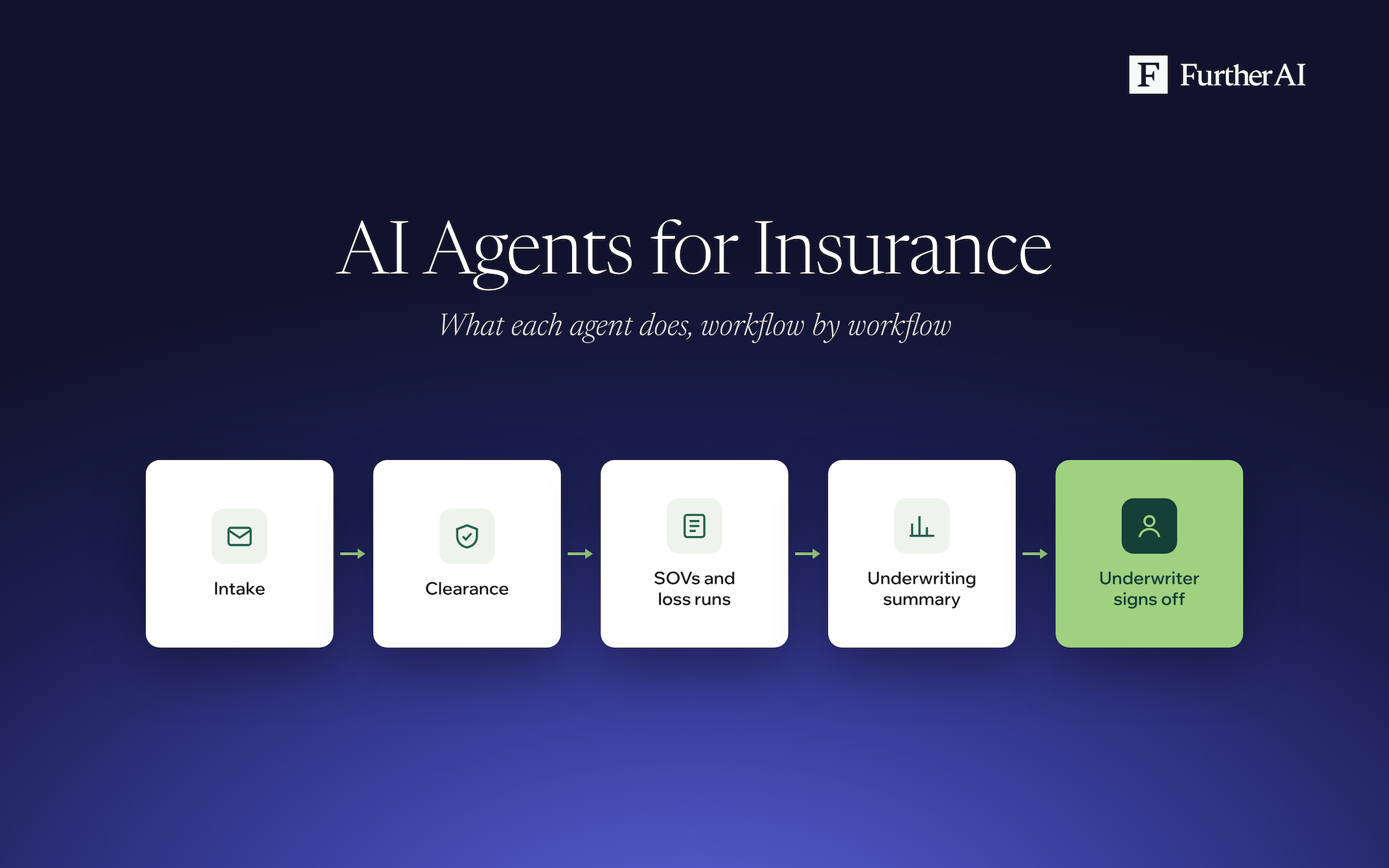
An AI agent for insurance is software that does the prep work a skilled assistant would. It reads the broker’s email and attachments, pulls out the data, checks it against your rules, and enters the results in your systems. When a step needs human judgment, it stops and hands the file to the right person. Today, insurance teams use agents mostly for document-heavy operations work: submission intake, clearance, SOVs and loss runs, underwriting summaries, policy checking, proposals, claims intake, and audits.
Think about everything that happens before an underwriter can actually underwrite: opening attachments, retyping ACORD fields, and chasing a missing loss run. That’s the work AI agents take on. Below, we walk through nine of them, showing what each one reads, what it hands back, where a person signs off, and what it has delivered in production for carriers, MGAs, and brokers. If you’re comparing vendors instead, start with our guide to the best AI platforms for insurance.
Key takeaways
- AI agents take actions inside your workflow. They extract an SOV or write a record to your policy admin system on their own, within limits you set, where a chatbot or copilot waits to be asked.
- The agents with proven results are the operations ones. FurtherAI customers report 30x faster submission clearance at an MGA, 646% ROI on SOV intake at a top-10 carrier, and more than 90% automation of claims intake at a specialty insurer.
- Agents work best as a relay. A single agent automates one step; a multi-agent system moves the file from step to step and pulls in a human only where judgment is needed.
- Most insurers are still early. In Celent's 2025 survey, 22% of insurers planned to have an agentic AI solution in place by the end of 2026, and Gartner expects more than 40% of agentic AI projects to be canceled by the end of 2027.
- Human sign-off is part of the design. Every agent below has a defined point where a person approves, adjusts, or overrides the work.
What is an AI agent in insurance?
An AI agent is a system that works toward a goal by taking actions, using tools and data, and deciding its next step within rules you define. In insurance, that means an agent can open a broker email, classify the attachments, extract the data, check it against your guidelines, and write the result to your systems, then stop and ask a person when it reaches a decision it isn't authorized to make.
"As AI adoption accelerates, agents will own the work while humans will own the judgment — the underwriter shifts from doing the busywork to managing a team of agents. That only works with governance underneath it: every output traces to source language, every action is logged, every workflow has human checkpoints." Danny O'Lenic, Insurance Product Lead at FurtherAI
That last part matters in a regulated business. AI agents in insurance production run with bounded autonomy: they do the reading, keying, checking, and drafting, and underwriters, adjusters, and account managers keep the decisions. Our post on workflows vs. agents vs. gentic workflows explains why we pair fixed workflow steps with agents that handle the variable parts.
The label gets stretched. Gartner estimates that only about 130 of the thousands of vendors claiming agentic AI offer the real thing. If you're assessing a vendor's claims, our CIO's guide to spotting real agentic AI sets out the tests.
Which kind of AI agent this guide covers
"AI agents for insurance" can mean two different things. In this guide, we cover operations agents, the ones that work on submissions, policies, claims, and audits behind the scenes. We don't cover customer-facing voice or chat agents that answer policyholder calls, or AI receptionists for agencies. Celent expects insurers’ generative AI use to stay focused on virtual assistants and copilots in the near term, with claims, underwriting, and marketing and sales enablement leading agentic adoption.
If you're looking for AI tools for producers and account managers on the go, see our guide to AI workspaces for insurance agents.
The nine AI agents insurance teams use today
Here's the full catalogue at a glance. Each agent gets its own section below.
1. Submission intake agent
- Takes in: broker emails and attachments, including ACORD forms, statements of values (SOVs), loss runs, and supplementals.
- Produces: one structured submission with exposures extracted, missing data flagged, and external data added.
- Human sign-off: the underwriter reviews the prepared file and decides whether to pursue it.
- Output goes to: your submission queue, policy admin system, or CRM.
- In production: at one MGA, a FurtherAI client, the average time to clear a submission fell from about 32 minutes to about one minute. Within three months, it processed more than $20 billion in total insured value and saved more than 2,000 hours of manual work.
For a comparison of intake vendors, see our guide to submission processing platforms for carriers and MGAs.
2. Clearance and appetite agent
- Takes in: the structured submission plus your clearance rulebook and appetite guidelines.
- Produces: a clearance result (duplicate, broker-of-record conflict, in or out of appetite) with the rule that triggered it.
- Human sign-off: judgment calls the rulebook leaves open go to the clearance desk.
- Output goes to: the clearance queue and your submission record.
- In production: Upland Specialty runs every submission for roughly a dozen lines of business through one clearance desk. A year after going live, it had cut clearance time by roughly 30 to 40%. Upland ran FurtherAI in shadow mode first and turned it on once agreement with its own team cleared 85%.
3. SOV agent
- Takes in: statements of values in any layout, from tidy spreadsheets to multi-tab files with tens of thousands of locations.
- Produces: a clean location schedule mapped to your underwriting schema, with addresses validated and geocoded.
- Human sign-off: underwriters review flagged rows and low-confidence fields.
- Output goes to: your underwriting or rating system.
- In production: a top-10 global carrier's large property unit cut SOV intake from one to five days per file to under 10 minutes, even for SOVs with more than 50,000 locations. Field-level accuracy was above 95% at go-live and reached 97% within six months, for a 646% ROI (read the full SOV case study).
4. Loss run agent
- Takes in: loss runs in every carrier's format, across policies and years.
- Produces: one normalized claims history with paid, reserved, and open amounts, plus a summary.
- Human sign-off: the underwriter or account manager reviews the summary before it informs a quote or a renewal.
- Output goes to: the submission file, the proposal, or the ACORD loss history.
- In production: at Leavitt Group, a producer had spent hours trying to format a loss run of more than 130 lines with general AI tools. "When they ran the same file through FurtherAI, it produced exactly what they needed in minutes," says Laurie Flanagan, Chief Innovation Officer. In internal benchmarks run with OpenAI's Agents SDK, FurtherAI reached 100% page extraction on loss runs longer than 900 pages (read more in our FurtherAI x OpenAI article).
5. Underwriting summary agent
- Takes in: the cleared submission, enriched data, and your underwriting guidelines.
- Produces: a decision-ready summary with a triage score, guideline breaches, and the questions to ask the broker.
- Human sign-off: the underwriter makes the risk decision and sets terms.
- Output goes to: the underwriter's workspace and, once approved, your CRM or policy admin system.
- In production: at Euclid Program Managers runs FurtherAI inside its underwriting workflow. “An underwriter who was handling $10 million before without AI can now handle $15 million,” says Nick Colis, co-founder and chief program officer. (For the wider benchmarks, see how AI improves underwriting).
6. Policy checking and comparison agent
- Takes in: quotes, binders, issued policies, endorsements, and competitor forms.
- Produces: a line-by-line check of what was bound against what was quoted, and side-by-side comparisons of coverage, exclusions, and endorsements.
- Human sign-off: an underwriter or account manager resolves every discrepancy the agent flags.
- Output goes to: the policy file or a correction request to the carrier.
- In production: one insurer's policy checks ran more than 20x faster and its policy comparisons more than 30x faster than the manual process, with a 400% ROI within months (see our policy check case study).
7. Proposal agent
- Takes in: carrier quotes in PDF, Excel, and email.
- Produces: a branded proposal with terms, premiums, and limits compared across markets, plus a flag if the work duplicates an existing proposal.
- Human sign-off: the producer or account manager reviews before it goes to the client.
- Output goes to: the client and your CRM or agency management system
- In production: a large national MGA cut proposal work from 30 to 45 minutes to under 10, and found that a quarter of its proposals had duplicated earlier work (read our proposal case study). Our guide to AI proposal generation covers the workflow in depth.
8. Claims intake agent
- Takes in: first notice of loss (FNOL) emails, forms, and supporting documents.
- Produces: a claim file checked against your required documents and fields, ready for an adjuster.
- Human sign-off: the adjuster takes the claim from there; missing items go back to the reporter.
- Output goes to: your claims system.
- In production: a specialty insurer handling more than 3,000 claims a year spent about 2.5 hours on intake per claim. With FurtherAI, it automated more than 90% of intake for the targeted workflow, saving about 7,500 hours and more than $360,000 a year, a 568% ROI (check out our claims case study). For vendor options, see our first notice of loss (FNOL) automation comparison.
9. Audit and compliance review agent
- Takes in: underwriting files, guidelines, rate rules, and policy documents.
- Produces: a mapped list of every guideline check, with each potential breach linked to its source.
- Human sign-off: the auditor decides whether each mismatch is a breach or a justified exception.
- Output goes to: the audit report and your control register.
- In production: a reinsurer that audits more than 100 MGAs, another FurtherAI client, cut audit time by 45% from about 200 hours to about 110 hours per MGA, by automating about five hours of extraction and comparison per file. Our guide to AI compliance review for underwriting compares the tools.
How AI agents work together on one file
Insurance work is a relay: a submission passes from intake to clearance to underwriting; a claim passes from intake to coverage review to the adjuster. An agent that automates one leg leaves a person carrying the file across every handoff, which is where many deployments stall.
A multi-agent system runs the relay. Each agent works within the scope a person in that role would have, and the context travels with the file to the next agent or to the human who owns the next decision (learn more about it in our FurtherAI Multi-Agent System article).
Here's what that looks like on a property submission. The agent works through 17 steps on its own, including extracting account and ACORD data, running clearance and OFAC checks, aggregating loss runs, calculating a triage score, researching adverse media, and generating the underwriting summary. When it reaches the step that needs a sign-off, reviewing the Salesforce record, it pauses and tags the underwriter who owns the account. The underwriter approves, and the agent creates the opportunity in Salesforce and finishes the run (in FurtherAI, the feature is called Mentions and it works the same way you'd @mention a coworker in Slack).
Where AI agents connect to your systems
An agent only saves time if its output lands in your system of record without someone rekeying it. Agents need read and write access to the systems your team already uses:
- Policy administration systems such as Guidewire, Duck Creek, and Majesco
- Agency management systems such as Applied Epic, AMS360, Sagitta, and EZLynx
- CRMs such as Salesforce and Microsoft Dynamics
- Document repositories such as SharePoint
FurtherAI's agents connect through FurtherAI Connectors and run directly inside Guidewire PolicyCenter and ClaimCenter. For how to test write-back on core systems, see our guide to AI workspaces for policy administration, and for how the layers fit together, our guide to the insurance AI stack.
What's in production and what's still a pilot
Adoption is real but uneven. In Celent's third annual survey on generative AI in insurance, published in May 2025, 22% of insurers said they planned to have an agentic AI solution in place by the end of 2026. Gartner predicts that more than 40% of agentic AI projects will be canceled by the end of 2027 "due to escalating costs, unclear business value or inadequate risk controls."
The agents that reach production share a profile: they work on high-volume, document-heavy tasks with a clear rulebook and a measurable before-and-after. That's why intake, clearance, SOVs, loss runs, policy checks, and audits lead the catalogue above. Agents that make binding decisions without a person, such as autonomous pricing or claim denials, remain rare in commercial lines, and regulators expect human oversight of AI decisions. As of October 8, 2026, 27 states, plus Washington, D.C., and Puerto Rico, had adopted the NAIC’s model bulletin on insurers’ use of AI systems, according to the NAIC.”
If you're planning your first agent, our playbook for deploying AI for the first time covers choosing the workflow, running the proof of concept, and the first 90 days. For costs and ROI by workflow, see our guide to AI for insurance operations.
How to keep AI agents under control
Autonomy should match the risk of the step. We'd look for four controls before any agent goes live:
- Defined decision rights. Each agent has a written scope, and steps outside it route to a named person.
- Source citations. Every extracted value and every finding links back to the page it came from.
- Testing on your own data. Run the agent against real files from your pipeline before it ships. FurtherAI's Eval Studio does this, and workflows built in Builder Agent pass through it before production.
- An audit trail. Every action, approval, and override is logged, so you can show a regulator or reinsurer what happened and why.
For the full autonomy spectrum and a vendor checklist, see the CIO's guide to spotting real agentic AI.
Where FurtherAI fits
FurtherAI is an agentic AI workspace built for the nuance of commercial insurance. It runs each agent in this guide on carrier, MGA, broker, and reinsurer workflows, and its Multi-Agent System coordinates them across the full workflow. Agents pause for human sign-off where your rules require it, and every output carries citations and an audit trail. To see the agents on your own documents, book a demo.
Frequently asked questions
REFERENCES
Celent. "Shedding Light on Agentic AI in Insurance." celent.com
FurtherAI. "Broker Case Study: Client Proposals in Under 10 Minutes." furtherai.com
FurtherAI. "Claims Case Study: 90% Intake Automation, 568% ROI." furtherai.com
FurtherAI. "Euclid Lifts Underwriter Capacity 50% With FurtherAI." furtherai.com
FurtherAI. "FurtherAI Builder Agent: Build Insurance Workflows at Enterprise Scale." furtherai.com
FurtherAI. "FurtherAI Launches Connectors for Insurance Systems." furtherai.com
FurtherAI. "FurtherAI Multi-Agent System for Insurance Workflows." furtherai.com
FurtherAI. "FurtherAI Partners With Guidewire to Close a Gap in Insurance AI." furtherai.com
FurtherAI. "FurtherAI x OpenAI: AI Agents Built for Insurance Docs." furtherai.com
FurtherAI. "Leavitt Group Case Study: Loss Run Processing with AI." furtherai.com
FurtherAI. "Mentions: Human-in-the-Loop AI Agents at FurtherAI." furtherai.com
FurtherAI. "MGA Case Study: 30x Faster Submission Processing." furtherai.com
FurtherAI. "Policy Check & Compare Case Study: 400% ROI in Months." furtherai.com
FurtherAI. "SOV Intake Case Study: 646% ROI at a Top-10 Carrier." furtherai.com
FurtherAI. "Test Insurance AI on Real Data — FurtherAI Eval Studio." furtherai.com
FurtherAI. "Underwriting Audit Case Study: 45% Less Audit Time." furtherai.com
FurtherAI. "Upland Specialty Proved FurtherAI in Production, Then Cut Clearance Time by 30 to 40%." furtherai.com
Gartner. "Gartner Predicts Over 40% of Agentic AI Projects Will Be Canceled by End of 2027." gartner.com
National Association of Insurance Commissioners. "Implementation of NAIC Model Bulletin: Use of Artificial Intelligence Systems by Insurers." naic.org
DISCLAIMER
This article is for general informational purposes only and does not constitute legal, regulatory, compliance, underwriting, or other professional advice. The content reflects information available as of the date of publication, and FurtherAI undertakes no obligation to update it as laws, regulations, or AI technologies evolve.
Recent posts
.png)
.png)
Ready to go further and
transform your insurance ops?
Reclaim your time for strategic work and let our AI Assistant handle the busywork. Schedule a demo to see how you can achieve more, faster.




.svg)