FurtherAI Available in Microsoft Marketplace
Introducing Connectors



How Carriers Speed Up Policy Comparison: Accurate Review of Unstructured Policy PDFs

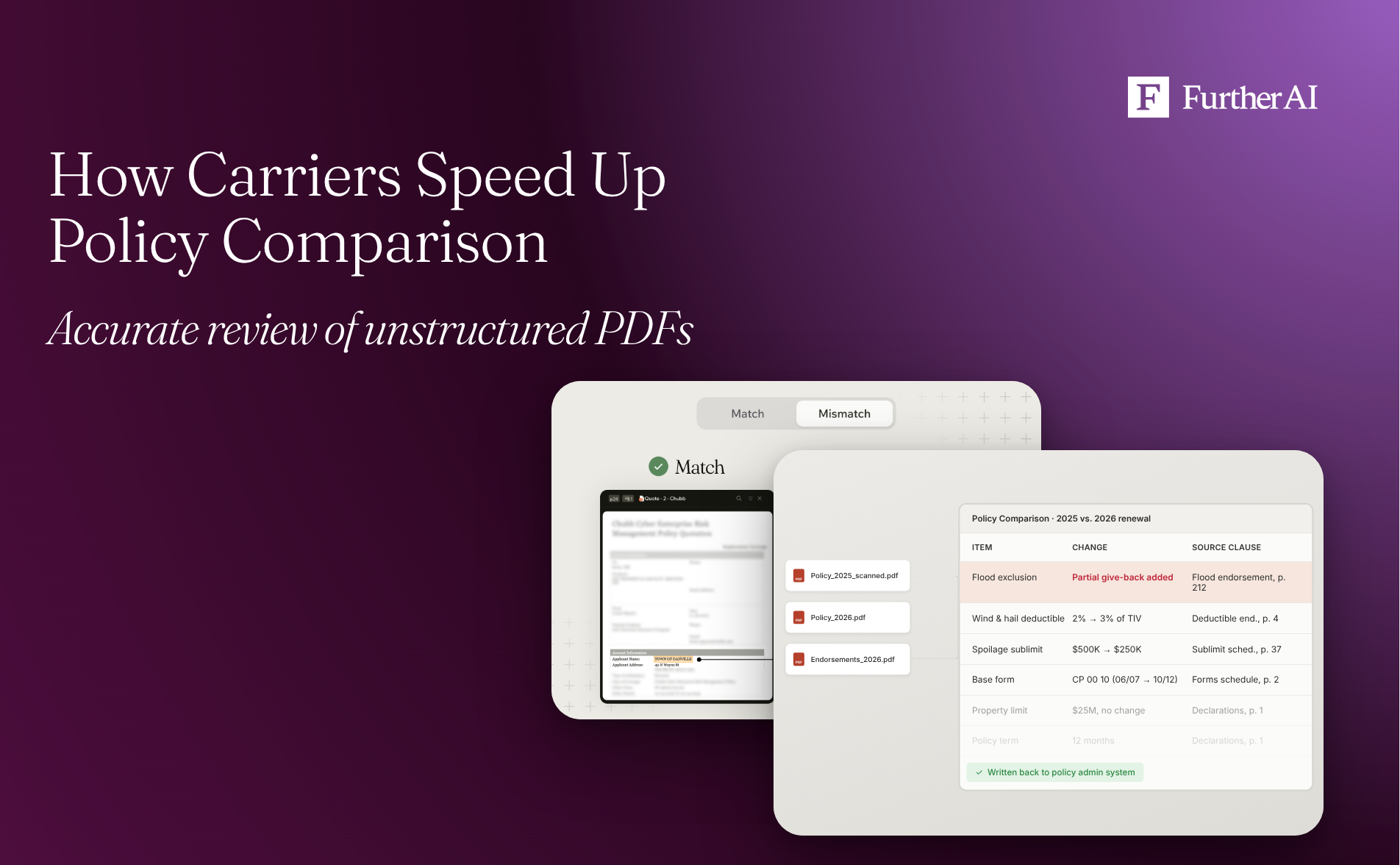
Carriers speed up policy comparison by using an insurance-specific AI platform that reads the full policy packet, including scanned pages, base forms, and endorsements, aligns matching sections across documents, and links every difference back to the source clause. At one mid-sized insurer, FurtherAI ran policy comparisons more than 30 times faster than manual review with equal or better accuracy. Horizontal document-extraction tools can pull text and fields from the same PDFs, but they leave the comparison, the coverage logic, and the audit trail for your team to build.
This guide covers how much time carriers save, why unstructured policy PDFs are hard to compare reliably, how differences get verified, when a horizontal extraction tool is enough, and how comparison results reach your core systems.
Key takeaways
- Speed comes from reading less by hand, not reading faster. The platform does the first pass across the full packet, and reviewers confirm flagged differences instead of reading every page.
- Extraction is only step one. Comparing policies means aligning sections across documents that use different formats and labels, then working out net coverage across base forms and endorsements.
- Every difference needs a source. A redline that links each change to the clause behind it can be confirmed in seconds and defended later.
- No major cloud extraction service ships a commercial policy model. Amazon Textract, Azure Document Intelligence, and Google Document AI all require you to set up custom extractors and build the comparison logic yourself.
- Integration decides the payoff. Results should write back to the policy administration system instead of living in a separate report.
How much faster is AI policy comparison for carriers?
Commercial P&C underwriters still spend 35% of their time on non-core activities, according to Accenture research reported by Carrier Management. Policy comparison is a large share of that work at renewal and endorsement time. The table shows results from FurtherAI carrier deployments.
The time saving comes from changing who does the first read. Instead of an underwriter or analyst reading two 300-page policies side by side, the platform reads both, flags what changed, and hands the reviewer a short list to confirm.
What are the best solutions for comparing unstructured policy files?
The best solutions read the policy the way an experienced reviewer does: every page, every form, and every endorsement, with the relationships between them. That matters because commercial policies rarely arrive as clean data. A typical file mixes native PDFs, scanned endorsements, carrier-specific form layouts, and schedules that run across pages.
Look for four capabilities:
- Full-packet reading. FurtherAI compares coverage breadth, terms, exclusions, and endorsements, factoring in the full policy packet, including base forms and conditional endorsements.
- Section alignment across formats. Two carriers label the same coverage differently, and the same carrier changes layouts between years. The software has to match equivalent sections before it can compare them.
- Net coverage logic. A base form excludes a peril, an endorsement gives part of it back, and a second endorsement narrows the give-back. FurtherAI identifies these "give-back" endorsements that restore coverage excluded in base policies.
- Clause-level redlines. FurtherAI redlines limits, deductibles, forms, and endorsements and lets reviewers jump directly to the changed clauses.
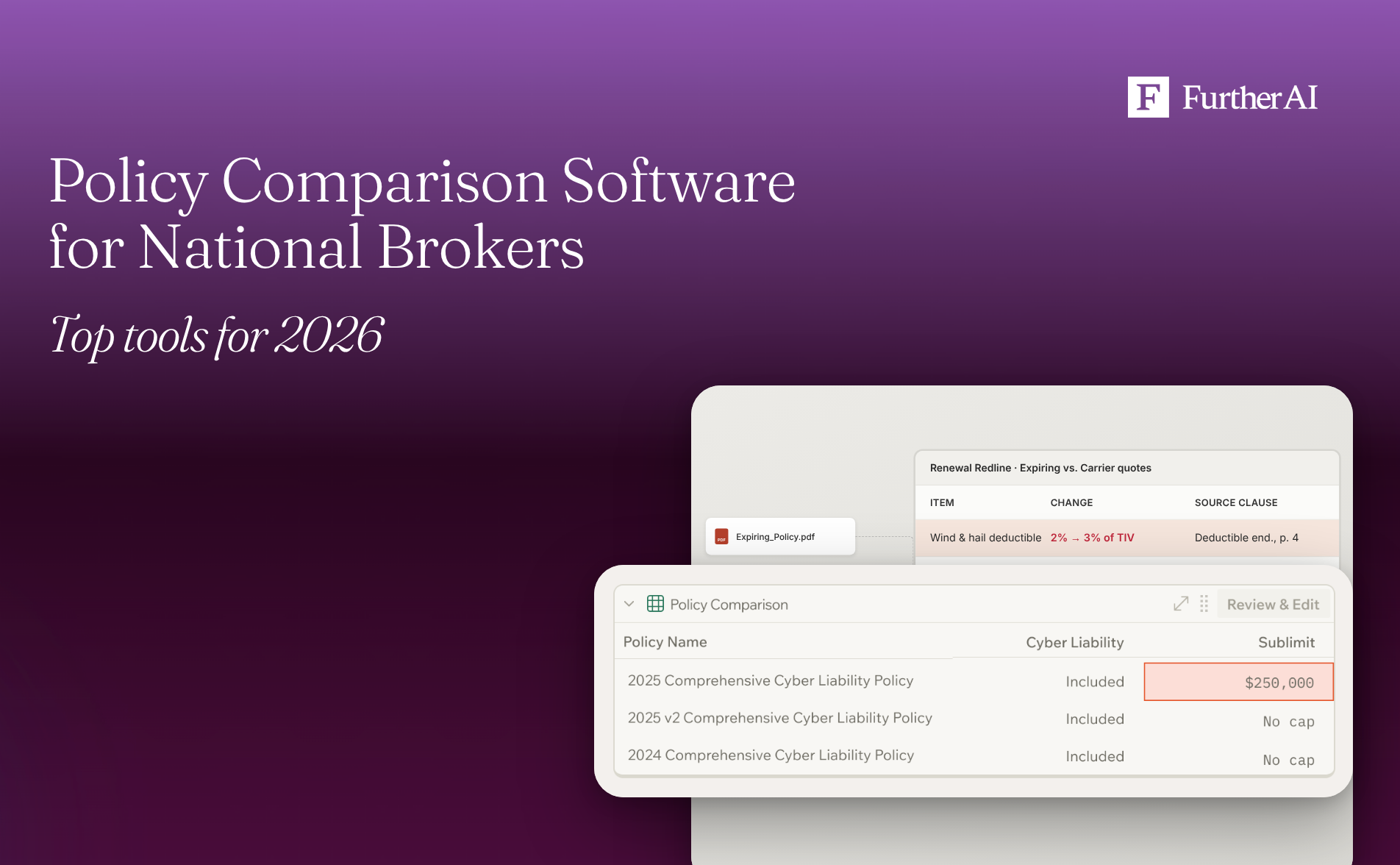
The same insurer also used FurtherAI comparisons to give brokers detailed side-by-side answers to client questions, and to analyze competitor filings from public sources such as SERFF. Brokers comparing quotes across carrier partners can see our guide to policy comparison software for national brokers.
Which tools process complex policy documents most reliably?
Reliability on complex policies comes down to three things: reading scanned and messy pages correctly, keeping track of where everything sits in a long document, and proving each result against the source.
Scanned and messy PDFs
Optical character recognition (OCR) is the first point of failure. Scanned endorsements, skewed pages, stamps, and tables that break across pages all degrade the text that downstream models see. Research on retrieval systems built on OCR output found that none of the OCR tools tested was competent for building high-quality knowledge bases, with tables and other complex elements hit hardest.
Length is the second risk. In a peer-reviewed study of how language models use long inputs, performance was often highest when the relevant information sat at the beginning or end of the input, and dropped when it sat in the middle. In a 300-page policy, the clause that matters is often buried deep in the packet.
Insurance-specific platforms handle both by breaking the policy into its parts before comparing. FurtherAI engineer Frieda Huang built a system that aligns similar sections across multiple policy documents, each more than 300 pages, using semantic similarity to match endorsements and coverage items even when formatting or values differ, with a second layer that groups only items that are directly similar.
How differences are verified against source clauses
A difference the reviewer can't trace is a difference they have to re-check by hand, which erases the time saving. Verification works in three layers:
- Citation on every difference. FurtherAI outputs come with clickable citations that highlight the areas within your files behind each insight, so a reviewer can confirm a change in seconds.
- Missing items flagged, not filled. FurtherAI flags missing information with source citations instead of guessing.
- Accuracy measured on your own documents. With Eval Studio, teams load a test set of real documents, typically 50 or 100, define what a correct result looks like, and score each workflow version before it reaches production.
Auditability also matters for governance. As of October 8, 2026, 29 jurisdictions had adopted the NAIC Model Bulletin on insurers' use of AI, which expects insurers to maintain governance and documentation for the AI systems they use.
Horizontal extraction tools vs insurance-specific platforms
For comparing unstructured policies, an insurance-specific platform is the better choice for most carriers. Horizontal extraction services are a strong foundation for teams with engineering capacity, but they return fields, not comparisons. Insurance-specific platforms start from policy forms, endorsements, and coverage logic, and return differences with citations.
The three largest cloud services are capable extractors:
- Amazon Textract extracts typed and handwritten text, forms, and tables, and processes up to 3,000 pages per asynchronous job.
- Azure AI Document Intelligence offers read and layout models and processes up to 2,000 pages per PDF.
- Google Document AI offers OCR, Form Parser, Layout Parser, and a generative Custom Extractor.
None of them ships a prebuilt model for commercial insurance policies or ACORD forms. Azure's only insurance model reads US health insurance cards. Each lets you train custom extractors on labeled samples of your own documents, and the comparison logic, the coverage rules, and the reviewer workflow are yours to build.
A hybrid can work: some carriers keep a horizontal service for simple, high-volume forms and use an insurance-specific platform for policy comparison. For compliance review and the broader buying decision, see our guide to horizontal AI tools vs dedicated insurance platforms. If your bottleneck is intake rather than comparison, our guide to mixed-format submissions covers it.
Which platforms integrate with carrier systems for policy review?
Comparison results only save time if they land where underwriters already work. Ask every vendor how it connects to your policy administration system (PAS), document management, and email, and whether it can write back or only read.
FurtherAI connects in four ways:
- Native connectors. FurtherAI Connectors, launched in July 2026, read and write policy records and exposure data in Guidewire, Duck Creek, and Majesco, alongside CRM, agency management, and document systems such as SharePoint and ImageRight.
- Guidewire PolicyCenter. The FurtherAI Accelerator for PolicyCenter, live on the Guidewire Marketplace since October 2026, takes submissions from the broker's email into PolicyCenter with no re-keying.
- Legacy systems without APIs. Computer Use 2.0 lets agents read and act on dense legacy screens the way a person does.
- Proprietary systems. A top-10 global carrier had FurtherAI map SOV data directly to its proprietary underwriting system schema.
Documents already stored in Microsoft tools stay where they are: FurtherAI works inside Outlook and SharePoint. For a full integration matrix and a write-back test plan, see our guide to AI workspaces for policy administration.
Tracking changes across renewals
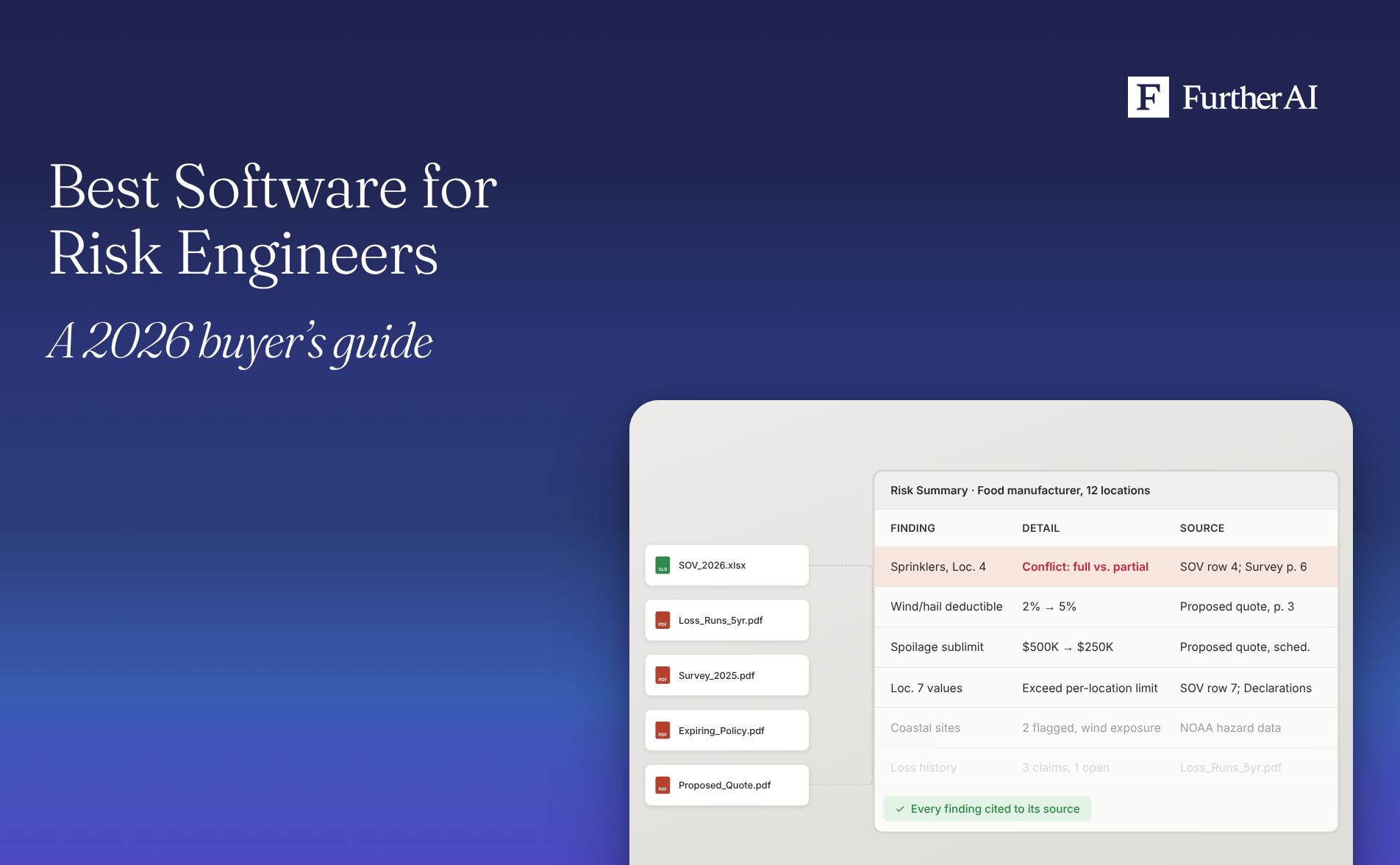
Comparison doesn't stop at one renewal. Underwriting teams also track how terms drift across several policy years, and FurtherAI can compare a submission against the last several renewals using documents already stored in SharePoint. For what a renewal summary should include and how to roll one out, see our guide to automated renewal summaries. After bind, the same comparison logic powers AI policy checking. Risk engineers use it too, to find coverage gaps between current and proposed policies.
Where FurtherAI fits
FurtherAI is an AI workspace for insurance. For carrier policy teams, it reads full policy packets, including scanned pages, aligns matching sections across documents, redlines limits, deductibles, forms, and endorsements, and links every difference to its source clause. Results write back to Guidewire, Duck Creek, Majesco, or your own systems, and every action is logged. FurtherAI holds SOC 2 Type II and ISO 27001 and contractually guarantees that customer data isn't used to train models.
To see it on your own policies, book a demo with FurtherAI.
Frequently asked questions
DISCLAIMER
This article is for general informational purposes only and does not constitute legal, regulatory, compliance, underwriting, or other professional advice. The content reflects information available as of the date of publication, and FurtherAI undertakes no obligation to update it as laws, regulations, or AI technologies evolve.
Recent posts

Ready to go further and
transform your insurance ops?
Reclaim your time for strategic work and let our AI Assistant handle the busywork. Schedule a demo to see how you can achieve more, faster.