FurtherAI Available in Microsoft Marketplace
Introducing Connectors



Introducing Computer Use 2.0 on FurtherAI

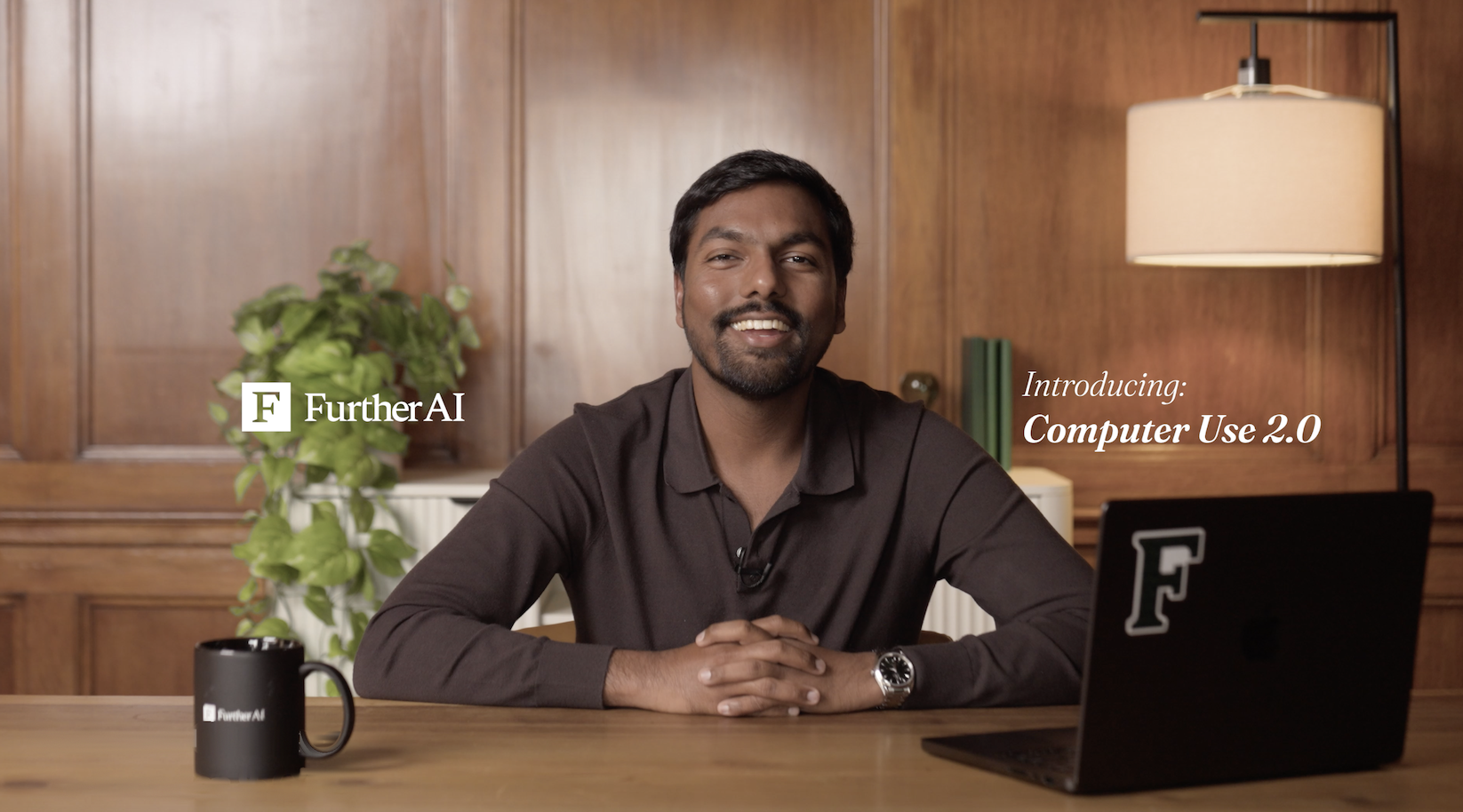
Today we're launching FurtherAI Computer Use 2.0, our next-generation architecture for AI agents that navigate insurance portals, policy admin systems, and legacy tools by operating the screen the way a person does.
So much of insurance runs inside systems that were built long before APIs existed. Portals, policy admin systems, and legacy underwriting tools hold exactly the busywork insurance teams want off their plate, and until now this work has been the hardest to automate. There is no integration for it. The only way through is the screen itself.
Some of the biggest automation gains are locked inside systems APIs can't reach
Every insurance operation runs on a stack of systems that don't talk cleanly to one another. Some have modern APIs. Many don't. The ones that don't tend to be the systems most tightly wound into the daily work of underwriting, claims, and program management, which means the automation opportunity is largest exactly where API-based approaches fall short.
That's what computer use agents solve for. They see the screen and act on it the way a person does, reading forms, clicking through steps, and entering data. If a person can do the work by pointing and clicking, a computer use agent can too, without any integration built underneath.
Computer Use 2.0 closes the two gaps that limited earlier agents
FurtherAI has been running computer use agents in production longer than most, which means we've watched them succeed and fail against real insurance systems for a long time. Agents handled complex interfaces well when the workflow was short, but two things broke them when the work got harder.
The first was orientation. Long workflows that crossed multiple systems tripped the agents up. They would lose track of what step they were on, or forget the context they needed from an earlier screen.
The second was screen reading. Dense screens with small fields, packed tables, and legacy portal layouts confused the vision layer. The agent would misread a value, click the wrong row, or fill in the wrong field.
Computer Use 2.0 closes both gaps. Agents now stay oriented through an entire workflow, across every system the work touches. And they read dense screens accurately, including packed tables, small fields, and legacy portals that used to break earlier versions.
The hardest workflows to automate are now within reach
The workflows that live behind legacy portals and non-API systems are almost always the same ones insurance teams want off their plate first. Rekeying data across three systems for a single submission. Pulling records out of a legacy policy admin to check a coverage question. Entering claims data into a portal that hasn't been updated in a decade.
Computer Use 2.0 makes that work automatable at production quality. Every workflow that FurtherAI runs, including workflows built inside Builder Agent or orchestrated by our Multi-Agent System, can now reach through the screen into any system a person can use.
The automation opportunity in insurance stops being constrained by which systems happen to have an API.
If you want to see FurtherAI Computer Use 2.0 running against the systems your team spends the most time inside, get in touch.
Recent posts
Ready to go further and
transform your insurance ops?
Reclaim your time for strategic work and let our AI Assistant handle the busywork. Schedule a demo to see how you can achieve more, faster.




.svg)