FurtherAI Available in Microsoft Marketplace
Introducing Connectors



How AI Agents Automate Commercial Policy Servicing, From First Call to Finished Work

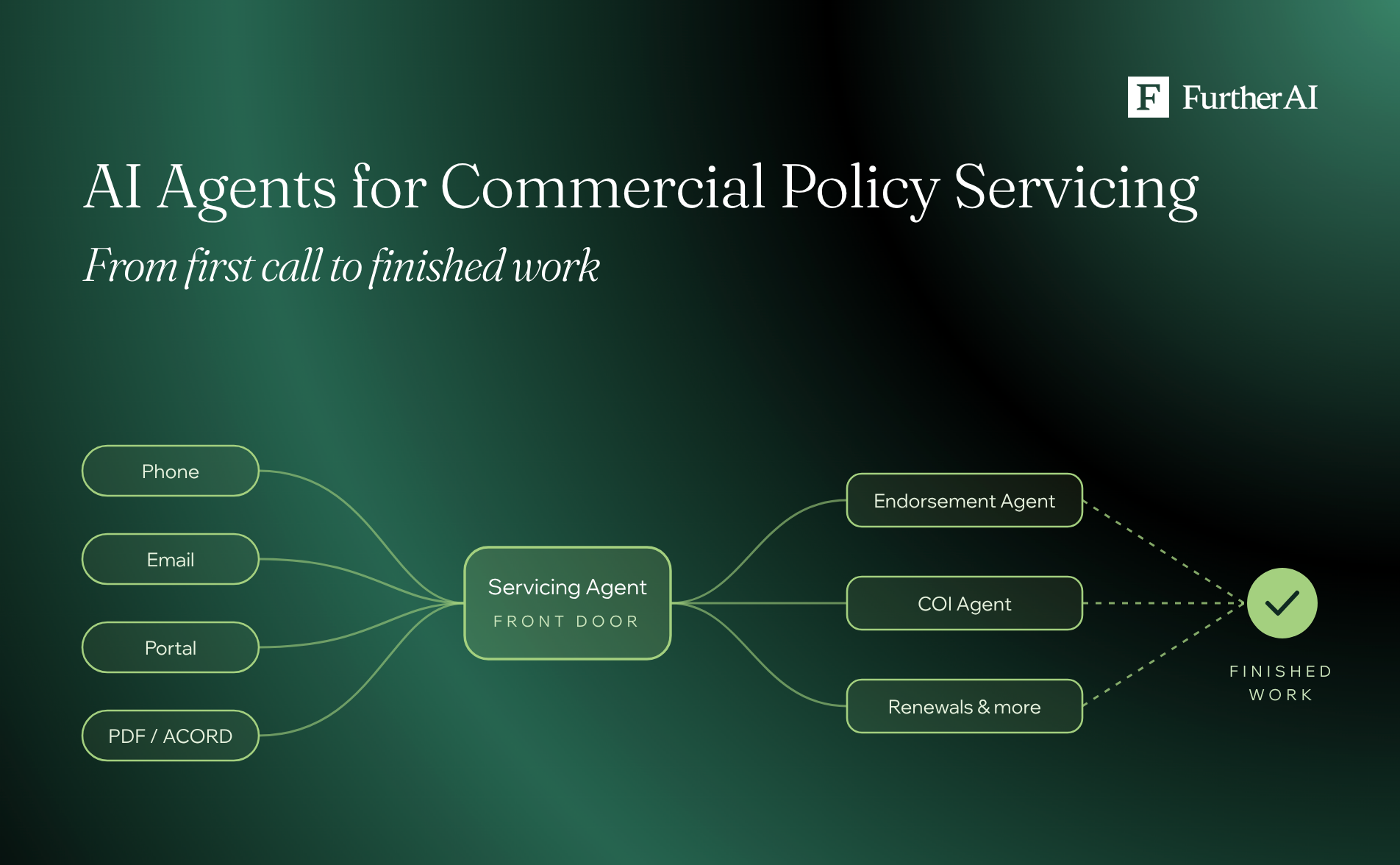
AI policy servicing uses a team of AI agents to take every post-bind request (endorsements, certificates of insurance, renewals, and reinstatements) from whatever channel it arrives on, match it to the right policy, and carry it through to finished work, with a person approving anything outside guidelines or authority. A Servicing Agent acts as the front door. Specialist agents do the work behind it. The test of a good system is finished work: an endorsement ready for review, or a certificate in the broker's inbox.
This guide explains how that flow works from first call to finished work, where people stay in the loop, and what a brokerage, carrier, or managing general agent (MGA) should look for when it evaluates AI policy servicing tools.
Key takeaways
- Servicing is a stream of small, constant requests. Location additions, certificates, limit changes, renewals, and reinstatements arrive by phone, email, broker portal, and PDF, and each one touches the policy system and a document trail.
- One front door, many specialists. A Servicing Agent reads the request, confirms the policy, and hands the case, with its documents, to the agent built for that request type.
- Measure finished work. Count a request as done when the endorsement is staged for underwriter review or the certificate reaches the broker. A drafted reply still leaves the work with your team.
- Replace: People keep the judgment calls. Agents prepare a recommendation (for an endorsement: add, refer, hold, or wait) and cite every source. Underwriters and account managers decide anything outside guidelines or authority.
- Evaluate on completion. When you compare tools, ask whether the system finishes the task, asks only for what's missing, and logs every step.
What is AI policy servicing?
Policy servicing is everything that happens to a commercial policy between binding and renewal. A broker asks to add a location, raise a limit, name an additional insured, send a certificate of insurance (COI), reinstate a lapsed policy, or renew on updated terms. Each request is small. Each also touches the policy administration system (PAS) or agency management system, the underwriting rules, and a document trail.
AI policy servicing hands that work to AI agents that read the request, find the policy, gather what's missing, check the work against your rules, and complete the task. It differs from a chatbot that answers questions, and from a single extraction tool that pulls data from one document. The agents carry a request across systems until it's done, then stop for a person wherever a decision needs judgment.
Requests reach a servicing team through four main channels:
- Phone calls
- Broker portals
- PDFs and ACORD forms
The same request can arrive through any of them, so the first job is always the same: work out what was asked and which policy it concerns.
Why commercial policy servicing is hard to scale
Servicing breaks down at the hand-offs. Someone reads the request, someone else finds the policy, a third person re-keys the details, and the case waits in an inbox between each step. Our CEO saw this from the customer side when FurtherAI needed a COI naming our landlord. Writing the request took a minute; getting the certificate back took 27 days.
The data shows the same pattern across the market:
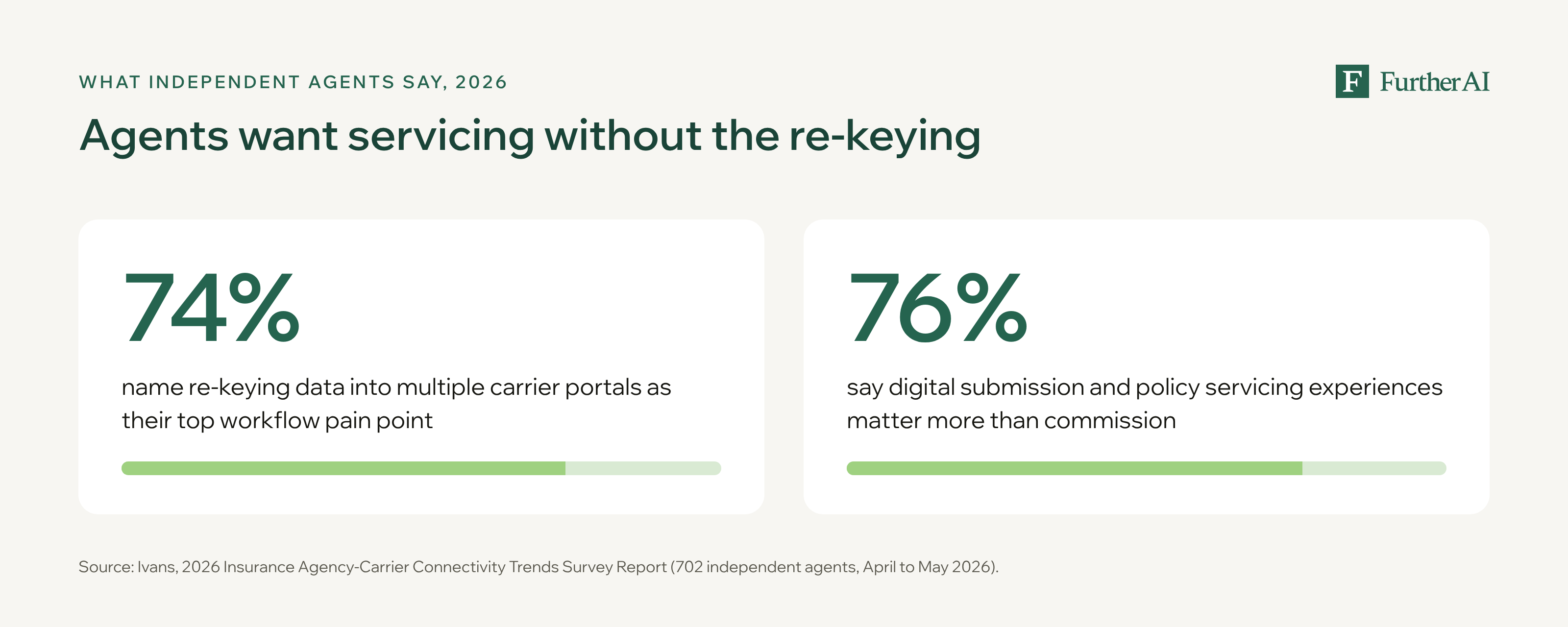
- Re-keying is the top pain point. In the Ivans 2026 Agency-Carrier Connectivity Trends survey of 702 independent agents, 74% named re-keying data into multiple carrier portals as their biggest workflow pain point, and 76% said digital submission and policy servicing experiences matter more than commission.
- Costs have moved the wrong way. McKinsey found that insurers' operating expenses as a share of revenue have risen 60% in North America since 2005, even after technology lifted productivity across claims, servicing, and policy issuance.
- Service decides retention. In J.D. Power's 2025 U.S. Small Commercial Insurance Study, good service was the most common reason customers gave for staying, and only 55% said they "definitely will" renew.
- The clerical workforce isn't growing. The U.S. Bureau of Labor Statistics projects employment of insurance claims and policy processing clerks to fall 2% by 2035.
Volume is likely to rise, too. As Aman Gour, FurtherAI's co-founder and CEO, put it: "Making a request now takes seconds, but fulfilling it can still take days." When policyholders and brokers use AI to send and chase requests, the teams on the receiving end get more work through the same inbox.
How AI agents handle servicing, from first call to finished work
FurtherAI runs policy servicing as a multi-agent system: one Servicing Agent at the front desk, and specialist agents that do the work. Here's the flow.
- Intake from any channel. The Servicing Agent answers the call, reads the email, or picks up the portal request or form. Voice and email intake puts both channels into the same workflow, so a phoned-in request and an emailed one are handled the same way.
- Classify and match the policy. It identifies the request type and confirms the policy before any work starts. If the policy check fails, the case ends with a summary for the broker instead of moving forward.
- Hand off to the right specialist. The case goes to the agent built for that request, with its documents and context attached, so the broker isn't asked twice.
- Gather, check, and assemble. The specialist asks only for what's missing, waits for the reply, reasons over every source, checks its work against your servicing rules, and assembles the right forms.
- A person makes the call. Anything outside guidelines or authority goes to an underwriter or account manager with a recommendation (for a policy change: add, refer, hold, or wait), every reason linked to its source, and, for changes that need rating, the questions to ask before pricing. FurtherAI assigns these decisions to people as Tasks, with notifications by email or Slack, and in our demos the underwriter approves in Microsoft Teams.
- Finished work. Once approved, the change is written to the PAS or agency management system, and premium, installments, and certificates update. Every step is cited and logged.
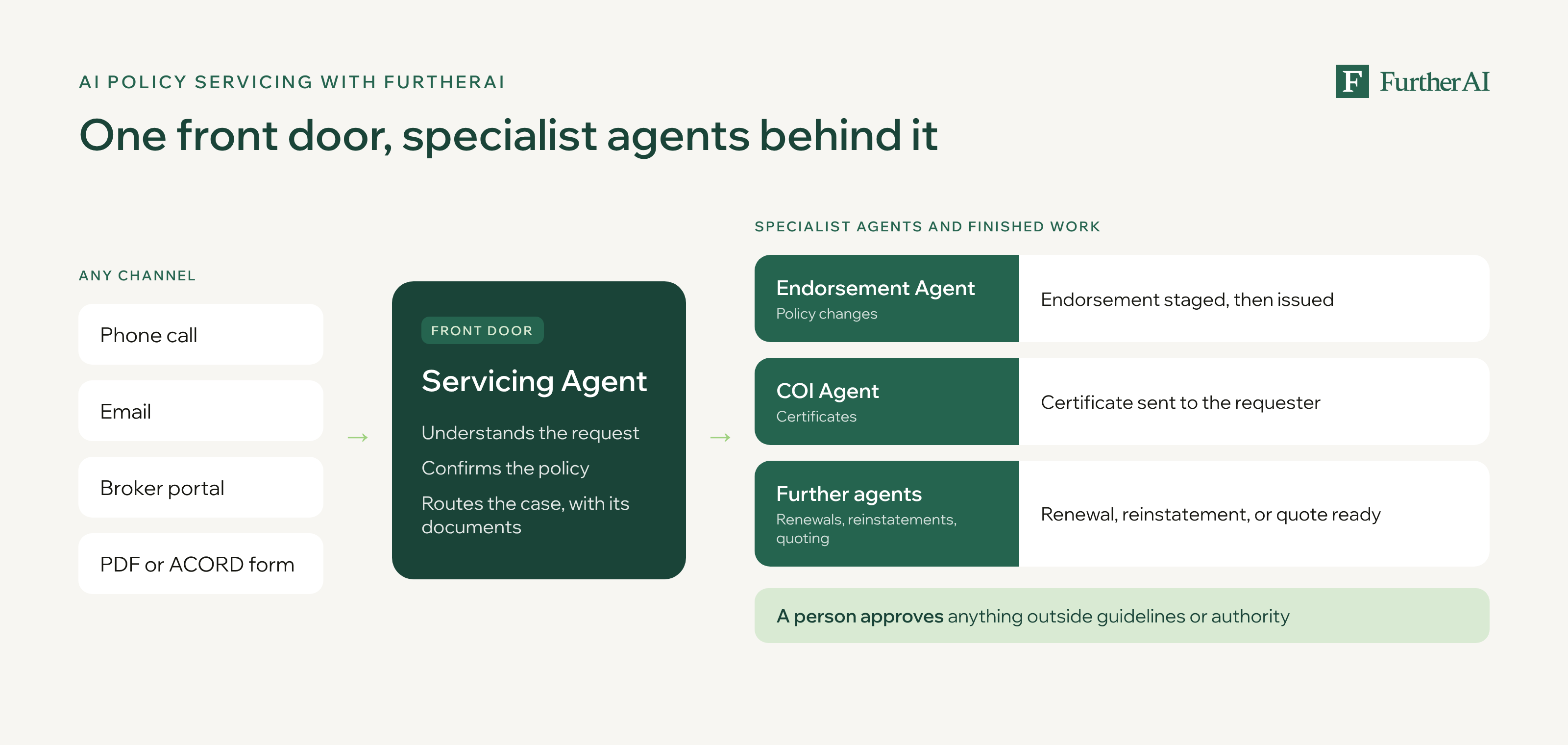
Each request type ends in a different piece of finished work:
A worked example: adding a location
A broker emails: "Hi, I need to add a location to my client's policy."
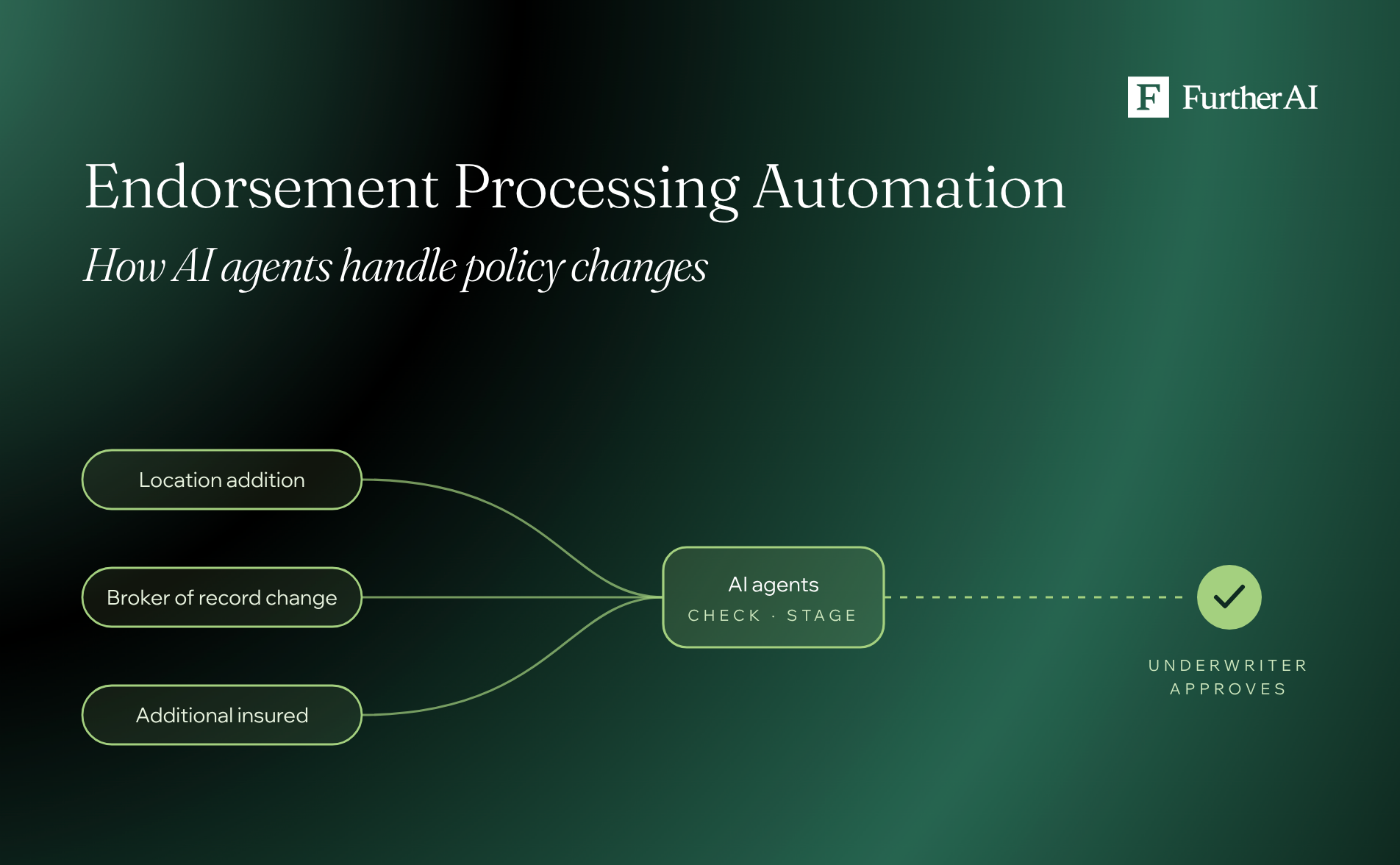
- The Servicing Agent classifies the email as a policy change, finds the policy, and opens a case.
- The Endorsement Agent asks the broker for the one missing item, an updated statement of values (SOV).
- When the SOV arrives, the agent reads it row by row against the live policy and flags anything that contradicts the request.
- It applies your location rules, such as county and backdating limits, and recommends add, refer, hold, or wait.
- After the underwriter decides, the endorsement is issued and premium, installments, and certificates update.
The broker touches the process twice: one request in, one document reply out. Nobody re-keys anything. For the full walkthrough, including broker of record changes and additional insureds, see our guide to endorsement processing automation.
Reading SOVs is work FurtherAI already does in production on the submission side. A top-10 global carrier using FurtherAI for complex SOV intake brought intake to under 10 minutes even for SOVs with 50,000+ locations, with field-level accuracy above 95% at go-live rising to 97% within six months.
What should our brokerage look for in AI policy servicing tools?
Look for a tool that takes requests from every channel your clients use, confirms the policy before work starts, hands cases between specialist agents without losing context, applies your rules, keeps a person on every judgment call, and produces finished work with a full audit trail. Adoption is climbing fast: the Big "I" 2026 Agency Universe Study found 46% of agencies now use AI, up from 15% in 2024. Governance lags, though: the Big "I" 2026 Tech Trends Report found 55% of agencies have no written AI use policy.
Use this checklist when you compare tools:
- Every channel. Does it handle calls, email, portals, and PDFs, or only one? 86% of agencies in the Agency Universe Study prefer to service customers by phone, so a tool that only reads inboxes leaves those requests to your team.
- Policy matching first. Does it confirm the right policy before work starts, and stop with a clear summary when it can't?
- Clean handoffs. Do specialist agents receive the documents and context, or does staff pass them along?
- Asks only for what's missing. Does it request specific items, then wait and resume when the reply arrives, instead of asking for a full resubmission?
- Your rules. Does it check work against your guidelines, appetite, and authority levels, written your way?
- Human decisions. Can an underwriter or account manager approve, refer, or hold with the reasoning and sources in front of them?
- Citations and audit trail. Is every step sourced and logged? The NAIC's model bulletin on insurers' use of AI, adopted in 29 jurisdictions as of November 3, 2026, sets expectations for governance, documentation, testing, and third-party oversight, and your carriers will expect the same of tools that touch their policies.
- Finished output. Does the tool produce the completed endorsement or certificate in your system of record, or only a suggestion someone has to act on?
- Integration and security. Does it work with your PAS or agency management system and with Outlook? Does the vendor hold SOC 2 Type II and contractually commit not to train models on your data? Data privacy and compliance risk is the top AI concern among agencies (24%) in the Tech Trends Report.
Start with the work you already know is manual. Leavitt Group, one of the largest independent insurance brokerages, began its FurtherAI rollout with account manager workflows such as proposal building, policy checking, document comparison, and loss run analysis. Servicing requests follow the same pattern: high volume, repetitive steps, and a person who needs to sign off.
Where policy servicing fits in the wider agent set
Servicing is one of five areas where FurtherAI agents work, alongside agency operations, underwriting, claims, and compliance. For the full list of agents and what each does, read AI agents for insurance: what each agent does, workflow by workflow. For the broker-side view, from submission to certificate, see the FurtherAI Broker Workspace. If your PAS is Guidewire PolicyCenter, FurtherAI is listed on the Guidewire Marketplace. Where a system has no API, Computer Use 2.0 lets agents work through the screen.
How to get started
- Pick one request type. Start with the one that costs your team the most re-keying, usually endorsements or certificates.
- Write down the rules. Capture the checks, referral triggers, and approval levels your team applies today.
- Connect the channels and the system of record. Point the Servicing Agent at your service inbox and phone line, and connect your PAS or agency management system.
- Back-test, then go live with approval on. Run the agents on past requests, compare their output with what your team did, and keep approval on every case until you trust the results.
Next step: book a demo to see the Servicing Agent and Endorsement Agent handle a location addition from the first email to underwriter review.
Frequently asked questions
DISCLAIMER
This article is for general informational purposes only and does not constitute legal, regulatory, compliance, underwriting, or other professional advice. The content reflects information available as of the date of publication, and FurtherAI undertakes no obligation to update it as laws, regulations, or AI technologies evolve.
Recent posts


Ready to go further and
transform your insurance ops?
Reclaim your time for strategic work and let our AI Assistant handle the busywork. Schedule a demo to see how you can achieve more, faster.