FurtherAI Available in Microsoft Marketplace
Introducing Connectors



Policy Comparison Software for National Brokers: Compare Carriers and Win Renewals

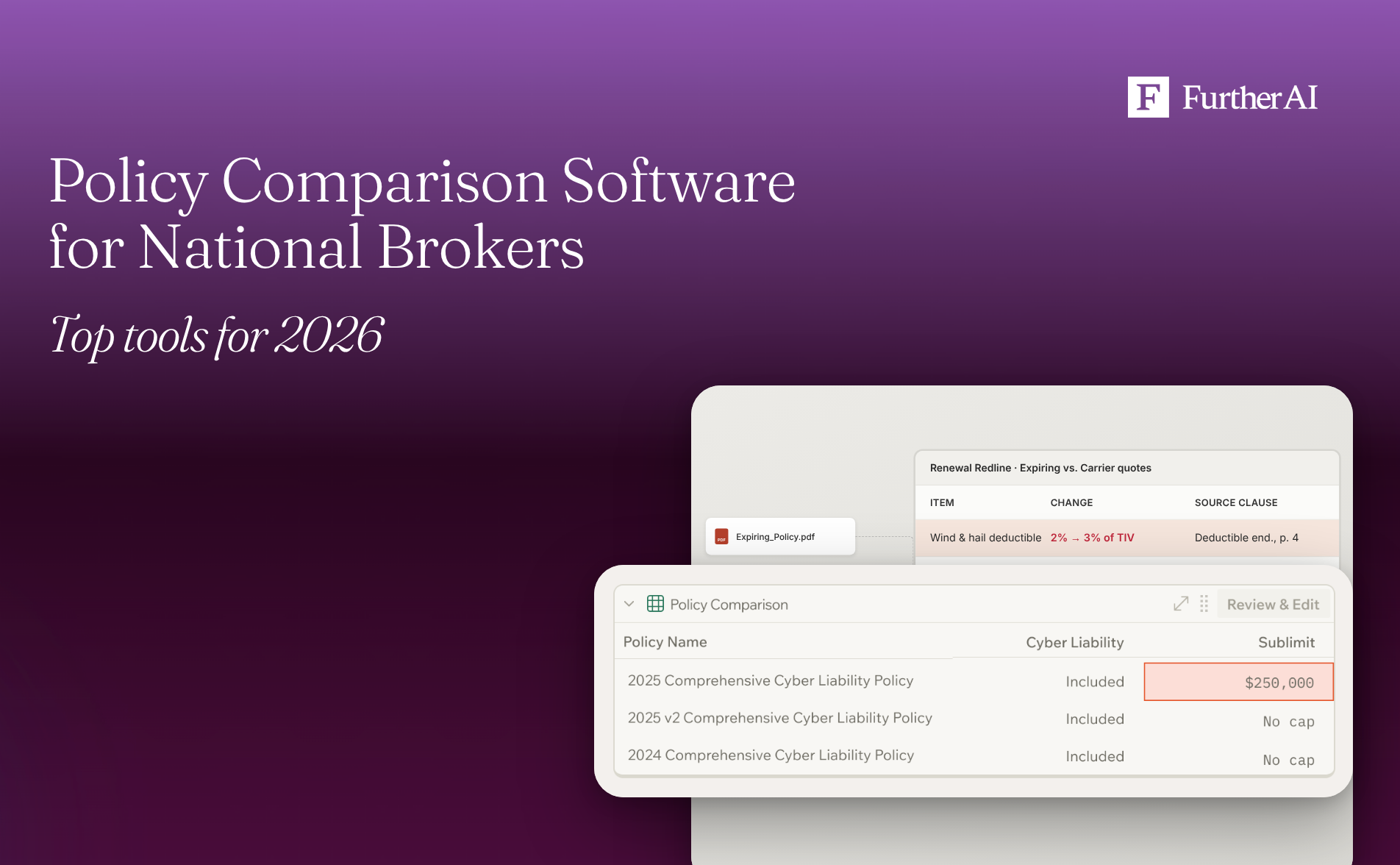
The best policy comparison software for national brokers is an insurance-specific AI platform such as FurtherAI, which reads every quote and policy in full, redlines the differences in limits, deductibles, forms, and endorsements, and links each change to the clause it came from. That turns a stack of carrier PDFs into a client-ready comparison in minutes, with a record of what the client was shown. Manual review and spreadsheets still work for a handful of accounts, but they don't scale across dozens of carrier partners and a full renewal calendar.
In this guide, we compare the four ways brokers compare policies today, show what a good redline looks like, give you an outline for a client-ready comparison report, and walk through a year-over-year renewal workflow.
Key takeaways
- Comparison is where E&O exposure starts. Utica National's E&O team says not matching coverage is the most frequent cause of E&O claims on new business when an account moves carriers.
- Premium is the easy part. The differences that matter sit in sublimits, deductibles, exclusions, and endorsements, deep in each carrier's forms.
- Soft markets mean more remarketing. Global commercial insurance rates fell 5% in the third quarter of 2026, the ninth straight quarterly decline, according to Marsh. More quotes per account means more comparisons per broker.
- Links to changed clauses are the test. A comparison your team can trust shows each difference next to the exact wording behind it.
- The report wins the renewal. Clients act on a clear recommendation and a short list of changes, not a 40-row spreadsheet.
How do national brokers compare policies across carrier partners?
National brokers, the large firms that place business across the country with many carrier partners, compare policies in one of four ways. The table shows how each approach holds up when you're comparing quotes from several carriers on a complex commercial account.
Spreadsheets give every comparison a consistent format, which is why so many account teams still rely on them. The problem is the rekeying. Every value has to be typed from a PDF, and endorsements that change coverage in subtle ways rarely fit in a cell.
What is the best software for comparing coverage across multiple insurance policies?
Look for software that reads the whole policy packet, not just the declarations page. Coverage differences often sit in a form or endorsement that modifies the base policy, and a tool that only compares headline fields will miss them.
FurtherAI compares coverage breadth, terms, exclusions, and endorsements, factoring in the full policy packet, including base forms and conditional endorsements. It also flags "give-back" endorsements that restore coverage a base form excludes. At one mid-sized insurer, comparisons ran more than 30 times faster than manual work with equal or better accuracy, and the team used the output to give brokers detailed side-by-side comparisons when clients asked questions.
For brokers, FurtherAI structures carrier quotes side by side with terms and pricing highlighted and generates client-ready placement summaries. Leavitt Group, one of the largest independent brokerages, runs account manager workflows on FurtherAI that include proposal building, policy checking, and document comparison.
Agency-focused tools also exist. InsurGrid compares policies, quotes, and declaration pages for agencies, and Sonant offers a free tool that compares two policy PDFs. These suit smaller agencies comparing a few documents at a time. National brokers placing complex commercial accounts with many carriers usually need full-packet reading, clause links, and a shared account record.
What does a policy comparison redline show?
A redline is the list of differences between two or more documents, organized so a broker can review them quickly. FurtherAI redlines limits, deductibles, forms, and endorsements and lets reviewers jump directly to the changed clauses. A useful redline covers four categories:
- Limits and sublimits: per-occurrence and aggregate limits, plus sublimits that cap specific perils or coverages.
- Deductibles and retentions: flat and percentage deductibles, including wind and hail, and self-insured retentions.
- Forms: the base coverage form and edition, and any change in the form schedule.
- Endorsements and exclusions: endorsements added, removed, or reworded, and new exclusions.
Here's what the output looks like for one renewal. The account and figures are illustrative.
Each row links to the passage in the source document, so an account manager can confirm a change in seconds instead of searching a 300-page policy. FurtherAI's coverage summaries are anchored to the source policy wording for auditability.
Which tools help national brokers win renewals with clear coverage comparison reports?
The tools that help most are the ones that turn the redline into something a client can read in five minutes. FurtherAI's Broker Workspace lays carrier quotes side by side with the differences flagged, and once the broker picks a quote, one click turns it into a proposal in the firm's own branding. FurtherAI puts proposal preparation at about 10 minutes instead of two to three hours by hand.
A broker still reviews and approves every step that needs judgment. As FurtherAI Product Lead Danny O'Lenic puts it, the question is often whether one carrier's wording on additional insureds is "actually going to hold up the way the client expects."
Sample client-ready comparison report outline
Whether you build it by hand or with software, a commercial coverage comparison report works best in this order:
- Summary and recommendation. Two or three sentences: which option you recommend and why.
- At-a-glance table. One row per carrier: premium, key limits, deductibles, policy term, and carrier financial strength rating.
- Coverage reductions. Every change that narrows coverage against the expiring policy, in plain language, with the clause reference.
- Coverage improvements. Broader terms, restored limits, or new endorsements that help the client.
- Exclusions and conditions to note. Anything that could affect a likely claim for this client's operations.
- Subjectivities and open items. What each carrier needs before binding.
- Client acknowledgment. A line for the client to confirm they've reviewed the coverage differences.
- Appendix. The full redline with links to the source clauses.
Putting reductions ahead of improvements is deliberate. Utica National's E&O guidance tells agents to "point out any coverage differences to the client" when changing carriers, and a report that leads with what the client is losing makes that conversation hard to skip.
What's the best way for regional brokers to present policy comparisons to commercial clients?
Regional brokers compete with national firms on service, so the presentation matters as much as the placement. Three habits make comparisons land:
- Lead with the recommendation. Commercial clients want your judgment, not a data dump. Put the decision on the first page.
- Translate wording into outcomes. For example, "Your wind deductible on the Tampa warehouse rises from about $200,000 to $300,000" is clearer than "deductible changed from 2% to 3% of TIV."
- Show your work. Keep the full redline in an appendix with clause links. Clients rarely read it, but it documents what you told them.
Software helps regional teams deliver this format without adding staff. Our guide to tools that streamline renewal pack preparation for regional brokers compares the options.
What's the best tool for brokers to speed up year-over-year policy analysis?
Year-over-year analysis compares the expiring policy, the renewal offer, and often the prior years' terms, so you can see how coverage has drifted over time. Brokers are starting this work earlier: Insurance Business reported in September 2026 that Trucordia has moved much of its renewal activity to between 120 and 150 days before expiry.
FurtherAI compares policy versions with precise change tracking and lets brokers jump directly to modified language. It can also compare a submission against the last several renewals using documents already stored in SharePoint.
A year-over-year renewal workflow
- Gather the history (120 to 150 days out). Pull the expiring policy, prior renewals, endorsements issued mid-term, and the loss runs.
- Baseline the expiring terms. Extract limits, deductibles, forms, and endorsements into one record.
- Market the account. Send applications to incumbent and new carriers.
- Redline every quote. Compare each quote against the expiring baseline and against each other.
- Flag multi-year drift. Note terms that have narrowed over several renewals, such as a sublimit cut two years running.
- Build the client report. Use the outline above, leading with your recommendation and any reductions.
- Check what's bound. After issuance, check the policy against the quote the client accepted.
Market conditions make step 5 worth the time. With US casualty rates still up 6% in the third quarter of 2026 even as the US composite fell 1%, per Marsh, some lines are loosening while others keep tightening. For the underwriting side of this process, see our guide to automated renewal summaries, and for step 7, our guide to AI policy checking.
Where can brokers buy software that summarizes policy differences for clients?
Brokers buy policy comparison software in three ways:
- Free and self-serve tools that compare two PDFs at a time. These suit occasional use on personal or small commercial accounts.
- Agency software subscriptions with monthly pricing, built for independent agencies comparing quotes and renewals.
- Enterprise insurance AI platforms such as FurtherAI, sold directly with guided implementation and connections to agency management systems. FurtherAI is also available through the Microsoft Marketplace.
Before you buy, test each option on three real accounts: one with a large property schedule, one with a long endorsement list, and one renewal with a known reduction in coverage. Check whether the tool finds the reduction, links to the changed clause, and produces a summary you'd send to the client. Then confirm security: FurtherAI holds SOC 2 Type II and ISO 27001 and contractually guarantees that customer data isn't used to train models.
Comparison is one half of the job. To understand how it differs from checking issued policies, read policy checking vs policy comparison.
Frequently asked questions
DISCLAIMER
This article is for general informational purposes only and does not constitute legal, regulatory, compliance, underwriting, or other professional advice. The content reflects information available as of the date of publication, and FurtherAI undertakes no obligation to update it as laws, regulations, or AI technologies evolve.
Recent posts


Ready to go further and
transform your insurance ops?
Reclaim your time for strategic work and let our AI Assistant handle the busywork. Schedule a demo to see how you can achieve more, faster.