FurtherAI Available in Microsoft Marketplace
Introducing Connectors



Policy Checking vs Policy Comparison: What Brokers Need

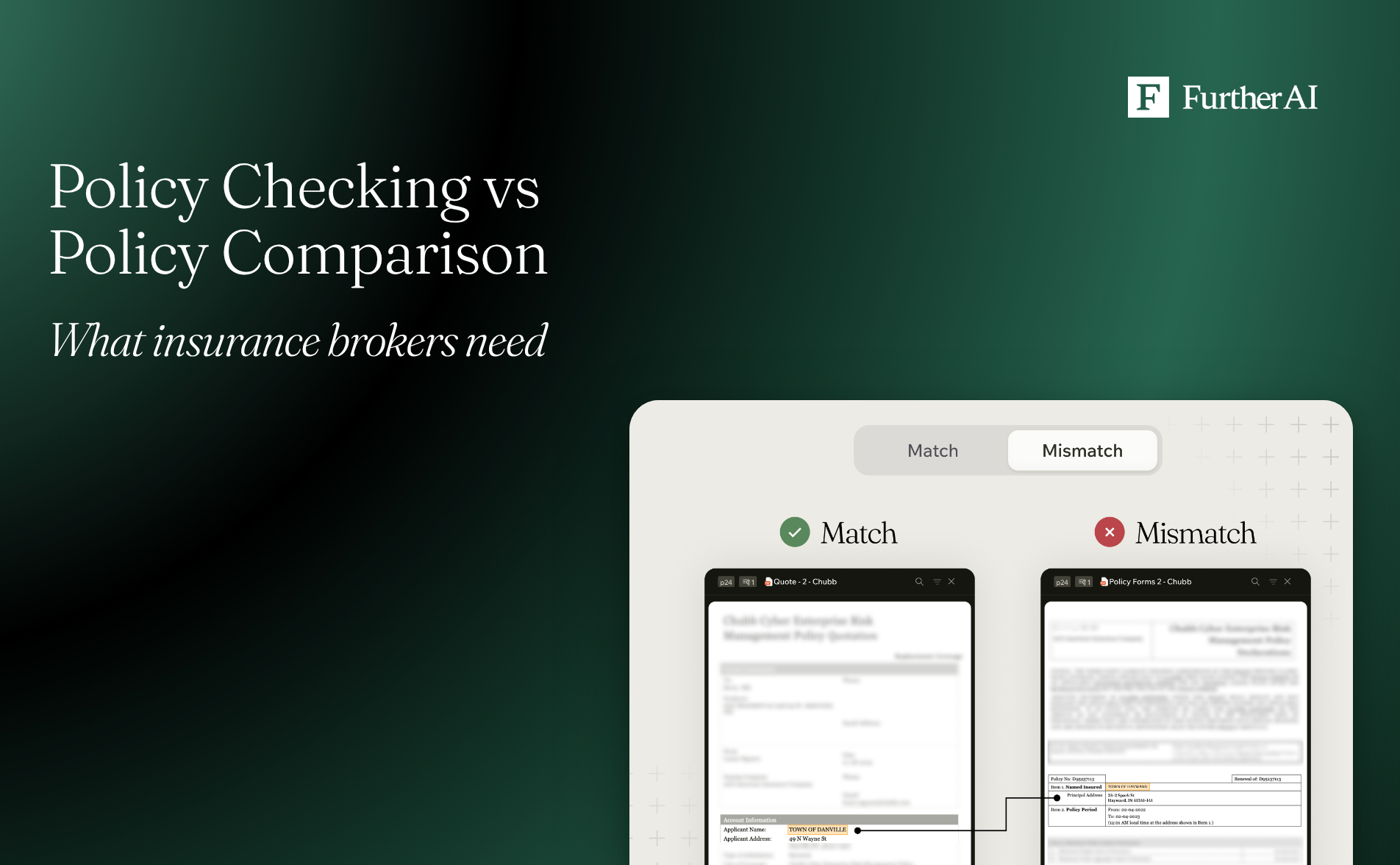
Policy checking confirms that the policy a carrier issued matches what your client agreed to buy. Policy comparison lines up two or more documents, such as competing quotes or an expiring policy and its renewal, so a broker can advise on the differences. Brokers need both at different points in a placement, and each one protects against a different kind of errors and omissions (E&O) claim.
Commercial pricing softened again in the second quarter of 2026, with average premiums down 2.0% across account sizes, according to The Council of Insurance Agents & Brokers (CIAB). Softer markets bring more remarketing, and Utica National's E&O team estimates that at least one-third of agency E&O claims involve moving coverage to a new carrier. Every move adds a comparison before the bind and a check after it.
Key takeaways
- Policy checking happens after issuance and has a right answer: the policy either matches the binder, quote, and application, or it doesn't.
- Policy comparison happens before a decision and produces a list of differences that a broker interprets and explains to the client.
- A typical placement involves four related tasks: quote comparison, bind-order verification, policy checking, and renewal comparison.
- Failure to procure coverage is still the No. 1 reason agencies are sued, based on Big "I" Swiss Re E&O program data, and both workflows guard against it.
- Nearly half of independent agencies now use AI, yet a separate Big "I" survey found only 20% use AI in policy comparison tools.
What policy checking is
Policy checking is the review of an issued policy against the documents that came before it: the application, the proposal, the quote, and the binder. Rough Notes recommends reviewing each policy received against everything in the client file, including previous policies, proposals, applications, and premium comparisons. Big I New York’s E&O Report adds a more specific step: when the policy arrives, check every attached form against the forms listed in the quote or binder.
The checker is looking for discrepancies that shouldn't exist. A misspelled named insured, a missing location, the wrong policy period, a form that was never quoted, or a limit lower than the binder all count. IA Magazine notes that carriers sometimes add a vaguely worded endorsement that works as an exclusion. Policy checking is the step that catches it before the client files a claim.
Quality targets are less forgiving than they sound. Utica National points out that a 95% quality ratio still means one out of every 20 policies contains a mistake. Its guidance is to check promptly, using a saved checklist that covers the named insured, addresses, dates, policy number, and coverage-specific items.
What policy comparison is
Policy comparison puts two or more documents side by side to show where they differ. For brokers, it usually takes one of two forms. Quote comparison lines up competing carrier quotes for the same risk before the client chooses. Renewal comparison lines up the expiring policy against the renewal offer before the client renews.
Comparison rarely has a single correct answer. A higher deductible might be acceptable if the premium drops, and a narrower exclusion might matter to one client and not another. The broker's job is to surface the differences and help the client decide. Utica National recommends a side-by-side spreadsheet that lists the main coverage issues and shows how each carrier handles them, along with the client’s written acknowledgment of any reduction in coverage.
Where each one fits in a placement
Most brokerages don't run a single "policy review" step. They run four related tasks at different moments, each with its own documents, owner, and failure mode. For a refresher on how the documents relate, see our explainer on the quote, binder, policy and certificate.
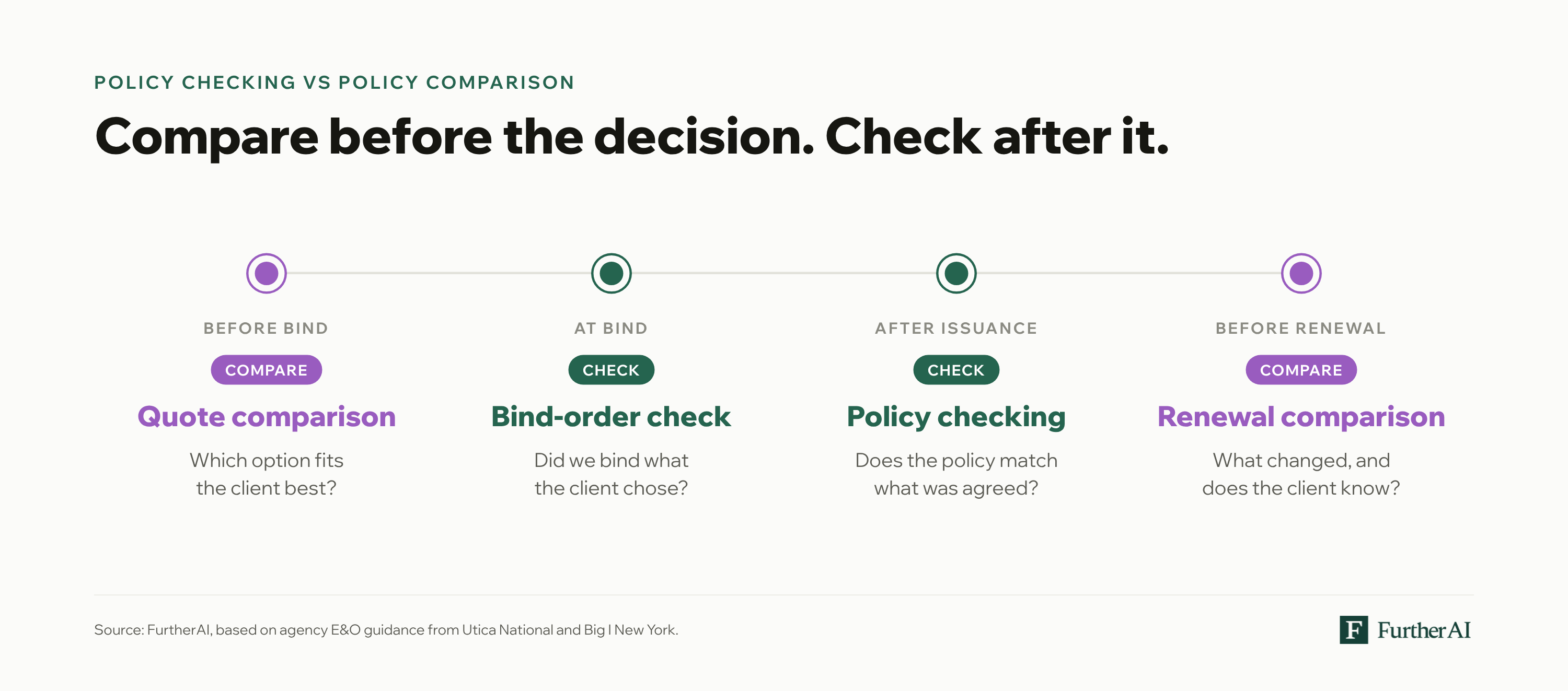
Two of the four tasks are checks and two are comparisons. The checks happen after a decision has been made, so any difference is an error to fix. The comparisons happen before a decision, so any difference is information for the client.
Where E&O risk sits in each
Big "I" Swiss Re E&O program data from 2017–2022 ranks failure to procure coverage as the No. 1 reason agencies are sued, according to IA Magazine. The next most common causes were failing to adequately explain or disclose policy provisions, giving the carrier inaccurate information, failing to recommend the correct type of coverage, and failing to recommend adequate values or limits.
Those causes, plus the administrative errors Big "I" now ranks third, split along the same line as the two workflows:
The pressure isn't easing. In early 2025, Big “I” Professional Liability’s E&O operations lead told IA Magazine that the program had seen an uptick in both the frequency and severity of E&O claims over the previous six months, with failure to procure still the top loss driver and administrative errors the third largest. For more on catching form problems early, see our guide to endorsement and form checks before submission.
Which one does your brokerage need first?
For most brokerages, policy checking comes first. It has a clear pass-or-fail standard, it maps directly to the leading cause of E&O claims, and it applies to every bound policy, so the volume is predictable. Comparison becomes the priority when the book is in motion: a remarketing push, a carrier exit, or a soft market where clients shop on price.
Adoption data shows where agencies stand. The Big "I" 2026 Agency Universe Study found that 46% of agencies use AI, up from 15% in 2024, with coverage form analysis (43%) and contract reviews (35%) among the reported uses. In March 2026, Insurance Journal reported that a Big "I" Agents Council for Technology (ACT) survey found that far fewer agencies use AI in policy comparison tools (20%). Liberty Mutual's 2026 Independent Agency Growth Study puts the payoff at an average of four hours saved per week for agents using AI.
Staffing is the other constraint. Agencies in the same Agency Universe Study listed finding and screening strong job candidates among their top challenges (45%). Manual checking and comparison compete for the same account manager hours, which is why many teams start with the task that runs on every policy and add comparison as capacity frees up. Teams with heavy renewal volume can also look at automated renewal summaries and renewal pack preparation tools.
How AI handles both on one desk
Checking and comparison share their raw material: quotes, binders, policies, and endorsements. That makes them a natural fit for one AI system, as long as a person reviews the output. A 2023 E&O Report on AI in agencies from Big I New York advises that an experienced employee oversee and double-check any AI policy-checking process, confirming the accuracy of its review.
FurtherAI's Policy Check & Compare case study shows what this looks like at scale. A mid-sized insurer with over 1,500 employees and $1 billion in annual revenue deployed an AI teammate to review quotes, binders, and issued policies for coverage breadth, terms, exclusions, and endorsements, including "give-back" endorsements. Policy checks ran 20 times faster than the manual process, and side-by-side comparisons ran 30 times faster with equal or superior accuracy. Manual review time fell by up to 95%, and the insurer reported 400% ROI within months. The same comparisons gave its brokers detailed side-by-side views of coverage.
On the brokerage side, Leavitt Group uses FurtherAI for account manager workflows that include proposal building, policy checking, document comparison, and loss run analysis. A loss run of more than 130 lines went from hours to minutes, with consistent results in production over six months. Quote comparison also sits next to proposal building. One large national MGA that uses FurtherAI to compare carrier quotes and assemble proposals cut proposal time by 75%, producing proposals in under 10 minutes instead of 30–45.
The FurtherAI Broker Workspace brings these tasks into one place on the account manager's desk. For a feature-level view of what to evaluate, see our breakdown of insurance policy analysis software features and our ranking of the best AI for policy checking. To see how the workflows fit together for brokerages, visit AI for insurance brokers.
Frequently asked questions
DISCLAIMER
This article is for general informational purposes only and does not constitute legal, regulatory, compliance, underwriting, or other professional advice. The content reflects information available as of the date of publication, and FurtherAI undertakes no obligation to update it as laws, regulations, or AI technologies evolve.
Recent posts

Ready to go further and
transform your insurance ops?
Reclaim your time for strategic work and let our AI Assistant handle the busywork. Schedule a demo to see how you can achieve more, faster.