FurtherAI Available in Microsoft Marketplace
Introducing Connectors



How Brokers Cut Compliance Review Time: Endorsement and Form Validation Before Submission (2026)

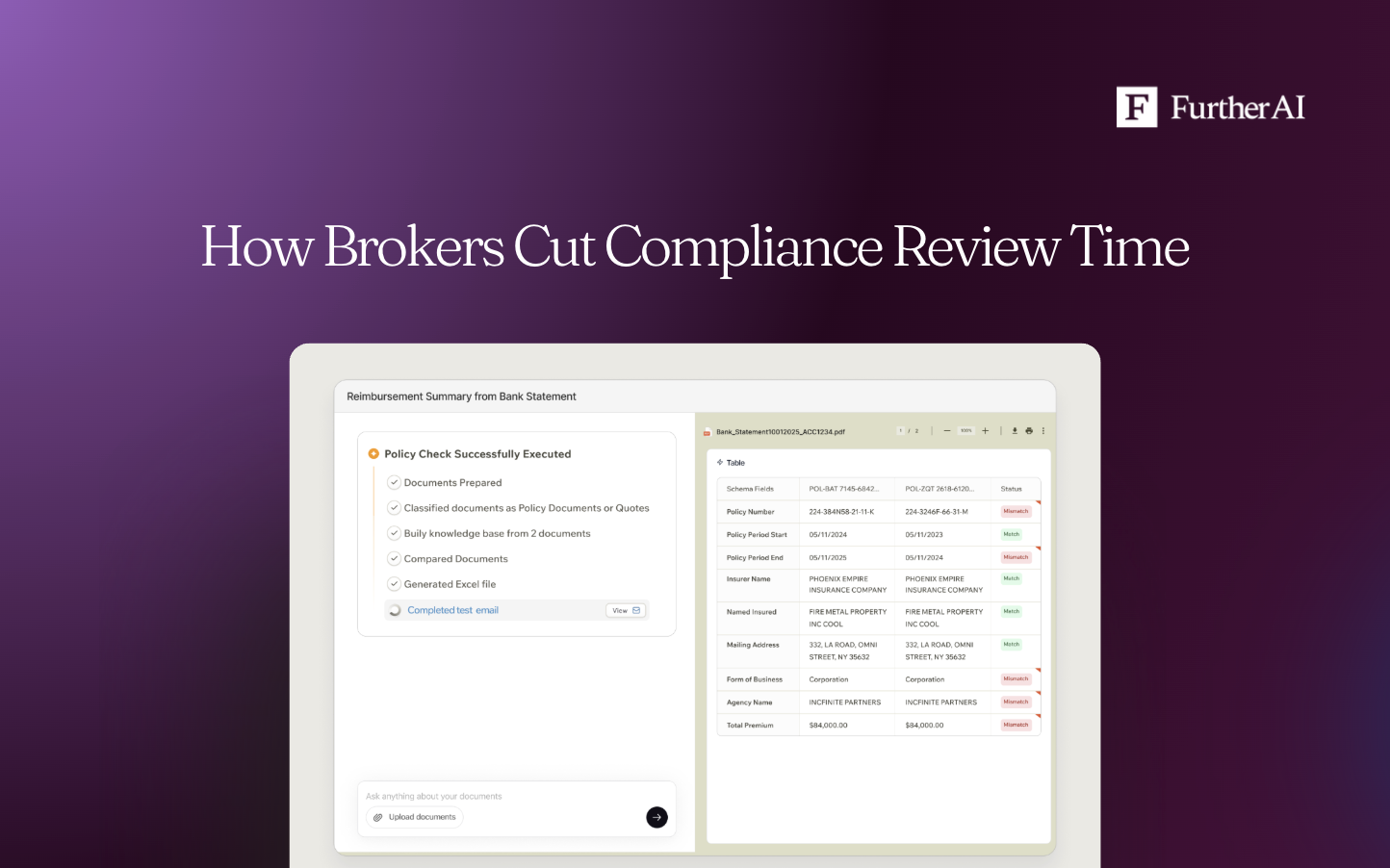
Most of the compliance review time in a brokerage goes on one question asked over and over: does the paper actually say what we told the client it says. A certificate lists an additional insured. A contract demands primary and noncontributory wording. A binder promises two endorsements. Somebody has to confirm each of those claims against the documents that make them true, and that somebody is usually a service team member with 40 other renewals open.
The work compresses well, because most of it is comparison rather than judgment. What follows is where the hours actually go, what breaks when a check gets skipped, and what the tooling market does and doesn't cover.
Key takeaways
- A certificate is not coverage, and ACORD says so on the form. The ACORD 25 tells the reader in its own words that a statement on the certificate confers no rights "in lieu of such endorsement(s)." Most pre-submission reviews exist to close that gap.
- Four checks account for most of the time: endorsement schedule reconciliation, form edition currency, state amendatory wording, and carrier-specific requirements.
- Failure to procure coverage is the top driver of agency errors and omissions claims — about 30% of claims by frequency, in both commercial and personal lines, in Swiss Re Corporate Solutions data — and still ranked first in 2025 reporting.
- Edition dates move, including on the certificate itself. ACORD 25's 2025/12 edition supersedes the long-used 2016/03, and both are still in the field, and ISO's completed operations endorsement runs from a 10 01 edition to a 12 19 one.
- None of the seven offerings we reviewed publicly documented form edition currency checking or state amendatory handling. We read their public product material in September 2026. The gap is worth knowing before a demo.
The pre-submission check a brokerage actually runs
Before a submission or a certificate leaves the office, someone is confirming five things. The order varies by shop; the list rarely does.
- Does the contract's insurance schedule match what we placed? Limits, additional insured status, waiver of subrogation, primary and noncontributory wording, notice of cancellation.
- Are the endorsements that create those obligations actually attached? Not listed on a certificate — attached to the policy.
- Are the forms current? Right form number, right edition date, right state version.
- Does the carrier's own paperwork agree? Carrier-specific forms and manuscript wording that replace or modify the standard versions.
- Is the submission complete enough to avoid a bounce-back? Covered separately in our submission prep checklist.
Steps one through four are the compliance review. They're also where the time goes.
Where the hours go
The certificate-to-endorsement gap
ACORD is the industry's standards body, and its certificate forms are unusually candid about their own limits. The ACORD 25, Certificate of Liability Insurance, carries this in its header:
"THIS CERTIFICATE IS ISSUED AS A MATTER OF INFORMATION ONLY AND CONFERS NO RIGHTS UPON THE CERTIFICATE HOLDER. THIS CERTIFICATE DOES NOT AFFIRMATIVELY OR NEGATIVELY AMEND, EXTEND OR LTER THE COVERAGE AFFORDED BY THE POLICIES BELOW. THIS CERTIFICATE OF INSURANCE DOES NOT CONSTITUTE A CONTRACT BETWEEN THE ISSUING INSURER(S), AUTHORIZED REPRESENTATIVE OR PRODUCER, AND THE CERTIFICATE HOLDER."
And then, more specifically:
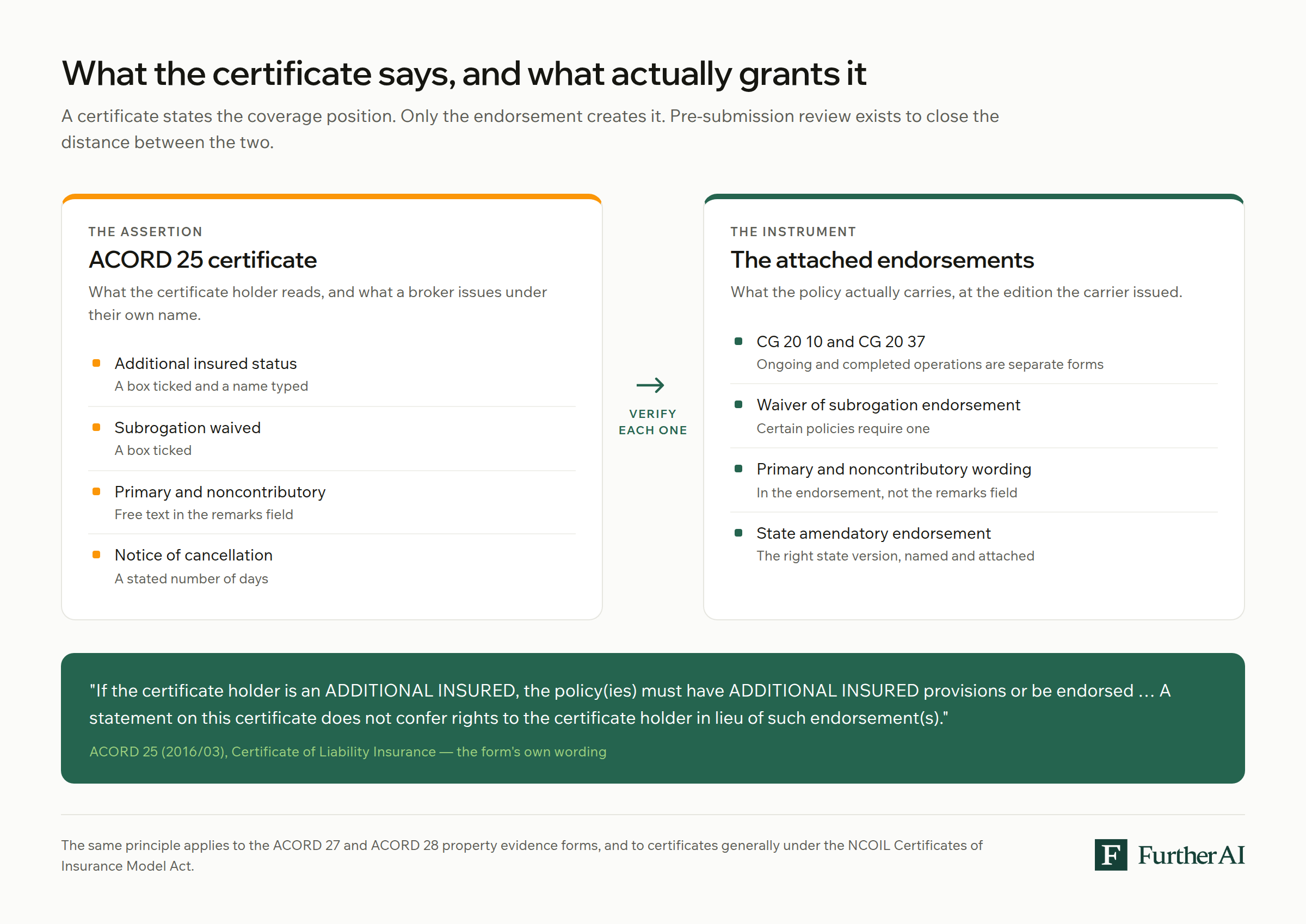
"IMPORTANT: If the certificate holder is an ADDITIONAL INSURED, the policy(ies) must have ADDITIONAL INSURED provisions or be endorsed. If SUBROGATION IS WAIVED, subject to the terms and conditions of the policy, certain policies may require an endorsement. A statement on this certificate does not confer rights to the certificate holder in lieu of such endorsement(s)."
That sentence is the whole job in one line. The certificate asserts; the endorsement delivers. A broker who issues a certificate naming an additional insured without confirming the endorsement is attached has created a document that says something the policy doesn't do.
The same logic governs the property equivalents, the ACORD 27, Evidence of Property Insurance, and the ACORD 28, Evidence of Commercial Property Insurance, both of which confer no rights on the additional interest named.
Regulators treat certificates the same way. The NCOIL Certificates of Insurance Model Act states that a certificate "is not a policy of insurance and does not affirmatively or negatively amend, extend, or alter the coverage afforded by the policy to which the certificate of insurance makes reference," and
New York bars anyone from requiring a liability certificate on a form the Superintendent hasn't approved, unless the insurer issuing the referenced policy promulgated it (N.Y. Ins. Law art. 5, § 502).
Endorsement schedule reconciliation
The check itself is mechanical. Pull the endorsement schedule from the policy, pull the endorsements promised on the binder or required by the contract, and list the differences.
The classic miss is a contract requiring additional insured status for both ongoing and completed operations, where only the ongoing operations endorsement gets attached. ISO's CG 20 10 covers ongoing operations and CG 20 37 covers the products-completed operations hazard. They complement each other, so a contract requiring both means both have to be on the policy. We've covered how that check works at book scale in our guide to policy checking; the broker-side version runs earlier and on fewer documents, but the failure mode is identical.
Form edition currency
Editions of the same form circulate simultaneously, and the wording differs between them. CG 20 37 exists in a 10 01 edition and a 12 19 edition. A submission citing the right form number with the wrong edition passes a glance and fails a real review.
This applies to the certificate too. ACORD 25 ran in its 2016/03 edition for a decade. The 2025/12 edition now supersedes it and is approved in New York, and it is not a cosmetic change — it adds a sentence the older form doesn't carry: "LIMITS SHOWN ARE INCLUSIVE OF AMOUNTS REQUESTED BY THE CERTIFICATE HOLDER AND MAY NOT REFLECT POLICY LIMIT AMOUNTS IN EXCESS OF THOSE REQUESTED." A brokerage running templates built years ago is issuing superseded paper without anyone deciding to.
State amendatory endorsements
State amendatory endorsements modify a standard policy to conform to a particular state's law, commonly on cancellation and nonrenewal. ISO's CG 02 05, Texas Changes — Amendment of Cancellation Provisions or Coverage Change, sits in that state series, and it repays actually reading: its operative text adds a requirement that the insurer mail advance written notice of cancellation or material coverage reduction to a person or entity named in a schedule, across seven liability coverage parts. A form's title and its actual effect are not the same thing, which is precisely why this check can't be run from the form number alone.
The temptation is to paper over conflicts with a catch-all. New York's Insurance Department — the predecessor of today's DFS — addressed exactly that in OGC Opinion No. 07-09-10, advising that it would likely not approve "inconsistency" wording that would apply whichever of the state amendatory or the policy terms were "more favorable to the Insured" as "both overly broad and ambiguous." The state version has to be the right one, named and attached.
Where multi-state work runs into licensing, appointments, and surplus lines tax rather than forms, that's a different problem — see multi-state compliance for national brokers.
Carrier-specific requirements
The fourth time sink has no standard at all. Carriers substitute their own additional insured forms for the ISO versions, add manuscript wording, and impose their own certificate rules. A broker placing across 15 markets is holding 15 sets of conventions, and none of them are published in a form software can look up.
What breaks when the check gets skipped
Errors and omissions exposure. Failure to procure coverage is the largest single cause of agency E&O claims. Swiss Re Corporate Solutions data reported by IA Magazine put it at about 30% of claims by frequency, in both commercial and personal lines, with the next highest cause barely reaching 10%. That data is from 2020, and IA Magazine's 2025 reporting still puts it first — Big "I" Professional Liability's Amanda Juratovic calls failure to procure the number one loss driver, and Swiss Re says the top causes have stayed consistent over time.
A missing endorsement is a failure to procure with a paper trail showing you said otherwise.
Rework. A wrong form found after issuance means a policy change request, a carrier turnaround, a reissued certificate, and a client conversation. Found before submission, it's an email.
Bind delay. Underwriters bounce submissions with inconsistent documents, and the bounce arrives days later, often close to the effective date.
We can't put an industry number on rework or certificate error rates, because no independent measurement exists — every figure in circulation traces back to a vendor selling the fix. What is measurable is the direction of travel: the checks are cheap before submission and expensive after.
What the workflow looks like before and after
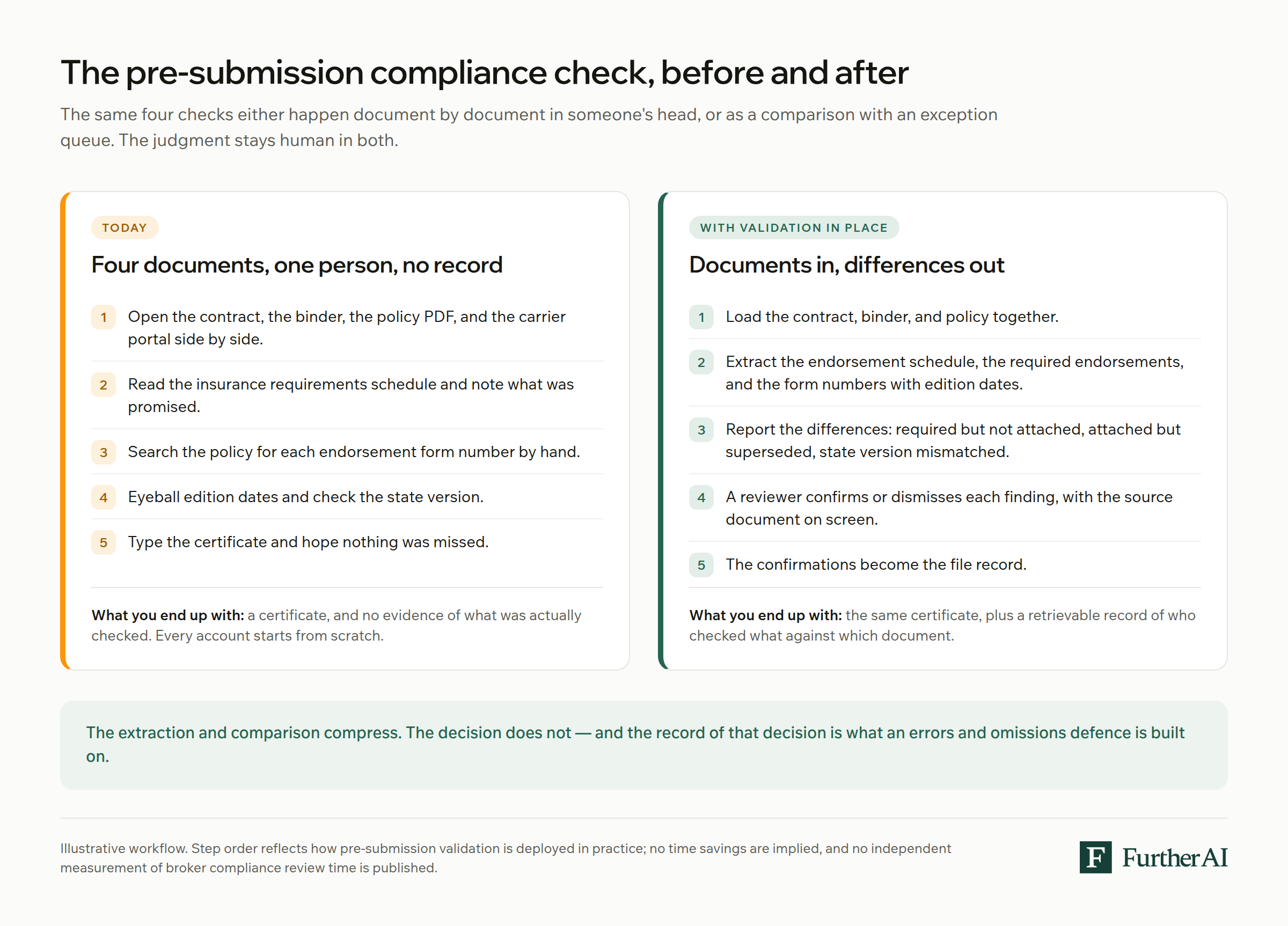
Before. A service team member opens the contract, the binder, the policy PDF, and the carrier portal. They read the insurance requirements schedule, search the policy for each endorsement form number, eyeball edition dates, check the state version, then type the certificate. Every account is a fresh start, and the only record of what was checked is whether the person remembers.
After. The documents go in together. The system extracts the endorsement schedule, the contract's insurance requirements, and the form numbers with their edition dates, then reports differences as a list: required but not attached, attached but superseded, state version mismatched. A person confirms or dismisses each one, and the confirmations become the file record.
The shape holds up in practice. At Leavitt Group, one of the largest independent brokerages, account manager workflows including policy checking and document comparison moved to this pattern.
The case study describes a single loss run of more than 130 lines of unstructured data that had previously required hours of manual work.
Chief Project Officer Laurie Flanigan: "We had a producer spend hours trying to extract and format a loss run using general AI tools, and it just wasn't working. When they ran the same file through FurtherAI, it produced exactly what they needed in minutes."
Note what that is and isn't. It's a document-handling result from a real brokerage, not a compliance-review benchmark. Anyone quoting a percentage for endorsement validation time saved should be asked where it came from.
How the tooling market covers this
We reviewed the public product material of seven offerings in September 2026.
Two things are worth knowing before reading the table.
First, the broker technology market is more concentrated than its brand names suggest. Applied Epic, Indio, and Ivans are all Applied Systems. Sircon is Vertafore, which is owned by Roper Technologies. Bold Penguin is a subsidiary of American Family Insurance. Those six brand names are three companies, so the table names the owner. All three ownership claims verified. Roper's 10-K filed 24 February 2026 still lists Vertafore in continuing operations — no divestiture. Bold Penguin is still American Family's, though note that Bold Penguin's own site mentions American Family nowhere; the claim rests on 2021 trade press. Ivans is an Applied Systems division rather than a separately-held subsidiary, which is a nuance rather than an error.
Second, vendors are listed alphabetically. This is a capability matrix, not a ranking.
How to read this table. "Documented" means the capability is described in the offering's own public product material. "Partial" means an adjacent capability is described but not the specific one. "Not documented" means we couldn't verify it publicly, which is not the same as saying it doesn't exist — several of these publish marketing pages rather than product documentation. "N/A" means the capability doesn't apply to that product's role. Vendor links are omitted deliberately; assess each against your own requirements.
What the matrix shows
One column is empty across every row, and the other holds a single "Partial" — and they're the two that cause the most rework.
Nobody publicly documents form edition currency checking. Certificate Hero comes closest, with a field for recording an endorsement's edition date — which is not the same as checking whether that edition is still current. Nobody publicly documents state amendatory handling at all.
Those are the checks that depend on knowing what the current edition is and which state version applies — reference knowledge that has to be maintained, not inferred from a document. In practice it stays with your team, which means the useful question for a vendor is whether you can load that knowledge in and have it applied consistently, rather than whether they already have it.
Endorsement schedule checking is better served. Exdion said in September 2026 that it validates each returned endorsement against the original change request, and Patra's policy checking product works from source documents including the binder, bind order, quote, and prior policy against a 900-plus point checklist. Certificate Hero approaches it from the certificate side, with an endorsement library tied to individual insureds and a live ACORD form editor.
What a broker should test in a pilot
- Use your own messy documents. Ten real accounts including a manuscript carrier form, a scanned certificate, and a contract with an unusual insurance schedule. Demo data proves nothing about your markets.
- Count false negatives, not accuracy. A missed endorsement is the failure that becomes an E&O claim. A false positive costs a reviewer seconds. Measure the two separately and weight them accordingly.
- Ask what happens to an edition date. Give it a policy citing a superseded form edition and see whether anything surfaces. Most won't. Knowing that before you sign is worth more than a better demo.
- Check the record. After a reviewer dismisses a finding, confirm the dismissal, the reviewer, and the source document are all retrievable six months later. That record is your E&O defence.
Frequently asked questions
REFERENCES
ACORD. "About ACORD." acord.org
ACORD. "ACORD 25 (2016/03), Certificate of Liability Insurance." Sample hosted by the City of Tampa. tampa.gov
ACORD. "ACORD 25 (2025/12), Certificate of Liability Insurance." dfs.ny.gov
ACORD. "ACORD 27, Evidence of Property Insurance." Sample hosted by New York City Department of Design and Construction. nyc.gov
ACORD. "ACORD 28, Evidence of Commercial Property Insurance." Sample hosted by New York City Department of Design and Construction. nyc.gov
Butler, Katie. "What's Driving the Rise in E&O Claims — and What Can Your Agency Do to Prevent One?" IA Magazine, May 1, 2025. iamagazine.com
Davis, Matthew. "The Top 5 Causes of Agency E&O Claims in 2020." IA Magazine, March 1, 2021. iamagazine.com
Independent Insurance Agents of Texas. "CG 02 05 12 04, Texas Changes — Amendment of Cancellation Provisions or Coverage Change." iiat.org
Insurance Services Office, Inc. "CG 20 10 04 13 — Additional Insured – Owners, Lessees or Contractors – Scheduled Person Or Organization." nyc.gov
Insurance Services Office, Inc. "CG 20 37 12 19 — Additional Insured – Owners, Lessees Or Contractors – Completed Operations." ogs.ny.gov
International Risk Management Institute. "Primary and Noncontributory." irmi.com
International Risk Management Institute. "Waiver of Subrogation." irmi.com
National Council of Insurance Legislators. "Certificates of Insurance Model Act." Adopted November 18, 2012; re-adopted July 2017. ncoil.org
New York State Department of Financial Services. "Certificates of Insurance." dfs.ny.gov
New York State Insurance Department, Office of General Counsel. "OGC Opinion No. 07-09-10: State Inconsistency or Amendatory Endorsements." September 12, 2007. dfs.ny.gov
DISCLAIMER
This article is for general informational purposes only and does not constitute legal, regulatory, compliance, underwriting, or other professional advice. The content reflects information available as of the date of publication, and FurtherAI undertakes no obligation to update it as laws, regulations, or AI technologies evolve.
Recent posts

Ready to go further and
transform your insurance ops?
Reclaim your time for strategic work and let our AI Assistant handle the busywork. Schedule a demo to see how you can achieve more, faster.




.svg)