FurtherAI Available in Microsoft Marketplace
Introducing Connectors



How Leavitt Group Is Using FurtherAI to Redefine Insurance Operations

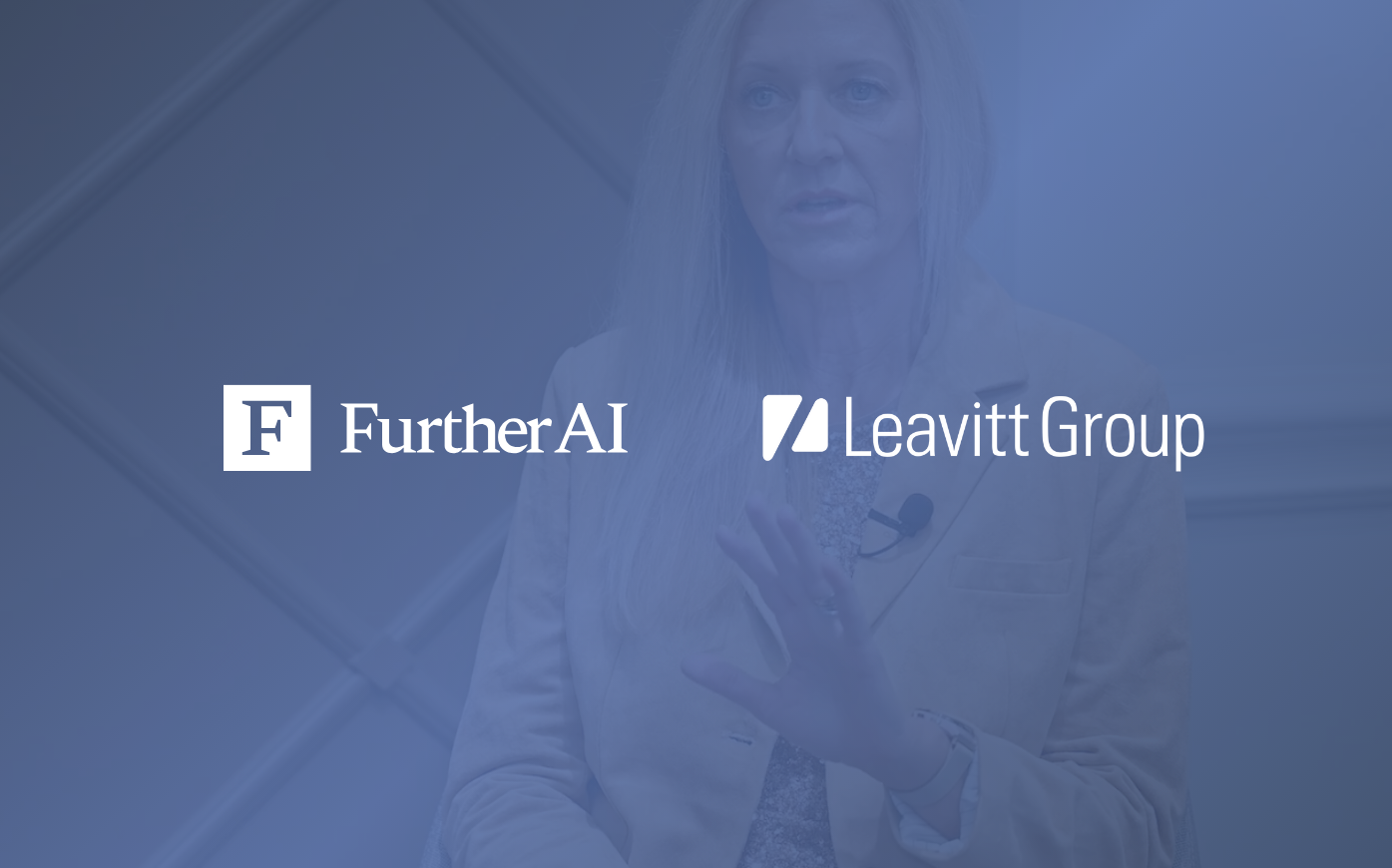
We recently sat down with Laurie Flanigan, Chief Project Officer at Leavitt Group, to understand how one of the largest independent insurance brokerages is operationalizing AI at scale—without sacrificing accuracy, control, or trust.
Leavitt Group operates across commercial lines, personal lines, employee benefits, financial services, and life products. At this level of complexity, AI must work inside real insurance workflows. Anything less creates risk instead of value.
This is how Leavitt Group is moving from AI experimentation to AI infrastructure—and why FurtherAI plays a central role.
Building AI Into Core Insurance Workflows
Leavitt Group began exploring AI in operations more than two years ago. Early pilots made one thing clear: AI that does not meet strict accuracy standards increases manual review and slows teams down.
Rather than layering AI on top of legacy systems, Leavitt made a deliberate decision to treat AI as foundational infrastructure. The objective was to automate high-effort insurance workflows while maintaining enterprise-grade accuracy, governance, and visibility.
This approach required a platform designed specifically for insurance operations, not a general-purpose AI tool adapted after the fact.
Starting Where Manual Work Creates the Most Friction
Leavitt Group focused first on account manager workflows—the operational backbone of the organization. These workflows include proposal building, policy checking, document comparison, and loss run analysis.
Each task is essential. Each is historically manual. And each introduces risk when done under time pressure.
By applying AI directly to these workflows, Leavitt targeted the highest sources of operational cost and delay. The goal was not marginal efficiency gains, but meaningful reductions in manual effort without compromising accuracy.
FurtherAI enabled these workflows to be automated in a way that aligned with how insurance teams actually work.
From Hours to Minutes: Automating Loss Run Analysis
A single loss run file—more than 130 lines of unstructured data—previously required hours of manual work. The carrier could not provide the data in a sortable format. Attempts to extract the information using general AI tools failed to produce usable results.
When the same file was processed through FurtherAI, the output was structured, accurate, and ready for analysis in minutes.
“We had a producer spend hours trying to extract and format a loss run using general AI tools, and it just wasn’t working. When they ran the same file through FurtherAI, it produced exactly what they needed in minutes. That’s when it really clicked for us.”
— Laurie Flanigan, Chief Project Officer, Leavitt Group
This shift demonstrated a critical inflection point: AI had crossed the threshold from experimentation to production-ready execution in insurance operations.
Accuracy and Validation Are Non-Negotiable
In insurance, inaccurate outputs introduce downstream risk. AI must operate within a controlled environment where results are transparent, reviewable, and verifiable.
FurtherAI delivers structured and explainable outputs that allow account managers to review results before moving work forward. This reduces reliance on unchecked automation and eliminates the risk associated with ad hoc AI usage.
For Leavitt Group, trust in AI is earned through visibility and validation—not speed alone.
Keeping Humans In The Loop
Leavitt Group’s AI strategy is explicitly human-in-the-loop. AI handles data-heavy, repetitive work. Humans make decisions.
Workflows are designed with clear control points. AI prepares and structures the work. Results are presented back to the user. Account managers review, adjust, and approve.
This model preserves accountability while accelerating execution. AI becomes an operational assistant—not a black box.
Driving Adoption Through Operational Fit
Technology adoption succeeds when it aligns with how teams already work.
Leavitt Group involved account managers directly during the proof-of-concept phase and gave them a decisive role in evaluating usability and workflow fit. Their feedback centered on whether the platform could be used effectively in daily operations.
When those users confirmed the platform improved their workflows, Leavitt scaled deployment and built internal champions to support rollout.
Why AI Is Working Now
Two years ago, AI struggled to meet the reliability standards required for insurance operations. Today, improvements in model performance and workflow-specific AI design have changed that reality.
Over the last six months, Leavitt Group has seen consistent, dependable results in production. Outputs are accurate. Workflows are faster. Teams trust what they see.
AI has moved from potential to infrastructure.
Leading the Next Phase of Insurance Operations
Leavitt Group’s approach reflects a broader shift across the industry. Real transformation does not come from digitizing forms or adding portals. It comes from embedding AI directly into operational workflows and designing systems that respect the complexity of insurance work.
With FurtherAI, Leavitt Group is reducing manual effort, improving accuracy, and enabling teams to focus on higher-value decisions.
This is what leadership in insurance AI looks like: practical, controlled, and built for real-world execution.
Recent posts
Ready to go further and
transform your insurance ops?
Reclaim your time for strategic work and let our AI Assistant handle the busywork. Schedule a demo to see how you can achieve more, faster.




.svg)