FurtherAI Available in Microsoft Marketplace
Introducing Connectors



10 Leading FNOL Process Automation Platforms in 2026

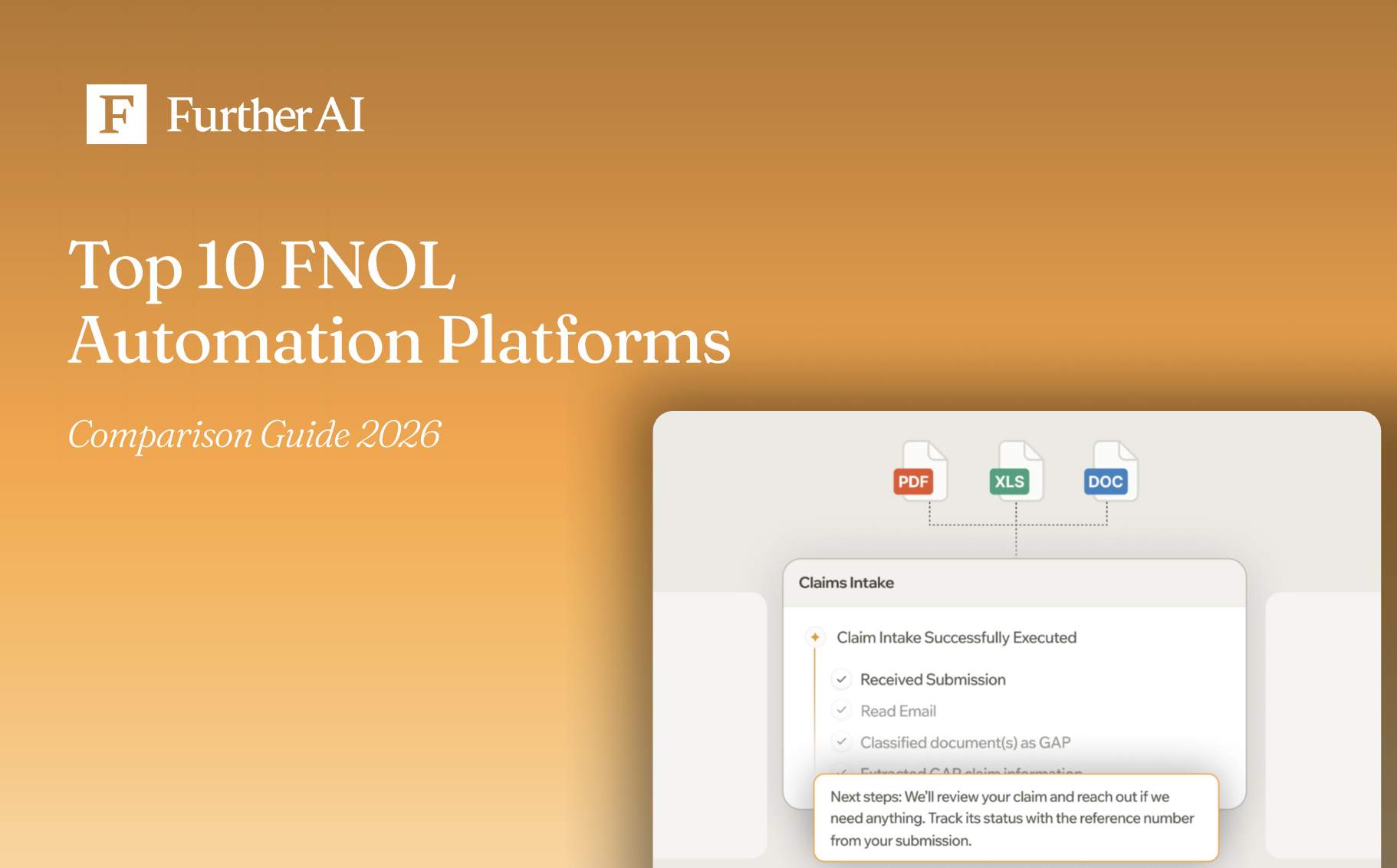
This guide compares ten platforms that help carriers, MGAs, TPAs, and brokers process first notice of loss faster and more accurately in 2026 — with published pricing, certifications, and measured deployment results.
FNOL automation is now one of the most direct ways to cut manual workload and raise claims throughput. McKinsey's analysis of AI in insurance, published 23 July 2026, reports domain-level transformations already producing reductions of 20 to 40 percent in customer onboarding costs and improvements of 10 to 20 percent in agent productivity, with AI leaders delivering roughly six times the total shareholder return of laggards; its earlier work put automation's effect on the cost of a claims journey at as much as 30 percent. With agentic AI and orchestration design converging, MGAs and Third-Party Administrators (TPAs) can reach measurable ROI in under 90 days.
This is a buying guide. If you need to design the intake workflow itself — pillars, controls, governance, KPIs — start with our AI claims intake framework. Below: ten platforms, the capability checklist to evaluate them against, what carriers measure in production, and what compliance now requires.
What changes when FNOL is automated
FNOL is the initial report filed after a covered event — the moment raw, unstructured information (emails, ACORDs, PDFs, photos, voicemails, broker notes) has to become a structured, validated claim file that can be triaged, reserved and routed. The fastest implementations replace inbox-and-rekeying workflows with four building blocks:
- Unified digital ingestion. One intake layer consolidating email, broker portals, voice calls, mobile submissions and partner APIs into a normalized stream, eliminating duplicate entry across claims, policy and document management systems.
- Document intelligence. LLMs and specialized document AI parse ACORDs, loss runs, police reports, repair estimates, medical bills and SOVs into structured fields. This is the hardest layer in commercial lines and where platform capability varies most — our deep-dive on AI tools that process unstructured claim documents and photos covers how to test it.
- AI triage and routing. Rules plus ML scoring assign claims by severity, complexity, coverage match, geography and fraud risk, so high-severity files reach senior adjusters in minutes rather than sitting in a queue.
- Orchestration into core systems. A lightweight integration layer writes structured FNOL data into claims, policy admin, document management and BI without rip-and-replace.
Manual vs. AI-powered FNOL intake, at a glance
Accenture describes the same shift: with AI and generative AI "claims can be assessed and resolved quickly, dropping the aggregate cycle time from days to minutes." The most-cited data point belongs to Lemonade — per its own shareholder reporting, claims bot AI Jim handled FNOL for 96 percent of claims without human intervention as of December 2025, with roughly 55 percent automated end to end. That is a personal-lines, self-reported figure on a purpose-built digital stack: a ceiling to reason about, not a commercial-lines benchmark.
Why fraud screening belongs at intake
Moving fraud detection to FNOL rather than investigation is one of the clearest arguments for automating intake. Deloitte's April 2025 analysis puts detection rates at 20 to 40 percent for soft fraud and 40 to 80 percent for hard fraud, and projects P&C insurers integrating multimodal AI could save $80–160 billion by 2032. A 2022 Coalition Against Insurance Fraud study put total U.S. insurance fraud at $308.6 billion a year.
LexisNexis Risk Solutions research published in 2023 found the same split between tiers: top-20 carriers "predominantly find identity-related fraud at First Notice of Loss," while carriers ranked 21–50 find it at investigation — "a key difference between industry leaders and laggards." Do it at intake, or pay for it downstream; for the detection layer itself see our comparison of claims leakage and fraud detection software for carriers.
One caveat: the fraud surface is moving. Verisk's March 2026 State of Insurance Fraud Study found 98 percent of insurers agree AI editing tools are fuelling a rise in digital media fraud, while only 32 percent feel very confident identifying deepfakes.
FNOL automation platform comparison
The ten platforms in detail
1. FurtherAI
FurtherAI is a modular, orchestration-led platform purpose-built for commercial insurance. Its agentic architecture ingests FNOL submissions from web, email and voice under full audit and compliance controls, connecting to Guidewire, Duck Creek, Majesco, Salesforce, Microsoft Dynamics, Applied Epic, AMS360, Sagitta and EZLynx, with SOC 2 Type II, ISO 27001, HIPAA and GDPR. FurtherAI clients report 30× faster submissions and 200%+ efficiency gains, with up to 400% ROI within months on policy comparison. The company raised a $25M Series A led by Andreessen Horowitz in October 2025.
Best for: Commercial insurers, MGAs, wholesalers and brokers wanting FNOL handled as one piece of a broader AI workforce — submission intake, audit, proposal generation — not a bolt-on voice tool.
Where it falls short: If the problem is purely "answer the phone and take a report," a voice specialist like Liberate, Infer or Sonant deploys faster. Personal lines and very small teams will find it over-scoped.
"Implementing FurtherAI has been game-changing — faster turnarounds, higher accuracy, and a platform we can keep expanding." — Laurie Flanagan, Group CIO, Leavitt Group
2. Bevaya (formerly Roots Automation)
Bevaya launched 28 May 2026 to replace the earlier Roots platform. The naming matters for contracts: Bevaya is the platform and go-forward brand, while the legal entity remains Roots Automation, Inc. It sells a library of named agents rather than one product — FNOL/FROI Setup captures first notice of loss and first report of injury details and creates the claim file; Claim Indexing classifies and routes documents; others cover legal demand extraction, claim-to-policy comparison and medical bill extraction. Its model, InsurGPT, is an ensemble trained on 300M+ insurance documents. Bevaya is the only vendor here publishing a per-agent rate card, from $4,000 per agent per month, and states SOC 2 Type 2, HIPAA, GDPR, CCPA and 23 NYCRR 500 — the strongest posture in this table.
Best for: Carriers, brokers, MGAs and TPAs with document-heavy intake, particularly anyone handling workers' comp FROI alongside P&C, who want a price before the sales call.
Where it falls short: No evidence of a live voice agent — intake is email, portal and documents, so ask what "phone" means in their materials. No SMS or chat. Integrations are short (Guidewire, Duck Creek, Salesforce, Outlook, Teams, Slack, SFTP) with no agency management system, and its best numbers — 246% ROI in six months, 99% no-touch — come from an unnamed "Fortune 500 carrier."
3. Liberate
Liberate builds reasoning AI agents — its assistant is named Nicole — across voice, SMS, email and digital self-service. It is explicitly FNOL-native: the platform completes FNOL end-to-end and writes back to the claims core, producing the same structured output whichever channel the loss arrived through, with identity verification, vendor dispatch, document requests and warm transfer. Response time is stated as under one second. Its integration list is the deepest of the voice-first vendors — fourteen named systems including Guidewire, Duck Creek, Snapsheet, Applied, Verisk, CCC, CoreLogic, EZ Lynx, Vertafore, Insuresoft, FiveSigma and TurboRater. Allied Trust went live in six weeks; at Branch Insurance, average claim-filing time is about 7 minutes 10 seconds against roughly 12 minutes 23 seconds through an outsourced call centre. Liberate raised a $50M Series B in October 2025 led by Battery Ventures, reportedly at a $300M valuation.
Best for: P&C carriers and agencies whose bottleneck is inbound contact volume across more than one channel; the connector breadth makes it easy to slot into an existing claims stack.
Where it falls short: A conversation layer, not a document engine — no published ACORD, loss-run or medical-bill extraction depth, and downstream claims work is out of scope. It states SOC 2, HIPAA, PCI and GDPR but does not publish a SOC 2 type — worth asking for. No CCaaS platform in its integration directory, and no published pricing.
4. Sonant AI
Sonant AI is turnkey voice automation for independent P&C agencies and brokers, offloading inbound call volume — quote intake, policy questions, scheduling, FNOL capture — without an IT project. Its multilingual receptionist supports 10+ languages with mid-call switching, performs live policy lookups and writes structured data back to the AMS in real time. Sonant reports a 43% productivity increase at one named agency, Cornerstone Insurance Services, from cutting 25–30% of routine workload. It is an Applied Certified Vendor Integration, SOC 2 Type 2 and GDPR compliant.
Best for: Independent P&C agencies wanting production-ready voice AI across FNOL, policy questions and quote intake.
Where it falls short: Positioned for agencies specifically — the company points carriers, MGAs and wholesalers elsewhere. Voice-first rather than omnichannel, usage-based pricing climbs at volume, and it does not touch underwriting judgment or adjudication.
5. Strada
Strada is an omnichannel AI platform spanning voice, email, chat and SMS, covering policy servicing, claims status, renewals and quote follow-up beyond FNOL. What separates it from voice-only tools is governance: quality assurance, escalation rules and audit trails are built into the workflows rather than bolted on. Strada is SOC 2 Type II certified and describes itself as GDPR Ready; its integrations logo wall shows Salesforce, Five9, Genesys, Twilio, Zendesk, NICE, Talkdesk and Amazon Connect, though it publishes no detailed integration documentation. The company was part of Y Combinator's Summer 2023 batch.
Best for: Carriers, MGAs and wholesalers needing FNOL across more than one channel with the audit trail a regulated claims environment demands.
Where it falls short: A younger company with a short published integration list — Liberate names considerably more core systems. Document-heavy commercial FNOL still needs document intelligence alongside it.
6. Five Sigma (Clive)
Five Sigma's Clive is an "AI claims adjuster" for P&C insurers, MGAs, TPAs and self-insureds, orchestrating agents across intake, triage, liability, coverage, fraud detection, communications, compliance and settlement. Five Sigma reports Clive Intake accelerates claim initiation by up to 75% and Clive Triage cuts delays and reassignments by up to 35%; at platform level it claims 70% fewer human errors, 33% higher adjuster productivity and 92% accuracy. A December 2024 release also claimed over 90% reduction in pet-insurance handling time — a capability claim with no customer named against it. Specialty insurer Starr adopted the platform in January 2026.
Best for: Insurers, MGAs and TPAs with an established claims management system wanting to extend AI across the full claims lifecycle.
Where it falls short: Claims-heavy and overkill if the job is answering the phone. Value depends on integration with a claims management system, so implementation effort is non-trivial and teams without a core platform face a longer ramp.
7. Infer
Infer is a voice AI platform for insurance phone workflows — quote intake, FNOL, renewals, endorsements and appointment booking. Its published integration list names Five9, Genesys and Amazon Connect among others; AgencyZoom and RingCentral appear in a customer case study rather than the integration list. Infer was part of Y Combinator's Summer 2021 batch and is tuned for MGAs and lead-generation operations rather than retail-agency reception.
Best for: Mid-market operators — MGAs, agencies and lead-gen companies — wanting a voice-first product pointed at insurance workflows without enterprise contact-centre cost.
Where it falls short: Smaller company and narrower footprint than FurtherAI or Liberate, and its site names no integration with EZLynx, Applied Epic, HawkSoft or AMS360. Voice-first, so document-heavy FNOL needs an extraction tool alongside.
8. Synthflow
Synthflow is a horizontal, general-purpose no-code voice AI platform. Not built for insurance, it can be configured for FNOL intake: its drag-and-drop Flow Designer handles telephony, voicemail detection, SMS follow-ups and live-agent handoff, with integrations into HubSpot, Salesforce, Twilio, Zapier and major contact-centre platforms. Note that Synthflow has moved upmarket and retired its self-serve tiers — Enterprise is now the only plan, from $30,000 annually. It raised a $20M Series A led by Accel in June 2025.
Best for: Ops teams wanting a fast FNOL pilot on voice AI before committing to an insurance-focused vendor — though the entry price is no longer low.
Where it falls short: No insurance templates: no ACORD awareness, policy-system integrations or claims taxonomy. Reviewers repeatedly note agents struggle when callers go off-script, a common reality in emotional FNOL calls.
9. LlamaParse
LlamaParse, part of LlamaCloud, is an agentic document parser and a strong developer-first option for turning insurance documents into structured data, extracting from PDFs, ACORD forms, images and bundled attachments with citations back to source. Pricing is credit-based at $1.25 per 1,000 credits, with 10,000 free, $50/month for 40,000 (Starter) and $500/month for 400,000 (Pro). Four v2 accuracy tiers consume different credits per page: Fast (1), Cost-effective (3), Agentic (10) and Agentic Plus (45). It is SOC 2 Type II, HIPAA and GDPR compliant.
Best for: Engineering and data teams embedding document parsing into an existing claims or underwriting pipeline via API, with auditable, citation-backed JSON output.
Where it falls short: A parsing engine, not a workflow platform — no no-code UI, no voice channel, no claims orchestration, and ops teams cannot pick it up without engineering help. Credit consumption on Agentic Plus needs watching at scale.
10. V7 Go
V7 Go turns PDFs, scanned loss reports, policy documents and images into structured claim data with visual grounding: every extracted data point links back to its exact location in the source, backed by a dedicated visual grounding agent and citation feature. It is SOC 2 Type II and ISO 27001 certified, and HIPAA and GDPR compliant. Pricing is quote-only — base fee plus users plus data volume.
Best for: Underwriting and claims operations teams with document-heavy FNOL — commercial property, marine, large-loss, or any line where loss runs, incident reports or surveys drive the intake effort.
Where it falls short: An extraction layer, not an end-to-end claims system; teams still need orchestration on top to route the claim, notify the insured and update core records. V7 now leads with finance and private markets alongside insurance, so insurance roadmap depth is thinner than an insurance-native platform's.
Capability checklist for commercial-grade FNOL platforms
Commercial claims are harder than personal lines: more documents per file, more line-item variation, more compliance touchpoints. The platforms that hold up share five capabilities.
- Document intelligence tuned to insurance. ACORDs, SOVs, loss runs, certificates of insurance, surveyor reports, police and medical records — not generic OCR.
- Multi-modal intake. Email, broker portal, voice, mobile photo and video, partner API.
- Schema-aware orchestration. Maps extracted fields into the carrier's claims system schema with provenance and audit trails.
- Human-in-the-loop controls. Confidence-thresholded escalation, with citation back to source page and line for every extracted field.
- Compliance posture. SOC 2 Type 2, ISO 27001, HIPAA and GDPR, plus alignment with the NAIC Model Bulletin.
A practical note on the first two: almost no platform here is strong at both. The voice-first vendors own the conversation but not the document; the document engines own the file but not the call. Insurance-native workspaces attempt both. Decide which is your actual bottleneck before shortlisting.
What "best" looks like for commercial FNOL summary creation
FNOL summary creation — the structured narrative an adjuster reads to open a claim — is where AI delivers the most concentrated value. A good tool ingests every artifact attached to a notice, extracts the underwriting-relevant facts and produces a uniform briefing with citations back to source.
The available options fall into four categories, and the distinction matters more than the brand names:
- Insurance-native AI workspaces. Purpose-built for carriers, MGAs, and TPAs, combining document AI, LLM reasoning, orchestration, and audit logging in one compliance-first stack. Recommended for commercial claims.
- General-purpose document extraction APIs. Cloud OCR plus LLM extraction can turn PDFs into JSON, but carriers must build their own validation, citation, governance, and routing layers — increasing time-to-value and audit risk.
- RPA and workflow orchestrators. Useful for connecting systems and triggering notifications, but they do not interpret unstructured content. Pair them with dedicated document AI.
- No-code AI agents for customer-facing FNOL. Effective for guided 24/7 intake and status updates, but limited on complex commercial nuance without human-in-the-loop escalation.
Measured results from commercial deployments
Vendor benchmarks are easy to find; deployment numbers are not. These are FurtherAI's own reported results — self-reported, as all vendor case-study figures are, but tied to specific carrier profiles rather than modelled projections.
Specialty insurer, 3,000+ commercial claims a year. Moved from roughly 0% to over 90% automation of initial intake: more than $360,000 saved annually, approximately 568% ROI, 2.5 hours of human time saved per claim and 7,500 labor hours reclaimed each year. The full FurtherAI Claims Processing customer story sets out the workflow.
Top-10 global carrier, $20B+ GWP, Large Property. Cut SOV intake from 1–5 days to under 10 minutes, including SOVs with 50,000+ locations, at over 95% field-level accuracy at go-live rising to 97% within six months, and 646% ROI.
Top-tier U.S. MGA, $1.5B+ premium, 20+ programs. Submissions clearance dropped from roughly 32 minutes to about 1 minute — 30× faster — with 99%+ data accuracy and a 200%+ underwriting efficiency gain in three months.
Regional carrier, FNOL voice intake. Distinguished claims calls from roadside assistance in real time, automating 50% of inbound calls and producing structured claim files with full transcripts, driving $600K in annual savings per operation.
Faster intake only pays off if the gain survives downstream — our guide to speeding up claims settlement covers where time is lost again after triage. For context, J.D. Power's 2026 U.S. Property Claims Satisfaction Study found satisfaction up 20 points to 702 on a 1,000-point scale, on faster repair cycle times (29.6 days, down 2.8) and shorter time to final payment (40.7 days, down 3.4), with digital-tool utilisation at FNOL reaching 38%. (The study was redesigned for 2025, so scores are not comparable with earlier editions.)
Compliance, governance, and the 2026 regulatory picture
Speed without controls creates new exposure. Three pillars keep fast FNOL safe. Single source of truth: unified ingestion plus lightweight orchestration writes once to the claims system of record, every field traceable to source page and line — which supports the NAIC Model Bulletin's expectation that insurers can produce documentation about AI development and use during an investigation or market conduct exam. Targeted AI, not blanket automation: use AI to enrich, classify and triage, reserving human review for complex, high-severity and edge cases; Deloitte's September 2025 research highlights adjuster soft skills, not technology availability, as the real differentiator. Model governance from day one: versioning, drift monitoring, explainability logs and bias testing are baseline expectations, and our complete guide to AI governance in insurance covers standing this up before an examiner asks.
What the NAIC bulletin actually says
The NAIC Model Bulletin: Use of Artificial Intelligence Systems by Insurers was adopted 4 December 2023. It is guidance rather than binding rule — insurers are "expected to" rather than required to — but it is the reference document regulators work from, expecting a written AI Systems Program, senior management accountable to the board, testing to identify errors and bias, and documentation available on request. As of the NAIC's adoption map dated 1 April 2026, 24 states plus the District of Columbia have adopted it; California, Colorado, New York and Texas maintain their own insurance-specific AI regulation instead.
The NAIC AI Systems Evaluation Tool. In March 2026 the NAIC launched a pilot with 12 state regulators running through September 2026, applying a structured AI evaluation across market conduct exams, financial exams and financial analyses, targeted for possible adoption at the Fall 2026 National Meeting. This is the operational instrument behind the bulletin, and carriers deploying FNOL automation should assume their intake models will be examined against it.
Colorado. Regulation 10-1-1, amended effective 15 October 2025, extended ECDIS and AI governance obligations beyond life insurance to private passenger auto and health benefit plan insurers, with quantitative testing for unfair discrimination. Full compliance was required from 1 July 2026.
Compliance checklist for AI-driven FNOL
- End-to-end audit trails on data changes and decisions
- Real-time validation of coverage, completeness, and fraud indicators
- Role-based access, PII encryption, and retention policies
- Human-in-the-loop approvals for exceptions and high-severity cases
- Versioning, drift monitoring, and explainability logs on every model
- SOC 2 Type 2, ISO 27001, HIPAA, and GDPR alignment in the vendor
Choosing the best FNOL automation platform in 2026
Match automation scope to business complexity:
- Voice-first and omnichannel intake (Liberate, Sonant AI, Strada, Infer) — quickest deployment, best where the bottleneck is inbound contact volume. Liberate has the deepest core-system connectors; Sonant is agency-only; Strada leads on built-in governance.
- Orchestration-led (FurtherAI) — for broader transformation across submission intake, claims, audit and reporting.
- Agent-library (Bevaya) — for buying specific automations rather than a platform, especially where workers' comp FROI sits alongside P&C.
- Claims-lifecycle (Five Sigma) — for teams with an established claims management system extending AI end to end.
- Document intelligence (LlamaParse, V7 Go) — for document-heavy commercial intake, embedded via API or used as an extraction layer.
- Horizontal voice (Synthflow) — prototyping only; no insurance templates.
Segment matters as much as capability. Brokers should start with our guide to secure, verifiable claims intake for brokers; TPAs running adjudication as well as intake should see the best AI for claims processing and adjudication at TPAs.
Before purchasing: benchmark time-to-first-action and field-level accuracy against your own baseline, not vendor marketing; prioritise existing AMS, CRM and policy-admin integrations, since integration effort usually determines time to value; confirm SOC 2 Type II and, where applicable, ISO 27001 and HIPAA, noting that not every vendor here specifies a type; and ask how the vendor will support an AI Systems Evaluation Tool review.
A phased adoption roadmap
- Phase 1 — Assess (4–8 weeks). Map current intake handoffs and rekeying hotspots; benchmark cycle time, accuracy, and straight-through-processing rate; define target-state architecture.
- Phase 2 — Pilot (8–12 weeks). Deploy unified ingestion plus document intelligence on one high-volume commercial line. Measure cycle-time reduction, accuracy, and adjuster time saved.
- Phase 3 — Scale (3–6 months). Expand orchestration across core systems. Harden governance, model monitoring, and broker enablement.
- Phase 4 — Enterprise rollout. Standardize KPIs, certify outputs, publish broker-facing service levels.
This sequence is consistent with McKinsey's Claims 2030 work, which sets out five areas of focus: empowering the claims workforce, redefining proactivity, reimagining the insurer's role through prevention, evolving the claims ecosystem, and transforming talent.
Frequently asked questions
FurtherAI's insurance-native AI handles structured extraction from loss runs, ACORD forms, and broker emails, then plugs directly into systems like Guidewire and Duck Creek. Schedule a demo to see how your claims team can compress FNOL from hours to minutes.
REFERENCES
Accenture. "Insurance Claims." accenture.com
Bevaya. "AI Agents for Claims Automation." bevaya.ai
Bevaya. "Pricing." bevaya.ai
Bevaya. "Trust." bevaya.ai
Coalition Against Insurance Fraud. "The Impact of Insurance Fraud on the U.S. Economy." (2022) insurancefraud.org
Colorado Division of Insurance. "Regulation 10-1-1: Governance and Risk Management Framework Requirements for Insurers' Use of External Consumer Data and Information Sources, Algorithms, and Predictive Models." doi.colorado.gov
Deloitte. "Property and Casualty Carriers Can Win the Fight Against Insurance Fraud." (April 2025) deloitte.com
Five Sigma Labs. "Clive." fivesigmalabs.com
FurtherAI. "Customers." furtherai.com
FurtherAI. "FurtherAI Launches Connectors: One Workspace, Every Insurance System." furtherai.com
FurtherAI. "Security and Compliance." furtherai.com
Insurance Business. "AI Is Accelerating in Insurance — Are You Ready?" (April 2026) insurancebusinessmag.com
J.D. Power. "2026 U.S. Property Claims Satisfaction Study." jdpower.com
LexisNexis Risk Solutions. "Combating Insurance Digital Identity Claim Fraud with a Multilayered Approach." risk.lexisnexis.com
LexisNexis Risk Solutions. "Identity and Access Management in Claims Study." (May 2023) risk.lexisnexis.com
Liberate. "Integrations." liberate.ai
Liberate. "Liberate Raises $50M to Build the First-Ever Reasoning AI Agents for Insurance." (October 2025) globenewswire.com
Liberate. "Platform." liberate.ai
LlamaIndex. "LlamaParse Pricing." developers.llamaindex.ai
McKinsey & Company. "Claims 2030: Dream or Reality?" mckinsey.com
McKinsey & Company. "How AI Will Reshape the Economics of Insurance: A CEO's Guide to Strategy." (July 2026) mckinsey.com
McKinsey & Company. "Time for Insurance Companies to Face Digital Reality." mckinsey.com
National Association of Insurance Commissioners. "AI Model Bulletin Adoption Map." (August 2026) content.naic.org
National Association of Insurance Commissioners. "Model Bulletin: Use of Artificial Intelligence Systems by Insurers." content.naic.org
PR Newswire. "Roots Automation, Inc. Launches Bevaya, Its New Flagship AI Agent Platform for Insurance." (May 2026) prnewswire.com
Sonant AI. "AI Voice Agents for Insurance Agencies." sonant.ai
Strada. "Trust Center." trust.getstrada.com
Synthflow. "Pricing." synthflow.ai
TechCrunch. "Liberate Bags $50M at $300M Valuation to Bring AI Deeper into Insurance Back Offices." (October 2025) techcrunch.com
V7 Labs. "Security." v7labs.com
V7 Labs. "V7 Go." v7labs.com
Verisk. "State of Insurance Fraud Study." (March 2026) verisk.com
Y Combinator. "Infer." ycombinator.com
DISCLAIMER
This article is for general informational purposes only and does not constitute legal, regulatory, compliance, underwriting, or other professional advice. The content reflects information available as of the date of publication, and FurtherAI undertakes no obligation to update it as laws, regulations, or AI technologies evolve.
Recent posts
%20(2).png)
Ready to go further and
transform your insurance ops?
Reclaim your time for strategic work and let our AI Assistant handle the busywork. Schedule a demo to see how you can achieve more, faster.




.svg)