FurtherAI Available in Microsoft Marketplace
Introducing Connectors



The Definitive Framework for Secure, AI‑Powered Claims Intake

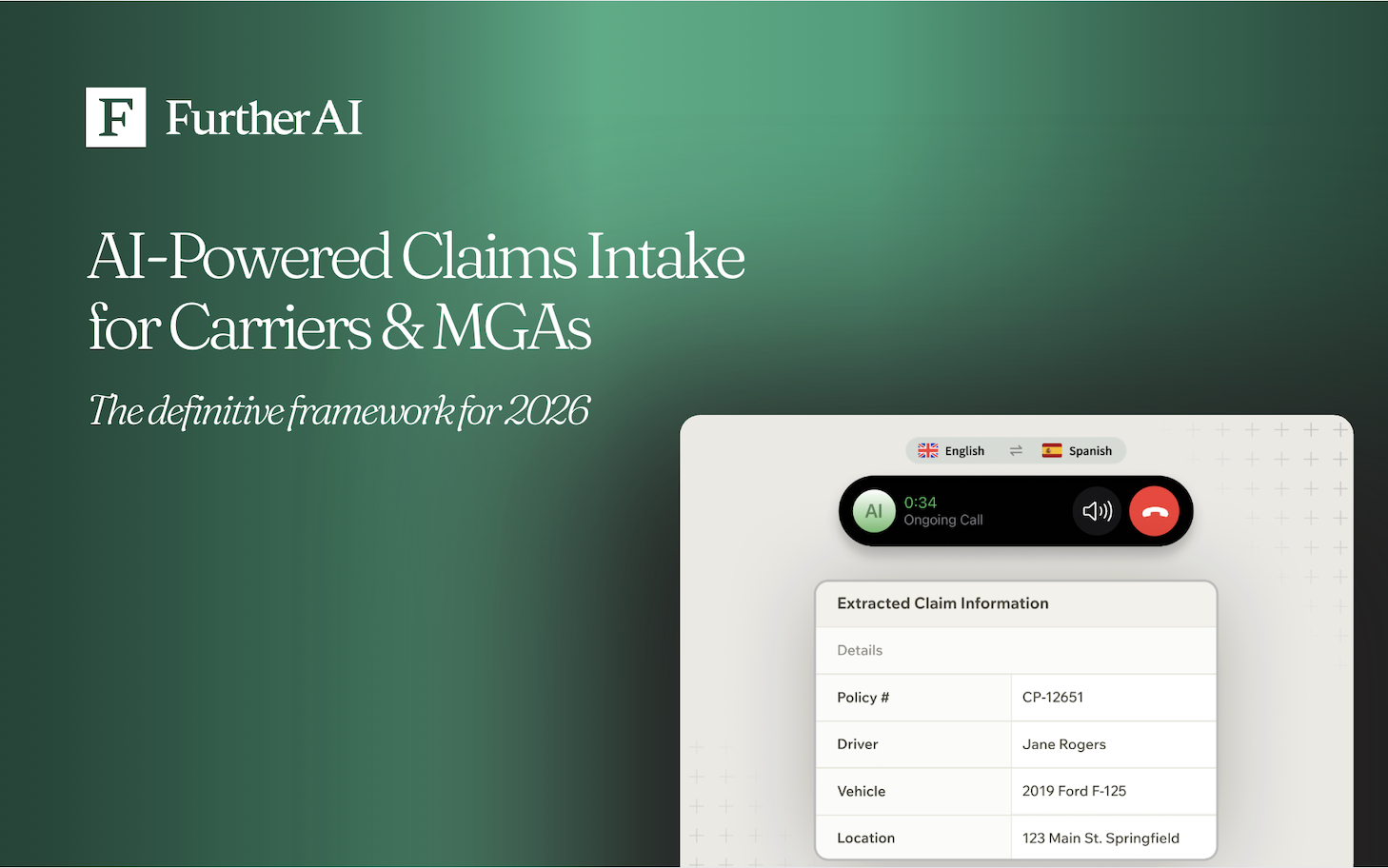
AI-powered claims intake uses large language models (LLMs) and machine learning to capture First Notice of Loss (FNOL) across channels, turn unstructured files into structured data, triage and route claims, and keep a full audit trail with human review. Done well, it shortens cycle times, lowers handling costs, and strengthens compliance — all without handing high-stakes decisions to a black box.
This guide lays out the five-part framework we use at FurtherAI to deploy secure claims intake for carriers, managing general agents (MGAs), and brokers, the four categories of solution you can build it on, the data behind each step, and a practical rollout checklist you can follow.
Key takeaways
- Claims intake is the bottleneck worth fixing first. Bain & Company estimates generative AI could reduce P&C claims loss-adjusting expenses by 20–25% and cut total leakage by 30–50%, producing more than $100 billion in economic benefits globally — shared between insurer profits and lower customer rates. McKinsey has projected that routine, predictable claims, about 60% of future volume, may be suited for digital resolution.
- Digital experience drives satisfaction. Digital reporting has overtaken the phone as the most satisfying way to file a claim, and pushing customers across more than one channel costs more than 100 points of satisfaction. Yet insurers deliver adequate digital status updates just 22% of the time.
- A secure framework has five pillars: multichannel FNOL, data capture and normalization, intelligent triage, fraud detection, and governance with auditability.
- Four categories of solution can deliver it, and they are not interchangeable: insurance-native AI workspaces, document-extraction APIs, workflow and integration orchestration platforms, and conversational intake agents. Each trades away something specific, and three of the four struggle with commercial-lines document volume.
- The results are measurable. One specialty insurer using FurtherAI's Claim Intake reached over 90% automation, more than $360K in annual savings, and 10x faster processing (FurtherAI Claims Processing customer story).
What is AI-powered claims intake, and how does it work?
AI-powered claims intake is the automated capture, structuring and routing of new claims using machine learning and language models. It collects FNOL across web, mobile, voice and broker channels, normalizes data from emails, PDFs, photos and handwritten notes, and escalates anything sensitive to a human adjuster. Five steps:
- Capture the first notice from any channel — web, mobile, voice, SMS, email or broker API.
- Extract and normalize fields from unstructured files into a consistent schema via OCR and IDP.
- Validate against the policy and coverage record, requesting missing documents automatically.
- Score and triage for complexity and fraud risk, then tag the specialty.
- Route with an audit trail — clean claims straight through, sensitive ones escalated, every action logged.
The problem is structural. At one specialty insurer, 98% of claim workflows were fully manual and initial intake alone consumed roughly 2.5 hours per claim — about 7,500 labor hours a year across 3,000-plus claims.
How carriers and MGAs automate claims intake with AI
Carriers and MGAs deploy the five-pillar workflow below, starting with one high-volume line and expanding once accuracy is proven. Target initial intake first, where the work is repetitive and rules-based.
Priorities differ by role: carriers standardize intake across channels to expand capacity without headcount; MGAs prioritize audit-trailed extraction and appetite-aligned routing to scale binding authority; brokers submit complete, validated files first time. The specialty insurer above went from near-zero automation to more than 90%, cutting 2.5 hours per claim and reaching roughly 568% ROI.
Core components of a secure claims intake framework
A trustworthy framework balances speed with control across five pillars. Each one maps to a specific risk: incomplete data, messy files, misrouting, fraud leakage, and regulatory exposure.
Top performers treat intake as a decision intelligence problem, not data entry: human-in-the-loop gates on high-risk decisions, audit trails, synthetic-data testing before go-live.
Multichannel First Notice of Loss capture
How a claim starts shapes how fast it closes. In J.D. Power's 2024 U.S. Claims Digital Experience Study, digital reporting overtook the phone as the most satisfying way to file, while roughly one customer in five used more than one channel to get a question answered — costing over 100 points of satisfaction. The 2025 study found insurers deliver adequate digital status updates just 22% of the time. (It was redesigned for 2025, so the editions are not comparable.)
A strong channel mix spans adaptive web and mobile smart forms, conversational AI over voice and SMS, and APIs ingesting broker submissions from core systems. For a vendor-level view, see our first notice of loss (FNOL) automation comparison.
Data capture and normalization technologies
Two technologies do the heavy lifting: optical character recognition (OCR), converting typed or handwritten text into machine-readable text, and intelligent document processing (IDP), which classifies documents, extracts fields and applies validation rules.
EY's work shows both payoff and ceiling: using OCR and NLP for a Nordic insurer, 70% of documents were correctly extracted. Three in ten still needed a human — plan for the remainder. Match the file type to the right approach:
Intelligent triage and routing
Complexity scoring routes each claim to the right handler, reserving human expertise for high-risk cases. Score complexity and risk, tag the specialty, then route: below threshold to straight-through processing, borderline or high-value to an adjuster with reasons, regulatory-sensitive to a compliance hold.
The payoff is cycle time, and the relationship is continuous rather than cliff-edged: J.D. Power's 2025 auto claims study found average repairable-vehicle cycle time falling from 22.3 to 19.3 days, contributing to a nine-point satisfaction improvement.
Fraud detection and authenticity verification
Machine learning flags suspicious patterns, inconsistencies, and forged documents for Special Investigation Unit review — reducing leakage without burdening honest claimants.
P&C-specific numbers depend on the basis used. The Coalition Against Insurance Fraud's 2022 study put total U.S. insurance fraud at $308.6 billion a year, of which the Insurance Information Institute attributes roughly $45 billion to property and casualty; Deloitte, assuming 10% of P&C claims are fraudulent, arrives at $122 billion. Treat the range as the honest answer. Deloitte projects insurers integrating multimodal AI across the claims lifecycle could save $80–160 billion by 2032.
Common controls: anomaly detection on amounts, timing and frequency; image and video forensics with metadata checks; duplicate and cross-template checks; fraud database enrichment. One caveat — AI is now a fraud vector too. Verisk's March 2026 State of Insurance Fraud Study found 98% of insurers agree AI editing tools are fuelling digital media fraud, while only 32% feel very confident identifying deepfakes.
Governance, auditability, and compliance controls
Every automated decision must be logged, explainable and reviewable, and regulators now expect it. The NAIC adopted its Model Bulletin on the Use of Artificial Intelligence Systems by Insurers on 4 December 2023; as of its adoption map dated 6 August 2026, 24 states plus the District of Columbia have adopted it, while California, Colorado, New York and Texas maintain their own insurance-specific AI regulation. It is guidance rather than binding rule: insurers are "expected to" maintain a written AI Systems Program built on transparency, fairness and accountability.
Recommended controls: audit trails with reason codes; role-based access, SSO and MFA; immutable time-stamped logging; documented appeal pathways; and annual attestations such as SOC 2 Type II. Our AI governance for insurance teams guide covers standing this up before an examiner asks.
What type of claims intake solution do you need?
The five pillars describe what has to happen. This is about what kind of thing you buy to make it happen — a question most buying guides skip. Four categories can deliver parts of the framework. They sit at different layers and fail in different places, and choosing the wrong category is a costlier mistake than choosing the wrong vendor within one.
Insurance-native AI workspace
Examples: FurtherAI, Bevaya, Five Sigma (Clive).
Purpose-built for insurance: document AI, LLM reasoning, orchestration and audit logging in one stack. FurtherAI covers submission and claims intake, SOV mapping, tower analysis and policy comparison, with SOC 2 Type II, ISO 27001, HIPAA and GDPR. Bevaya — the platform and go-forward brand of Roots Automation, Inc., launched May 2026 — sells named agents across underwriting, claims and policy servicing, adding CCPA and 23 NYCRR 500. Five Sigma's Clive differs structurally: a claims system of record with a multi-agent layer that can also overlay an existing system.
What you give up: portability. You adopt the vendor's opinion of what a claim file is — schema, thresholds, audit format — and cannot swap the pieces out. These are venture-stage companies holding your regulatory audit trail, and none publishes pricing.
Where it breaks down in commercial lines: coverage turning on endorsement interplay, layered towers and manuscript wordings. All three deliver assistive reasoning with citation, not determination — the audit trail proves what the model read, not that the conclusion is right.
General-purpose document-extraction API
Examples: Amazon Textract, Google Document AI, Azure Document Intelligence (currently Azure Document Intelligence in Foundry Tools; formerly Azure AI Document Intelligence, and before that Form Recognizer). LLM-native challengers include LlamaCloud and Reducto.
Documents in, structured JSON out, at transparent per-page rates: roughly $1.50 per 1,000 pages for basic OCR, $30–$50 for forms and key-value extraction, about $30 for custom models. Azure's rates are calculator-based.
What you give up: everything downstream of extraction. You get JSON — not a decision, a routing rule, a citation tied to a claim record, or an audit trail an examiner would accept. This is a build: a standing engineering function for schema, exceptions, routing and logging, plus your own accuracy harness, since no vendor publishes accuracy figures for insurance forms.
Where it breaks down in commercial lines: the sharpest mismatch of the four.
- No insurance models ship prebuilt. You get invoice, receipt, ID, W-2, bank statement, passport — no ACORD, loss run, SOV or certificate of insurance. Each is a custom model trained on data you label.
- The page is the wrong primitive. A commercial claim file is 300–500 mixed pages: you classify and split before extracting.
- SOVs break the model outright. You pay per page to reconstruct a spreadsheet that arrived as a spreadsheet.
- Loss runs have no standard. Extraction is not one custom model but n, growing with each incumbent carrier.
- Reconciliation is yours. Does the SOV total match the ACORD 125? These APIs read documents in isolation; commercial insurance lives in the contradictions between them.
Workflow and integration orchestration
Examples: UiPath, Automation Anywhere, SS&C Blue Prism.
Formerly RPA; Gartner now classes the enterprise end as Business Orchestration and Automation Technologies, with an inaugural Magic Quadrant in October 2025.
The old criticism — that these move data but cannot interpret unstructured content — no longer holds. Gartner's BOAT definition makes unstructured document extraction mandatory for inclusion. UiPath's IXP targets unstructured emails, contracts and 100-page reports with field-level source attribution; Automation Anywhere ships Document Automation and AI Agent Studio; SS&C Blue Prism brought Decipher IDP under WorkHQ in April 2026. UiPath and Automation Anywhere both market insurance offerings including ACORD processing.
What you give up: determinism. RPA's value was that the bot did the same thing every time and you could prove it; switch on the generative layer and you trade that for probabilistic behaviour with no insurance-specific ground truth, at the highest ongoing headcount of the four.
Where it breaks down in commercial lines: economics, not technology. A bot amortises across 50,000 identical personal-auto FNOLs, not 300 commercial property claims a year with a different document set each time. They earn their place as connective tissue — broker email in, Guidewire out — not as intake interpretation.
Conversational intake agent
Examples: Liberate, Strada, Sonant AI.
Agents capturing FNOL through guided conversation across voice, SMS, chat and web. Liberate has the widest segment reach — carriers, agencies, brokers, TPAs and MGAs — with an FNOL agent that verifies responses against core systems. Strada spans voice, email, chat and SMS, with SOC 2 Type II and audit trails in the workflows. Sonant AI shows how sharply these differ: an AI receptionist for independent agencies that does not handle FNOL at all.
What you give up: documents, entirely. This is a conversation layer and it does not read the attachments — which in commercial insurance are the claim. Deployment is the lightest of the four, but you still own escalation design, call QA and integration mapping.
Where it breaks down in commercial lines: the channel assumption. Commercial FNOL is broker-mediated — an email with an ACORD form and a dozen attachments, not a phone call — and guided intake presumes a question tree commercial coverage triage does not have.
How to choose between them
Most commercial insurers end up with two of the four. Start with where your claims arrive, then decide whether you are buying an outcome or building a pipeline: insurance-native if your constraint is claims operations capacity, an extraction API if an engineering team will own it permanently. Treat orchestration as connective tissue, not the intake engine.
FurtherAI in action: claims intake outcomes
A specialty insurer with three straight years of 20%-plus premium growth deployed FurtherAI's Claim Intake to clear an intake bottleneck.
FurtherAI customers have also reached 30x faster submissions with 200%-plus efficiency gains, a 45% cut in underwriting audit time, and 646% ROI on property statement-of-values intake. Across the platform, FurtherAI has processed roughly $30 billion in premiums across 20-plus lines of business in 50 states.
Step-by-step implementation checklist
- Plan. Define target lines, volumes, SLAs and risk thresholds; map integrations and data governance.
- Configure. Enable FNOL channels; set up OCR, IDP, vector search and workflow rules.
- Build workflows. Triage thresholds, fraud checks and human-in-the-loop gates.
- Test. Validate accuracy, fairness and failure modes on synthetic data before go-live.
- Roll out. Pilot one line, measure KPIs, calibrate thresholds.
- Optimize. Expand coverage, monitor for drift, update governance.
Monitoring KPIs and continuous improvement
Review these monthly on a dashboard and quarterly in depth.
How to select the right AI claims intake solution
Once you have settled on a category, check four things: SOC 2 attestation — including the type — with audit trails, SSO, MFA and NAIC alignment; native connectors to your core claims suite and broker portals; extraction across PDFs, emails and images with confidence scoring and PII redaction; and configurable triage thresholds and human-in-the-loop gates.
Vendor-level comparisons by segment: our first notice of loss (FNOL) automation comparison covers ten platforms for carriers, MGAs and TPAs; secure, verifiable claims intake for brokers compares a different vendor set; and the best AI for claims processing and adjudication at TPAs covers administrators running adjudication too.
FurtherAI is purpose-built for commercial insurance and delivers on each through modular, integration-ready AI assistants, backed by a $25 million Series A led by Andreessen Horowitz.
Frequently asked questions
Ready to go further?
See how FurtherAI turns manual claims intake into a secure, automated workflow built for commercial insurance. Schedule a demo.
REFERENCES
Bain & Company. "A $100 Billion Opportunity for Generative AI in P&C Claims Handling." (October 2024) bain.com
Coalition Against Insurance Fraud. "The Impact of Insurance Fraud on the U.S. Economy." (2022) insurancefraud.org
Deloitte. "Property and Casualty Carriers Can Win the Fight Against Insurance Fraud." (April 2025) deloitte.com
EY. "How a Nordic Insurance Company Automated Claims Processing." (February 2024) ey.com
Five Sigma. "Clive." fivesigmalabs.com
FurtherAI. "Claims Processing Case Study." furtherai.com
Gartner. "Magic Quadrant for Business Orchestration and Automation Technologies." (October 2025) gartner.com
Insurance Information Institute. "Background on: Insurance Fraud." iii.org
J.D. Power. "2024 U.S. Claims Digital Experience Study." jdpower.com
J.D. Power. "2025 U.S. Claims Digital Experience Study." jdpower.com
McKinsey & Company. "Claims 2030: Dream or Reality?" mckinsey.com
National Association of Insurance Commissioners. "AI Model Bulletin Adoption Map." (August 2026) content.naic.org
National Association of Insurance Commissioners. "Model Bulletin: Use of Artificial Intelligence Systems by Insurers." content.naic.org
Roots Automation. "Roots Automation, Inc. Launches Bevaya, Its New Flagship AI Agent Platform for Insurance." (May 2026) prnewswire.com
UiPath. "Intelligent Xtraction and Processing (IXP)." uipath.com
Verisk. "State of Insurance Fraud Study." (March 2026) verisk.com
DISCLAIMER
This article is for general informational purposes only and does not constitute legal, regulatory, compliance, underwriting, or other professional advice. The content reflects information available as of the date of publication, and FurtherAI undertakes no obligation to update it as laws, regulations, or AI technologies evolve.
Recent posts

Ready to go further and
transform your insurance ops?
Reclaim your time for strategic work and let our AI Assistant handle the busywork. Schedule a demo to see how you can achieve more, faster.




.svg)