FurtherAI Available in Microsoft Marketplace
Introducing Connectors



What Underwriters Actually Need From Brokers Upfront: The Submission Prep Checklist

Most submission advice starts from the premise that nobody knows what underwriters want. The industry wrote the list down and published it, and has been issuing standard forms since 1971.
What the forms can't do is produce the documents their fields point at. A submission is the ACORD form set plus a stack you have to go and get: loss runs from the incumbent carrier, a schedule of values built to a cat modeller's specification, and evidence of security controls.
This page is the checklist for both halves: required data by line of business, what triggers a bounce-back, ten questions worth answering before you're asked, and the tooling that assembles it. Everything is sourced to the form, statute, or standard it comes from, so you can hand it to a producer without vouching for it yourself.
Key takeaways
- The forms ask more than most brokers expect, including retroactive dates and subcontractor percentages. ACORD 131 even prints its own assembly instruction: "Attach to ACORD 125 and ACORD 126."
- Nobody publishes what makes a submission bounce. No survey, regulator report, or study gives reasons for returned submissions from a defined sample. The figures in circulation carry no disclosed method.
- What underwriters ask for is interpretation, not just data. A regional underwriting director told Canadian Underwriter that the best submissions "don't just present data — they connect the dots."
- "Three to five years of loss runs" is a convention, not a rule. What is written into law is the insurer's duty to hand them over, and in the five jurisdictions we could find one, the look-back runs from three years to full policy tenure.
- A blended total insured value isn't modellable. The open cat standard treats building, contents, business interruption, and other values as four separate mandatory fields.
- The data burden scales with account size. The GAO found small businesses may face "as few as four questions" for cyber while larger ones get site visits and hardware examination.
The core: What every commercial submission carries
Every line starts from the same applicant section. These are the section headings printed on a blank ACORD 125 Commercial Insurance Application (2016/03). One sourcing note for this page: ACORD's catalogue sits behind a login, so every form reference here was read off a blank copy of the form itself.
Producers newer to commercial lines tend to send what they have rather than what the underwriter needs. A short explainer on what each document in a submission is for is worth passing along before their next submission.
That last row deserves attention, because the form is more demanding than most people remember. The ACORD 125 loss grid asks, per claim, for the LINE, TYPE / DESCRIPTION OF OCCURRENCE OR CLAIM, DATE OF OCCURRENCE, a separate DATE OF CLAIM, AMOUNT PAID, AMOUNT RESERVED, whether the CLAIM OPEN, and SUBRO-GATION status. No insured produces that from memory. It comes off the loss runs, which puts them on the critical path.
One caution if you work from older templates: the 2005/06 edition of ACORD 125 embedded the general liability and property sections in the application itself. The 2016/03 edition lists the lines as checkboxes and expects the section forms attached separately.
Property
Property is the line where the form maps most cleanly onto how underwriters think. The premises block on the ACORD 140 Property Section (2007/09) is, field for field, the COPE framework IRMI defines as "the four property risk characteristics an underwriter reviews when evaluating a submission for property insurance: construction, occupancy, protection, and exposure."
Two things worth knowing. The statement of values is ACORD 139, not ACORD 823, the Additional Premises Information Schedule. And the ACORD 139 as printed carries no columns for year built, storeys, or construction class, which is one reason cat-exposed accounts tend to arrive on a carrier's own expanded template. Ask for it before you populate anything, and see our commercial property page for how we handle schedules arriving in a dozen formats.
Casualty
Casualty submissions are built around classification, and classification around three fields repeated per hazard per location. The ACORD 126 (2016/09) prints them as columns in its SCHEDULE OF HAZARDS.
The ACORD 130's prior-carrier grid is worth a look even if you write little comp, because it shows what a multi-year submission looks like: YEAR, CARRIER & POLICY NUMBER, ANNUAL PREMIUM, MOD #, CLAIMS AMOUNT PAID, and RESERVE, row after row. The instruction above it asks for the past five years, which is more direction than ACORD 125 gives.
Commercial auto sits on its own section form, ACORD 137, issued in state-specific editions rather than one national version, so confirm you have the right state's. Its vehicle and driver schedules are a separate assembly job on top of the loss runs, and what our commercial auto and fleet work is built around.
Professional liability
This is the thinnest line for published standards, and we'd rather say so than dress it up. Beyond the definitional sources below, no authoritative public source specifies what an E&O underwriter requires, so the table labels convention as convention.
A note on California: its loss-run statute expressly excludes professional liability, so on the one line where claims history is the pricing, there's no statutory right to get it. Build that into your timeline.
Cyber
Cyber is the newest line and, unusually, the best documented from a non-vendor source. The State of Indiana's cyber insurance toolkit enumerates the control categories underwriters ask about, with the questions as posed.

Two calibrations. This is a state government's list, not a regulatory requirement: New York DFS's Cyber Insurance Risk Framework asks insurers to assess "corporate governance and controls, vulnerability management, access controls, encryption, endpoint monitoring, boundary defenses, incident response planning and third-party security policies," naming none of MFA, EDR, or backups. And the burden scales with size: the GAO reported that "smaller businesses may only be required to answer a short questionnaire of as few as four questions, while larger businesses may be subject to a more robust assessment that includes site visits, interviews, and examination of hardware."
For context on how fast this line moved: a 2019 study of cyber applications in the Journal of Cybersecurity found a median questionnaire of 26 questions, drawn from 118 topics across the whole sample, in which two-factor authentication was one item among many and EDR didn't appear. Our cyber page covers the control-verification side of the same problem.
Loss runs: Nobody agrees on how many years
Ask ten brokers how many years of loss runs a submission needs and you'll hear "three to five" ten times. There is no single answer, and the sources that say something disagree. ACORD 125 leaves the look-back blank for you to fill in; ACORD 130 prints "PROVIDE INFORMATION FOR THE PAST 5 YEARS" and gives you a LOSS RUN ATTACHED checkbox.
Then there's the disclosure duty, which runs the other way: how fast and how far back the insurer must hand loss runs over. We found five jurisdictions with a published rule, and no two pair the deadline and look-back the same way. Oregon's binds "property and casualty insurers or their appointed producers of record," so there it reaches the broker too.
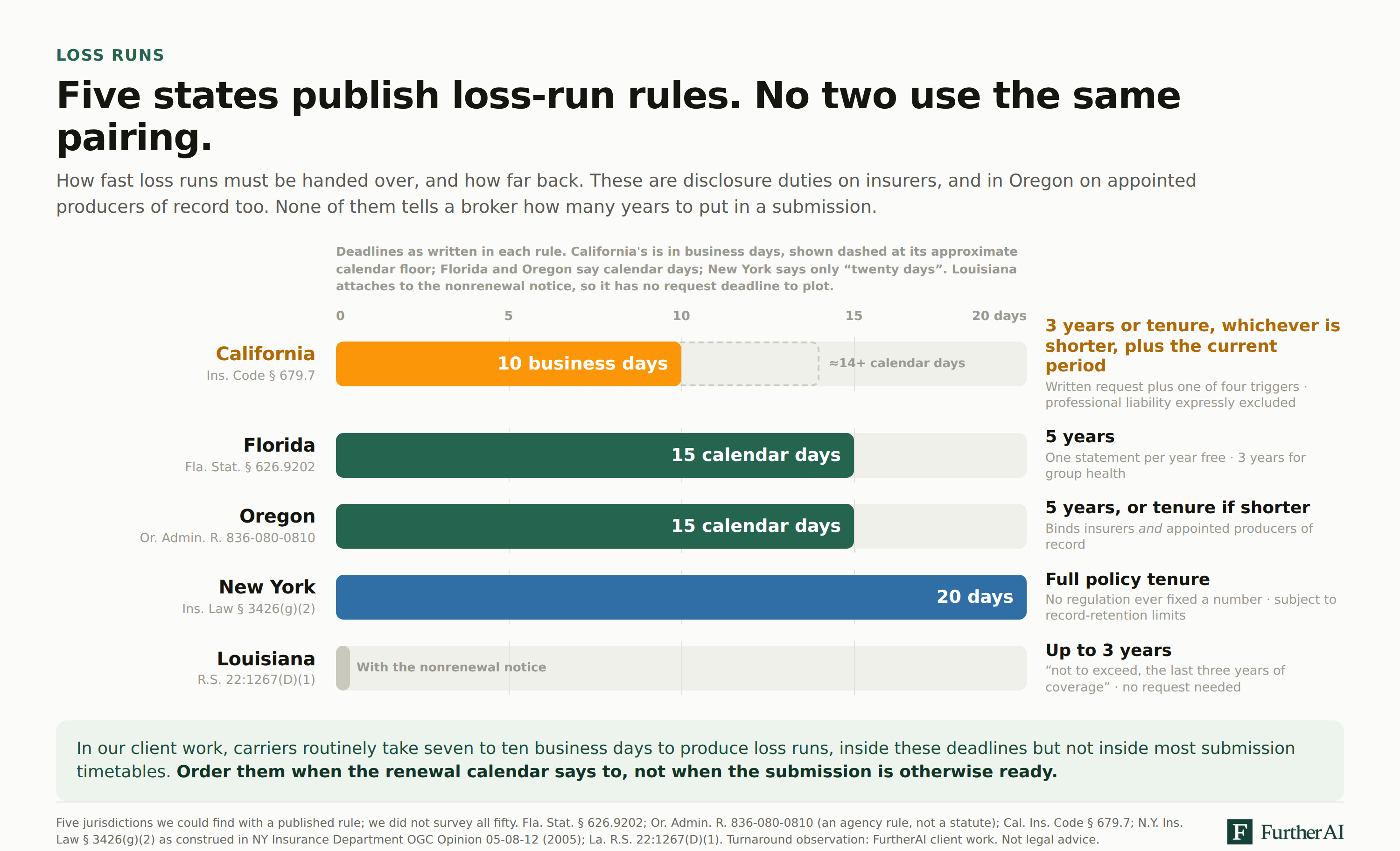
California catches people. It's three years and not five, ten business days and not fifteen, and a written request alone isn't enough: the duty also needs cancellation, non-renewal, a request within 60 days of renewal, a carrier downgrade, or conservation. That second trigger covers most renewal work, but check before relying on it.
The practical consequence is a scheduling one. In our own work with brokers, obtaining loss runs from carriers routinely takes seven to ten business days before anyone reads them. Start that clock when you start building the submission and you've already lost the fortnight.
What actually triggers a bounce-back
This is the part of the subject with the least evidence behind it. No survey, regulator report, or academic study we found reports, from a defined sample with a disclosed method, why commercial submissions are returned to brokers. The numbers that circulate, including the claim that a fixed share of submissions never get quoted, appear with no sample or method, and the incompleteness figures alongside them come from vendors. We won't repeat them.
What exists is testimony. Brian Gallimore, Regional Director of ROC at Peace Hills Insurance, told Canadian Underwriter that the best submissions "don't just present data — they connect the dots," and that they "anticipate underwriting questions, address inconsistencies upfront." Robyn Beswick, President and Chief Underwriting Officer at ABEX Insurance, added: "It is amazing how many submissions are sent with no requested limits or coverages." Both are Canadian underwriters, and the piece's author works at a submission-technology company.
The trend data is mixed. The 2026 Ivans survey of 702 agents found 90% have reduced business with a carrier over submission friction. First Connect's 2026 survey put "significant" difficulty understanding carrier appetite at 8%, against 17% a year earlier, with 11% calling quote speed a significant challenge. That panel shrank from 344 agents to 238, so read it as a signal rather than a trend, and note both surveys come from interested parties.
What we can say is structural. Each item below is a field or document cited above, and a submission missing it can't be worked without a question going back:
- No requested limits, deductibles, or coverage
- A named insured that doesn't match the legal entity
- Loss history with paid amounts but no reserves, or no open/closed flag
- Locations on the SOV that don't reconcile to locations on the application
- A blended total insured value with no building, contents, and BI split
- Class codes without the matching premium basis and exposure amount
- Claims-made business with PROPOSED RETROACTIVE DATE left blank
- Cyber with control answers left blank rather than answered "no"
Tolerance for all of this is thinnest in excess and surplus, where the risk is non-standard and the file does more of the explaining.
The ten questions worth pre-empting
There is no published measurement of what underwriters send back to brokers. We searched trade press, consultancy research, regulators, and the academic literature: no question counts, no round counts, no elapsed time. An industry that complains about submission Q&A constantly has never measured it.
So the list below is not a statistic. It's the pattern we see in the submission work we run, and each item maps to a data element from the tables above, which is why we publish it as a working checklist rather than a finding.
- What is the legal named insured, and does it match the entity on the loss runs?
- Which limits and deductibles are you actually asking us to quote?
- What does this business do, in a sentence a non-specialist would understand?
- What's the split between building, contents, and business interruption values?
- Which locations are owner-occupied, and who are the other occupants?
- What's the protection class and the distance to the nearest hydrant?
- Which class code applies to this operation, and on what premium basis?
- What percentage of the work is subcontracted, and are subs allowed to work without a certificate?
- What's the retroactive date on the expiring policy, and has cover been continuous?
- Is MFA enforced on email and administrative access, and are backups tested?
Run a submission against those ten before it leaves your office and you absorb the questions rather than waiting on them. That's the point of underwriting prep: the work happens either way, and it's cheaper before the file is in a queue.
Assembling it without doing it by hand
Everything above is a data-gathering problem, and it's the part of a broker's week that scales worst. Accenture's 2021 survey of 434 underwriters put 13% of underwriter time on "data entry/data gathering to prepare submissions or renewals," and the broker side is where that material originates.
Three capabilities do most of the work. The first is normalising loss runs, which arrive in every carrier's own format across policies and years, into one claims table you can drop into the ACORD 125 grid. In our own loss run work that cuts roughly 70% of the manual effort, turning review into same-day once files land. The second is reconciling the schedule of values against the application so location counts and values agree before an underwriter finds the discrepancy. The third is proposal assembly at the other end: at one national MGA, proposals went "from 30–45 minutes to under 10 minutes," and one proposal in four turned out to duplicate work the team had already done. A fourth sits alongside them: compliance review before submission, checking endorsement wording and form editions against what the carrier will actually accept.
Whatever you use, the test is the checklist's: does it tell you what's missing before you send, or after the underwriter asks? For a vendor comparison, see our guide to high-volume submission intake for brokers.
Where we fit
We build AI workflows for the document-heavy parts of this: reading loss runs in whatever format they arrive in, reconciling schedules of values, and flagging the fields a submission is missing before it goes out. To see it against your own renewals, a demo is the fastest way to start. Bring a submission you know came back with questions.
Frequently asked questions
REFERENCES
Accenture. 2021 P&C Underwriting Survey. October 2021. riskandinsurance.com
ACORD. Commercial Insurance Application, ACORD 125 (2016/03).
ACORD. Commercial General Liability Section, ACORD 126 (2016/09).
ACORD. Workers Compensation Application, ACORD 130 (2005/08).
ACORD. Statement of Values, ACORD 139 (2015/12).
ACORD. Property Section, ACORD 140 (2007/09).
Bennett, Shane. "Handbook: What makes a great submission." Canadian Underwriter, July 7, 2026. canadianunderwriter.ca
Bregman, Robert. "Online Underwriting Information for D&O Liability Insurance." IRMI Expert Commentary, July 1, 2000. irmi.com
California Insurance Code § 679.7. california.public.law
Carrier Management. "Agent-Carrier Relationships Improving, Survey Shows." July 2, 2026. carriermanagement.com
Florida Statutes § 626.9202, "Loss run statements for all lines of insurance." 2025. leg.state.fl.us
Indiana Cybersecurity Hub. "Underwriting Security Controls Questions & Resources." State of Indiana, last modified June 1, 2026. in.gov
IRMI. "construction, occupancy, protection, and exposure (COPE)." Glossary of Insurance and Risk Management Terms. irmi.com
IRMI. "exposure base." Glossary of Insurance and Risk Management Terms. irmi.com
IRMI. "retroactive date." Glossary of Insurance and Risk Management Terms. irmi.com
Ivans. "Agents Are Choosing Carriers That Automate Submissions Say Findings in 2026 Insurance Agency-Carrier Connectivity Trends Survey Report." August 26, 2026. ivans.com
Louisiana Revised Statutes § 22:1267(D)(1). legis.la.gov
New York State Department of Financial Services. Insurance Circular Letter No. 2 (2021): Cyber Insurance Risk Framework. February 4, 2021. dfs.ny.gov
New York State Department of Financial Services. Office of General Counsel Opinion No. 05-08-12, "Loss Information Requests." August 16, 2005. dfs.ny.gov
Oasis Loss Modelling Framework. "OED — Open Exposure Data." oasislmf.github.io
Oregon Administrative Rules § 836-080-0810, "Provision of Commercial Loss Runs." law.cornell.edu
Romanosky, Sasha, Lillian Ablon, Andreas Kuehn, and Therese Jones. "Content analysis of cyber insurance policies: how do carriers price cyber risk?" Journal of Cybersecurity 5, no. 1 (2019): tyz002. academic.oup.com
Stanovich, Craig F. "The ISO Classification System and the CGL Policy." IRMI Expert Commentary, March 2015. austinstanovich.com
U.S. Government Accountability Office. Cyber Insurance: Action Needed to Assess Potential Federal Response to Catastrophic Attacks. GAO-22-104256, 2022. gao.gov
DISCLAIMER
This article is for general informational purposes only and does not constitute legal, regulatory, compliance, underwriting, or other professional advice. The content reflects information available as of the date of publication, and FurtherAI undertakes no obligation to update it as laws, regulations, or AI technologies evolve.
Recent posts


Ready to go further and
transform your insurance ops?
Reclaim your time for strategic work and let our AI Assistant handle the busywork. Schedule a demo to see how you can achieve more, faster.




.svg)