FurtherAI Available in Microsoft Marketplace
Introducing Connectors



Compliance Software for Risk Engineering Teams: Audit-Ready Reports and Multi-State Filing Review (2026)

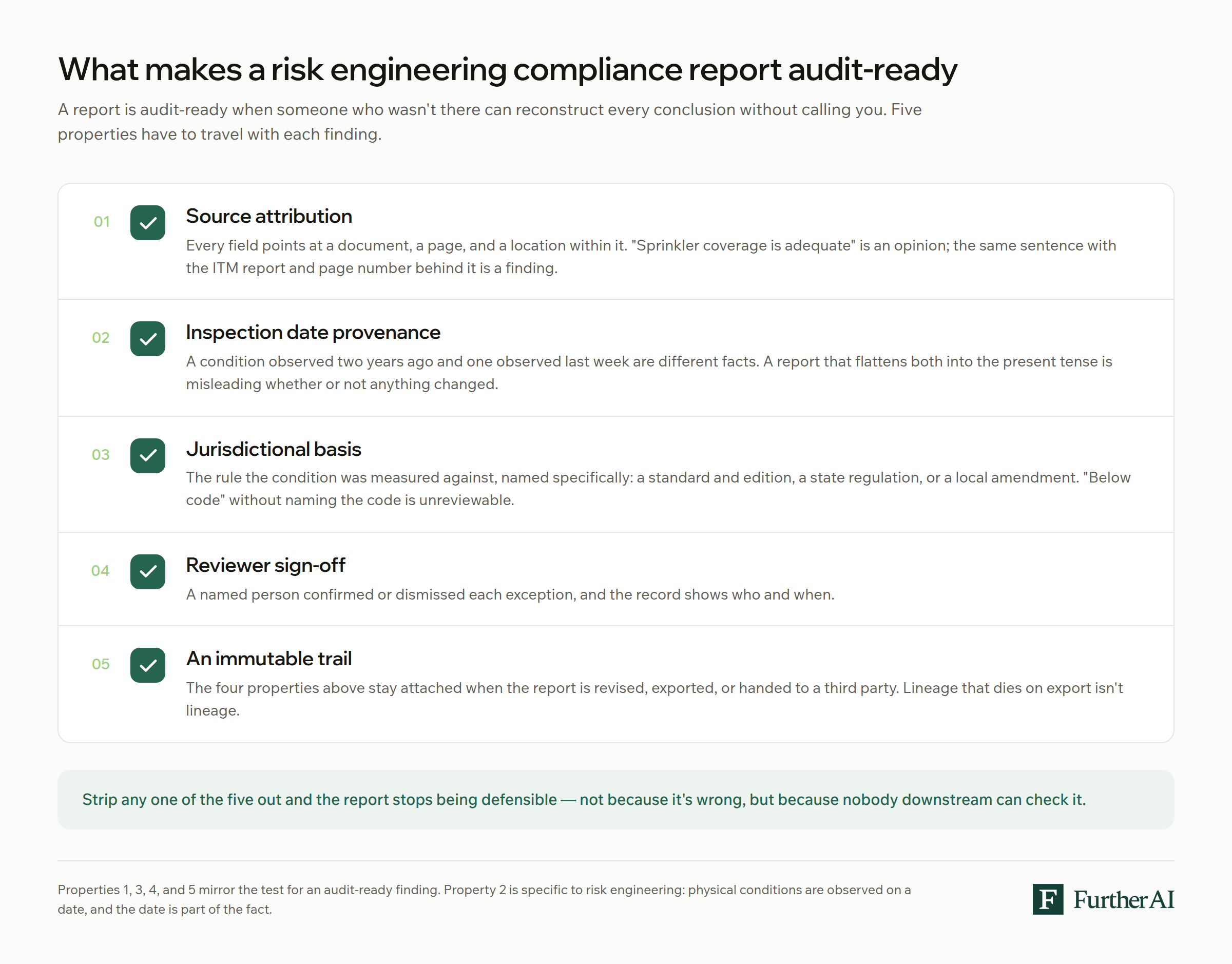
A risk engineering compliance report is audit-ready when a stranger can reconstruct how you reached every conclusion in it without giving you a call. That means five things travel with each finding: the source document it came from, the date the condition was observed, the jurisdictional rule it was measured against, the name of the person who signed it off, and a record that none of those changed afterward.
Software helps with four of the five. The fifth (knowing which rule applied in which state on which date) is where every product in this category currently stops, and where risk engineers still do the work by hand.
Key takeaways
- Audit-ready means five properties, not one. Source attribution, inspection date provenance, jurisdictional basis, reviewer sign-off, and an immutable trail. Strip any one out and the report stops being defensible.
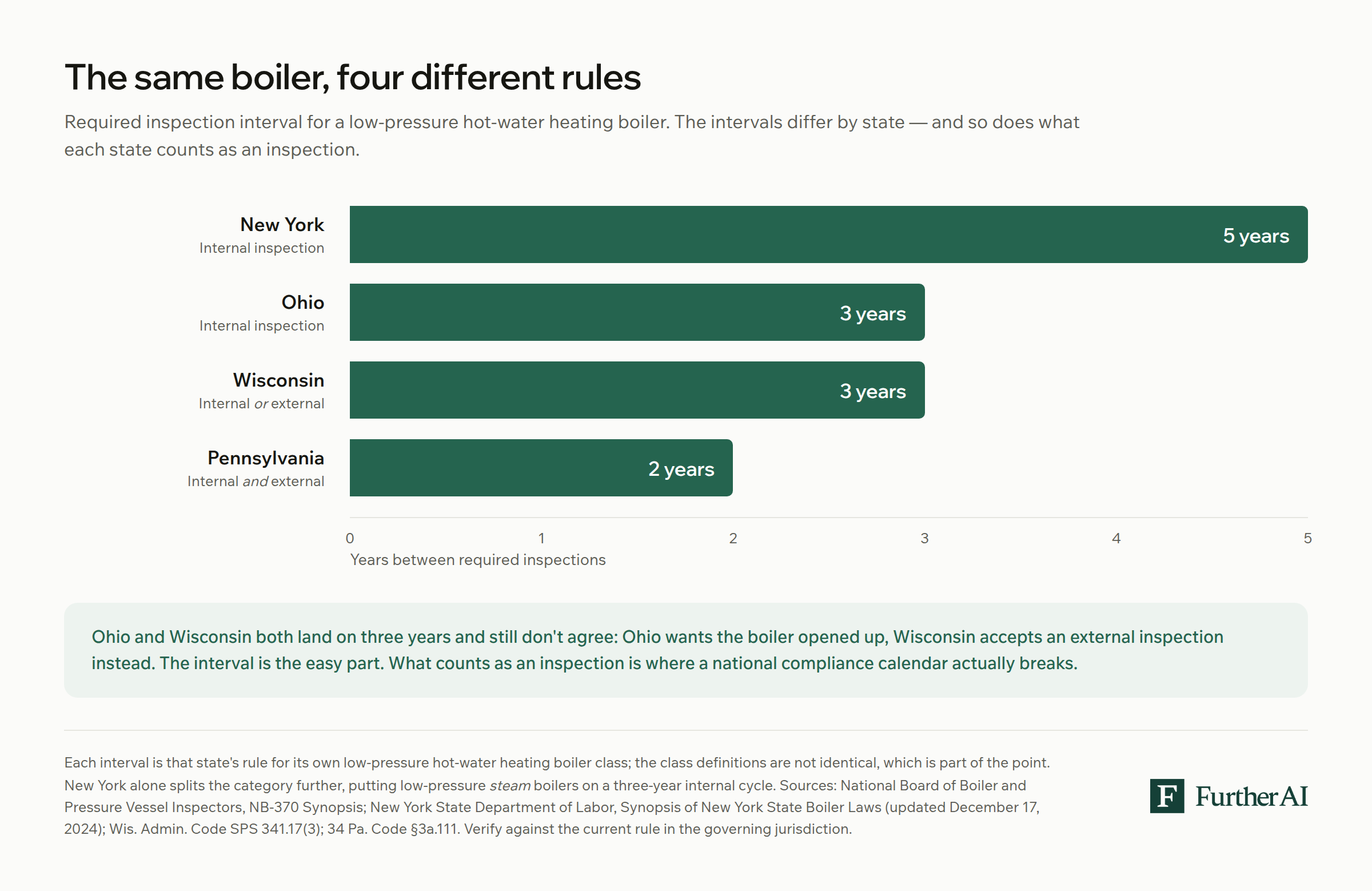
- The jurisdictional basis is the hard part. Inspection intervals for the same class of equipment differ by state: a low-pressure hot-water heating boiler is inspected every five years in New York, every three in Ohio and Wisconsin, and every two in Pennsylvania.
- Filing obligations differ too, and some carry dates. Texas requires an annual accident prevention services report by April 1. New York attaches a premium surcharge when a qualifying employer's consultation isn't filed within 30 days.
- No platform in this category ships a jurisdictional rule library. We reviewed seven in September 2026. Several handle citation and inspection documents well; none maintains the state-by-state rule content, which means the rules stay yours to supply and maintain.
- Extraction automates cleanly; judgment doesn't. Pulling values out of inspection reports, COPE data, and statements of values is solved work. Deciding whether a condition breaches a jurisdiction's standard is not.
What makes a risk engineering compliance report audit-ready
Risk engineering output gets read by people who weren't there: a carrier's audit team, a reinsurer reviewing a program, a regulator during a market conduct examination, or opposing counsel after a loss. All of them are checking the same thing, which is whether the conclusion follows from the evidence.
Five properties make that possible:
- Source attribution. Every field points at a document, a page, and a location within it. "Sprinkler coverage is adequate" is an opinion. "Sprinkler coverage is adequate, per the contractor's ITM report, page 4" is a finding.
- Inspection date provenance. A condition observed in March 2024 and a condition observed last week are different facts, and a report that flattens them into one present tense is misleading whether or not anything has changed.
- Jurisdictional basis. The rule the condition was measured against, named specifically: a standard and edition, a state regulation, or a local code amendment. "Below code" without naming the code is unreviewable.
- Reviewer sign-off. A named person confirmed or dismissed each exception, and the record shows who and when.
- An immutable trail. The four properties above stay attached when the report is revised, exported, or handed to a third party.
We've written about the equivalent test on the audit side, where audit-ready findings have to be traceable, rule-tied, plainly reasoned, and human-signed. Risk engineering adds the fifth property, because physical conditions are observed on a date and the date is part of the fact.
What risk engineers still check by hand
Ask a risk engineer where the week goes and the answer is rarely the site visit. It's the reconciliation afterward, and a specific slice of that reconciliation is checking observed conditions against rules that live in four different places.
Jurisdictional fire and life-safety codes
Model codes are adopted by reference, and adoption is local. The US Fire Administration's own training material puts it plainly: jurisdictions adopt a model code by reference so it "is legally enforceable as the jurisdiction's fire safety regulations," and "some states add amendments to the model code, for example the deletion of a specific chapter or the addition of more stringent requirements."
So the operative question is never what the model code says. It's which edition this jurisdiction adopted and what it amended on the way in, and that lookup is manual almost everywhere.
Sprinkler inspection, testing, and maintenance intervals
Two standards carry most of the weight. NFPA 13, Standard for the Installation of Sprinkler Systems, is in its 2025 edition. NFPA 25, Standard for the Inspection, Testing, and Maintenance of Water-Based Fire Protection Systems, is in its 2026 edition.
NFPA 25 sets the intervals a risk engineer holds in their head while reading someone else's ITM paperwork. New York's Department of State, explaining what its Uniform Code enforces by reference to the 2017 edition, notes that fire department connections are inspected quarterly and that FDC piping is hydrostatically tested "at 150 psi (10 bar) for 2 hours at least once every 5 years."
Checking a contractor's report against those intervals is arithmetic against a calendar. It automates cleanly, and mostly hasn't been.
Boiler and pressure vessel inspection cycles
This is the clearest case of rules that look uniform and aren't. The National Board of Boiler and Pressure Vessel Inspectors publishes a synopsis of boiler and pressure vessel laws covering every US state, Canadian province, and a number of individual cities, and it exists because each of them writes its own
Take one class of equipment. For a low-pressure hot-water heating boiler, New York requires an internal inspection every five years. Ohio requires one every three. Pennsylvania requires a field inspection, internal and external together, every two. Wisconsin accepts an internal or external inspection every three. Same equipment, four intervals, three different definitions of what the inspection has to cover — and New York alone splits low-pressure steam from low-pressure hot water, putting them on three- and five-year cycles respectively.
Extension provisions diverge further. Texas allows power boiler internal intervals to be extended out to 60 months with approval from both the executive director and the inspection agency. Pennsylvania allows 24 months for power boilers and 60 for process boilers, each with its own water-treatment and supervision conditions.
An engineer working a national account is holding several of these at once.
State loss control and filing obligations
The fourth place rules live is the one risk engineering firms feel most directly, because the obligation sits on the carrier and the work lands on the engineer. Several states require insurers writing workers' compensation to provide loss control services, some require proof, and at least one puts the duty on the employer instead.
Texas requires carriers to maintain or offer accident prevention services and to file an annual report with the Division of Workers' Compensation by April 1 covering the prior calendar year.
California requires loss control consultation services certified by the Division of Occupational Safety and Health, written notice to policyholders that the services are available at no additional charge, and records of services to targeted employers retained for four years.
New York puts the duty on the employer rather than the carrier: an employer with payroll above $800,000 and an experience rating above 1.2 must arrange a safety and loss prevention consultation within 30 days of notification, then file the evaluation with both its insurer and the Department of Labor within 30 days of receiving it. The insurer's role is to receive the copy and apply a 0.05 manual-rate premium surcharge for as long as non-compliance continues.
Pennsylvania requires licensed insurers to report to the Bureau of Workers' Compensation by June 1 each year on the accident and illness prevention services offered to policyholders during the prior calendar year, using form LIBC-210I. Self-insured employers report separately under their own subchapter.
In practice, this would mean four states, four different artifacts, and three different deadlines. And while nothing itself is very hard about it, the complex nature of it makes it easy for things to get lost.
What automates cleanly, and what doesn't
The split is sharper here than in most insurance workflows.
Automates cleanly: pulling structured values out of inspection reports, engineering surveys, COPE data, statements of values, and recommendation letters; matching a system or asset across documents that name it differently; comparing an observed date against a required interval; flagging a missing document rather than silently defaulting; assembling the citation trail as work happens instead of reconstructing it at report time.
Document extraction at this scale is solved work. One top-10 global carrier took statement-of-values intake from between one and five days down to under 10 minutes, even on 50,000-location schedules, at 95%-plus field accuracy rising to 97% within six months.
Doesn't automate: deciding which edition of a standard a jurisdiction adopted and what it amended; judging whether an observed condition is a deficiency or an acceptable equivalency; weighing a recommendation's priority against the account's loss history; and the sign-off itself, which is the point at which a human takes responsibility.
Between those two lists sits the reconciliation problem — working out which source wins when an inspection report and a statement of values disagree about the same building. That's a different job with its own rules, and we've covered it separately in our guide to verifiable risk data. Report generation and scoring frameworks are covered again separately, in risk assessment documentation automation. This page is about the third thing: the regulatory rules the record gets measured against.
Reviewing multi-state filing requirements without a rule library
An engineer covering a national account answers four questions per location, and only the first is about the building.
- What did we observe, and when? The inspection report and survey, with dates.
- Which jurisdiction governs this location? State, and often municipality, since local amendments are where the surprises live.
- What does that jurisdiction require for this equipment class? Interval, scope, and who is qualified to perform the inspection.
- What has to be filed, by whom, by when? Certificates, loss control reports, and the carrier-side obligations above.
Software answers the first question well and the second adequately. Three and four are where the category is usually thin, and pretending otherwise doesn't help anyone buying.
The workable pattern today is to author the rules yourself and let the software enforce them. You maintain a rule set (equipment class, jurisdiction, interval, evidence required) and the platform checks every document against it, cites the source for each finding, and routes exceptions to a reviewer. That puts the regulatory knowledge where it already is, with your engineers, and automates the checking, which is what was consuming the time.
That changes the buying question. Instead of asking whether a platform knows Pennsylvania's boiler rules, ask whether you can express them in it, change them when the state does, and see which findings came from which version of the rule.
How the market covers risk engineering compliance
We reviewed the public product documentation of seven platforms in September 2026 against five capabilities specific to this work. Vendors are listed alphabetically. This is a capability matrix, not a ranking.
What the matrix shows
One column is effectively empty, and it's the one the persona needs most.
No platform here publicly documents a maintained multi-state rule library for inspection intervals, code adoption, or filing obligations.
FurtherAI supports configurable rules that documents are checked against, which is why it reads Partial rather than Documented — the rules are yours to author, not ours to ship. HSB is an interesting exception, and it isn't software: it holds real jurisdictional knowledge and applies it by performing certificate inspections itself, noting that "codes vary from state to state, but generally boilers and other pressure equipment must be inspected by commissioned inspectors at specified intervals for continued operation."
Vanta is in the table as a deliberate contrast. Along with FurtherAI it's one of only two platforms here that documents both an audit-ready output and the evidence trail behind it, and it has no insurance risk engineering function at all — its frameworks are IT security and privacy standards such as SOC 2, ISO 27001, and HIPAA. The mechanics of audit-readiness are a solved problem in another domain. Nobody has finished porting them into this one.
For a risk engineering team the useful reading is that these capabilities are split across the category rather than absent from it. Archipelago ingests loss control engineering reports and links extracted data back to source documents; HSB does the jurisdictional work as a service. The judgment is which half you'd rather buy and which half you'd rather keep.
What to ask in a demo
- Show me a finding with its citation. Not a confidence score — the document, the page, and the observation date, on screen, for a real inspection report.
- Let me write a rule. Have them express "low-pressure heating boiler, Pennsylvania, internal inspection every 24 months" during the call. If rule authoring needs a services engagement, that's your maintenance cost for every state rule change.
- Break something. Give it an inspection report with a missing date and confirm it returns "not stated" rather than a silent default.
- Export it. Check the citations and sign-off survive the export to PDF or to the carrier's system. Lineage that dies on export isn't lineage.
Frequently asked questions
REFERENCES
California Department of Industrial Relations. "8 CCR §339.4 — Loss Control Consultation Services." dir.ca.gov
International Risk Management Institute. "Construction, Occupancy, Protection, and Exposure (COPE)." irmi.com
Munich Re / Hartford Steam Boiler. "Inspection Services." munichre.com
National Board of Boiler and Pressure Vessel Inspectors. "NB-370, Synopsis of Boiler and Pressure Vessel Laws, Rules and Regulations." nationalboard.org
National Fire Protection Association. "NFPA 13, Standard for the Installation of Sprinkler Systems," 2025 edition. nfpa.org
National Fire Protection Association. "NFPA 25, Standard for the Inspection, Testing, and Maintenance of Water-Based Fire Protection Systems," 2026 edition. nfpa.org
New York State Department of Labor. "Synopsis of New York State Boiler Laws." Updated December 17, 2024. dol.ny.gov
New York State Department of State, Division of Building Standards and Codes. "Technical Bulletin 2018-01: Maintenance, Testing and Inspection Requirements for Fire Department Connections," 2020 update. dos.ny.gov
New York State Senate. "Workers' Compensation Law §134 — Safety and Loss Prevention Program." nysenate.gov
Pennsylvania Code. "34 Pa. Code Chapter 129, Subchapter B — Accident and Illness Prevention Services." law.cornell.edu
Texas Department of Insurance, Division of Workers' Compensation. "Accident Prevention Services." tdi.texas.gov
US Fire Administration, National Fire Academy. "Introduction to Code Administration and Enforcement," precourse reading. usfa.fema.gov
DISCLAIMER
This article is for general informational purposes only and does not constitute legal, regulatory, compliance, underwriting, or other professional advice. The content reflects information available as of the date of publication, and FurtherAI undertakes no obligation to update it as laws, regulations, or AI technologies evolve.
Recent posts

Ready to go further and
transform your insurance ops?
Reclaim your time for strategic work and let our AI Assistant handle the busywork. Schedule a demo to see how you can achieve more, faster.




.svg)