FurtherAI Available in Microsoft Marketplace
Introducing Connectors



Explainable AI for Insurance Audits: Source-Backed, Audit-Ready Findings 2026

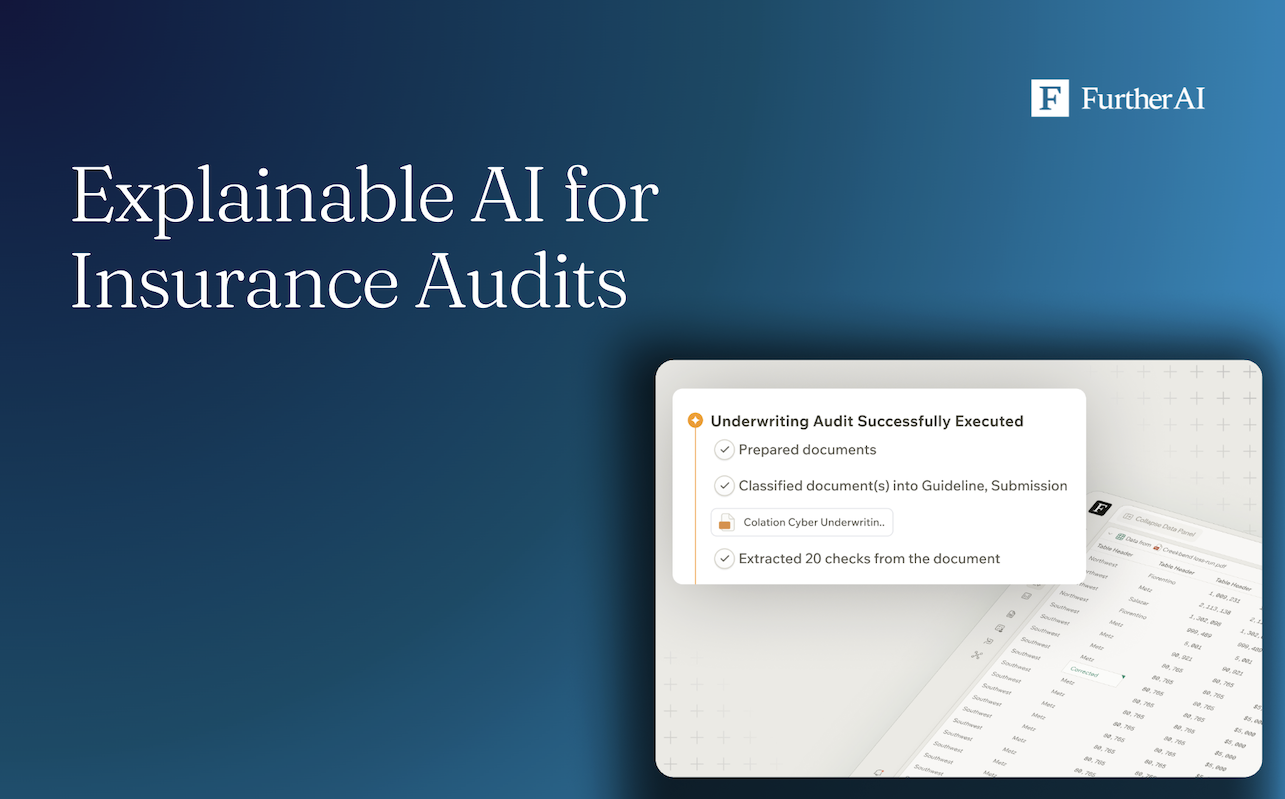
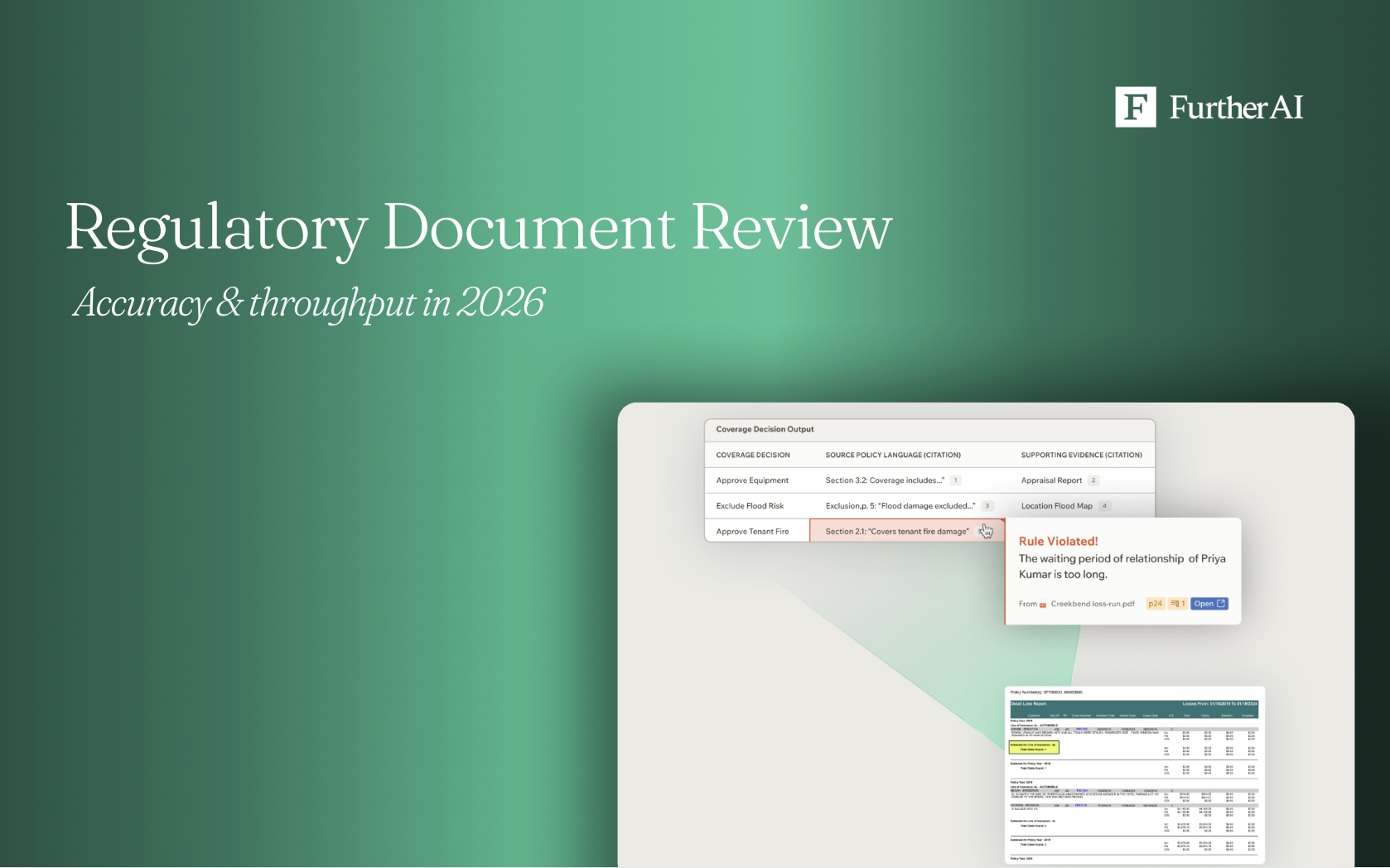
Explainable AI for insurance audits produces findings a person can verify: every exception it raises links back to the exact source document and the rule it was checked against, rather than an opaque score. That traceability is what makes a finding audit-ready, and it is the difference between an AI result a carrier can defend to a regulator and one it cannot.
The distinction matters more as AI moves into compliance work. Even AI tools that retrieve and cite real documents still get things wrong: Stanford researchers found leading AI legal-research tools hallucinated on at least 17% of queries. In an audit, a confident wrong answer with no visible source is a liability. This guide explains what makes an AI audit finding explainable, why source-backed results matter, and what to look for when accuracy has to hold up.
Key takeaways
- Explainable AI audit findings cite their source — the exact file, page, and rule behind every exception — so a reviewer can verify them in seconds.
- Source citations are a safeguard against AI error: even retrieval-grounded tools hallucinate, so a finding you cannot trace is a finding you cannot trust.
- The National Association of Insurance Commissioners (NAIC) expects insurers to document, explain, and audit their AI systems, which makes explainability a compliance requirement, not a nicety.
- Explainability keeps humans in the loop: reviewers confirm or dismiss each finding, so AI scales the work and people keep the judgment.
- This is the trust layer beneath every audit (bordereaux, underwriting, and claims), not a separate product.
What is explainable AI for insurance audits?
Explainable AI for audits is software that not only flags a problem but shows exactly how it reached that conclusion. For each exception, it surfaces the underlying document, the specific field or passage, and the rule or guideline the record was measured against. A reviewer sees the reasoning, not just the result.
This is the opposite of a black-box model that returns a risk score with no way to check it. In an audit, the reasoning is the product. A finding is only useful if someone can confirm it, act on it, and later show a regulator or reinsurer how it was reached. The teams asking for "AI that produces audit-ready findings with source citations" and "explainable, source-backed results" are asking for exactly this.
What makes an audit finding audit-ready?
An audit-ready finding shows its work. Four properties separate a finding a carrier can defend from one it cannot, illustrated below.
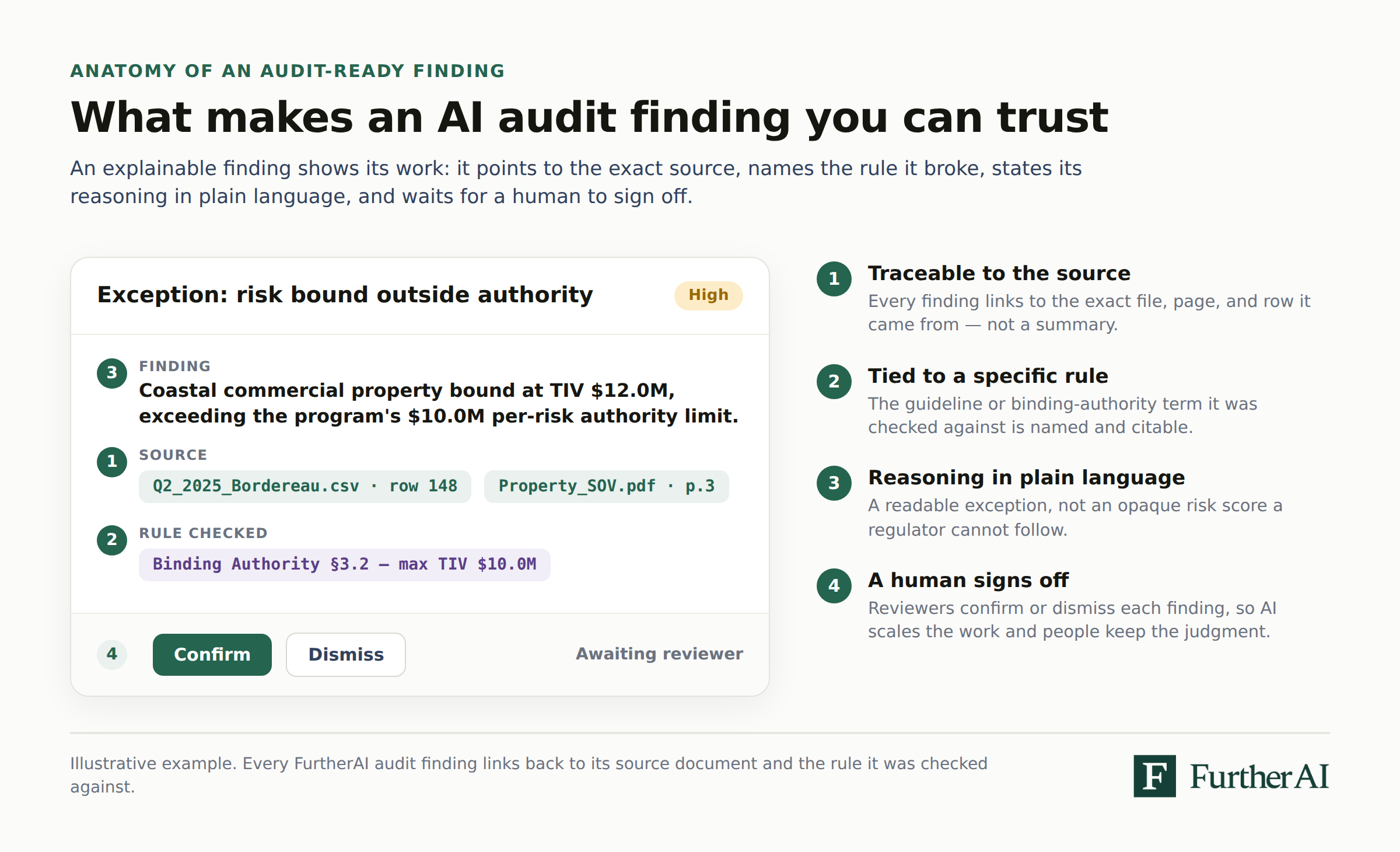
First, it is traceable to the source — the exact file, page, and row, not a paraphrase. Second, it is tied to a specific rule, so it is clear why the record is an exception rather than merely that it is. Third, its reasoning is in plain language a reviewer or examiner can follow, not a bare number. Fourth, a human signs off: the finding routes to a person to confirm or dismiss. Strip any one of these away and the finding stops being defensible.
“Every data point FurtherAI processes cites back to exactly where in the document it came from. If it creates a data point, it gives a reason why it thinks that's right. If it has low confidence, it says so — is it because there's conflicting information, or because it can't process it? Auditability, transparency, and the repeatability of action are super important." — Aman Gour, Co-founder and CEO at FurtherAI
Why source-backed findings matter
Two forces make source citations non-negotiable in audit work: AI's own error rate, and the regulator's expectations.
On error, grounding an AI answer in retrieved documents helps but does not eliminate mistakes. The Stanford study above found that even purpose-built legal-research tools, which cite real sources, still hallucinated on 17% or more of queries. The lesson is not to avoid AI; it is that every finding needs a citation a human can open and check. A visible source turns a possible hallucination into an easy rejection.
On regulation, the NAIC's Model Bulletin on the use of AI by insurers asks insurers to maintain documentation of their AI systems and to ensure outcomes are transparent and explainable, with traceability and auditability built in. Regulators expect to inspect that documentation. An audit tool whose findings cannot be traced to a source works against that expectation; one built on source citations supports it directly. For the broader picture, see our guide to AI governance in insurance.
Explainable AI vs black-box AI in audits
Both approaches can flag an anomaly. Only one produces something a carrier can stand behind. The table compares them on the dimensions that decide an audit.
The practical takeaway: a score asks an audit team to trust the machine, while a citation lets them verify it. Only the second scales without adding risk.
How FurtherAI produces source-cited findings
At FurtherAI, source citation is the final stage of every audit workflow, not an add-on. The platform reads the underlying documents, checks each record against the applicable rules, and returns each finding alongside the document and rule that triggered it. In our underwriting-audit engagement, that source-cited output let a reinsurer's team act on exceptions in minutes and cut its per-MGA audit from 200 hours to about 110, because reviewers spent their time judging findings instead of hunting for the evidence behind them.
Two design choices make the difference. The output is structured and cited, so every exception carries its provenance. And the workflow is human-in-the-loop: reviewers confirm or dismiss each finding, which keeps expert judgment in control and produces a clean record of who decided what. That combination is what turns fast AI review into defensible audit evidence.
"There are two kinds of interrupts where AI can take human help. One is planned — before AI moves to the next step, you want a human to approve it. The other is when AI has low or no confidence, so it brings the human into the loop. That's where agentic systems are smarter: they know where to bring in the human, and where to just continue making the decision." — Aman Gour, Co-founder and CEO at FurtherAI
The trust layer across every audit
Explainability is not a separate use case; it is the property that makes every other audit trustworthy. The same source-cited approach runs underneath each of our audit workflows:
- Bordereaux and premium reconciliation: every reconciled record traces to the reported data and the binding-authority term it was checked against. See software for bordereaux management.
- Underwriting audits: each guideline or binding-authority violation links to the underwriting file behind it. See underwriting audit automation for carriers.
- Claims audits: each leakage or overpayment finding cites the claim document that supports it. See post-payment and closed-claim audits.
Whichever audit a carrier runs, the assurance is the same: a finding it can open, verify, and defend.
Key features to look for in explainable audit AI
When accuracy has to hold up, weigh these capabilities against any tool you evaluate.
For a comparison of audit-readiness platforms more broadly, see our roundup of insurance audit readiness software.
Bring explainable audits to your carrier with FurtherAI
If your team is weighing AI for audit work but worries about defending its outputs, explainability is the feature that resolves the tension. FurtherAI gives carriers source-cited, human-reviewed findings across bordereaux, underwriting, and claims audits, so you get the speed of automation with evidence a regulator can follow. Explore the full platform on our solutions overview.
REFERENCES
National Association of Insurance Commissioners (NAIC). "Model Bulletin: Use of Artificial Intelligence Systems by Insurers." Adopted December 4, 2023. naic.org
Stanford RegLab (Magesh, Surani, Dahl, Suzgun, Manning, and Ho). "Hallucination-Free? Assessing the Reliability of Leading AI Legal Research Tools." reglab.stanford.edu
FurtherAI. "45% Reduction in Underwriting Audit Time." FurtherAI Customer Stories. furtherai.com
DISCLAIMER
This article is for general informational purposes only and does not constitute legal, regulatory, compliance, underwriting, or other professional advice. The content reflects information available as of the date of publication, and FurtherAI undertakes no obligation to update it as laws, regulations, or AI technologies evolve.
Recent posts
Ready to go further and
transform your insurance ops?
Reclaim your time for strategic work and let our AI Assistant handle the busywork. Schedule a demo to see how you can achieve more, faster.




.svg)