FurtherAI Available in Microsoft Marketplace
Introducing Connectors



Post-Payment and Closed-Claim Audits: How Carriers Recover Leakage 2026

A post-payment audit reviews paid claims to confirm each was priced and handled correctly and to recover overpaid dollars, while a closed-claim audit reviews settled files to measure handling quality and find the patterns driving leakage. Together they are how carriers claw back money that has already gone out the door and stop the same mistakes from repeating.
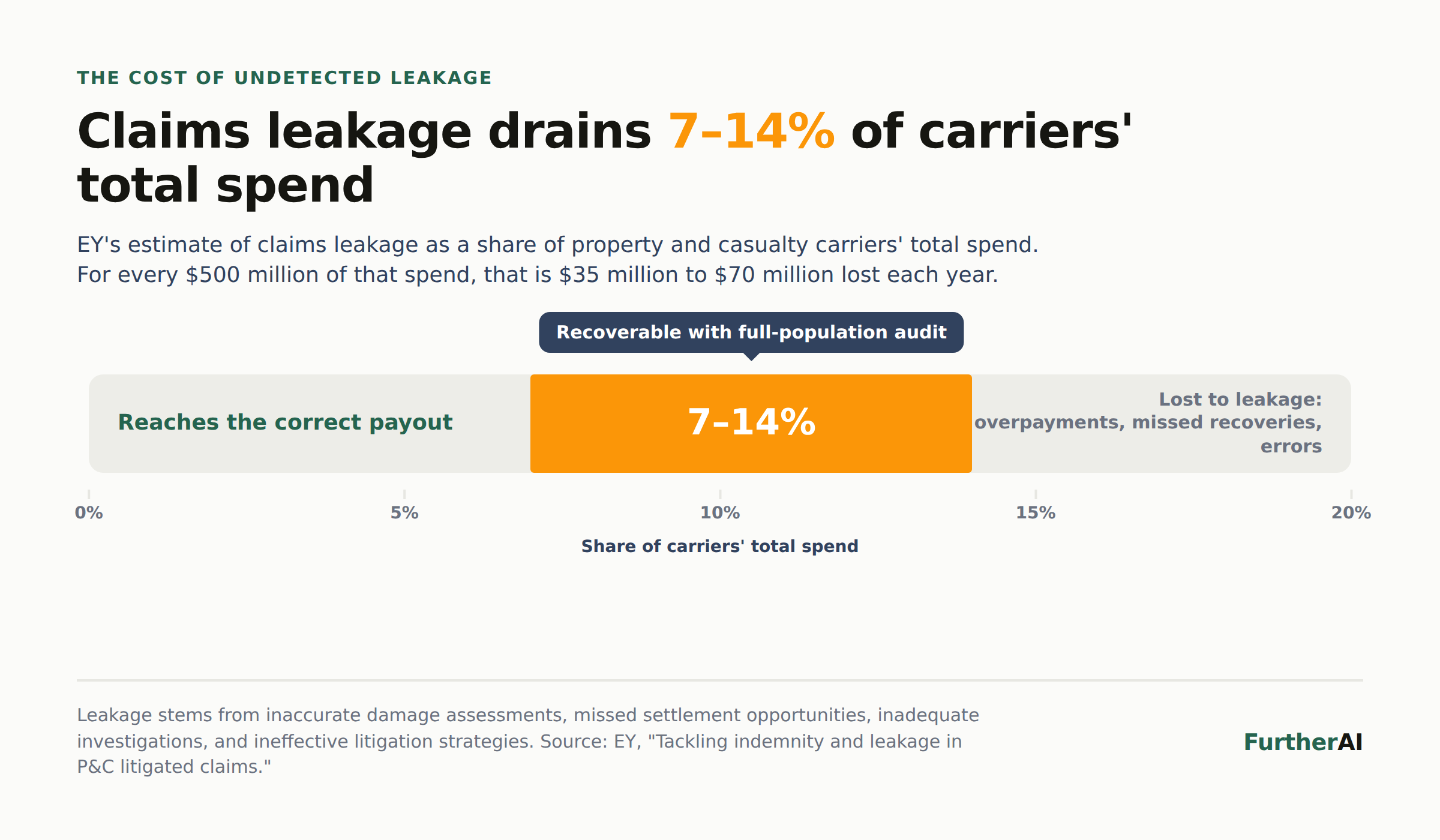
The money at stake is real. EY estimates that claims leakage runs 7% to 14% of carriers' total spend, which is $35 million to $70 million for every $500 million of that spend. Much of it is recoverable, but only through audits rigorous enough to catch it. This guide explains how post-payment and closed-claim audits work, why manual sampling leaves money behind, and how AI lets carriers audit every claim instead of a sample.
Key takeaways
- A post-payment audit recovers dollars from claims already paid; a closed-claim audit reviews settled files to improve future handling.
- Both look backward at decided claims, unlike a pre-payment review that stops errors before money moves.
- Leakage runs 7% to 14% of carriers' total spend (EY), so even a partial recovery is material on a large book.
- Manual audits sample a small share of files, so sampling risk lets clustered leakage slip through; software can review 100% of claims.
- The payoff of full-population auditing is both recovered cash and the systemic fixes that prevent the next round of leakage.
What are post-payment and closed-claim audits?
Claims audits fall into three types, separated by when they run and what they are for. Understanding the distinction matters, because each produces a different outcome and the tools that support them differ.
This article focuses on the two backward-looking audits. If your priority is stopping leakage and fraud before payment, or choosing between vendors, our guide comparing claims leakage and fraud detection software for carriers covers that intent and the tool landscape.
Why carriers run post-payment and closed-claim audits
Carriers run these audits for two reasons: to recover specific dollars, and to fix the systemic issues driving leakage across a book. A post-payment audit turns a paid claim back into cash when it surfaces an overpayment, a missed subrogation opportunity, a duplicate payment, or coverage applied where it should not have been. A closed-claim audit turns a settled file into a lesson by revealing where handling drifted from guidelines.
Timing makes both urgent. J.D. Power reports that property claims now take more than 44 days on average from first notice of loss to final payment, so errors lock in quickly and only a disciplined post-payment or closed-claim audit surfaces them afterward. For high-volume carriers and third-party administrators (TPAs), volume multiplies both the leakage and the workload of finding it.
Why manual sampling leaves recoverable money behind
Traditional post-payment and closed-claim audits rely on sampling. A reviewer pulls a small, often random set of files, works through them by hand, and extrapolates to the book. The method is a practical response to limited time, but it carries a structural weakness auditors call sampling risk — the chance that a conclusion drawn from a sample differs from what a review of the full population would show.
Leakage is exactly the kind of problem sampling misses. It clusters in specific adjusters, injury types, vendors, or coverage lines, so a small sample can look clean while real money leaks elsewhere. As the PCAOB's sampling standard makes clear, even a well-designed sample carries this risk, and the smaller the sample, the greater that risk.
The trade-off used to be unavoidable, because reviewing every file by hand was impossible. It no longer is. When software can read and compare data across an entire book in the time a team once spent on a sample, full-population review becomes the practical default, and the audit shifts from a spot check to complete coverage.
How to run a post-payment audit that recovers leakage
A post-payment audit that actually recovers money follows a repeatable sequence. The steps are the same whether you run them manually or with software; the difference is how many claims you can cover.
First, scope the population: decide which paid claims to review, and aim for the full population rather than a sample. Second, gather the evidence from each claim, including the unstructured files — adjuster notes, invoices, medical records, and estimates — where most leakage evidence lives. Third, compare each claim against the policy terms, fee schedules, and handling guidelines that should have applied. Fourth, flag recoverable findings: overpayments, missed subrogation and salvage, duplicate payments, and coverage errors. Fifth, pursue and measure, routing confirmed findings to recovery and tracking what converts to cash.
The bottleneck in the manual version is steps two and three, where reviewers spend most of their hours gathering and cross-checking data instead of exercising judgment. Removing that bottleneck is what makes full-population auditing possible.
Building a closed-claim audit program
A closed-claim audit is less about recovering a single payment and more about protecting the book over time. A durable program has a few consistent elements: a regular cadence, a clear selection method, a scorecard that rates handling against guidelines, and a feedback loop that routes findings back to claims leaders.
The goal is to convert patterns into prevention. When a closed-claim audit shows that a particular injury type is routinely over-reserved, or that one vendor's invoices skew high, that insight belongs in the handling guidelines and adjuster training, not in a report nobody reads. Full-population coverage strengthens this loop, because it reveals patterns a small sample would treat as noise. For carriers in life and health, our guide to health insurance claims auditing covers the same discipline in that line of business.
How AI changes post-payment and closed-claim audits
AI removes the manual bottleneck that has always limited these audits. An insurance-specific platform reads the unstructured documents in each claim, compares them against the rules that should have applied, and returns source-cited findings a reviewer can confirm in minutes rather than hours.
At FurtherAI, this is the same audit engine we run in delegated-authority work. In an underwriting-audit deployment, the intake, guideline-comparison, and source-cited-output workflow cut a reinsurer's per-file audit from 200 hours to about 110, a 45% reduction, while improving consistency. The same three steps apply to paid and closed claims. Across the platform, FurtherAI supports roughly $30 billion in premiums across more than 20 lines of business in nearly 50 states, and we bring the approach to claims directly through work like our partnership with RMA Insurance. When it comes time to choose a tool, our claims leakage and fraud software comparison walks through the options.
Metrics to track in a claims audit program
A post-payment or closed-claim program earns its budget by moving a handful of numbers. Track these to show impact and tune the program over time.
Audit coverage is the metric most transformed by software. Moving from a single-digit sample to full-population review changes every other number on the list, because you can only recover and learn from what you actually review.
REFERENCES
EY. "Tackling Indemnity and Leakage in P&C Litigated Claims." ey.com
FurtherAI. "45% Reduction in Underwriting Audit Time." FurtherAI Customer Stories. furtherai.com
J.D. Power. "2025 U.S. Property Claims Satisfaction Study." jdpower.com
Public Company Accounting Oversight Board (PCAOB). "AS 2315: Audit Sampling." pcaobus.org
DISCLAIMER
This article is for general informational purposes only and does not constitute legal, regulatory, compliance, underwriting, or other professional advice. The content reflects information available as of the date of publication, and FurtherAI undertakes no obligation to update it as laws, regulations, or AI technologies evolve.
Recent posts
Ready to go further and
transform your insurance ops?
Reclaim your time for strategic work and let our AI Assistant handle the busywork. Schedule a demo to see how you can achieve more, faster.




.svg)