FurtherAI Available in Microsoft Marketplace
Introducing Connectors



Software for Bordereaux Management: Automate Premium Audits 2026

Software for bordereaux management ingests, validates, and reconciles the premium, claims, and risk data that managing general agents (MGAs) report to carriers, then turns that data into audit-ready records automatically. For carriers and reinsurers overseeing delegated authority programs, the right platform replaces spreadsheet reconciliation and once-a-year audit scrambles with continuous, exception-based checks that flag discrepancies before they become compliance problems.
We build this software at FurtherAI, and the results are specific: in a FurtherAI customer case study, one reinsurer overseeing more than 100 MGAs cut its per-audit workload 45%, from 200 hours to about 110, by automating file intake and the checks that follow. This guide explains what bordereaux management software does, why manual processes break down at scale, and what to look for when you evaluate a platform in 2026.
Key takeaways
- Bordereaux management software automates the ingestion, validation, and reporting of MGA-reported data so carriers can audit delegated business continuously instead of annually.
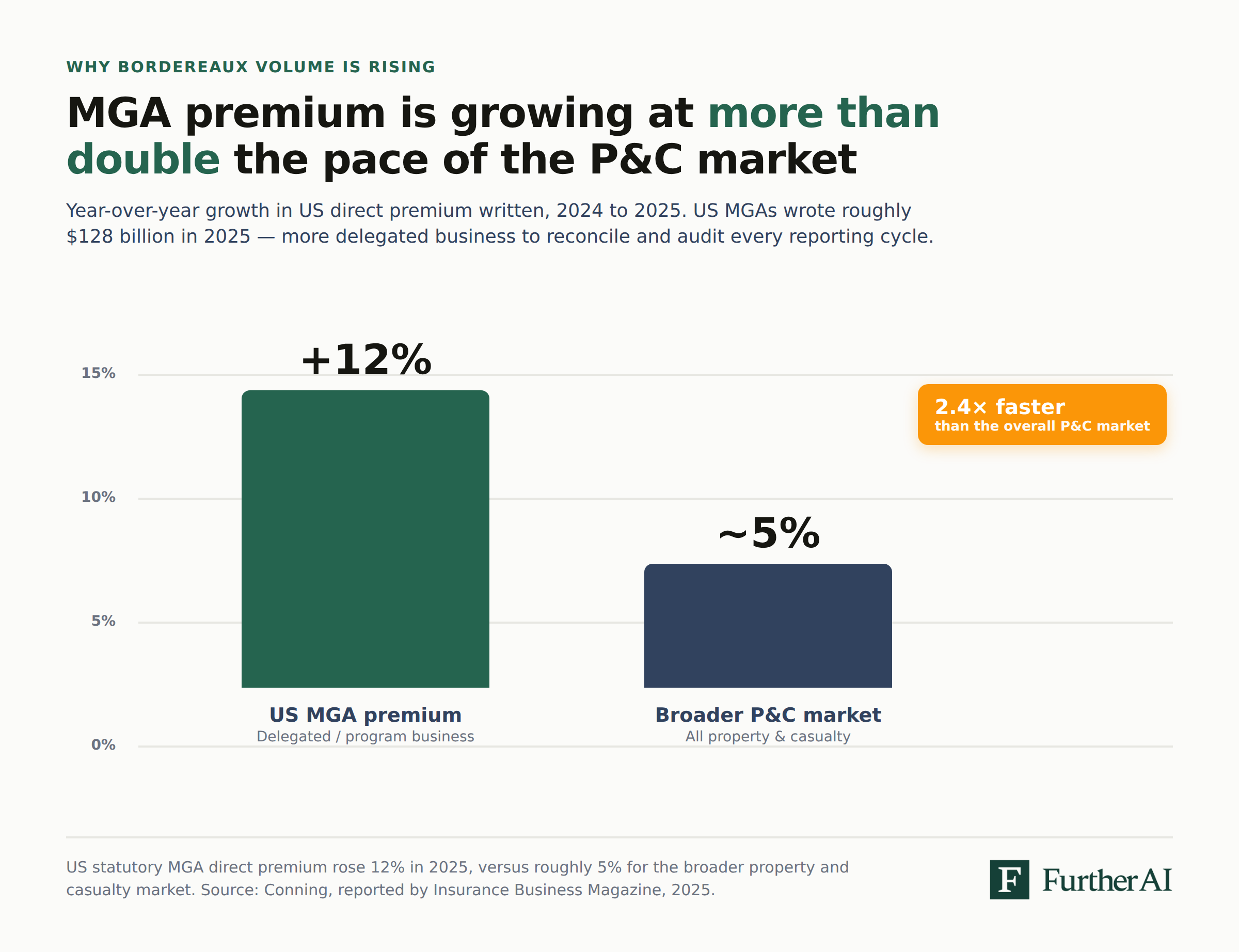
- Manual reconciliation does not scale: the U.S. MGA market reached roughly $128 billion in premium in 2025, growing at more than double the pace of the broader property and casualty (P&C) market, according to Conning.
- The strongest platforms reconcile reported data against each MGA's binding-authority terms — rates, commissions, and limits — not just file formats.
- FurtherAI customers have cut audit time 45%, processed intake 30 times faster, and reached 400% ROI on policy-checking workflows, per FurtherAI customer stories.
- For carriers, the payoff is audit readiness and regulatory defensibility across every program, at once.
What is bordereaux management in delegated authority programs?
A bordereau (plural: bordereaux) is the periodic report an MGA or coverholder sends to a carrier, listing the policies it has bound, the premiums it has collected, and the claims it has handled under delegated authority. Bordereaux management is the process of collecting, cleaning, validating, and reconciling those reports so the carrier has an accurate, timely view of the business written in its name.
The stakes are high because delegated authority is now a core distribution channel, not a niche. At Lloyd's, roughly 39% of gross written premium flows through delegated arrangements, according to specialist auditor Pro Global, which is why the market treats data quality in this channel as a governance priority. When a carrier delegates underwriting and claims to dozens of MGAs, the bordereau becomes its primary window into risk, exposure, and compliance.
Managing that window well is hard. Every MGA formats its data differently, submits on its own cadence, and defines fields in its own way. Bordereaux management software standardizes those inputs so carriers can trust the numbers they report to reinsurers and regulators.
What are bordereaux and premium audits, and why do carriers run them?
A premium audit in a delegated program verifies that the premium, commission, and risk data an MGA reports actually matches the policies it bound and the terms of its binding authority. It answers questions like: does the reported premium match the policies actually bound, were commissions calculated correctly, and does every record fall within the binding authority's limits? This is distinct from a traditional exposure-based premium audit of a policyholder's payroll or sales, though both share the same goal of confirming that recorded premium reflects reality. Whether each risk was underwritten inside the carrier's appetite and guidelines is a separate question, answered by an underwriting audit.
Carriers run these audits because delegated business carries delegated risk. Pro Global notes that between 2013 and 2019, weak monitoring of delegated business drove deteriorating loss ratios through poor risk selection and inadequate pricing. Auditing is how a carrier catches those problems early, and the market is shifting from reactive, once-a-year reviews toward proactive, continuous oversight.
Premium audits exist because the exposure estimated at bind rarely matches what the year actually produced. Which figure gets audited depends on the line, and we've set out what premium is calculated from across the six most common ones.
Why manual bordereaux reconciliation fails at scale
Most carriers still reconcile bordereaux in spreadsheets. An analyst downloads each MGA's file, reformats it by hand, keys values into a master template, and hunts for mismatches against policy records. The approach works for two or three MGAs. It collapses across 20 or 50.
The core problem is that skilled people spend their time on clerical work. McKinsey finds that underwriters spend 30% to 40% of their time on administrative tasks such as rekeying data and manually running analyses. In audit teams, the same pattern holds: in FurtherAI's reinsurer engagement, roughly half of every 200-hour audit went to manual data extraction and validation before any expert judgment began.
Three failure modes compound as programs grow:
- Inconsistent inputs. No two MGAs submit bordereaux the same way, so every file needs manual cleanup before reconciliation can start.
- Delayed detection. Errors surface at the annual audit, months after the underlying policies bound, when they are expensive to correct.
- Stale data. Pro Global has flagged that syndicates still receive data that is not current, which undermines both pricing and reserving.
The result is a process that is slow, error-prone, and impossible to scale without adding headcount. Faster deployment of automation is precisely how leading programs are removing these bottlenecks.
How bordereaux management software automates MGA audits
Modern platforms automate the ingestion, validation, and reporting trifecta, then extend it into audit compliance. At FurtherAI, our audit-automation workflow runs in three stages that map directly onto how a carrier reviews delegated business.
First, data intake extracts and enriches the premium, claims, and risk data from each bordereau in any format, without manual keying. Second, validation and reconciliation checks each reported record for completeness and consistency and reconciles it against the binding authority's agreed terms — rates, commissions, and limits — flagging data that does not tie out. Third, consumable output produces a structured reconciliation report an auditor can act on immediately, showing exactly where the reported data breaks.
Because the checks run automatically, the software surfaces exceptions continuously rather than once a year. That single change is what compresses a 200-hour audit into roughly 110 hours, and it lets teams review every MGA on the same schedule. Auditing the underwriting decisions behind those bordereaux — checking each risk against the carrier's guidelines and appetite — is a separate discipline, covered in underwriting audit automation for carriers.
Key features to look for in bordereaux management software
Not every tool that ingests spreadsheets can support a carrier audit. When you evaluate platforms, weigh these capabilities against your delegated portfolio.
A capable platform treats intake as a decision-intelligence problem, not a data-entry chore. For a broader capability checklist, our roundup of the best agentic AI platform for MGAs compares approaches across the underwriting lifecycle.
Bordereaux management software compared: three approaches
Carriers generally choose among three approaches to bordereaux management. The table below compares them on the dimensions that matter for audit and oversight, so you can match an approach to your program's size and risk.
The distinction that matters most is audit depth. Standardizing how data moves is valuable, but carrier oversight also depends on whether the software reconciles that data against the terms each MGA agreed to. That reconciliation layer is where audit readiness and regulatory defensibility live.
Ensuring audit-ready compliance across 100+ MGA partners
Audit readiness at scale is where automation pays off most clearly. In our underwriting-audit engagement, a reinsurer overseeing more than 100 MGAs faced a 200-hour audit per partner, with about half that time lost to manual data extraction before any analysis began.
By automating intake and the checks that follow, the reinsurer cut each audit to roughly 110 hours, a 45% reduction, and freed more than 90 hours per MGA. That reclaimed time moved to higher-value work: proactive underwriting analysis, compliance oversight, and broker engagement. Accuracy improved too, because automated checks apply the same standard to every file instead of relying on a tiring analyst at hour 180.
Across our customer base, FurtherAI has processed roughly $30 billion in premium spanning more than 20 lines of business in nearly 50 states, giving carriers a consistent audit standard across every delegated program they run.
Automate your bordereaux workflows with FurtherAI
If your team is reconciling MGA data in spreadsheets or dreading the next audit cycle, bordereaux management software is the fastest way to recover both time and confidence. FurtherAI automates ingestion, validation, reconciliation, and audit-ready reporting so you can oversee every MGA on one schedule, with a defensible trail behind each record.
See how we support operations and audit leaders across delegated programs on our solutions overview, or explore the workflow built for the operations leader accountable for MGA oversight.
REFERENCES
Conning. "U.S. MGA Premiums Reach $128 Billion as Market Evolution Continues." Reported by Insurance Business Magazine, July 28, 2026. insurancebusinessmag.com
FurtherAI. "45% Reduction in Underwriting Audit Time." FurtherAI Customer Stories. furtherai.com
McKinsey & Company. "From Art to Science: The Future of Underwriting in Commercial P&C Insurance." mckinsey.com
Pro Global. "Proactive Audits and Delegated Authority: The Next Wave of Market Risk." pro-global.com
DISCLAIMER
This article is for general informational purposes only and does not constitute legal, regulatory, compliance, underwriting, or other professional advice. The content reflects information available as of the date of publication, and FurtherAI undertakes no obligation to update it as laws, regulations, or AI technologies evolve.
Recent posts
Ready to go further and
transform your insurance ops?
Reclaim your time for strategic work and let our AI Assistant handle the busywork. Schedule a demo to see how you can achieve more, faster.




.svg)