FurtherAI Available in Microsoft Marketplace
Introducing Connectors



Underwriting Audit Automation for Carriers: Flag Guideline and Binding-Authority Violations 2026

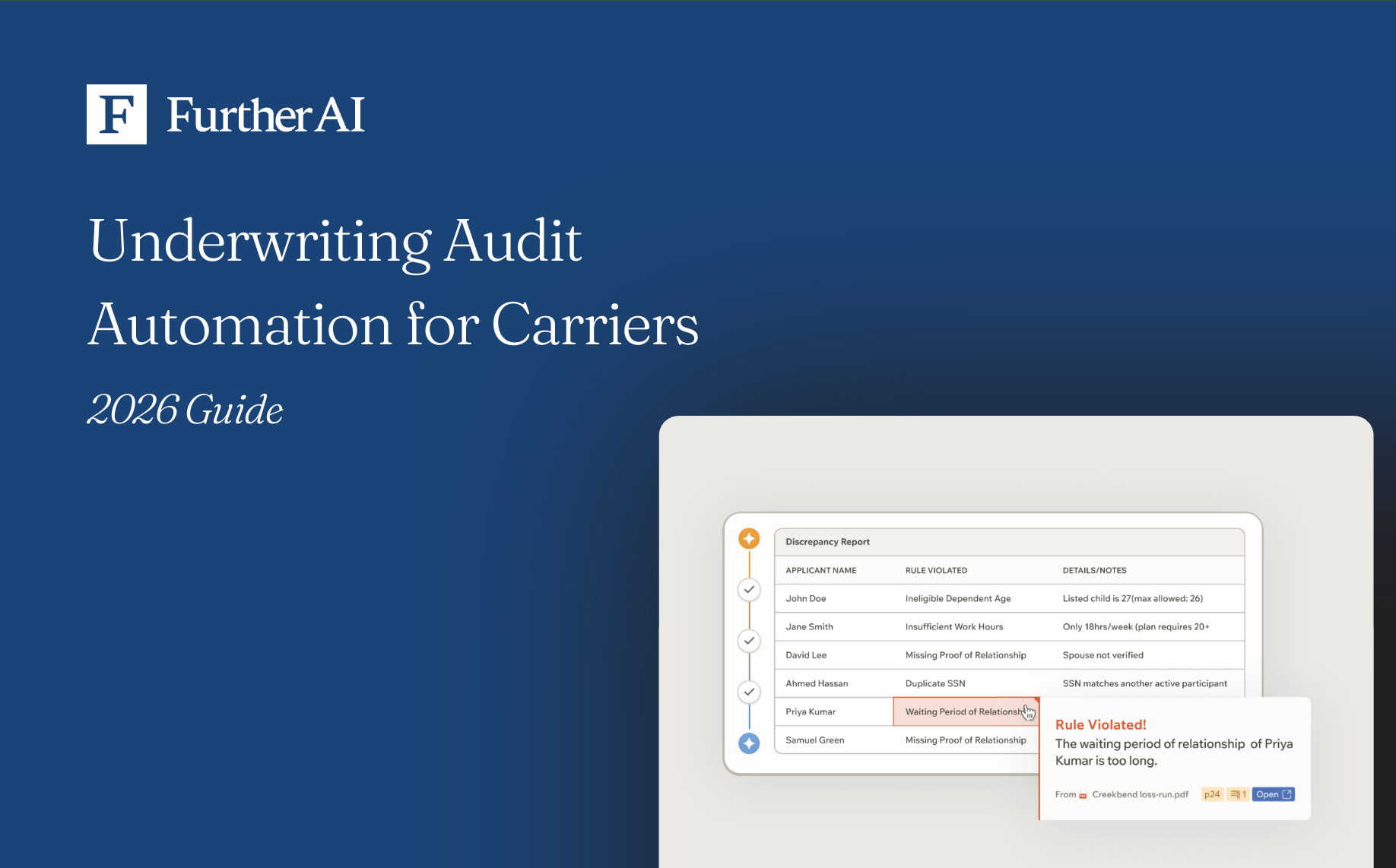
Underwriting audit automation lets a carrier review the underwriting files its managing general agents (MGAs) produce, check each one against the underwriting guidelines and binding authority that should have applied, and flag every violation with a citation to the source. Instead of sampling a handful of files by hand, a carrier can audit 100% of them and see exactly where a delegated program drifted outside its rules.
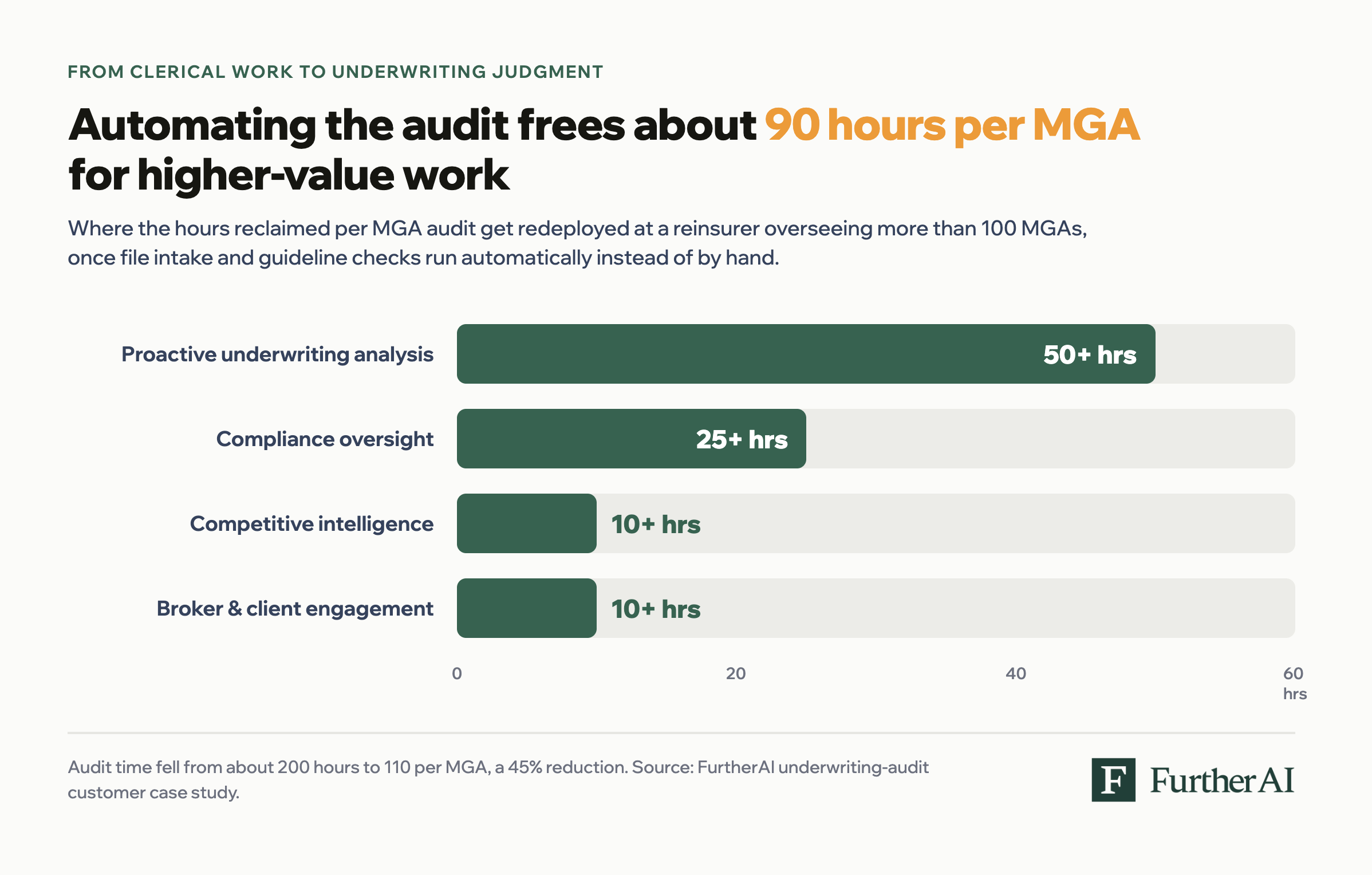
This is a distinct job from automating underwriting itself, and from reconciling the data MGAs report. The results are concrete: in a FurtherAI customer case study, a reinsurer overseeing more than 100 MGAs cut its audit from 200 hours to about 110 per MGA, a 45% reduction, by automating file intake and guideline comparison. This guide explains what carrier-side underwriting audits check, why manual sampling lets violations through, and what to look for in an audit platform.
Key takeaways
- Underwriting audit automation reviews completed underwriting files against guidelines and binding authority and flags violations, rather than automating the underwriting decision.
- It is separate from bordereaux management (which reconciles reported data) and from underwriting automation (which speeds up the decision).
- Manual audits sample a small share of files, so sampling risk lets clustered violations slip through; automation reviews every file.
- Lloyd's is explicit that delegation does not transfer underwriting accountability, which is why carriers must audit delegated business continuously.
- FurtherAI customers have cut audit time 45% and redeployed the reclaimed hours to analysis, compliance, and broker relationships.
What is underwriting audit automation for carriers?
Underwriting audit automation is software that examines the underwriting decisions made under a delegated program and confirms each one followed the rules. It reads the underwriting file, compares the bound risk against the carrier's guidelines and the MGA's binding authority, and produces a structured, source-cited report showing where the two match and where they do not.
The audience is the carrier or reinsurer that has delegated underwriting to MGAs and now has to prove those MGAs stayed inside their appetite. This is the work behind questions like "software for carriers to automate underwriting file audits" and "platforms that flag underwriting guideline violations during audits." It is oversight of the underwriting decision, not origination.
What underwriting audits check: guidelines and binding authority
A binding authority (also called a binder or delegated authority) is the contract that lets an MGA bind risks on a carrier's behalf, within defined limits on class, size, geography, and terms. An underwriting audit checks whether the business the MGA actually bound stayed inside those limits and followed the carrier's underwriting guidelines.
In practice, that means answering questions for each file: was the risk inside the agreed appetite, was it rated and priced correctly, were the right terms and endorsements applied, and did it exceed any authority limit? A violation is a risk that should never have been bound as written, and finding it is the whole point of the audit.
This is different from reconciling the numbers an MGA reports. Verifying that premium, commission, and claims data tie out is bordereaux management, a related but separate discipline. Underwriting audit is about the decision behind each risk, not the data feed that summarizes it.
Binding authority is one of those terms that gets used well before it gets defined. If it's new to you, we've covered what binding authority actually means alongside the rest of the vocabulary an audit touches.
Why carriers must audit delegated underwriting
Delegated underwriting is now a core channel, which raises the stakes on oversight. US MGAs wrote roughly $128 billion in premium in 2025, growing at more than double the pace of the broader property and casualty (P&C) market, so a carrier's delegated book increasingly drives its results. At Lloyd's, roughly 39% of gross written premium flows through delegated arrangements, and the market treats monitoring that business as a discipline, not a formality.
The reason is accountability. Lloyd's guidance states plainly that "delegation does not transfer underwriting accountability," and that managing agents remain responsible for underwriting outcomes throughout the life of the agreement — a principle that applies just as squarely to US carriers overseeing their MGAs. It calls for regular monitoring and periodic independent review to catch performance drift before it becomes systemic. History backs this up: specialists note that weak monitoring of delegated business between 2013 and 2019 drove deteriorating loss ratios through poor risk selection and inadequate pricing.
For a carrier overseeing dozens of MGAs, the audit is the mechanism that turns accountability into evidence. The challenge is doing it across every program without a proportional increase in headcount.
Why manual underwriting audits miss violations
Most carriers audit delegated underwriting by sampling. A reviewer pulls a small set of files per MGA, works through them by hand, and infers the health of the program from the sample. The method is a response to limited time, and it has a structural blind spot the auditing profession calls sampling risk — the chance that a conclusion drawn from a sample differs from what a full review would show. As the PCAOB's sampling standard notes, the smaller the sample, the greater that risk.
Guideline violations are precisely the kind of problem sampling misses, because they cluster in one class, one program, or one underwriter rather than spreading evenly. A clean sample can sit next to a systemic breach.
The manual process is also slow for the wrong reasons. McKinsey finds that underwriters spend 30% to 40% of their time on administrative tasks such as rekeying data. In the reinsurer engagement above, roughly half of every 200-hour audit went to extracting and organizing data before any expert judgment began. That is effort spent finding the files, not evaluating them.
How underwriting audit automation works
Modern platforms apply the same review to every file rather than a sample. At FurtherAI, the underwriting audit runs in three moves.
First, the platform reads each underwriting file and pulls the details of the bound risk, in any format and without manual keying. Second, it tests that risk against the rules that should have applied — the MGA's underwriting guidelines and binding-authority limits on appetite, class, size, pricing, and terms — and marks anything outside them as a violation. Third, it returns each violation next to the document and rule that triggered it, so a reviewer can confirm and act.
Because the review runs automatically, the software surfaces violations across the whole book continuously, instead of once a year on a sample. That shift is what compresses a 200-hour audit and lets a team hold every MGA to the same underwriting standard.
Key features to look for in underwriting audit software
Not every tool that reads documents can support a defensible carrier audit. Weigh these capabilities against your delegated portfolio.
Explainability carries the most weight. A flagged violation is only useful if a reviewer can trust and defend it, which is why source-cited findings beat an opaque risk score. For a broader view of AI capabilities across the MGA lifecycle, see our guide to the best agentic AI platform for MGAs.
Applying consistent guideline checks across every MGA
Consistency is where automation pays off most clearly. A carrier auditing three MGAs can hold each to its guidelines by hand; a carrier auditing 100 cannot apply the same appetite, pricing, and authority checks to every file that way without adding a team. Full-population automation removes that ceiling and holds every program to one standard, so a violation in the twelfth MGA is caught as reliably as one in the first.
In our underwriting-audit engagement, the reinsurer cut each audit to about 110 hours from 200 and freed more than 90 hours per MGA. That reclaimed time moved to higher-value work rather than disappearing, as the chart below shows.
Across the platform, FurtherAI supports roughly $30 billion in premiums across more than 20 lines of business in nearly 50 states, which gives carriers one consistent audit standard across every delegated program. Reconciling the premium and bordereaux data those same programs report is a separate job, covered in software for bordereaux management.
How it differs from underwriting automation and bordereaux management
Carriers often run all three of these capabilities, so it helps to keep them straight. Each checks a different thing and answers a different question.
The short version: underwriting automation speeds the decision, bordereaux management reconciles the data, and underwriting audit verifies the decision after the fact. MGAs producing their own audit-ready files is a fourth, related workflow we cover in audit-ready underwriting summaries for MGAs.
Underwriting audit automation with FurtherAI
FurtherAI brings insurance-specific AI to the carriers and reinsurers that oversee delegated underwriting. Our platform reads each underwriting file, compares it against the MGA's guidelines and binding authority, and returns source-cited findings your team can act on, so you can audit every program on one schedule with a defensible trail behind each decision.
If your team is sampling underwriting files by hand or stretching a fixed audit budget across a growing panel of MGAs, underwriting audit automation is the fastest way to move from spot checks to full coverage. Explore how we support audit and oversight leaders on our solutions overview, or see the workflow built for carriers.
REFERENCES
Conning. "U.S. MGA Premiums Reach $128 Billion as Market Evolution Continues." Reported by Insurance Business Magazine, July 28, 2026. insurancebusinessmag.com
Lloyd's. "Delegated Underwriting Guidance." Lloyd's Market Resources. lloyds.com
McKinsey & Company. "From Art to Science: The Future of Underwriting in Commercial P&C Insurance." mckinsey.com
FurtherAI. "45% Reduction in Underwriting Audit Time." FurtherAI Customer Stories. furtherai.com
Pro Global. "Proactive Audits and Delegated Authority: The Next Wave of Market Risk." pro-global.com
Public Company Accounting Oversight Board (PCAOB). "AS 2315: Audit Sampling." pcaobus.org
DISCLAIMER
This article is for general informational purposes only and does not constitute legal, regulatory, compliance, underwriting, or other professional advice. The content reflects information available as of the date of publication, and FurtherAI undertakes no obligation to update it as laws, regulations, or AI technologies evolve.
Recent posts
Ready to go further and
transform your insurance ops?
Reclaim your time for strategic work and let our AI Assistant handle the busywork. Schedule a demo to see how you can achieve more, faster.




.svg)