FurtherAI Available in Microsoft Marketplace
Introducing Connectors



Commercial Insurance, Explained: A Plain-English Guide

Summary
Commercial insurance works on one idea: all businesses pay a small, predictable amount of money so that the few who suffer a large, unpredictable loss are reimbursed for it. Everything else (the forms, the jargon, the hundred-page policies) is detail hanging off that idea.
This guide covers the whole picture in about 20 minutes. You'll learn who the four parties are and what each one does, the four words that describe every dollar that moves, how a deal travels from a broker's email to a signed policy, which documents show up along the way, and the handful of distinctions that trip up newcomers more than anything else. A glossary of roughly 40 terms sits at the end.
We wrote it originally for people joining FurtherAI who had never worked in insurance, so no prior knowledge is assumed.
Key takeaways
- Insurance is the business of pricing uncertainty. Insurers are obsessive about two questions: how likely is a loss, and how big would it be. Nearly every document and process exists to answer one of those two questions.
- Four parties show up over and over. The insured buys coverage, the broker markets the risk, the carrier holds it and pays claims, and the reinsurer de-risks the carrier. Money flows one way and risk flows the other.
- Four words describe every dollar. Premium is the price, the deductible is what you pay first, the limit is the most the carrier will pay, and the claim is the request for payment.
- A commercial deal has a fixed shape. Submission, triage, underwriting, quote, bind, policy, endorse, claim. Knowing that sequence is the fastest way to understand any conversation about commercial insurance.
- Coverage attaches to what's on the schedule. If a location, vehicle, or entity isn't listed, it usually isn't covered. The accuracy of those lists is a financial question, not a clerical one.
What commercial insurance actually is
The whole industry fits in one sentence: a lot of people each pay a small, predictable amount of money so that the few who suffer a large, unpredictable loss get reimbursed for it.
Picture a thousand restaurants that each pay $8,000 a year. Three of them burn down, the money from the 1000 pays to rebuild the three, the insurance company retains the difference, and its entire business is being right about how many will burn.
Getting that estimate right is the whole game. If you price it too high, customers go elsewhere. If you price it too low, you pay out more than you took in. So insurers care intensely about two questions: how likely is a loss, and how big would it be.
Commercial insurance versus personal insurance
All it takes to insure your car is filling out a form and providing a credit card. Insuring a haulage firm with 300 trucks across nine states, in its turn, requires a negotiation, backed by a folder of documents and a human being deciding whether to take the risk at all.
That second world is commercial insurance. It's where the documents are, where the money is, and where the manual effort concentrates. Everything below describes that world.
Who's who: The four parties
Four kinds of organizations show up again and again, and the diagram below shows how they connect.
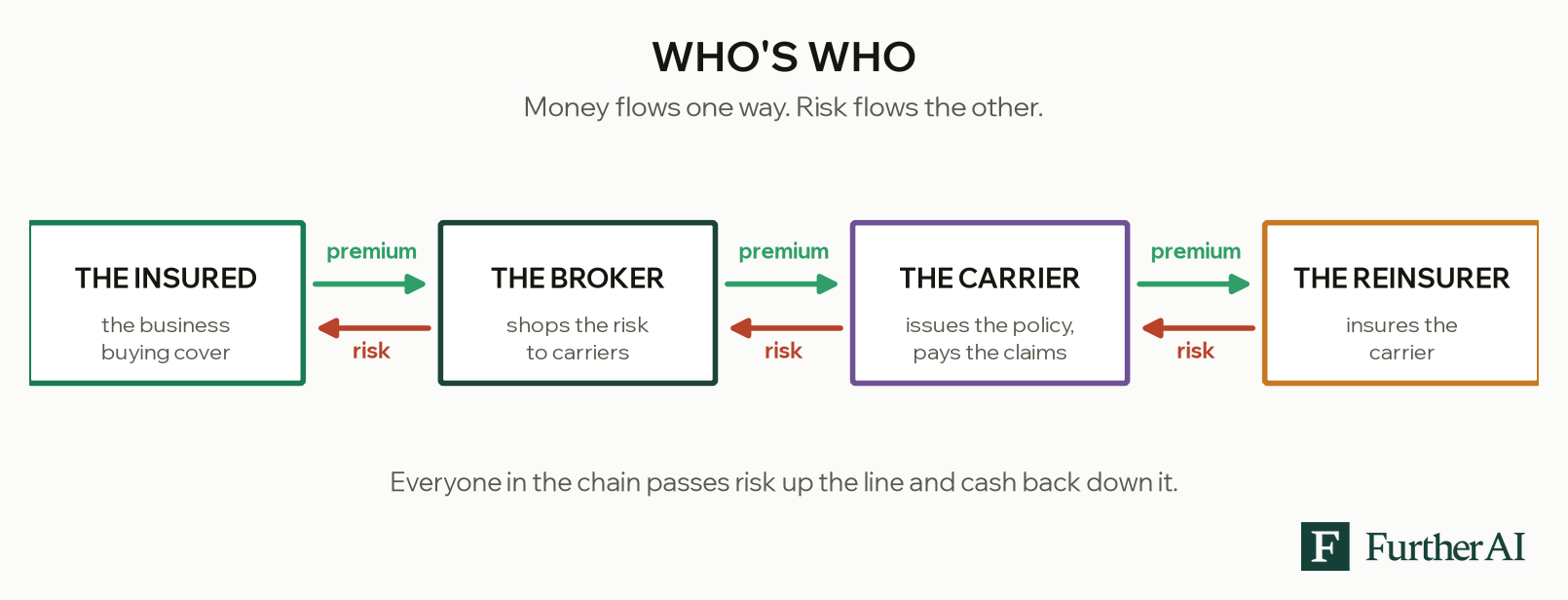
The insured is the business buying the coverage, also called the client or the account. Note that "the insured" is a noun, not an adjective. When someone asks "who's the insured on this?" they mean "which company is being covered?"
The broker is an intermediary who works on behalf of the insured. They take that business's risk to several carriers and find the best terms. Agents, confusingly, typically represent the carrier rather than the customer. Both earn commission on the premium.
The carrier is the insurance company. It issues the policy, holds the risk, and pays the claims. You'll also hear it called the insurer, the market, or the underwriter — that last one confusingly also means a person.
The reinsurer insures the insurer. Carriers buy reinsurance to cap their own downside. It's mostly invisible day to day, but it's how a Florida hurricane's cost gets spread worldwide instead of bankrupting one firm.
The four money words
If you learn only four terms, learn these. Together they describe every dollar that moves in an insurance relationship.
The deductible and the limit are easiest to understand together, because they bracket the coverage from opposite ends.
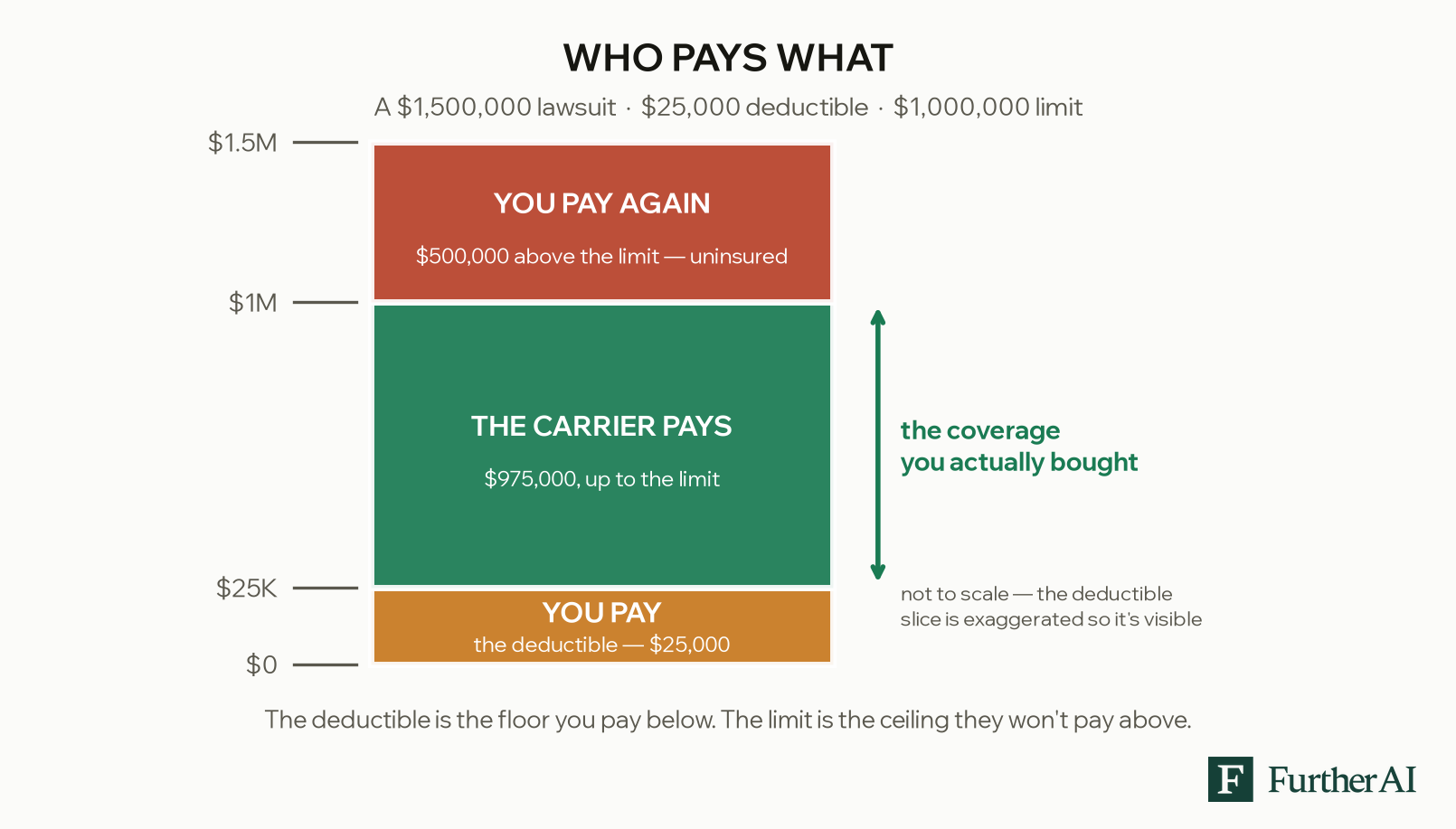
Say a business with a $25,000 deductible and a $1,000,000 limit faces a $1.5M lawsuit. The insured pays the first $25,000. The carrier pays the next $975,000, which takes it to the $1M ceiling. The remaining $500,000 is uninsured, and the insured pays that too. You pay at both ends.
Why deductibles exist at all
There are two reasons why deductibles exist. Processing a $300 claim costs the carrier more in paperwork than the claim is worth. And a deductible keeps the insured invested in not having losses, because the first slice of the cost is theirs.
The trade-off is straightforward: a higher deductible means a lower premium, because the insured is absorbing more of the risk themselves.
Retention and self-insurance
Retention, or self-insured retention (SIR), is a risk a company deliberately keeps on its own books rather than transferring to a carrier. It behaves like a large deductible, with one structural difference: the company handles and pays those claims itself before the carrier is involved at all.
Big companies with predictable losses retain more, because paying a carrier to process routine small claims is just paying a markup on their own money.
When one carrier isn't enough
A hospital system or a national trucking firm might need $50 million of liability cover. No single carrier wants that much exposure to one customer, so the coverage gets built in layers. That structure is called a tower.
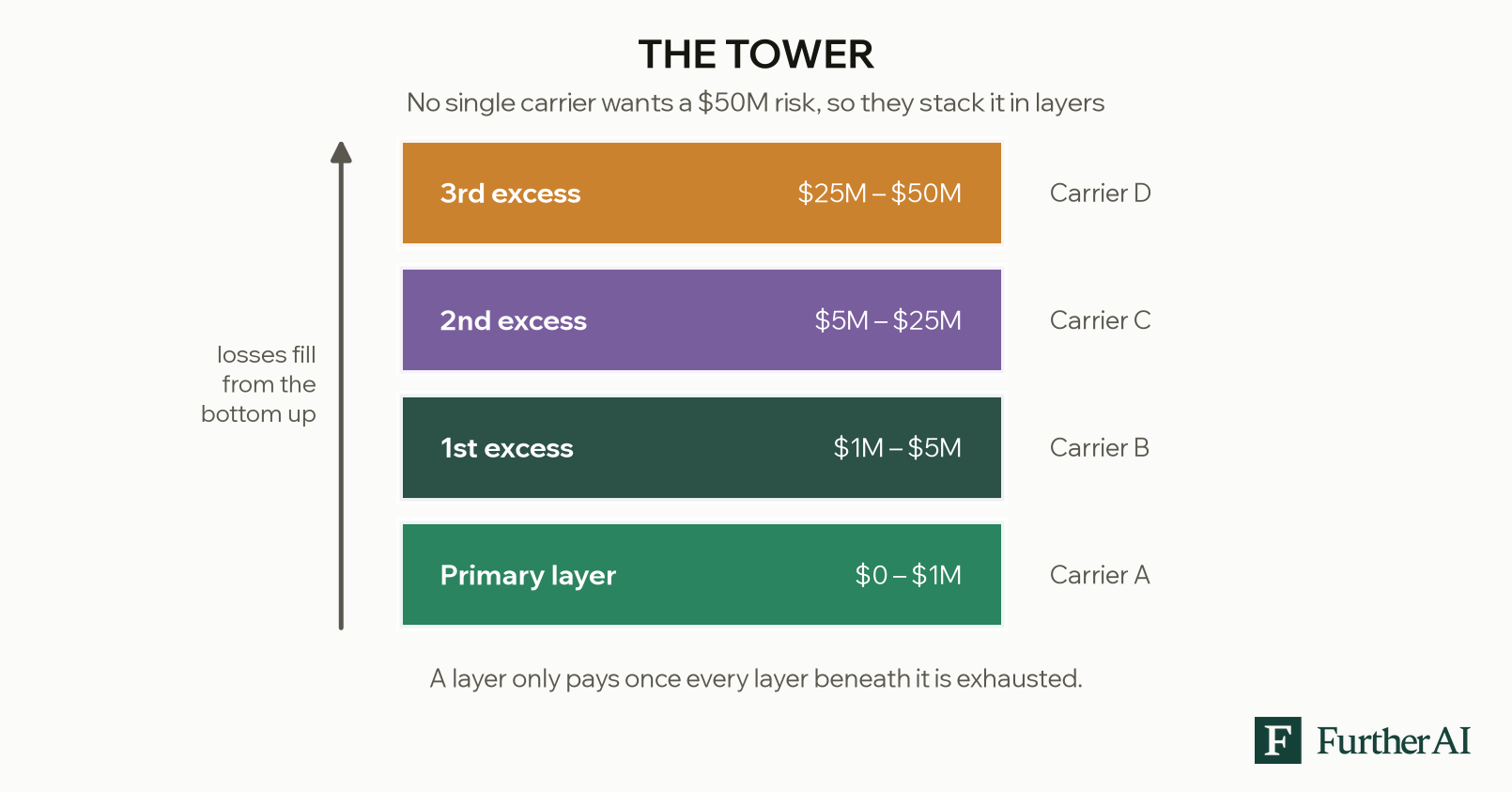
Losses fill the tower from the bottom up. A layer only pays once every layer beneath it is exhausted.
You'll see this written as "$1M primary / $50M tower." Say a $12 million claim lands against that tower. Carrier A pays its full $1 million and is exhausted. Carrier B pays its full $4 million, taking the running total to $5 million. Carrier C covers the remaining $7 million, using a little over a third of its $20 million layer. Carrier D pays nothing.
Carrier D still collected premium for the year, which is why the upper layers of a tower cost far less per dollar of cover than the primary layer does. They're only reached by the rare loss that burns through everything beneath them.
Two related terms sit in this area. An excess policy is a layer that follows the terms of whatever sits underneath it and simply adds height. An umbrella also adds height but can broaden the coverage as well, sitting above several different underlying policies at once.
How a commercial insurance deal actually happens
A commercial deal has a fixed shape. Understanding this sequence is the fastest way to follow any conversation in the industry.

Binder versus quote versus policy versus COI — the one people mix up
These four documents get confused constantly, so it's worth being precise.
A quote is an offer: "we would cover you for this much." Nothing is set in stone.
A binder is temporary but real coverage, issued the moment the deal is agreed, because the insured often needs proof today. The bank won't fund the mortgage and the truck can't leave the lot without it.
A policy is the full contract that replaces the binder weeks later, often dozens or even hundreds of pages.
A certificate of insurance (COI) is none of these. It's a one-page proof shown to a landlord or client that coverage exists.
What's in the envelope
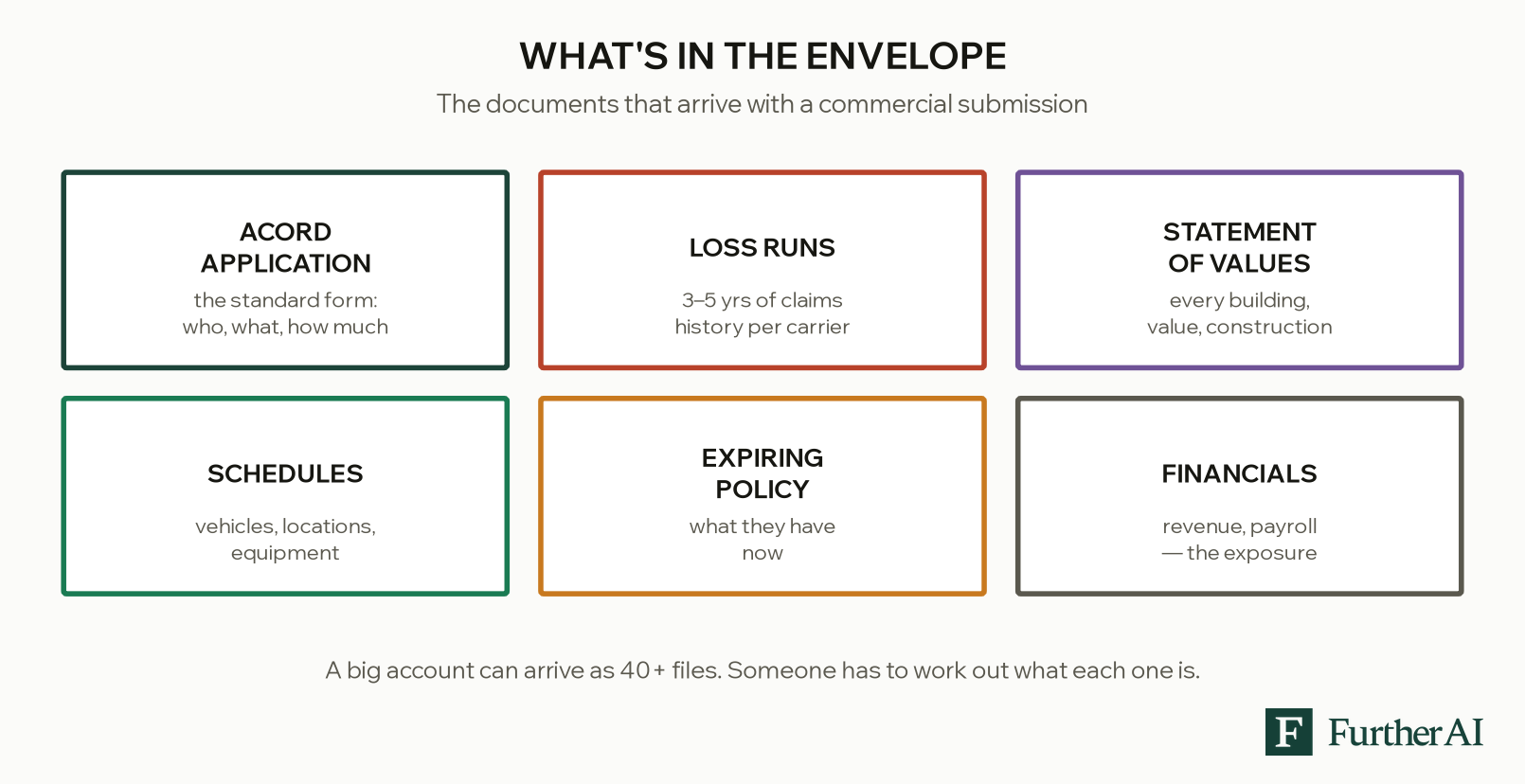
A mid-sized commercial submission arrives as a folder of files in wildly inconsistent formats. A big account can arrive as 40 or more.
The two that matter most
Loss runs are the single most important document in commercial underwriting. A loss run is a report from a carrier listing every claim the insured has filed over the years: date, description, amount paid, amount still reserved for future payment, and whether the claim is open or closed.
They matter because they're the closest thing to evidence. A trucking company will tell you they run a safe operation. The loss run tells you whether they've had 11 accidents in four years. Underwriters read these first, and they're miserable to read manually, because a five-year history means several documents from several carriers, each laid out differently. Automating loss run processing is one of the clearest wins available in underwriting operations for exactly that reason.
The statement of values (SOV) is the property equivalent. It's a spreadsheet with one row per building: address, construction type, square footage, year built, replacement cost, contents value, and lost business income if it had to shut down. For a large account it runs to hundreds of rows, and every row affects the price. Getting SOV data structured accurately at intake is what keeps pricing defensible later.
Schedules, and why the list is the coverage
A schedule is any list attached to a policy enumerating what's covered: vehicles, locations, equipment, named insureds.
The critical point for newcomers: coverage attaches to what's on the schedule. If a location isn't listed, it usually isn't covered. So the accuracy of that list is a real financial question, not clerical tidiness. This is why automated extraction has to be right rather than roughly right.
The ACORD application
ACORD is the Association for Cooperative Operations Research and Development, a non-profit founded in 1970 that maintains the standardized forms the industry runs on. The ACORD application is the standard form capturing who the business is, what they do, and how much cover they want.
Standardized doesn't mean uniform in practice. The forms arrive scanned, photographed, partially completed, and attached to emails under names like "final_v3.pdf," which is why ACORD form data extraction is harder to automate than it sounds.
Exposure: What the price is calculated from
Exposure is the measurable unit of risk that premium is calculated from. Different lines of business use different bases, which is why financial documents show up in a submission at all.
Four things that surprise people
Exclusions — insured doesn't mean insured for everything
Every policy carries a list of things it specifically will not cover. Standard homeowner's insurance excludes flood, which is why flood coverage is sold separately and why so many people discover the gap at the worst possible moment. Commercial policies commonly exclude war, nuclear incidents, and intentional acts.
Most unpleasant surprises in insurance come from exclusions, because people assume "covered" means "covered for anything," but it almost never does.
Occurrence versus claims-made
A subtle distinction that causes real disputes. It turns on which date the policy pays attention to.
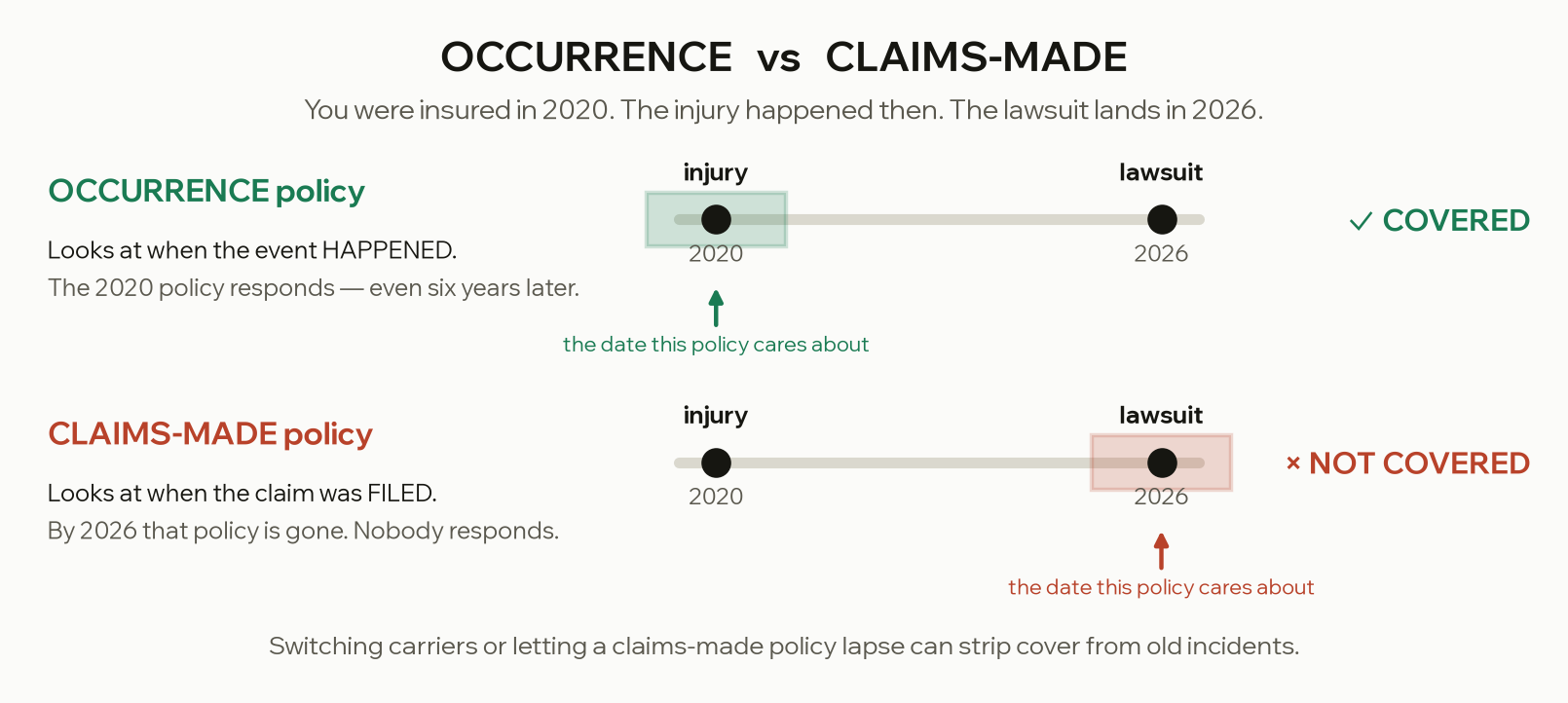
An occurrence policy looks at when the event happened. If you were insured in 2020 and the injury happened then, the 2020 policy responds even if the lawsuit lands six years later.
A claims-made policy looks at when the claim was filed. By 2026 that policy is gone, and nobody responds.
General liability is usually written on an occurrence basis. Professional liability and directors' cover are usually claims-made. Letting a claims-made policy lapse, or switching carriers carelessly, can quietly strip coverage from incidents that already happened.
Additional insured
Extending your policy to protect someone else. A landlord requires their tenant to name them as an additional insured, so that if someone is hurt in the tenant's space and sues the landlord, the tenant's policy responds.
Contracts in construction and property leasing demand this constantly, which is why businesses issue and chase thousands of certificates.
CAT — the thing that keeps carriers awake
CAT is short for catastrophe: hurricane, earthquake, wildfire, flood, or major storm. What makes a CAT different from an ordinary large loss is correlation. One event hits thousands of policies at once.
The usual math of insurance assumes losses are independent, and a CAT breaks that assumption. A portfolio that looks comfortably profitable on average can be wiped out by a single bad season in Florida, which is why carriers model CAT exposure obsessively and buy reinsurance against it.
A note on vocabulary
Insurance reuses ordinary words for specific things, and this trips up newcomers more than the genuinely technical terms do.
A binder is not a folder, a carrier is not a shipping company, retention has nothing to do with staff turnover, and a schedule is not a calendar. And, as surprising as it can be, a cat is a hurricane.
When a word seems oddly used, assume the insurance meaning first.
Where the manual work concentrates
Look back at the lifecycle diagram. Stages one and two (a submission arriving and someone working out what's in it) are where the manual effort piles up. An underwriter's scarce skill is judgment, and a large share of their day goes instead to retyping claim figures out of PDFs and reconciling spreadsheet columns.
That's the gap we work on at FurtherAI. The output we're aiming for is a prepared submission rather than a decision: the facts extracted, structured, and checkable, so the underwriter spends their time on the judgment call instead of the data entry. If you want the operational version of this guide, our walkthrough of the six stages of the underwriting workflow covers how teams are restructuring those steps.
If you remember nothing else
Insurance is the business of pricing uncertainty. A submission is a request to be insured. An underwriter decides whether to take it. The loss run tells them what actually happened in the past, and the schedule and exposure tell them how much is at stake.
Everything else is detail.
Glossary
Frequently asked questions
DISCLAIMER
This article is for general informational purposes only and does not constitute legal, regulatory, compliance, underwriting, or other professional advice. The content reflects information available as of the date of publication, and FurtherAI undertakes no obligation to update it as laws, regulations, or AI technologies evolve.
Recent posts


Ready to go further and
transform your insurance ops?
Reclaim your time for strategic work and let our AI Assistant handle the busywork. Schedule a demo to see how you can achieve more, faster.




.svg)