FurtherAI Available in Microsoft Marketplace
Introducing Connectors



Underwriting Workflow Software: The 2026 Buyer's Guide

Most underwriting technology gets sold as a feature list. You get a demo of document extraction, a slide about appetite scoring, a promise about integrations, and no clear answer to the question that actually matters: what happens to a submission from the moment it lands in the inbox to the moment it binds?
That question has six answers, and every platform on the market covers some of them well and others barely at all. This guide breaks the underwriting workflow into six stages, scores nine platforms on how much of each stage they genuinely handle, and gives you a way to run the comparison yourself.
We build one of the platforms in this guide. We've scored ourselves on the same rubric as everyone else, including where we stop short.
Key takeaways
- Underwriting workflow software covers six stages: intake, clearance, data extraction, risk summary, referral, and bind. For the intake stage alone, see our guide to submission processing platforms for carriers and MGAs. Almost no vendor covers all six with equal depth.
- Referral is the weakest stage across the entire market. Most platforms conflate appetite triage with authority-limit routing. They aren't the same thing, and only a handful automate the second one.
- Only core systems issue policies. Independent workbenches reach quote or binder management and hand off from there. Treat any vendor claiming end-to-end bind without a policy admin system with care.
- The category consolidated fast. Applied Systems acquired Cytora in September 2025, Duck Creek acquired Send in July 2026, and Guidewire took a strategic position in Sixfold's Series B in January 2026.
- Speed is a distribution issue as much as an efficiency one. In Ivans' 2026 survey, 54% of agents writing mostly commercial lines said they lose commercial deals every month because they can't reach the right markets fast enough.
What is underwriting workflow software?
Underwriting workflow software is the layer that moves a commercial or specialty insurance submission from arrival to decision. It ingests submissions from email, broker portals, and agency management systems; parses ACORD forms, statements of values, loss runs, and free-text threads; clears the account against duplicates, broker-of-record conflicts, sanctions lists, and appetite; extracts structured risk data from unstructured documents; assembles a risk summary the underwriter can read in minutes; routes the file to the right underwriter with the right authority; and passes the priced risk to a policy administration system to quote and bind.
It's distinct from a policy administration system, which is the system of record, and from a pricing or rating engine, which values the risk. Workflow software is the connective tissue: it decides what an underwriter sees, in what order, and with what context attached. Buyers evaluate it on stage coverage, integration depth, and auditability rather than on feature count.
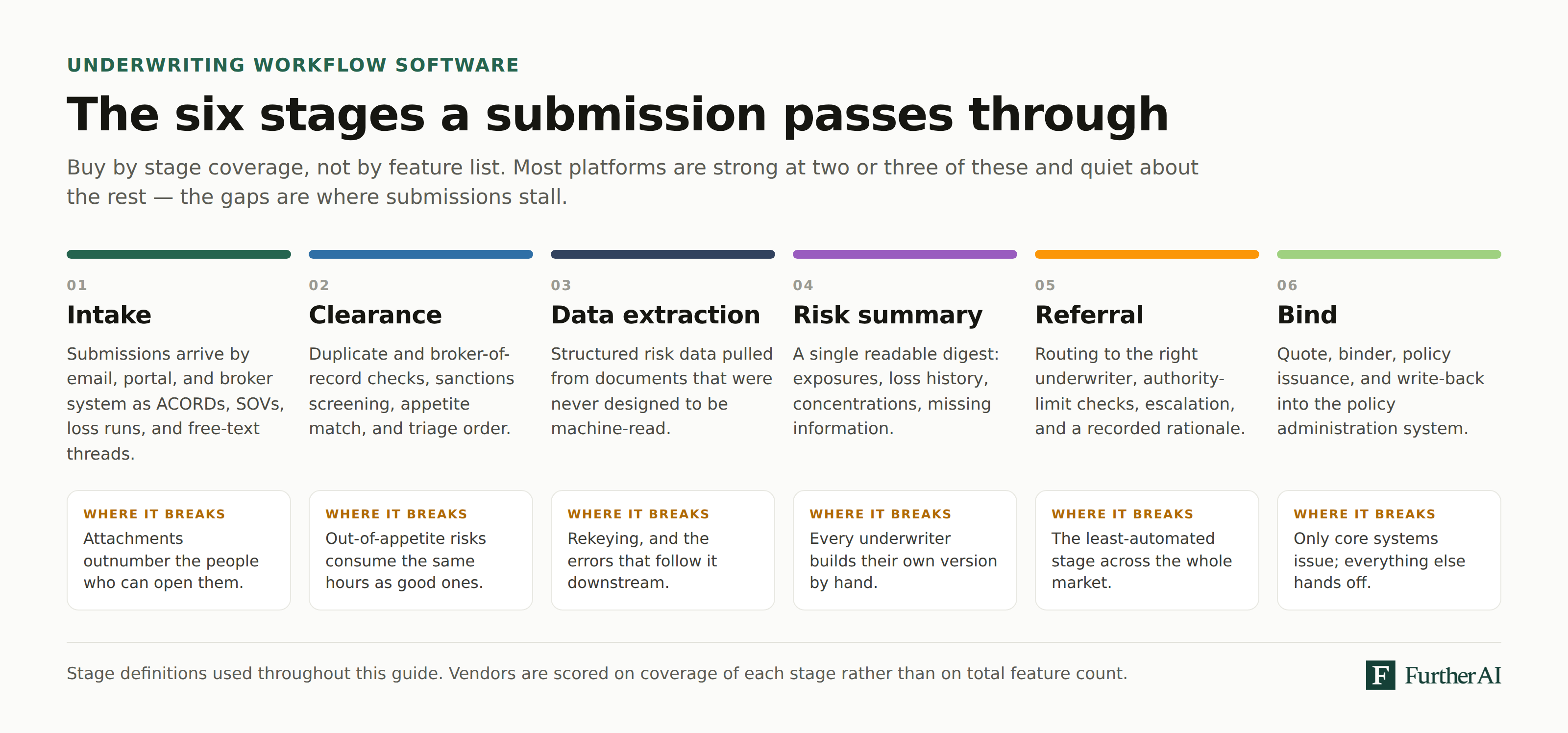
The six stages of the underwriting workflow
If any of these stage names are unfamiliar, start with how a commercial insurance deal moves from submission to bind. Every software decision below assumes you already know which stage you're trying to fix.
Stage 1: Intake
Submissions arrive as email threads with attachments, portal uploads, and broker system transfers. A single commercial property submission can carry an ACORD 125, an ACORD 140, a statement of values with thousands of locations, five years of loss runs, and a broker's cover note that contains the only mention of a material change in operations.
Where it breaks: volume. Surplus lines stamping offices recorded nearly 7 million premium-bearing items in 2024, a 9.5% rise on the prior year, according to WSIA's annual stamping office report. Attachments outnumber the people who can open them.
What good looks like: the system reads every attachment type without a template per broker, and it treats the email body as a document, not as packaging.
Stage 2: Clearance
Clearance answers whether you should be looking at this account at all. Is it a duplicate of something already in the system? Is there a broker-of-record conflict? Does anyone on it appear on a sanctions list? Does it fit appetite?
Where it breaks: an out-of-appetite risk consumes the same underwriter hours as a good one right up until someone declines it. Ivans' 2026 Agency-Carrier Connection Report, covering more than 700 agents, found that among those writing mostly commercial lines, 43% had reduced business with at least one carrier in the past month after the process broke down before a quote could be delivered. Across the full sample, 90% said they had reduced business with a carrier because of friction.
What good looks like: clearance runs before an underwriter opens the file, and the appetite decision carries a stated reason.
Stage 3: Data extraction
Pulling structured risk data out of documents that were never designed to be machine-read. Construction class from a narrative description. Sprinkler status from a footnote. Total insured value from a spreadsheet with merged cells and three header rows.
Where it breaks: rekeying, and the errors that follow it downstream. Re-keying data ranks as the top workflow pain point for 74% of agents in the Ivans survey. Agents who write more than 75% of their book in commercial lines report re-keying more than 70% of the time, against 62% at personal-lines-focused agencies.
What good looks like: extraction that reports its own confidence and points back to the page it read, so the underwriter can check rather than trust. Our guide to ACORD form data extraction covers what to test here.
Stage 4: Risk summary
The digest an underwriter actually reads: exposures, loss history with frequency and severity patterns, concentrations, coverage requested, and a list of what's missing.
Where it breaks: every underwriter builds their own version by hand, in their own format, and none of it is reusable at renewal or in an audit.
What good looks like: a consistent structure across the team, with every figure traceable to its source document.
Stage 5: Referral
Routing the file to an underwriter with the authority to write it, checking limits, escalating what exceeds them, and recording why the decision went the way it did.
Where it breaks: this is the least-automated stage in the market. Vendors routinely describe appetite triage as referral. Triage decides whether you want the risk. Referral decides who is permitted to sign it.
What good looks like: authority limits enforced in the system, escalation that routes rather than notifies, and a rationale record that survives an underwriting audit.
Stage 6: Bind
Quote issuance, binder management, policy issuance, and write-back to the policy administration system.
Where it breaks: the handoff. Independent platforms produce a priced, decision-ready risk and then pass it to a core system. That's a reasonable architecture, but it means "end to end" rarely means what a buyer assumes.
What good looks like: honest scoping, plus a documented connector to the core system you already run.
Why stage coverage beats feature count
Underwriters don't lose time evenly. They lose it in specific places, and the biggest single hole is at the front.
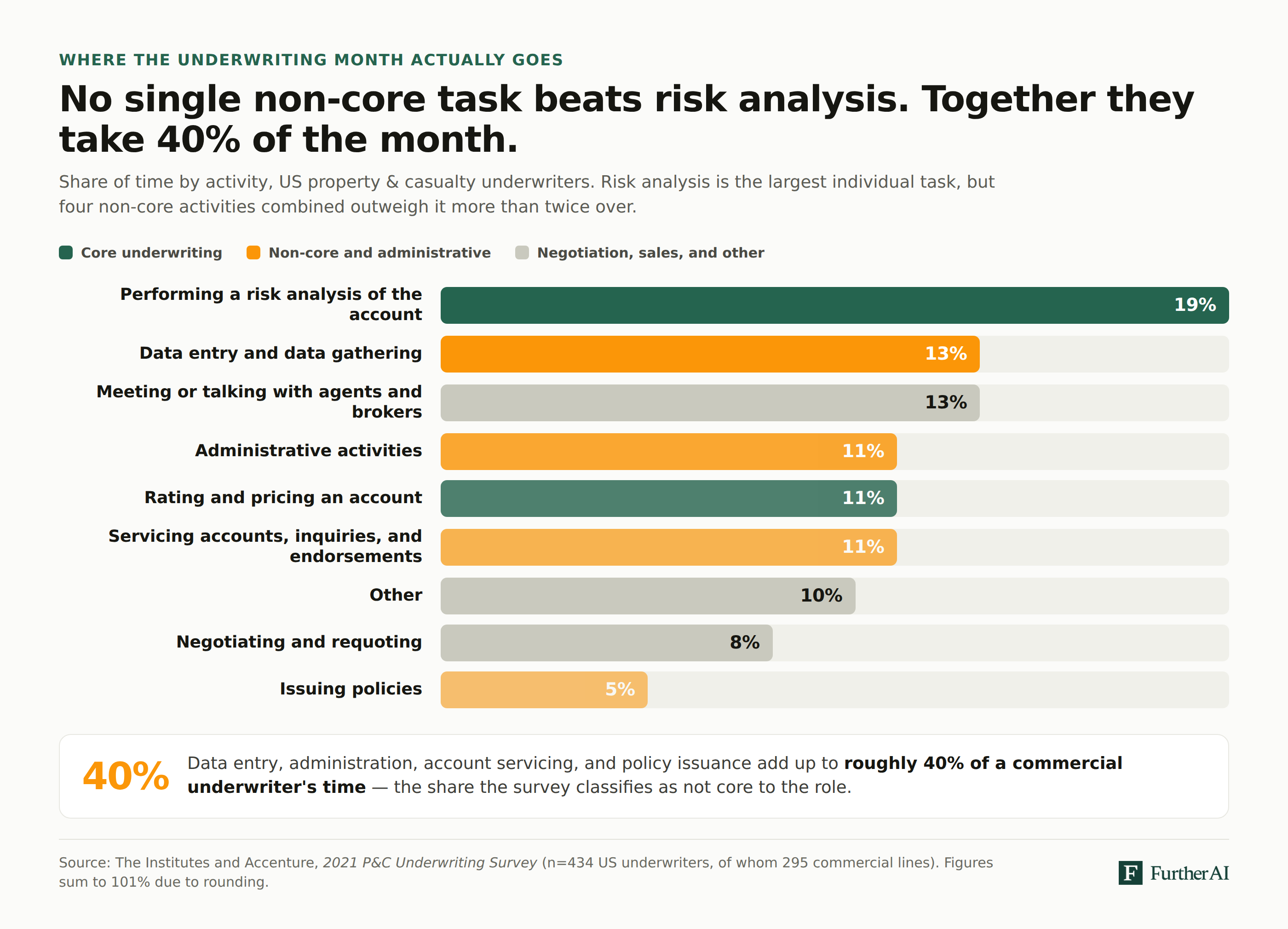
In the 2021 P&C Underwriting Survey from The Institutes and Accenture, which surveyed 434 US underwriters, risk analysis was the largest single activity at 19% of an underwriter's time. Data entry and data gathering took 13%.
That looks like a defensible split until you add up everything that isn't underwriting: data entry at 13%, administrative activities at 11%, account servicing at 11%, and policy issuance at 5%. Around 40% of a commercial underwriter's time went to tasks the survey classified as not core to the role, and 71% of commercial lines respondents put ineffective systems or redundant inputs and manual processes among their top three challenges.
That distribution tells you where to buy. No single non-core task is large enough to build a business case around, so the case lives in the aggregate. A platform that fixes data entry alone recovers 13%. One that also absorbs the administrative and servicing load reaches toward the full 40%. A platform with excellent extraction and no referral logic moves the bottleneck rather than removing it.
The economics are tight enough to make the choice matter. The US property and casualty industry ran a 25.2% expense ratio through the first half of 2025, on $124.0 billion of underwriting expenses, per the NAIC's mid-year industry analysis.
Underwriting workflow software compared
Nine platforms, scored on how much of each stage they cover. Vendors are listed alphabetically, not ranked. Full means the stage is a documented, named capability. Partial means the vendor covers some of the stage or the mechanism isn't publicly documented. N/A means the vendor doesn't offer it.
How we scored, and what we left out
Scores reflect publicly documented capability as of September 2026, drawn from trade press and vendor product documentation. Where a vendor implied a stage without describing the mechanism, we scored it Partial rather than Full.
Two companies that appear on similar lists aren't here, for the same reason. Gradient AI is a risk-scoring and loss-prediction engine, and Bevaya, formerly Roots Automation, centers on claims and policy servicing. Both are substantial businesses that a six-stage underwriting rubric would misrepresent.
Vendor-reported accuracy figures, unnamed customer tiers, and premium-on-platform numbers are self-reported across this entire category, ours included. Treat them as claims to test in a proof of concept, not as findings.
The nine platforms in detail
Convr
What it is: an AI underwriting workbench for commercial property and casualty, founded in 2016 and sold to carriers, MGAs, and brokers.
Stage strengths: the broadest stage claims of any independent here. Convr deployed agentic workflows in December 2025 covering referral summary generation, declinations, clearance and triage, and underwriting authority decisions — one of the few explicit authority-decision claims in the market.
Best for: mid-market commercial carriers that want a single workbench with appetite scoring and automatic declination flags.
Watch-out: it claims the widest stage coverage in this set with the least independently verified customer evidence, and the December 2025 announcement names no customers. Its last disclosed round was a $15.2 million Series B in November 2019, raised under its former name DataCubes. Ask for referenceable deployments at your size and line of business.
Cytora
What it is: a risk digitization platform that converts unstructured submission material into structured, routable data, spun out of the University of Cambridge in the early 2010s. Applied Systems acquired it in September 2025.
Stage strengths: digitization and routing across new business, renewals, mid-term adjustments, and first notice of loss. Markel reported a 113% increase in underwriting productivity after deploying it, and Zurich scaled it across five countries in 90 days in May 2026. Beazley is a named customer; Chubb uses Cytora for claims automation rather than underwriting.
Best for: large carriers digitizing high submission volume across the full policy lifecycle rather than new business alone.
Watch-out: it doesn't quote or issue, and the acquisition changes its independence. Applied is folding it into an agent-carrier data exchange strategy, which is an advantage if you sit in that ecosystem and a question if you don't.
Federato
What it is: an AI-native platform for carriers, MGAs, and mutuals, founded in 2020. It raised a $100 million Series D led by Growth Equity at Goldman Sachs Alternatives in November 2025, taking total funding past $180 million.
Stage strengths: submission through quote, plus billing, claims, and portal modules. Named customers include QBE North America, Ascot, Nationwide, and Velocity Risk.
Best for: carriers and MGAs that want portfolio-level steering — which risks to pursue against portfolio strategy, not only how to process the one in front of you.
Watch-out: its position has shifted. Federato's CEO has described it functioning as the effective core system for more than half its customer base. If you're shopping for a layer on top of what you already run, confirm which of those two things you're buying.
FurtherAI
What it is: an AI agent platform for insurance document and workflow automation, founded in 2023 and sold to carriers, MGAs, brokers, and reinsurers. It raised a $25 million Series A led by Andreessen Horowitz in October 2025.
Stage strengths: intake through risk summary, with appetite screening, eligibility checks, and bind-order verification as named workflows. An MGA managing over $1.5 billion in premium across 20+ programs cut average time to clear a submission from about 32 minutes to roughly one, and reported a 200% improvement in underwriting efficiency in the first three months while processing more than $20 billion in total insured value. Lynx Specialty attributes 35% growth to faster broker response rather than broker acquisition, with SVP Paul Ritter noting that "more brokers within our existing relationships are sending more submissions in, because we're responding so quickly."
Best for: teams that want one agent layer running underwriting, policy checking, and claims work without replacing the core system.
Watch-out: we verify bind orders, we don't issue policies, and routing-to-underwriter logic is lighter than what Sixfold or Send offer at the referral stage. If policy issuance is in scope, you need a core system alongside us — which is why we're pre-integrated with PolicyCenter and ClaimCenter through Guidewire PartnerConnect.
hyperexponential
What it is: a pricing decision intelligence platform for commercial property and casualty insurers and reinsurers. It raised a $73 million Series B led by Battery Ventures in January 2024.
Stage strengths: pricing sophistication is the asset. Hyperoperator, launched July 8, 2026, extended it into intake and extraction, taking a submission from broker email to triaged, priced risk with configured authority controls. Underwriting decisions on the platform now represent over $75 billion in annual premium, up from $45 billion a year earlier.
Best for: actuarial-led teams where the rating model is the center of gravity and workflow is built outward from it.
Watch-out: the workflow capability is roughly a year old. It's the only vendor here whose product identity is the pricing model itself, which is a strength if that's your gap and a mismatch if your problem is 400 unopened submissions.
Indico Data
What it is: a document intake and orchestration platform for insurance operations, sold to carriers, MGAs, and the London Market. Named customers include Allstate, Markel, and Convex.
Stage strengths: intake and extraction, with enrichment agents added in July 2025 that pull business credit, crime statistics, driver safety, and property characteristics. It holds a Ready for Guidewire validated accelerator for PolicyCenter on Guidewire Cloud — the clearest documented core-system integration in this comparison, though Guidewire is also a strategic investor in Indico, which is worth weighing when reading that validation.
Best for: Guidewire PolicyCenter shops that want validated intake automation feeding the system of record.
Watch-out: it deliberately isn't the underwriter's workspace. There's no risk summary layer and no quoting. Pair it with something that owns stages 4 through 6.
Kalepa
What it is: an AI underwriting platform for commercial and specialty insurers, MGAs, brokers, and reinsurers. It raised a $14 million Series A led by Inspired Capital in 2021; no later round is publicly confirmed.
Stage strengths: the most explicit clearance claims in the market — conflict detection, completeness verification, sanctions screening, and producer confirmation as named functions rather than implied ones. Named customers include Berkley's Admiral Insurance, Munich Re Specialty NA, Canopius US, Bowhead Specialty, and Merchants Insurance Group, with AmRisc, James River, and Church Mutual added through 2026.
Best for: commercial and specialty underwriters whose gap is external data on the risk itself, not just the documents the broker sent.
Watch-out: it integrates with core systems but names no specific policy admin connectors publicly. Authority-limit checking and escalation routing aren't documented.
Send
What it is: an AI-native underwriting workbench for commercial, specialty, and complex risk, founded in London in 2017. Duck Creek acquired it in July 2026, and it now anchors what Duck Creek markets as an agentic underwriting-to-core platform.
Stage strengths: the widest genuine coverage in this set, from submission management and bordereaux ingestion through quote and rate lifecycle management, binder management, and post-bind processing. Named customers include Aviva, Everest, Convex, The Hartford, and RenaissanceRe.
Best for: London Market, delegated authority, and reinsurance structures that need real post-bind processing rather than a handoff.
Watch-out: the independent-workbench framing is gone. If your reason for buying a workbench was to avoid committing further to a core system vendor, this now sits on the other side of that line. The combined product is roughly a year old and no joint customer outcomes are public yet.
Sixfold
What it is: an AI underwriting assistant that reads a carrier's own underwriting guidelines and applies them to risk data, founded in 2023. It raised a $30 million Series B led by Brewer Lane in January 2026, with Guidewire participating as a strategic investor.
Stage strengths: guideline-grounded reasoning, and the clearest referral story here — standardized case summaries for referral and peer review, plus automated rationale records for audit. Sixfold reports that Zurich North America saves up to two hours per submission and that Skyward Specialty saw 35% faster quote response; both figures come from Sixfold's own materials rather than the customers'. Skyward has separately said publicly that "bionic underwriting" cut its submission times by 40%.
Best for: carriers whose bottleneck is referral, peer review, and defending decisions to an auditor or regulator.
Watch-out: deliberately narrow. It's an overlay that assumes your intake already works, and it doesn't quote or bind. Scope it as one stage done well.
What about core system workbenches?
Guidewire and Duck Creek both now sell underwriting workflow capability directly. Guidewire's UnderwritingCenter covers intake, clearance including broker license validation and sanctions checks, extraction, and risk summary, and its August 2026 Qusar release added a set of AI agents across the suite. Duck Creek acquired that capability outright with Send.
The trade-off is the same one it has always been. A core-system workbench gives you the deepest possible integration with the system of record and the only genuine path to policy issuance inside one vendor's stack. It also requires that stack. Guidewire's UnderwritingCenter is currently in an early access program with no named customers published, which is worth weighing against independents that have been in production for years.
If you're working through that decision, we've written separately about choosing between horizontal tools and insurance-specific platforms and about building versus buying underwriting automation.
How to run your own evaluation
Score vendors yourself rather than accepting a feature matrix. Six questions, one per stage:
- Intake: send 20 of your worst real submissions, including the broker who attaches everything as photographs of printouts. Measure what parses without configuration.
- Clearance: ask specifically whether the system detects duplicates and broker-of-record conflicts, or only matches appetite. Get the answer in writing.
- Extraction: require field-level confidence scores and source citations. Build a gold set of 50 documents you've already keyed by hand and measure precision per field type, not overall accuracy.
- Risk summary: ask two of your underwriters to work a live account from the generated summary alone and tell you what they had to go find themselves.
- Referral: ask the vendor to demonstrate an authority-limit breach being routed and recorded, end to end. This is where demos usually stop.
- Bind: confirm what the system actually issues, if anything, and get the name of the connector to your policy admin system plus a customer running it.
Then ask about governance. Twenty-five jurisdictions have now adopted the NAIC's Model Bulletin on the Use of Artificial Intelligence Systems by Insurers, which expects documented AI governance programs. Any system touching an underwriting decision needs to produce a rationale record you can hand to a regulator.
What changed in 2025 and 2026
Consolidation defined the last 18 months. Two independents were acquired by incumbents, and a third took strategic investment from one. The category of genuinely independent workbenches is smaller than it was a year ago, and buyers evaluating a standalone platform should ask directly about acquisition posture.
Adoption is moving underneath that. Accenture's Underwriting Rewritten study, based on 430 senior underwriting executives across 11 countries, found insurers expect AI use in underwriting to rise from 14% to 70% within three years. In Europe, EIOPA's February 2026 survey of 347 undertakings found nearly two-thirds already using generative AI, with 64% of use focused on back-end productivity including data extraction and underwriting assistants.
The talent picture makes the timing awkward to ignore. The US Bureau of Labor Statistics projects insurance underwriter employment to fall 4% between 2025 and 2035 while roughly 6,800 openings appear each year, nearly all of them replacing people who retire or leave. Submission volume isn't falling with it.
Frequently asked questions
REFERENCES
Accenture. "Underwriting Rewritten." Accenture, August 25, 2025. accenture.com
BusinessWire. "Federato Raises $100 Million Series D Led by Growth Equity at Goldman Sachs Alternatives." BusinessWire, November 18, 2025. businesswire.com
Carrier Management. "Duck Creek Acquires Underwriting Workbench Provider Send." Carrier Management, July 15, 2026. carriermanagement.com
Convr. "DataCubes Raises $15.2 Million Series B." Convr, November 14, 2019. convr.com
EIOPA. "EIOPA Survey on Generative AI Shows Swift, Cautious Adoption Among Europe's Insurers." European Insurance and Occupational Pensions Authority, February 2, 2026. eiopa.europa.eu
FinTech Global. "Insurtech Firm Sixfold Secures $30m to Advance AI Underwriting." FinTech Global, January 30, 2026. fintech.global
FinTech Global. "Kalepa's Copilot Platform Selected by Merchants Insurance Group." FinTech Global, August 9, 2024. fintech.global
FurtherAI. "Submissions Processing." FurtherAI. furtherai.com
Insurance Journal. "Applied Systems Acquires Cytora." Insurance Journal, September 9, 2025. insurancejournal.com
Insurance Journal. "FurtherAI Raises $25 Million to Automate Insurance Workflows." Insurance Journal, October 9, 2025. insurancejournal.com
NAIC. "2025 Mid-Year Property & Casualty and Title Insurance Industries Analysis Report." National Association of Insurance Commissioners, 2025. content.naic.org
NAIC. "Adoption Map: Model Bulletin on the Use of Artificial Intelligence Systems by Insurers." National Association of Insurance Commissioners, August 6, 2026. content.naic.org
Reinsurance News. "Hyperexponential Launches Hyperoperator to Automate Commercial P&C Underwriting Workflows." Reinsurance News, July 2026. reinsurancene.ws
Risk & Insurance. "Re-Keying and Workflow Friction Are Costing Carriers Placement, Ivans Survey Finds." Risk & Insurance, August 28, 2026. riskandinsurance.com
Skyward Specialty. "Skyward Specialty and Sixfold Partner to Advance AI-Powered Underwriting." Skyward Specialty, December 18, 2025. skywardinsurance.com
TechCrunch. "NYC-Based Insurance Underwriting Platform Kalepa Raises $14M Series A." TechCrunch, September 3, 2021. techcrunch.com
The Institutes and Accenture. "2021 P&C Underwriting Survey." The Institutes, December 2021. riskandinsurance.com
US Bureau of Labor Statistics. "Insurance Underwriters." Occupational Outlook Handbook, August 27, 2026. bls.gov
WSIA. "2024 Surplus Lines Stamping Office Annual Report." Wholesale & Specialty Insurance Association, February 5, 2025. wsia.org
DISCLAIMER
This article is for general informational purposes only and does not constitute legal, regulatory, compliance, underwriting, or other professional advice. The content reflects information available as of the date of publication, and FurtherAI undertakes no obligation to update it as laws, regulations, or AI technologies evolve.
Recent posts

Ready to go further and
transform your insurance ops?
Reclaim your time for strategic work and let our AI Assistant handle the busywork. Schedule a demo to see how you can achieve more, faster.




.svg)