FurtherAI Available in Microsoft Marketplace
Introducing Connectors



7 Critical Factors MGAs Should Evaluate When Building vs Buying Underwriting Automation

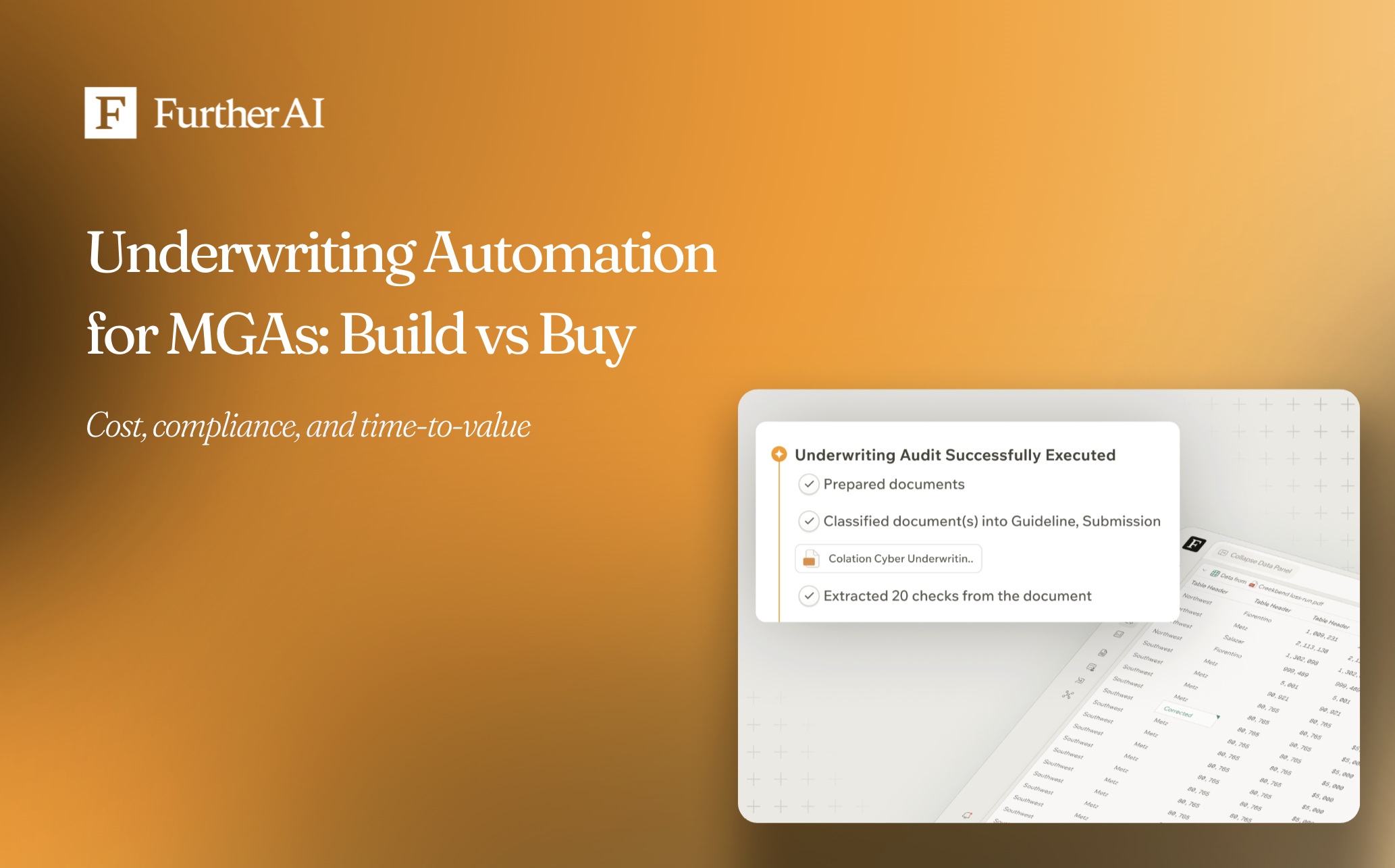
For most managing general agents (MGAs), buying a ready-made underwriting automation platform beats building one in-house. Buying delivers faster time-to-value, lower total cost, and built-in compliance controls, while building only pays off when you have unique data, in-house engineering depth, and a workflow so differentiated that no vendor can match it. This guide walks through the seven factors that decide which side of that line your firm falls on.
The stakes are real. The U.S. MGA market wrote an estimated $114.1 billion in direct premiums in 2024, up 16% year over year and outpacing the wider property-casualty market, according to Conning's 2025 MGA study. Growth like that rewards MGAs that can quote faster and bind more without adding headcount, and underwriting automation is how they do it.
Build versus buy is one decision inside a bigger evaluation. Our guide to choosing AI for underwriting walks through the rest.
Key takeaways
- Buy for speed and certainty. A platform can deliver measurable results in weeks; a custom build typically takes months to years, and large IT projects run 45% over budget and deliver 56% less value than predicted.
- Build only with a real moat. Building makes sense when you have proprietary data, specialized engineering talent, and a genuinely novel product line that off-the-shelf tools can't configure around.
- Compliance favors buying. Vendor platforms ship with the governance, audit trails, and explainability that regulators now expect under the NAIC Model Bulletin on AI.
- Integration is the hidden cost. Data preparation alone can consume nearly half of a data team's time (about 45%), whether you build or buy.
- Results speak. MGAs using FurtherAI have cut submission clearance time from ~32 minutes to ~1 minute (30x faster) and gained 200%+ underwriting efficiency.
What underwriting automation means for MGAs
Underwriting automation is the use of software, and increasingly AI, to handle the repetitive, data-heavy work of intake, triage, risk assessment, and decision support so underwriters spend their time on judgment rather than busywork. In practice, it ingests submissions, extracts and structures data from ACORD forms, statements of value (SOVs), and loss runs, checks risks against appetite and guidelines, and surfaces a decision-ready summary.
For MGAs operating on delegated binding authority, automation touches the core of the business: how fast you respond to brokers, how consistently you apply guidelines, and how cleanly you can prove those decisions to your capacity providers. The build vs buy question, then, is a question about agility, compliance posture, and whether you'd rather differentiate on technology or on underwriting.
Here are the seven factors to weigh.
Build vs buy at a glance
The table below summarizes how the two paths compare across all seven factors. Each factor is explained in detail in the sections that follow.
1. Data and integration capabilities
What it means: a modern underwriting system has to ingest, validate, and structure data from many sources (ACORD applications, SOVs, loss runs, and third-party feeds like motor vehicle, credit, and property data) then connect that output to your policy administration system (PAS) and broker tools through APIs.
Why it matters for MGAs: integration is where most automation projects quietly succeed or fail. Data ingestion and preparation alone consume nearly half of a data team's time (about 45%), per Anaconda's State of Data Science survey, and SOV data is especially messy given the format variance across the 30,000-plus P&C agents submitting business. Poor integration means rekeying, errors, and bottlenecks; clean integration means real-time, decision-ready data.
The build vs buy read: building means owning every connector and every schema change forever. Buying means inheriting pre-built integrations and a team that maintains them. One large MGA partnered with FurtherAI to automate exactly this problem and processed over $20 billion in total insured value while saving more than 2,000 hours of manual effort in three months.
2. Compliance and explainability requirements
What it means: compliance is adherence to insurance regulation (audit trails, documented decision logic, and consumer protections) and explainability is the system's ability to justify every automated decision in terms a regulator or capacity provider can follow.
Why it matters for MGAs: this is no longer optional. The NAIC Model Bulletin on the Use of AI Systems by Insurers, adopted in December 2023 and now reflected in many states, expects insurers to run a written AI program built on three pillars: governance, transparency, and accountability. That means documented model logic, bias testing, and senior-level oversight for any AI that touches a regulated decision.
The build vs buy read: compliance strongly favors buying. A vendor platform ships with audit logging, reason codes, and monitoring already built and maintained against evolving rules, which reduces both regulatory risk and audit burden. Building means you shoulder the full weight of designing, documenting, and defending that framework yourself.
3. Time-to-value and speed to market
What it means: time-to-value is the gap between deployment and measurable business impact, such as faster quote turnaround, higher win rates, or lower processing cost.
Why it matters for MGAs: in a hardening, fast-moving specialty market, response speed compounds. McKinsey reports that AI is cutting commercial quoting times from more than a month to days, and from two or three days to one-to-two hours. Speed also wins share from relationships you already have. Lynx Specialty, one of FurtherAI’s clients, grew about 35% in a single year by responding faster to existing brokers rather than chasing new ones.
The build vs buy read: buying wins decisively on speed. A configured platform can show results in weeks, while a custom build usually takes months or years before it earns its keep. When clearance time drops from ~32 minutes to ~1 minute, as it did for one FurtherAI customer, brokers feel the difference immediately.
4. Total cost of ownership
What it means: total cost of ownership (TCO) is every cost over a three-to-five-year horizon, not just the sticker price — development or license fees, integration, training, maintenance, model retraining, and support.
Why it matters for MGAs: the upfront number is the smallest part of the story. McKinsey's 2012 research with the University of Oxford found that large IT projects run 45% over budget on average and deliver 56% less value than predicted, and the Standish Group's CHAOS research finds only about 31% of software projects succeed on time, on budget, and in scope. A build carries those odds plus perpetual maintenance; a subscription shifts R&D and upkeep to the vendor.
The build vs buy read: for most MGAs, buying produces a lower and far more predictable TCO. The return can be substantial: one insurer saw 400% ROI within months on policy comparison and checks, and a carrier reached 646% ROI on complex property SOV intake.
5. Risk, governance, and resource expertise
What it means: governance is the ongoing monitoring, model management, and incident response needed to keep an automated system accurate, secure, and compliant over time.
Why it matters for MGAs: AI systems aren't set-and-forget. Models drift, data sources change, and security and compliance demands keep rising. Few MGAs carry the in-house data science, security, and compliance talent to manage all of that continuously, and getting it wrong exposes the book to real operational and regulatory risk.
The build vs buy read: buying spreads this load. The vendor monitors models, ships updates, and shares responsibility for uptime and accuracy, while your team keeps its attention on underwriting. Before you commit to building, run an honest internal readiness check: do we have the engineers, the ML operations discipline, and the compliance depth to own this for years, not just to launch it?
6. Customization needs versus standardization benefits
What it means: customization is a bespoke solution tailored to unique products and processes; standardization is a flexible platform you configure with rules and workflows, usually without writing code.
Why it matters for MGAs: the honest question is whether your business model truly needs custom code or just thoughtful configuration. Highly differentiated MGAs writing novel lines may genuinely need to build. Most firms, though, get everything they need from a configurable platform, and they avoid the cost and fragility of maintaining custom software.
The build vs buy read: match the tool to the moat. If your edge is a proprietary product or data set, building can protect it. If your edge is underwriting judgment and broker relationships, a configurable platform frees your team to focus there. Gray areas exist, and a scoped pilot on a single use case, such as submission intake or triage, is the safest way to test the fit before committing.
7. Vendor roadmap, support, and innovation
What it means: the roadmap is how often a vendor ships improvements, adopts new models, and incorporates customer feedback; support is how well they help you succeed after go-live.
Why it matters for MGAs: AI is moving fast, and a platform that's current today can fall behind within a year without steady investment. The value of buying is that someone else absorbs that pace of change. As Lynx Specialty's Paul Ritter put it, "You're focused on underwriting ... they're taking care of all the other changing technology within AI for us."
The build vs buy read: when you build, every future model upgrade and feature is your cost and your project backlog. When you buy the right partner, innovation is continuous and included. Evaluate vendors with a short checklist: how frequently do you ship, how do you handle post-go-live changes, can I speak to reference customers, and what's on your roadmap for my lines of business?
How to decide: Build, buy, or pilot
Use these questions as a quick decision filter:
- Do we have proprietary data or a novel product that no platform can configure around? If yes, building may be justified. If not, lean toward buying.
- Do we have the engineering, ML operations, and compliance talent to own a system for years? If not, buy.
- How fast do we need results? If the answer is this quarter, buy.
- Can we prove our decisions to regulators and capacity providers today? If that's a stretch, a compliance-ready platform closes the gap fastest.
- Still unsure? Run a scoped pilot on one workflow, measure turnaround time, error rates, and win-rate lift, and let the data decide.
Where FurtherAI fits
FurtherAI is an AI workspace built specifically for insurance, giving MGAs, carriers, brokers, and reinsurers modular AI assistants they can deploy without a multi-year build. The platform combines insurance domain expertise with large language models (LLMs) to automate submission intake, triage, policy checking, and underwriting audits, while keeping a human in the loop and preserving the audit trails compliance teams need.
The approach is partnership-driven rather than transactional: FurtherAI teams sit with underwriters, start with a single use case, and expand from there. That model has produced measurable outcomes across the value chain — 30x faster submission clearance and 200%+ efficiency gains at a $1.5 billion-premium MGA, a 45% cut in underwriting audit time at a reinsurer, and 90% claims-intake automation with $360,000 in savings. Backed by a $25 million Series A led by Andreessen Horowitz, the platform now supports 20-plus lines of business across all 50 states.
REFERENCES
Anaconda. "2020 State of Data Science." Anaconda. anaconda.com
Carrier Management. "MGAs by the Numbers: Fronting Biz, Non-Affiliated MGAs Drive Growth." Carrier Management. carriermanagement.com
FurtherAI. "Customer Stories." FurtherAI. furtherai.com/customers
FurtherAI. "How FurtherAI Powered 35% Growth at Lynx Specialty." FurtherAI. furtherai.com
FurtherAI. "Policy Comparison & Checks: 400% ROI in Months." FurtherAI. furtherai.com
FurtherAI. "Submissions Processing: 30x Faster Submissions & 200%+ Efficiency Gains." FurtherAI. furtherai.com
FurtherAI. "Underwriting Audit: Cutting Audit Time 45%." FurtherAI. furtherai.com
McKinsey & Company. "AI in Insurance: Understanding the Implications for Investors." McKinsey & Company, February 4, 2026. mckinsey.com
McKinsey & Company. "Delivering Large-Scale IT Projects on Time, on Budget, and on Value." McKinsey & Company, 2012. mckinsey.com
National Association of Insurance Commissioners. "NAIC Members Approve Model Bulletin on Use of AI by Insurers." NAIC. naic.org
The Standish Group. "CHAOS Report 2020: Beyond Infinity." The Standish Group. standishgroup.com
DISCLAIMER
This article is for general informational purposes only and does not constitute legal, regulatory, compliance, underwriting, or other professional advice. The content reflects information available as of the date of publication, and FurtherAI undertakes no obligation to update it as laws, regulations, or AI technologies evolve.
Recent posts

Ready to go further and
transform your insurance ops?
Reclaim your time for strategic work and let our AI Assistant handle the busywork. Schedule a demo to see how you can achieve more, faster.




.svg)