FurtherAI Available in Microsoft Marketplace
Introducing Connectors



AI for Underwriting: The 2026 Guide for Insurance Teams


AI for underwriting is software that reads a submission, extracts and validates the data inside it, checks the risk against appetite and guidelines, and hands the underwriter a decision-ready summary — so expert time goes to judgment instead of data entry. The best systems cover the whole path from intake to decision in one place, keep a human in the loop, and produce an audit trail regulators can follow. For carriers, managing general agents (MGAs), brokers, and reinsurers working complex commercial and specialty risk, an insurance-native system like FurtherAI delivers that end to end.
This guide explains what AI does at each step of underwriting, the five distinct types of AI involved, what separates a serious system from a bolt-on, where the technology still falls short, and how to choose the right fit for your team. Where you want to go deeper on a specific workflow, we link to a focused article. A glossary of the terms used throughout is at the end.
Key takeaways
- AI for underwriting recovers expert capacity by automating intake, extraction, checks, and summaries so underwriters focus on judgment. Accenture finds underwriters spend about 70% of their time on non-underwriting work.
- Five distinct technologies sit behind the label — rules automation, predictive models, computer vision, document intelligence, and generative AI — and they are good at different things. Most disappointing deployments come from buying one and expecting another.
- End-to-end coverage beats a bolt-on. The largest gains come from covering the full submission-to-decision path in one place rather than chaining point tools, because most of the lost time sits in the handoffs.
- The vendor market splits into four categories, not one list: insurance-native systems, document intelligence, predictive analytics, and computer vision or climate analytics.
- It does not work everywhere. Thin-data lines, novel risk, and low-volume specialty books see far smaller gains, and that is the correct outcome rather than a failure of the tooling.
- Governance is now a buying criterion, with the NAIC Model Bulletin adopted in 24 states and DC as of April 2026.
What is AI underwriting?
AI underwriting uses machine learning, large language models (LLMs), and computer vision to automate or assist the steps an underwriter takes: submission intake, data extraction, risk scoring, eligibility decisioning, and referral, all inside one governed workflow. Unlike rules-only automation, it handles unstructured inputs like PDFs, ACORD forms, statements of value (SOVs), and loss runs, and it produces recommendations a human can review and override.
An AI underwriting system is the environment where these capabilities come together and connect to your policy admin, rating, and claims systems. For the benchmarks behind the results these systems report, and how much weight each figure can carry, see our companion guide on how AI improves underwriting.
AI underwriting versus automated underwriting
The two terms are often used interchangeably and should not be. Automated underwriting is decades old: a rules engine applies fixed eligibility criteria to structured data and returns accept, refer, or decline. It is deterministic, auditable, and brittle — it can only act on fields that already exist in a database.
AI underwriting adds the ability to create those fields in the first place, from documents that were never structured, and to make probabilistic judgments about risks the rules did not anticipate. In practice the two run together: AI produces the structured record, the rules engine applies the guideline, and a human handles what neither can settle.
What it is not
It is not a system that binds risk without human involvement. Every serious deployment in commercial and specialty lines keeps an underwriter in the decision, both because regulators expect it and because the classes of risk worth automating are rarely the classes worth deciding blind.
The five types of AI used in underwriting
"AI" in an underwriting context covers five distinct technologies. They have different strengths, different failure modes, and very different evidence behind them. A team that buys document intelligence expecting predictive pricing will be disappointed, and vice versa — this is the single most common source of failed expectations in the category.
Rules and deterministic automation
Not AI in the strict sense, but it belongs in the taxonomy because it is what most insurers already have and what AI is usually measured against. Rules are exact, explainable, and cheap to audit. Their limitation is that they operate only on data someone has already keyed in, which is why a rules engine sitting behind a manual intake process does not solve an intake bottleneck.
Predictive machine learning
Gradient boosting, generalized linear models and risk embeddings applied to claims histories, submission attributes, financial and bureau data, IoT and telematics telemetry, and climate and catastrophe layers. Combined with automated underwriting rules, these models drive faster eligibility decisions and sharper portfolio steering. They reward scale: a book with tens of thousands of comparable risks supports a model, and a specialty book with two hundred bespoke placements usually does not.
Computer vision
Computer vision analyzes photos, drone footage and satellite imagery to assess condition, detect damage and flag hazards — automating roof assessments, wildfire-defensibility checks and agricultural surveys without dispatching an inspector. The common flow: submission received, imagery retrieved, AI scoring of condition and hazards, then a triage decision — straight-through, fast-track, or expert review.
Document intelligence
IDP uses OCR plus natural-language processing to convert brokers' PDFs, handwritten forms, ACORDs and medical records into structured fields underwriters can trust. An AWS executive told Risk & Insurance that carriers using IDP for document ingestion are cutting manual processing from days to minutes — an industry assertion rather than measured data. Modern systems layer LLMs for entity extraction, exposure summarization and automated triage, so each submission lands in the right queue with the right context. A typical maturity curve runs from legacy intake (email, manual parsing, spreadsheets), through hybrid (OCR templates for common forms plus manual clean-up), to format-agnostic ingestion with LLM summarization and automated validation.
"The winning systems will not be generic OCR wrappers. They will combine insurance-specific document intelligence, source-grounded policy comparison, deterministic validation, and human approval workflows that fit how carriers, MGAs, and brokers already operate." — Ben Grosser, Head of Insurance AI, FurtherAI
Generative AI and agents
Generative AI creates and summarizes content for underwriters — submission synopses, coverage comparisons, broker-ready clarifications, and synthetic datasets for safe model training. It can automate eligibility checks, generate next-best-action recommendations and pre-draft endorsements, so underwriters spend their time on the judgment calls only humans can make. Synthetic data also helps protect sensitive information during model development while preserving statistical signals.
The distinctive risk here is fluency: generative models produce confident, well-formatted output whether or not the underlying retrieval was correct. That is why source grounding (every assertion traceable to the document it came from) matters more for this type than for any of the other four.
Why underwriting teams are adopting AI now
Underwriters don't spend much of their day underwriting. The Accenture and The Institutes property and casualty (P&C) underwriting survey, fielded in 2021, found the average underwriter spends 40% of their time on administrative tasks and 30% on negotiation and sales support, leaving 30% for actual underwriting. That's roughly 70% of expert capacity going to rekeying, chasing documents, and clearance (and the figure predates the generative-AI tooling now aimed at exactly that work).
The economics have moved
In a McKinsey survey of more than 50 leaders at Europe's largest insurer groups, over half expect generative AI to drive productivity gains of 10% to 20% and premium growth of 1.5% to 3.0%, with underwriting named among the areas it stands to enhance. Adoption is already mainstream: in a June 2024 Deloitte survey of 200 US insurance executives, 76% said their organization had already implemented generative AI in one or more business functions.
What this means for an underwriting leader
The capacity is recoverable, the budget is moving, and the teams that pick the right system are pulling ahead of those still running pilots. The practical question is no longer whether to adopt but which of the five types above addresses your actual constraint.
What AI does across the underwriting lifecycle
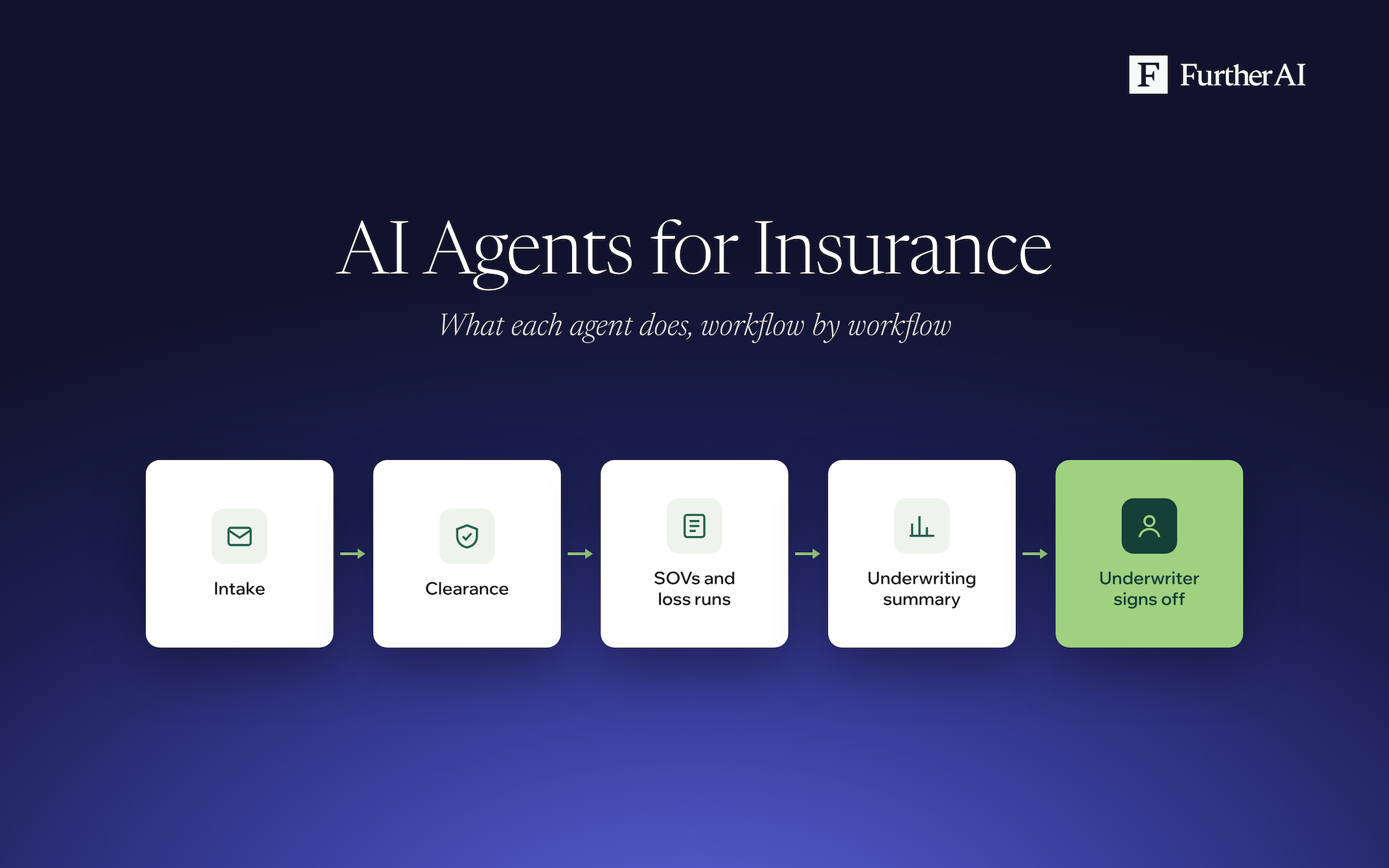
The clearest way to evaluate AI for underwriting is stage by stage. A submission moves through a predictable path, and AI can carry the manual weight at each step while the underwriter stays in control of the decision.
When these steps run in one system instead of a chain of disconnected tools, the data stops falling through email and spreadsheets between stages. That continuity is where most of the value comes from: the time lost in a manual workflow sits in the handoffs between steps at least as much as in the steps themselves.
The categories of AI underwriting vendors
The AI underwriting market is not one homogeneous list. Vendors cluster into categories that map to the five types above, and understanding the categories tells you what a given tool is really for before you compare products head to head. The categories below are unranked and deliberately so — they describe what each kind of vendor does, not which is better.
For a ranked comparison rather than a landscape, see the best AI platforms for insurance guide. For which insurance companies are publicly named as customers of which vendor, see the AI workspaces market map.
What the best AI underwriting software has in common
Tools vary widely, so it helps to judge them against a consistent bar. The strongest systems for underwriting share seven traits, which fall into three groups.
Depth: does it understand insurance?
- Insurance-specific intelligence. The system understands coverage structures, ACORD forms, and underwriting guidelines out of the box, rather than treating documents as generic text.
- Full-workflow coverage. It carries a submission from intake through extraction, enrichment, checks, and summary, so underwriters aren't stitching point tools together.
Control: can you defend its output?
- Human-in-the-loop control. Underwriters review, approve, and override outputs, which preserves accountability and builds trust.
- Explainability and audit trails. Every extracted field and recommendation can be traced to its source document, which matters for both quality and regulatory review.
Fit: will it survive contact with your estate?
- Core-system integration. It connects bidirectionally with policy admin, rating, and claims systems instead of creating another silo.
- Enterprise security. Look for certifications and compliance attestations such as SOC 2 Type II, ISO 27001, and HIPAA where applicable. FurtherAI's certifications are listed on the security page.
- Proven outcomes. Named customer results and a clear implementation plan matter more than a polished demo.
A useful shortcut when comparing options: a point tool speeds up one step, while an end-to-end system changes the whole decision cycle. Deciding which you need is the first real fork in the evaluation, and we walk through it in our guide to building versus buying underwriting automation.
What AI underwriting delivers in production
Across FurtherAI deployments spanning roughly $30 billion in premiums processed, 20+ lines of business, and about 50 states, the pattern is consistent: faster cycle times, higher accuracy, and recovered underwriter capacity. Reported results include submission clearance falling from about 32 minutes to roughly one, audit time cut by 45%, and 646% ROI on complex property SOV intake.
Those are vendor-reported figures from specific deployments rather than industry benchmarks, and the difference matters when you are building a business case. For the full results table, the independent research alongside it, and an evidence label on every figure, see how AI improves underwriting.
Where AI underwriting still falls short
Adoption stories rarely include the parts that did not work, which makes the technology look more uniformly effective than it is. Four limitations are consistent enough to plan around.
Thin data and novel risk
Predictive models need volume and history. A book with few comparable risks, a newly launched programme, or an emerging peril with no loss record gives a model nothing to learn from. In those cases AI can still carry the document work, but the risk judgment stays entirely human — and a vendor promising predictive lift on a thin book is describing something they cannot deliver.
Document quality sets the ceiling
The single largest driver of variance between deployments is not the software. It is whether submissions arrive in a handful of recognisable shapes or as a different bespoke spreadsheet from every broker. Books with high document consistency automate dramatically further than books without, on identical technology.
Extraction is not comprehension
A system can read every field on an ACORD correctly and still miss that the combination of those fields describes a risk outside appetite. Validation logic, appetite rules and referral thresholds have to be built and maintained; they do not emerge from extraction accuracy.
Confident errors
Generative models produce fluent output regardless of whether the retrieval behind it was sound, and fluent errors are harder to catch than obvious ones. This is why source grounding and human approval checkpoints are not optional extras in regulated workflows — and why "accuracy" claims are only meaningful when a vendor says how they measured them and against what sample.
How to choose AI for underwriting
Start with your biggest constraint, then match the tool to it. The wrong sequence — picking a system and hunting for a problem — is how pilots stall.
Start with your bottleneck
“Map the actual workflow before you map the systems — submissions often come in through multiple channels with different triage logic, and if you don't capture that, you'll automate the wrong process,” says Danny O’Lenic, Insurance Product Lead at FurtherAI
Then match it to your segment
Carriers usually optimize for standardized intake and capacity, MGAs for binding authority and audit readiness, brokers for complete submissions and fast turnaround, and reinsurers for clean portfolio data. FurtherAI publishes tailored solutions for carriers, MGAs, brokers, and reinsurers, and a role-based view for the underwriter persona.
If you want a named comparison of commercial-lines tools, AI tools for commercial underwriting breaks that market down vendor by vendor. For a ranked evaluation across full-company platforms, use our best AI platforms for insurance guide.
Governance and compliance come standard now
Regulators have caught up with the technology, so governance is part of the buying decision rather than an afterthought.
What the NAIC Model Bulletin expects
The National Association of Insurance Commissioners (NAIC) adopted its Model Bulletin on the Use of AI by Insurers in December 2023, and as of April 2026 24 states and the District of Columbia had adopted it. The bulletin expects insurers to maintain a written program for responsible AI use, including transparency, testing, and documentation — and it applies to third-party models you buy, not only to models you build.
What to require from a vendor
In practice, that means any system you choose should offer model transparency, fairness testing, traceable decisions, and human oversight by design. The practical test is whether a vendor can produce, on request, a live trace from source document to output for a single decision.
"As AI adoption accelerates, agents will own the work while humans will own the judgment — the underwriter shifts from doing the busywork to managing a team of agents. That only works with governance underneath it: every output traces to source language, every action is logged, every workflow has human checkpoints. It's also how you catch bias — expert review surfaces skewed patterns before they compound across a book." — Danny O'Lenic, Insurance Product Lead, FurtherAI
We cover the operating model in our complete guide to AI governance in insurance.
Glossary
The terms that appear most often in AI underwriting evaluations, defined once.
The terms below are the ones specific to AI in underwriting. If the industry vocabulary around them is newer to you — submissions, loss runs, towers, exposure bases — our plain-English guide to commercial insurance defines about 40 of them with worked examples.
Want to see it on your own submissions? Book a FurtherAI demo.
REFERENCES
Accenture. "Why Underwriters Don't Underwrite Much." insuranceblog.accenture.com
Deloitte. "2025 Global Insurance Outlook." deloitte.com
FurtherAI. "Customer Stories." furtherai.com
McKinsey & Company. "The Potential of Gen AI in Insurance: Six Traits of Frontrunners." mckinsey.com
National Association of Insurance Commissioners. "Model Bulletin on the Use of Artificial Intelligence Systems by Insurers." naic.org
Quarles & Brady LLP. "Nearly Half of States Have Now Adopted NAIC Model Bulletin on Insurers' Use of AI." quarles.com
Risk & Insurance. "How Underwriting and Claims Are Reshaped by AI in Insurance — and How They Stay the Same." riskandinsurance.com
DISCLAIMER
This article is for general informational purposes only and does not constitute legal, regulatory, compliance, underwriting, or other professional advice. The content reflects information available as of the date of publication, and FurtherAI undertakes no obligation to update it as laws, regulations, or AI technologies evolve.
Recent posts

Ready to go further and
transform your insurance ops?
Reclaim your time for strategic work and let our AI Assistant handle the busywork. Schedule a demo to see how you can achieve more, faster.




.svg)