FurtherAI Available in Microsoft Marketplace
Introducing Connectors



7 Leading Submission Processing Platforms Every Insurtech Firm Needs in 2026

Summary
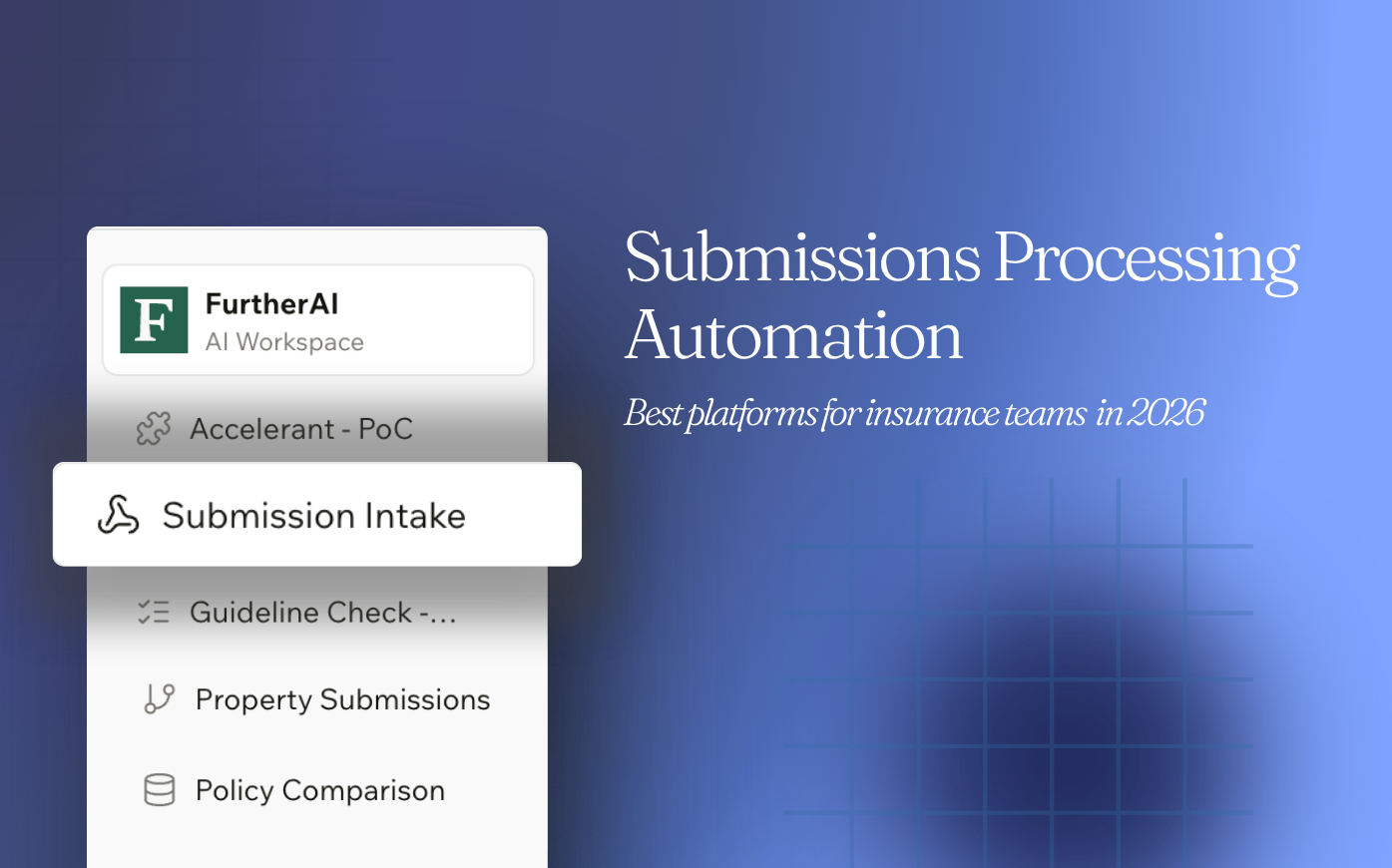
The best submission processing platforms for insurtech firms in 2026 are FurtherAI, Liberate, Roots.ai, V7 Labs, Sopact Sense, Submittable, and Submit.com. Each addresses distinct needs, from AI-powered commercial underwriting intake to GDPR-native compliance and high-volume reviewer coordination. Choosing the right platform depends on your document volume, regulatory exposure, integration requirements, and how deeply AI decision support needs to be embedded in your workflow.
Submission processing platform defined: A digital system that automates the intake, validation, and review of insurance documents — such as claims, certificates of insurance (COIs), and applications — optimizing speed and accuracy while supporting regulatory compliance and auditing needs.
Insurance and insurtech firms processing commercial submissions at scale face a compounding problem: manual intake is slow, inconsistent, and expensive.
The seven platforms below represent the leading submission intake solutions for insurers across every operational profile, from mid-market MGAs riding the 16% MGA premium growth Conning recorded for 2024 to enterprise carriers managing $1B+ in premium. Guidewire's intake automation guidance shows automating ACORD-form extraction can collapse new-business workflows from 13 manual steps to zero, directly improving expense ratios and bind rates.
Submission processing is one stage of a much larger workflow. For the full path from intake to decision, see our guide to AI across the underwriting lifecycle.
Platform comparison at a glance
1. FurtherAI: AI-powered submission intake and workflow automation
FurtherAI is one of the top submission processing platforms for commercial insurers and insurtechs that are looking for purpose-built AI, compliance-first design, and measurable ROI from day one.
Unlike general-purpose tools retrofitted for insurance, FurtherAI deploys modular AI assistants built specifically for commercial insurance workflows, automating every stage of submission intake, evidence extraction, and decision support, while keeping underwriters in control.
What makes FurtherAI different from other submission intake solutions
FurtherAI processes submissions up to 30× faster than manual workflows, with documented ROI ranging from 200% to over 600% across published carrier and MGA case studies.
Its architecture is designed for environments where submission volume, document complexity, and regulatory scrutiny are highest — from fast-growing insurtechs through top-10 global carriers, with the platform powering more than $50B in written premium across customer deployments.
- Modular AI agents handle intake, triage, extraction, and decision support as separate, composable functions, so insurers adopt what they need without ripping out existing systems.
- Compliance-first design means every AI decision includes a full audit trail, supporting regulatory review and internal governance from day one.
- Forward-deployed engineering ensures integrations with existing policy, claims, and analytics platforms are completed rapidly and maintained proactively.
Lines of business and use cases supported
FurtherAI supports purpose-built workflows across the most complex commercial lines, spanning 20+ lines of business across 50 states:
- Excess & surplus (E&S) submissions with non-standard documents and high variability
- Cyber risk intake requiring technical questionnaire extraction and security-posture scoring
- Commercial auto processing with fleet data ingestion and driver-record analysis
- Commercial property, life & health, and reinsurance workflows
Best for: Commercial carriers, MGAs, brokers, and insurtechs operating complex lines where speed, auditability, and AI-native design are non-negotiable.
Business outcomes delivered by FurtherAI
2. Liberate: Insurance-native agentic AI for digital intake and FNOL
Liberate is an insurance-native agentic AI platform that unifies voice, email, SMS, and digital intake into a single "system of action" for sales, servicing, and claims, targeting agencies, MGAs, and carriers that want intake automation tightly integrated with core agency-management systems.
What Liberate does well
- Reasoning AI agents that handle quote intake, FNOL, and servicing across voice, email, SMS, and forms
- Native connections to agency-management systems (HawkSoft) and claims platforms (Snapsheet)
- Personal-lines and SMB commercial intake where speed-of-response drives bind rate
Where Liberate trades off
Liberate's submission strength leans toward agency-side and personal-lines intake (quote, FNOL, retention) and voice-first workflows. Carriers processing complex commercial submissions with multi-page ACORD packages, statements of value, and loss runs will get more native fit from a workbench-style platform tuned for unstructured underwriting documents.
Liberate fit checklist for insurers
✓ Independent agencies, MGAs, or carriers prioritizing voice and conversational intake
✓ Personal lines, small commercial, or specialty programs with high inbound volume
✓ Already running HawkSoft, Snapsheet, or compatible agency tooling
✗ Carrier underwriting teams ingesting heavy ACORD/SOV/loss-run packages
✗ Need for evidence-anchored decision support inside an underwriting workbench
Best for: Independent agencies, MGAs, and carriers wanting voice-first AI intake unified with core agency-management and claims systems.
3. Roots.ai: Digital coworkers for insurance submission intake
Roots Automation packages submission intake as "Digital Coworkers" — pre-trained AI agents that handle classification, triage, clearance, and ACORD/document extraction without bespoke model training.
Powered by InsurGPT, an LLM pre-trained on millions of insurance documents, Roots.ai positions intake as a deployable "team member" rather than a workflow tool. The company raised $22.2M in 2024 to expand its submission-intake Digital Coworker and adjacent products across servicing and claims.
Where Roots.ai fits
- Carriers and MGAs that want pre-trained AI agents rather than configurable workflows
- Operations modernizing from manual or RPA-based intake
- Teams scaling submission throughput without proportional headcount growth
Roots.ai trade-offs
Pre-trained agents are fast to deploy but less configurable than workbench-style platforms. Insurers with highly idiosyncratic document types or specialty-line semantics (Lloyd's slips, MRCs) may need vendor support to extend coverage. Roots also pairs best with downstream policy/claims systems, so confirm integration coverage for your stack.
Roots.ai fit checklist for insurers
✓ Standardized commercial-lines submissions where pre-trained accuracy is high
✓ Operations seeking a "buy-not-build" alternative to in-house ML
✓ Carriers and MGAs migrating from RPA bots toward AI agents
✗ Lloyd's/specialty programs with bespoke broker slip formats
✗ Need for fine-grained workflow configurability per line of business
Best for: Insurance operations leaders looking to scale submission throughput without expanding headcount or building bespoke ML pipelines.
4. V7 Labs: Configurable document AI with a serious insurance vertical
V7 Go is a horizontal document AI platform with a dedicated insurance vertical, automating underwriting submission analysis, ACORD ingestion, statement-of-value (SOV) review, loss-run extraction, and Lloyd's slip processing across carrier and MGA workflows.
V7's Underwriting Submission Analysis automation ingests ACORD applications, SOVs, loss runs, broker supplementals, and even handwritten attachments, consolidating them into a unified risk summary. V7 also publishes a dedicated insurance slips and MRC ingestion automation for specialty markets, with native integrations into Guidewire and Duck Creek.
What V7 Labs does well
- High-accuracy OCR + LLM extraction on complex, multi-document submission packages
- Flexible agent and workflow builder (V7 Go) tunable to specialty lines
- Direct integrations with Guidewire and Duck Creek policy administration platforms
V7 Labs trade-offs
V7 is a general-purpose document AI platform with a deep insurance-vertical configuration rather than an insurance-native company. Buyers should evaluate the maturity of named carrier/MGA references and whether V7's horizontal product roadmap aligns with insurance-specific feature priorities over multi-year contracts.
V7 Labs fit checklist for insurers
✓ Carriers and MGAs with heterogeneous, multi-document submission packages
✓ Teams that value workflow flexibility and want to configure rather than wait on insurer-specific features
✓ Existing Guidewire or Duck Creek shops needing an upstream extraction layer
✗ Insurers wanting an end-to-end underwriting workbench (V7 is intake-focused, not decisioning)
✗ Buyers requiring deep, named insurance customer references at carrier scale
Best for: Carriers and MGAs with complex submission packages who value document-AI flexibility and want a configurable extraction layer feeding their existing core systems.
5. Sopact Sense: AI-driven pre-scoring for consistent underwriting decisions
Sopact Sense reduces reviewer variability by pre-scoring every submission against a custom rubric before a human underwriter opens it, delivering evidence-anchored, defensible decisions at scale.
AI pre-scoring defined: Technology that assesses submissions against pre-configured rubrics before human reviewers engage, providing standardized evidence-anchored scoring to improve decision quality and reduce judgment drift.
Sopact's intelligent-scoring product describes its approach as "AI pre-scoring that evaluates every application against the same standards regardless of fatigue," enabling consistent, traceable decisions even across large or distributed review teams. This approach is particularly valuable when multiple underwriters are evaluating similar risks with different reference points.
Note that Sopact is positioned primarily for grantmaking, awards, accelerators, and fellowships; insurance teams adopting it will need to translate underwriting guidelines into Sopact's rubric model.
Sopact Sense: Strengths and trade-offs
AI pre-scoring shines in scenarios where
- Multiple underwriters review the same risk class and score drift is a quality problem
- Compliance or E&O exposure requires documented, evidence-based decision rationales
- Underwriting guidelines are mature enough to be codified into a rubric
The main limitation is the inverse: if underwriting criteria are still evolving or submissions are highly idiosyncratic, the rubric-building phase adds friction before value is realized.
Best for: Underwriting teams seeking consistency, defensibility, and calibration across distributed reviewer pools, with the operational maturity to translate insurance-specific criteria into Sopact's rubric framework.
6. Submittable: Flexible intake and reviewer management for mid-market insurers
Submittable is a leading general-purpose submission and cycle management platform, offering fast deployment (vendor states "most customers launch in two weeks or less") and strong reviewer tooling, well-suited for mid-market insurers who need flexibility over AI depth.
Submittable serves an established user base across grants, publishing, CSR, and program administration, with documented insurance-sector deployments at carriers like IMT Insurance and trade publications like Insurance Thought Leadership. Its strength is breadth: multi-stage review, customizable forms, team management, and rapid onboarding without heavy IT involvement.
What Submittable does well for insurance intake
- Multi-stage review workflows support underwriting, program onboarding, and claims intake in a single configurable environment
- Reviewer management tools allow assignment, tracking, and notification across large teams
- Fast deployment means operational teams can go live in 2–6 weeks without extensive implementation projects
Where Submittable falls short for insurtech use cases
Without native AI scoring tuned for insurance documents, reviewer calibration depends primarily on human consistency. In high-volume environments where multiple reviewers assess the same risk class, score drift remains an operational risk. Insurtech firms that need AI submission review or automated triage will need to supplement Submittable with additional tooling.
Submittable fit checklist for insurers
✓ Need rapid deployment without heavy IT resources
✓ Mid-market scale with manageable reviewer pool
✓ Program onboarding, claims intake, or sponsorship workflows
✗ Require AI-assisted scoring or risk extraction native to insurance documents
✗ Operating at $500M+ premium with complex data integration needs
Best for: Mid-market carriers and MGAs running program onboarding, community investment, or lower-complexity intake workflows.
7. Submit.com: GDPR-native submission management for EU regulatory compliance
Submit.com offers GDPR-native submission management with EU data residency, SOC 2 Type 1, and Cyber Essentials certification — well-suited for EU carriers and MGAs prioritizing privacy, consent management, and streamlined intake over advanced AI.
GDPR-native defined: A platform designed to align with EU General Data Protection Regulation requirements by default, including data residency options, explicit consent capture, right-to-erasure workflows, and auditability.
This positioning matters more than ever in 2026. The European Insurance and Occupational Pensions Authority (EIOPA) August 2025 Opinion on AI Governance and the EDPB's December 2024 Opinion 28/2024 on AI models have raised the bar for data governance, fairness, explainability, and human oversight in EU insurance AI deployments. Platforms with built-in consent capture, right-to-erasure, and EU residency reduce audit burden under Solvency II, IDD, DORA, and GDPR.
Submit.com: Strengths and trade-offs
Submit.com fit checklist for insurers
✓ Operating in the EU or serving EU data subjects with strict privacy requirements
✓ Need rapid setup for standardized intake and consent capture
✓ Moderate complexity programs (onboarding, simple product submissions)
✗ Require AI-assisted extraction, triage, or rubric scoring
✗ Highly complex, multi-branch workflows across multiple legacy systems
Best for: EU carriers and MGAs where privacy, consent, and residency drive platform selection more than AI or deep customization.
How to choose the best submission processing platform for your insurtech firm
Selecting the right platform starts with clarifying operational goals and constraints, then mapping them to capabilities.
- Quantify volume and variability — Monthly submission count, document types, seasonality, and percentage of unstructured content.
- Define regulatory posture — Jurisdictions (GDPR, NAIC, state DOIs), auditability requirements, data residency. EU-exposed firms must align with EIOPA's 2025 AI Governance Opinion.
- Map integrations — Policy admin, claims, CRM, data lakes, identity/SSO, and analytics destinations.
- Determine reviewer model — Centralized vs. distributed teams, rubric maturity, calibration needs.
- Specify AI depth — Intake automation, evidence extraction, pre-scoring, and decision support. Celent reports GenAI deployment in underwriting grew from 8% in 2023 to 28% in 2024, with 44% projected for 2025.
- Set timeline and resources — Desired go-live window, internal admin capacity, external implementation support.
- Evaluate total cost of ownership (TCO) — Licensing, implementation, integration, and change management.
- Pilot with production-like data — Use real submissions; measure speed, accuracy, auditability, and reviewer satisfaction.
- Establish governance and KPIs — Define score-drift thresholds, exception handling, and audit protocols.
Quick guidance: If AI-native evidence extraction and audit trails are critical, prioritize FurtherAI. For voice-first agency intake and FNOL, Liberate leads. For pre-trained insurance digital coworkers, Roots.ai. For configurable document AI on heterogeneous submission packages, V7 Labs. For rubric-driven calibration in program-style intake, Sopact Sense. For broad submission/cycle management, Submittable. For EU privacy mandates, Submit.com leads.
Frequently asked questions
What's the difference between intake automation and AI pre-scoring?
Intake automation handles document capture, routing, and basic validation. AI pre-scoring evaluates submissions against a rubric to standardize reviewer decisions and reduce score drift. The two are complementary: intake automation gets the data into a structured form, and pre-scoring tells reviewers where to focus their judgment.
How long does implementation typically take?
FurtherAI: weeks. Liberate: weeks for agency-side deployments to months for carrier-core integrations. Roots.ai: weeks (pre-trained Digital Coworkers). V7 Labs: weeks for V7 Go workflow configurations. Sopact Sense: 2–4 weeks after rubric alignment. Submittable: vendor states "most customers launch in two weeks or less." Submit.com: days to weeks. Vendors don't always publish timelines on their public sites; the ranges blend vendor statements with independent analyst observations.
Do these platforms integrate with policy administration and claims systems?
Yes, via APIs, middleware, or custom connectors. Depth varies: FurtherAI emphasizes forward-deployed engineering for rapid integration with policy, claims, and analytics platforms; V7 Labs publishes direct Guidewire and Duck Creek integrations; Liberate connects natively to HawkSoft and Snapsheet; Roots.ai integrates with major core systems; the others may require additional iPaaS layers for enterprise-grade data sync. Match vendor depth to the scope of your existing tech stack before committing.
How do we ensure regulatory compliance and auditability?
Favor platforms with evidence-anchored decisions and immutable audit logs. FurtherAI and Sopact Sense provide evidence trails tied to each decision; V7 Labs supports auditable extractions through V7 Go's confidence scoring; Submit.com is GDPR-native. EU-exposed insurers should also align platform selection with EIOPA's 2025 AI Governance Opinion and the EDPB Opinion 28/2024 on AI models.
What KPIs should we track post-go-live?
End-to-end cycle time, straight-through processing rate, reviewer agreement (or score drift), rework rate, exception volume, and expense-ratio impact. The NAIC's 2024 P&C Annual Report provides industry-wide combined-ratio benchmarks against which to measure your improvement.
When is AI not the right starting point?
If underwriting guidelines are immature or highly variable, begin with standardized intake and reviewer calibration, then add AI extraction or pre-scoring once rubrics stabilize. AI deployed on top of unstable processes amplifies inconsistency rather than removing it.
How much do submission processing platforms typically cost?
Pricing varies by deployment model. General-purpose platforms (Submittable, Submit.com, Sopact Sense) typically range from $5K to $50K annually for mid-market deployments, with scaling tied to submission volume and reviewer seats. Insurance-native platforms (FurtherAI, Liberate, Roots.ai) and configurable document-AI platforms (V7 Labs) usually price per workflow, per line of business, or per processed submission, with implementation fees added separately. Most vendors don't publish list prices; expect TCO conversations covering license, implementation, integration, and change management.
Are these platforms SOC 2 or ISO 27001 certified?
Submit.com publicly publishes SOC 2 Type 1 and UK Cyber Essentials certification. Roots.ai and most enterprise-grade vendors (FurtherAI, Liberate, V7 Labs, Submittable) typically carry SOC 2 Type 2 attestations available under NDA. ISO 27001 is less common but emerging. Insurance-specific buyers should also confirm vendor coverage of HIPAA (for life/health adjacencies), state DOI privacy rules, and — where applicable — EU GDPR Article 28 data-processor agreements.
Should we build or buy a submission processing platform?
The build-vs-buy calculus has shifted decisively toward "buy" for most insurers. Capgemini's World P&C Insurance Report 2025 found 88% of P&C insurers see tech-enabled underwriting as critical but only 17% have the right capabilities — a gap most cannot close on their own timeline. Build only when (a) your submission process is a genuine competitive moat, (b) you have a multi-year ML/MLOps team in place, and (c) your data volumes justify the fixed cost. Otherwise, buying compresses time-to-value from years to weeks.
How long until we see ROI from AI submission processing?
Most carriers and MGAs see hard ROI within 6–12 months of go-live, with leading-indicator improvements (cycle time, throughput) visible within the first quarter. FurtherAI's published case studies document ROI ranging from 200% to over 600% in customer deployments. The biggest predictor of fast ROI is data quality and rubric maturity, not the platform itself — platforms accelerate good processes and amplify weak ones.
How do we manage change with underwriters during AI rollout?
Change management is the single biggest determinant of insurance AI ROI. Three patterns work consistently: (1) start with augmentation, not replacement — AI proposes, underwriter decides; (2) involve senior underwriters in rubric and prompt design so the system reflects their judgment; (3) measure reviewer agreement before and after to give underwriters visible evidence the AI improves their work rather than threatens it. Bain's underwriting research shows AI can reclaim roughly 30% of an underwriter's time when adopted well — frame this as capacity for higher-value work.
How do we prevent AI hallucinations or errors in submission extraction?
Three controls matter most. (1) Evidence anchoring: every extracted field should link back to a specific document location, so reviewers can verify in one click. (2) Confidence thresholds: route low-confidence extractions to human review automatically. (3) Continuous evaluation: sample 1–5% of processed submissions weekly against ground truth and track precision/recall. Platforms designed for compliance-sensitive environments (FurtherAI, Sopact Sense) bake these controls into the product; horizontal document-AI platforms (V7 Labs) require explicit configuration; general-purpose intake tools typically need custom assembly.
DISCLAIMER
This article is for general informational purposes only and does not constitute legal, regulatory, compliance, underwriting, or other professional advice. The content reflects information available as of the date of publication, and FurtherAI undertakes no obligation to update it as laws, regulations, or AI technologies evolve.
Recent posts

Ready to go further and
transform your insurance ops?
Reclaim your time for strategic work and let our AI Assistant handle the busywork. Schedule a demo to see how you can achieve more, faster.




.svg)