FurtherAI Available in Microsoft Marketplace
Introducing Connectors



Manual Sampling vs Full-Population Review for Underwriting Audits 2026

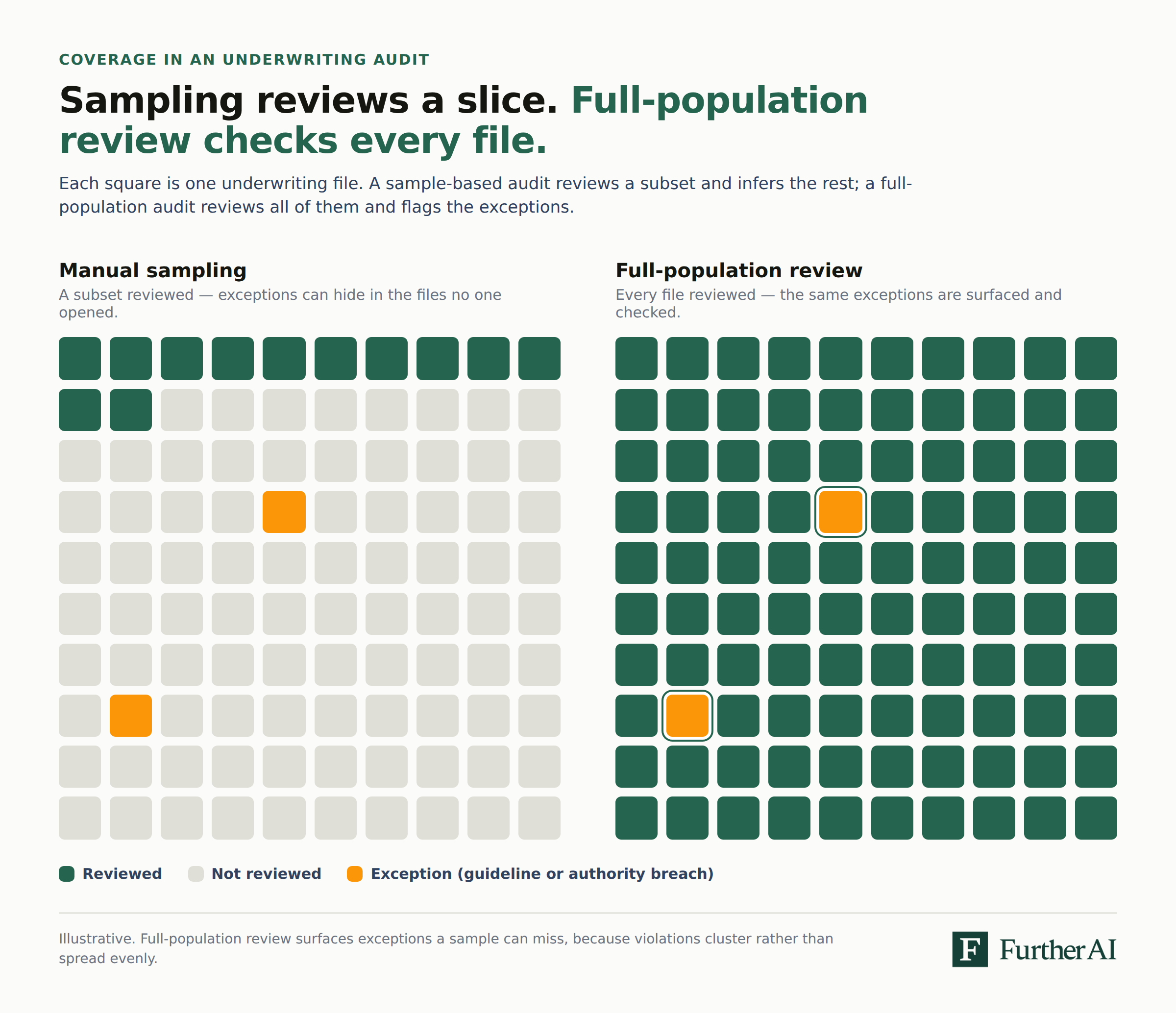
Manual sampling reviews a small subset of underwriting files and extrapolates the result to the whole book; full-population review checks every file and flags the exceptions. For most of auditing history, sampling was the only practical option. Automation has changed that, and full-population review is becoming the default for underwriting audits because it removes the one weakness sampling can never fix: the files no one looked at.
This guide compares the two approaches, explains why sampling misses what matters, and shows when each still fits. It is written for carriers and reinsurers auditing delegated underwriting; for how that plays out in a full carrier workflow, see our guide to underwriting audit automation for carriers.
Key takeaways
- Sampling reviews a fraction of files and infers the rest; full-population review examines all of them.
- Sampling carries sampling risk — the chance that the sample's conclusion differs from what a full review would show.
- Auditors sampled because reviewing every file by hand was impossible, not because a subset was ideal.
- Data analytics and AI have made full-population testing feasible, shifting audits from random selection to checking everything and flagging exceptions.
- Sampling still fits small, stable programs and procedures that cannot be automated; for high-volume underwriting audits, full-population review is now the stronger default.
What is audit sampling?
Audit sampling is the practice of applying a procedure to fewer than 100% of the items in a population, then using the result to draw a conclusion about the whole. An auditor might pull a random or statistical sample, or use judgment to target higher-risk files, then review that set in depth.
Sampling exists for a practical reason: reviewing every file by hand takes time no team has. In a real FurtherAI engagement, a reinsurer's manual audit of each managing general agent (MGA) rested on a random selection of 20 insured organizations per MGA, and still ran to roughly 200 hours per audit. The sample was a response to the clock, not a belief that 20 files told the whole story.
What is a full-population review?
Full-population review examines every item in the population rather than a subset. In an underwriting audit, that means checking each bound risk against the guidelines and binding authority that should have applied, and surfacing the ones that do not match.
Modern practice calls this audit-by-exception: software reads and checks all of the files, then routes the exceptions to a human. The reviewer's attention goes to genuine anomalies instead of a random draw. As one peer-reviewed study of audit data analytics puts it, full-population testing is now feasible and addresses the core problem that "sampling only provides a small snapshot of the entire population."
Manual sampling vs full-population review: the trade-offs
Both methods produce an audit opinion. They differ in what that opinion is built on. The table compares them on the dimensions that matter for underwriting audits.
Why sampling misses what matters
Sampling works when problems are spread evenly, so a small draw represents the whole. Underwriting problems are not spread evenly. A single MGA, class of business, or underwriter can account for most of the out-of-appetite risks, and a random sample can walk right past that cluster.
The auditing profession has a name for this exposure: sampling risk. The PCAOB's sampling standard defines it as the chance that a conclusion drawn from a sample differs from the conclusion a full review would reach, and notes that the risk grows as the sample shrinks. A clean sample can sit next to a systemic breach and never reveal it. In an audit whose job is to catch violations, that gap is the whole problem.
Why full-population review is now the default
Two things changed. First, the time constraint that forced sampling has largely lifted. McKinsey finds that underwriters spend 30% to 40% of their time on administrative tasks like rekeying data, and audit teams lose the same hours gathering files before any judgment begins. When software does that gathering, reviewing every file stops being a fantasy.
Second, the tooling caught up. Audit data analytics and machine learning let a system read and check an entire population in the time a manual team spent on a sample, then rank the exceptions by risk. The result is more assurance on the same effort, because attention concentrates on real anomalies rather than a random selection. Full-population review is no longer the ambitious option; it is the practical one.
How AI enables full-population underwriting audits
AI closes the gap between what auditors want to review and what they have time to review. An insurance-specific platform reads each underwriting file, compares the bound risk against the applicable guidelines and binding authority, and returns the exceptions with a citation to the source. Reviewers spend their hours judging flagged findings instead of hunting through files.
That is the shift behind the numbers in delegated-authority work. In the reinsurer engagement above, automating the data-gathering that consumed about half of every 200-hour audit cut the audit to roughly 110 hours, freeing the team to review more deeply rather than faster. The same automation is what lets an audit move from a fixed sample toward covering the full book. For the carrier-side workflow, see underwriting audit automation for carriers; for why traceable findings matter once you review everything, see explainable AI for insurance audits.
When sampling still makes sense
Full-population review is the stronger default, but it is not the only reasonable choice. Sampling still fits a few situations, and an honest comparison should say so.
Small, stable programs with a handful of files and low variability may not justify the setup for automated full-population review. Some procedures also resist automation: physical inspections, interviews, and confirmations cannot be run across an entire population the way document checks can, a limit the research on full-population testing acknowledges directly. And where data is thin or inconsistent, a targeted manual sample can be the more reliable read. The point is not that sampling is obsolete; it is that for high-volume, document-heavy underwriting audits, it is no longer the best available option.
REFERENCES
McKinsey & Company. "From Art to Science: The Future of Underwriting in Commercial P&C Insurance." mckinsey.com
FurtherAI. "45% Reduction in Underwriting Audit Time." FurtherAI Customer Stories. furtherai.com
Public Company Accounting Oversight Board (PCAOB). "AS 2315: Audit Sampling." pcaobus.org
"Audit Data Analytics, Machine Learning, and Full Population Testing." ScienceDirect. sciencedirect.com
DISCLAIMER
This article is for general informational purposes only and does not constitute legal, regulatory, compliance, underwriting, or other professional advice. The content reflects information available as of the date of publication, and FurtherAI undertakes no obligation to update it as laws, regulations, or AI technologies evolve.
Recent posts
Ready to go further and
transform your insurance ops?
Reclaim your time for strategic work and let our AI Assistant handle the busywork. Schedule a demo to see how you can achieve more, faster.




.svg)