FurtherAI Available in Microsoft Marketplace
Introducing Connectors



Best AI for Policy Checking: Flagging Inconsistencies Against Guidelines Across a Full Book (2026)

Policy checking is the post-bind review that compares a bound policy against the terms that were supposed to apply. The best AI for the job does three things at once: it compares the policy against the quote or binder at clause level, it checks every policy in the book rather than a sample, and it cites the source document behind every finding it raises.
Most AI platforms sold into commercial underwriting don't do all three. We reviewed the public product documentation of 10 platforms in September 2026, and policy-vs-quote comparison and clause-level redlines turned out to be the two least documented capabilities in the category. The reason is structural, and it's worth understanding before you shortlist anyone.
Key takeaways
- Policy checking is a post-bind control. It compares the bound policy against four reference points: the quote or binder, the underwriting guidelines that should have applied, the filed forms, and, at renewal, the expiring policy.
- Four inconsistency classes account for most findings: wrong or missing endorsements, limit and sublimit drift, exclusion conflicts, and form edition mismatches.
- At book scale the constraint changes. Reading speed stops being the bottleneck and triage takes over, which is why full-population review plus exception routing has displaced sampling on large books.
- The capability is concentrated in a narrow set of providers. Only two of the 10 platforms we reviewed document policy-vs-quote comparison, the capability that defines the job.
- A finding without a citation is a finding you can't defend. Source attribution lets a reviewer accept a correct exception in seconds and reject a wrong one just as fast.
What policy checking actually is
Policy checking is the review that happens after a risk is bound, when someone compares the policy as issued against the terms that were supposed to apply. If the two don't match, the difference is an error, a misunderstanding, or an exposure, and all three cost money.
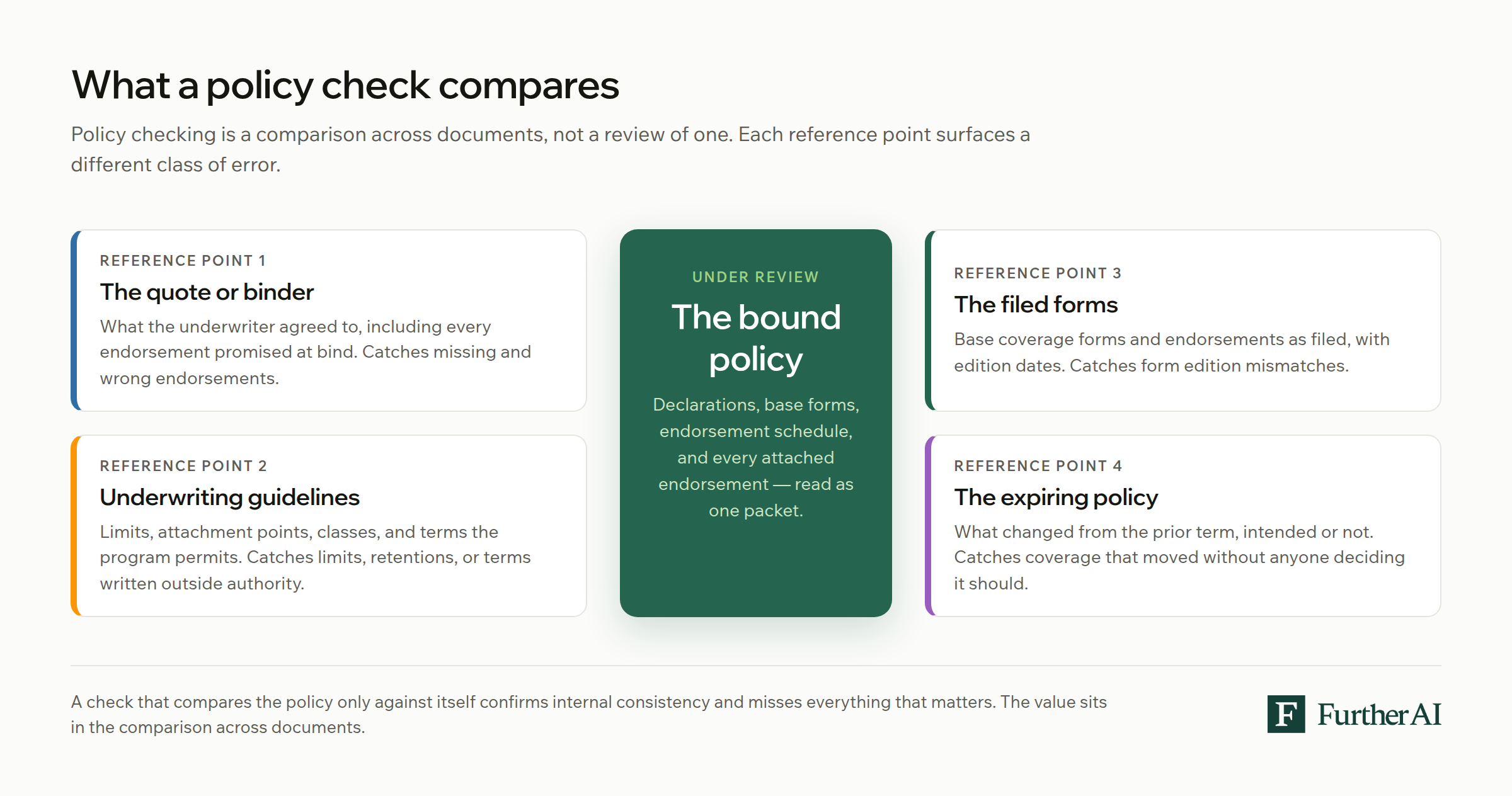
The job has four reference points, and confusing them is the most common reason a policy checking program produces noise instead of findings:
- The quote or binder. What the underwriter actually agreed to, including the schedule of endorsements promised at bind.
- The underwriting guidelines. The limits, attachment points, classes, and terms the carrier or program permits for that risk.
- The filed forms. The base coverage form and endorsements as filed, including their edition dates.
- The expiring policy. At renewal, what changed from last term, whether or not anyone meant it to change.
A check that only compares the policy against itself will confirm the document is internally consistent and miss everything that matters. The value sits in the comparison across documents.
Policy checking, policy comparison, and underwriting audit answer different questions
These terms get used interchangeably in vendor material, which makes shortlisting harder than it needs to be.
Policy checking sits in the narrowest window of the four and carries the sharpest consequence. Once the policy is delivered, a missing endorsement stops being a service issue and becomes a coverage question.
The four inconsistency classes a policy check has to catch
Nearly every finding worth raising falls into one of four buckets. Each has a different failure mode, and each needs a different comparison to surface.
Wrong or missing endorsements
The most common class, and the most expensive. A contract requires additional insured status for both ongoing and completed operations, so the binder promises two endorsements, and one gets attached.
ISO's CG 20 10, "Additional Insured – Owners, Lessees or Contractors – Scheduled Person Or Organization," grants additional insured status for ongoing operations. Its wording extends coverage "only with respect to liability for 'bodily injury', 'property damage' or 'personal and advertising injury' caused, in whole or in part, by … your acts or omissions … in the performance of your ongoing operations for the additional insured(s) at the location(s) designated above." CG 20 37 is its counterpart for the products-completed operations hazard. The two complement each other rather than substitute for each other, so a contract requiring both means both have to be on the policy.
Attach only CG 20 10 and the additional insured has no completed operations coverage. Nobody notices until there's a claim after the work is finished.
A check catches this by reading the endorsement schedule on the bound policy, reading the endorsements promised on the binder or bind order, and reporting the difference as a list rather than a judgment.
Limit and sublimit drift
A quote carries a $5M per-occurrence limit with a $250,000 sublimit for a named peril. The policy issues with the same headline limit and a $100,000 sublimit, because the sublimit lives in an endorsement that a different person keyed.
Headline limits rarely drift, because everyone looks at them. Sublimits, deductibles, self-insured retentions, and aggregate caps drift constantly, because they sit in endorsements and schedules that no single reviewer reads end to end. Catching drift requires the check to extract values at field level across the whole policy packet, not just the declarations page.
Exclusion conflicts
The hardest class, because the conflict is usually invisible in any single document. A base form excludes a peril. An endorsement gives part of it back. A second endorsement narrows the give-back. What's actually covered is the net of all three, and no page in the policy states it.
Our own policy comparison work identifies what one customer case study calls "nuanced 'give-back' endorsements that restore portions of coverage excluded in base policies," factoring in "the full policy packet, including base forms and conditional endorsements." That framing matters more than the technology behind it. A check that reads forms in isolation will report a coverage position the policy doesn't actually take.
Form edition mismatches
Multiple editions of the same form number circulate at the same time, and the wording differs between them. CG 20 10 exists in a 04 13 edition carrying a 2012 ISO copyright and in earlier editions, including a 10 01 edition carrying a 2000 copyright.
Same form number, different grant of coverage.
A policy referencing the right form number with the wrong edition date passes a superficial check and fails a real one. Edition dates have to be compared as data, not skimmed as text.
What changes when you check a book instead of a policy
Checking one policy well is a reading problem. Checking 10,000 is a triage problem, and the two need different systems.
Sampling stops working as a coverage strategy
Sampling survives because reviewers run out of hours, not because a sample tells the whole story. One reinsurer we work with audited roughly 20 insured organizations per managing general agent (MGA), and each audit still consumed about 200 hours.
The trouble with a sample is distribution. Underwriting problems cluster in one program, one class, one underwriter, or one quarter, and a random sample can walk straight past the cluster. We've written at length on why full-population underwriting audits have displaced sampling wherever the data supports it. The same logic applies to policy checking, with one difference: policies are more uniform than audit files, so full-population checking is easier to automate, not harder.
Exception routing is the actual product
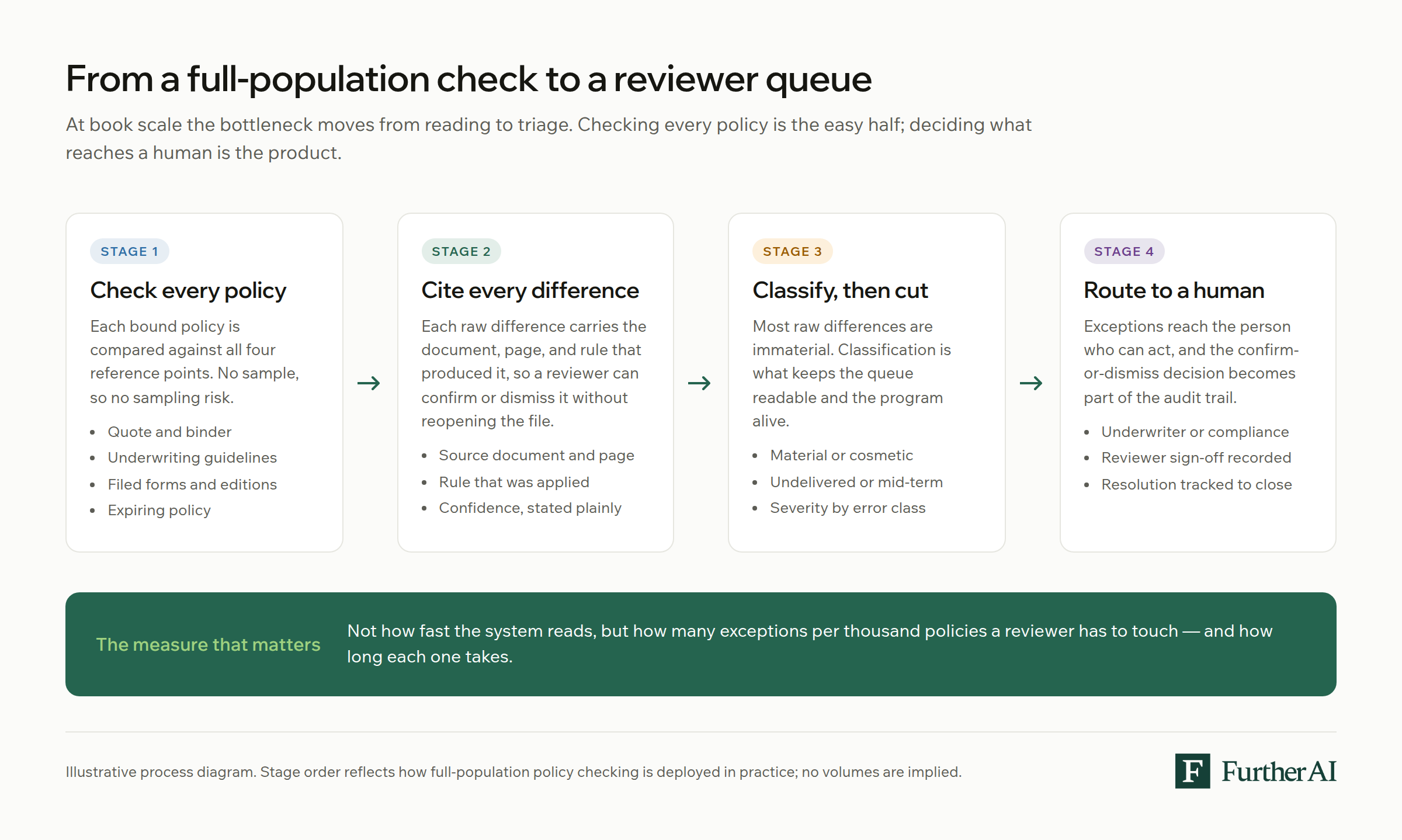
Once every policy gets checked, the output isn't a report. It's a queue.
A book of 10,000 policies checked against four reference points produces thousands of raw differences, most of them immaterial. The system earns its keep by classifying them: material or cosmetic, resolved by the underwriter or escalated to compliance, urgent because the policy hasn't been delivered yet or routine because it's mid-term.
Get the routing wrong and you've replaced an under-checked book with an unreadable exception queue. Reviewers stop trusting the queue, and the program dies quietly.
Reviewer workload, measured honestly
The workload question worth asking a vendor is not "how fast does it read" but "how many exceptions per thousand policies does a reviewer have to touch, and how long does each one take."
Two data points from our own deployments:
- A mid-sized insurer with more than 1,500 employees and $1 billion in annual revenue reduced manual review times by up to 95%, ran policy checks 20 times faster than its manual process, and reported 400% ROI within months of implementation.
- The reinsurer above cut audit time 45%, from roughly 200 hours to about 110 hours per MGA audit, by automating the data extraction and comparison work rather than the judgment.
Notice what moved in both cases. The extraction and comparison collapsed; the judgment stayed with people. McKinsey put the size of that prize at "anywhere from 30 to 40 percent of underwriting's time … spent on administrative tasks, such as rekeying data or manually executing analyses" back in 2019, and the figure still gets quoted because nothing has replaced it.
Why a finding without a citation doesn't survive scrutiny
An AI policy check produces assertions, and assertions need provenance. Two reasons pull in the same direction.
The first is defensibility. Regulators have moved decisively toward documentation and explainability for insurers' AI use. The NAIC adopted its Model Bulletin on the Use of Artificial Intelligence Systems by Insurers in December 2023, and 25 jurisdictions have issued a version of it according to NAIC's implementation tracker, status as of April 1, 2026. New York's Department of Financial Services issued Circular Letter No. 7 on July 11, 2024, telling insurers they "should maintain comprehensive documentation for their use of all AIS" and be "prepared to make such documentation available to the Department upon request." Colorado extended its governance framework beyond individual life insurers, to private passenger auto and health benefit plans, when amended Regulation 10-1-1 took effect on October 15, 2025.
Worth being precise here: Circular Letter No. 7 governs underwriting and pricing, not policy issuance checks, so it doesn't regulate policy checking directly. What it does is set the documentation bar that compliance teams now apply to AI use generally, and a policy checking tool that can't show its work will fail that bar by default.
The second reason is more practical. Models get things wrong. Stanford researchers evaluating leading AI legal research tools found they "each hallucinate between 17% and 33% of the time," and those are purpose-built professional tools with retrieval behind them. A finding that links to the exact document, page, and clause lets a reviewer confirm a right answer in seconds and dismiss a wrong one just as fast. An uncited finding costs the reviewer the same time it would have taken to check manually, which erases the point of the exercise.
This is why we treat source citation as the final stage of every audit workflow rather than an add-on: every exception links back to the source document and the rule it was checked against. We've laid out the mechanics of source-backed audit findings separately, including the four properties that make a finding audit-ready.
How the market actually covers policy checking
We reviewed the public product documentation of 10 platforms in September 2026 against six capabilities specific to policy checking. Vendors are listed alphabetically. This is a capability matrix, not a ranking.
How to read this table. "Documented" means the capability is described in the vendor's own public product material. "Partial" means an adjacent capability is described but not the specific one. "Not documented" means we couldn't verify it publicly, which is not the same as saying it doesn't exist, since several of these vendors publish marketing pages rather than product documentation and a private demo may show more. "N/A" means the capability doesn't apply to that product's role. Vendor links are omitted deliberately; assess each platform against your own requirements.
What the matrix shows
Two columns are nearly empty, and they're the two that define the job.
Policy-vs-quote comparison and clause-level redlines are documented by almost nobody. The closest adjacent capability in the set is Roots Automation's policy-to-policy comparison, which compares an expiring policy against its renewal. Useful, and a different check from verifying a bound policy against quoted terms.
The explanation is structural. Convr, Cytora, and Sixfold are built for submission intake and pre-bind underwriting, where commercial pull has been strongest. Duck Creek and Guidewire are full-lifecycle core systems. Indico Data, mea Platform, and Bevaya span claims and servicing alongside underwriting. None of those categories has post-bind policy checking at its center.
Post-bind policy checking has historically been a brokerage and outsourcing function, which is why the providers who name it explicitly tend to come from that world. Patra markets a Policy Checking AI product built around a 900-plus point checklist, and Exdion has marketed policy check automation for years.
If you're evaluating AI for policy checking, that structure is the useful finding. A platform that's excellent at reading submissions has not necessarily built the comparison logic, the rule configuration, or the exception routing that post-bind checking needs. Ask for the specific capability, not the general one. Our broader view of the category sits in our guide to AI underwriting compliance software, and the MGA-specific version in our agentic AI platform guide.
What to test before you commit
Accuracy claims are unfalsifiable until you test them on your own documents. Three things to insist on:
- A golden set from your own book. Pull 50 to 100 real policies with known issues, including the messy ones. Vendor demo data proves nothing about your forms, your carriers, or your scan quality.
- Recall over precision. In policy checking, a false positive costs a reviewer 30 seconds. A false negative ships a policy with a missing endorsement. Measure missed findings specifically, not blended accuracy.
- A repeatable evaluation loop. Models and prompts change, and performance drifts. Our own Eval Studio exists for exactly this, letting teams re-run a test set after any workflow change and compare versions side by side. Whatever tool you choose, make sure the vendor can show you one.
Frequently asked questions
REFERENCES
Chester, Ari, Susanne Ebert, Steven Kauderer, and Christie McNeill. "From art to science: The future of underwriting in commercial P&C insurance." McKinsey & Company, February 12, 2019. mckinsey.com
Colorado Division of Insurance. "Notice of Adoption of Amended Regulation 10-1-1, Governance and Risk Management Framework Requirements." August 20, 2025. doi.colorado.gov
Insurance Services Office, Inc. "CG 20 10 04 13 — Additional Insured – Owners, Lessees or Contractors – Scheduled Person Or Organization." nyc.gov
ISO Properties, Inc. "CG 20 37 10 01 — Additional Insured – Owners, Lessees Or Contractors – Completed Operations." panynj.gov
Magesh, Varun, Faiz Surani, Matthew Dahl, Mirac Suzgun, Christopher D. Manning, and Daniel E. Ho. "Hallucination-Free? Assessing the Reliability of Leading AI Legal Research Tools." Stanford RegLab and Stanford HAI; Journal of Empirical Legal Studies, Vol. 22, No. 2 (2025), pp. 216–242, doi:10.1111/jels.12413. reglab.stanford.edu
National Association of Insurance Commissioners. "Implementation of NAIC Model Bulletin: Use of Artificial Intelligence Systems by Insurers." Status as of April 1, 2026. content.naic.org
National Association of Insurance Commissioners. "NAIC Model Bulletin: Use of Artificial Intelligence Systems by Insurers." Adopted December 4, 2023. content.naic.org
New York State Department of Financial Services. "Insurance Circular Letter No. 7 (2024): Use of Artificial Intelligence Systems and External Consumer Data and Information Sources in Insurance Underwriting and Pricing." July 11, 2024. dfs.ny.gov
DISCLAIMER
This article is for general informational purposes only and does not constitute legal, regulatory, compliance, underwriting, or other professional advice. The content reflects information available as of the date of publication, and FurtherAI undertakes no obligation to update it as laws, regulations, or AI technologies evolve.
Recent posts
%20(2).png)
Ready to go further and
transform your insurance ops?
Reclaim your time for strategic work and let our AI Assistant handle the busywork. Schedule a demo to see how you can achieve more, faster.




.svg)