FurtherAI Available in Microsoft Marketplace
Introducing Connectors



8 Trusted Software Solutions for Insurance Audit Readiness in 2026

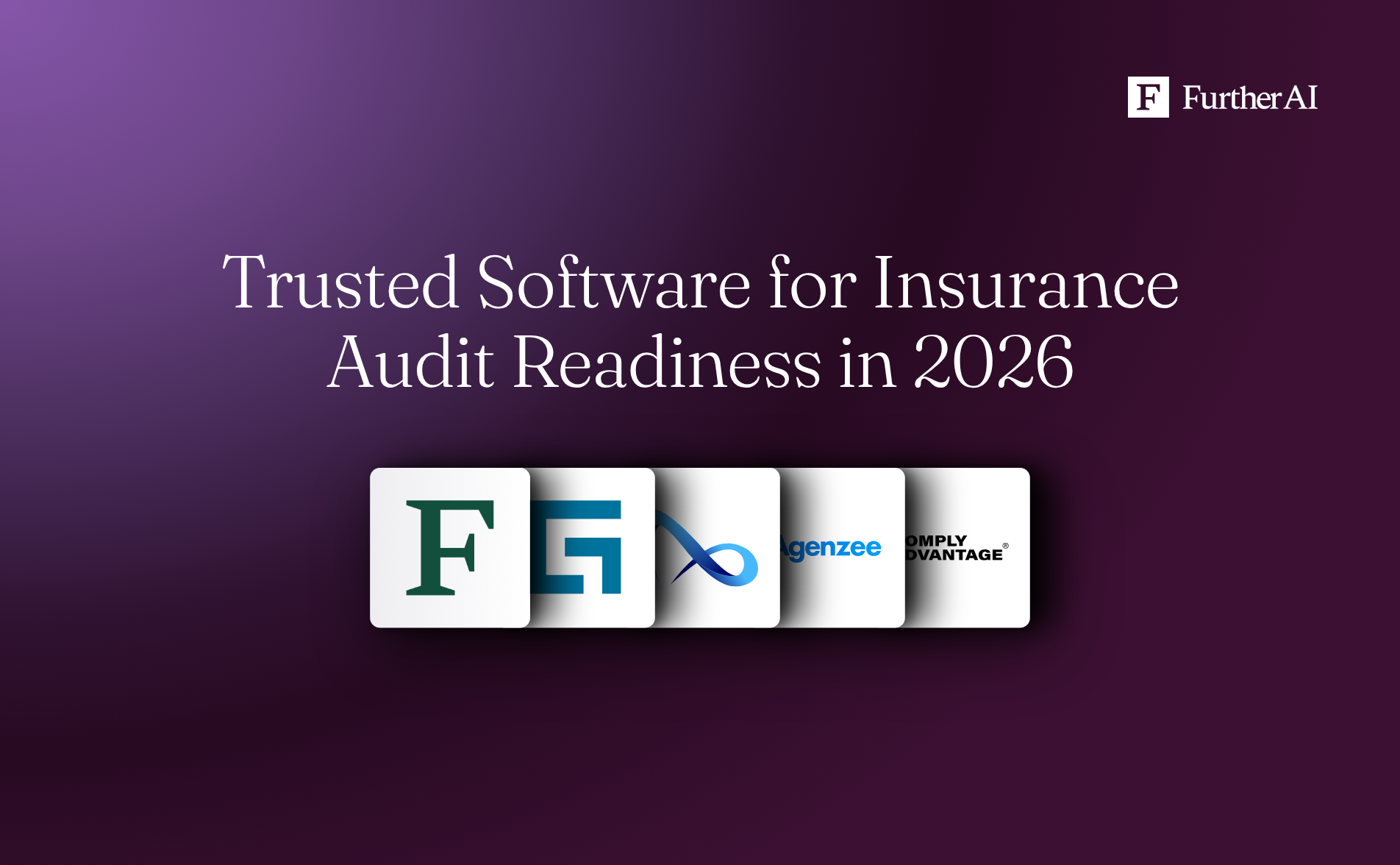
The eight best insurance audit readiness software tools in 2026 are FurtherAI (AI workflow layer for underwriting and compliance), Guidewire InsuranceSuite (P&C system of record), ZenGRC (compliance workflow), Agenzee (producer licensing), ComplyAdvantage (AML and sanctions screening), Onspring (configurable GRC), Vanta (security audit automation), and MetricStream (enterprise GRC). The right choice depends on your line of business, entity count, and whether your audit gaps sit in operations, controls, or financial-crime compliance.
Key takeaways
- Audit readiness is a stack, not a single tool. The operational system, the GRC layer, and specialist tools each record a different part of the evidence an examiner asks for.
- Examiners test whether a file can be reconstructed. NAIC guidance asks for records that are "adequate, accessible, consistent and orderly," and claim files detailed enough to rebuild events and dates.
- Retention rules vary by state. The NAIC model sets a three-year baseline for closed claim files; New York requires six years.
- Only some vendors publicly document their audit trails. Guidewire, ComplyAdvantage, and Vanta publish what they log; for the rest, ask for a sample export before you buy.
- AI raises the documentation bar. Under the NAIC AI Model Bulletin, insurers can expect examiners to ask how AI systems were built, tested, and audited.
Insurance audit readiness is the practice of keeping records, controls, and documentation in a verifiable state so carriers, MGAs, and brokers can answer regulators, market conduct examiners, and internal auditors at any point in the year, not only at year-end.
The stakes are real. State insurance departments collected $190.6 million in fines and penalties, according to the R Street Institute's 2024 Insurance Regulation Report Card. New York's amended cybersecurity rule finished phasing in on November 1, 2025, and covered entities now file an annual compliance certification signed by the CEO and CISO every April 15. And the NAIC Model Bulletin on AI had been adopted by 29 jurisdictions as of October 8, 2026, with four more states running their own AI rules.
The platforms below are the ones insurance teams use most often to keep evidence current, controls testable, and documentation defensible. We start with FurtherAI, an AI workflow layer that works alongside every other platform on this list, then cover the seven systems of record, GRC tools, and compliance specialists most relevant to insurance.
How we evaluated these platforms
We compared each tool across seven criteria specific to insurance audit readiness:
- Insurance fit: designed for carriers, MGAs, brokers, or financial services
- Workflow coverage: submission intake, underwriting, claims, licensing, financial crime, and IT controls
- Auditability: native audit trails, source citations, evidence trails, and version history
- Audit-trail transparency: whether the vendor publicly documents what it logs and how auditors get it
- Integration: connects to policy admin, claims, CRM, HRIS, and identity systems
- Regulatory alignment: coverage of NAIC MAR, NYDFS Part 500, SOX 404, SOC 2, ISO 27001, and AML
- Scalability: multi-entity, multi-jurisdiction, and multi-line support
Quick comparison: audit readiness software for insurance
1. FurtherAI: an AI workflow layer for insurance operations, including audit readiness
FurtherAI is a domain-specialized AI workspace that runs core insurance workflows (submission intake, policy comparison, underwriting audit, claims intake, and compliance checks) and produces structured, source-cited outputs (what we call source-backed audit findings).
Backed by a $25M Series A led by Andreessen Horowitz, FurtherAI is built for the nuance of insurance and has processed roughly $30B in premiums across 20+ lines of business for its customers.
Best for: carriers, MGAs, and brokers whose audit gaps sit inside document-heavy operational work (submission triage, policy checking, underwriting QA, and claims intake) rather than in IT controls.
Audit-relevant strengths:
- Underwriting audits: a reinsurer overseeing more than 100 MGAs cut audit time by 45%, from 200 hours to about 110 hours per MGA, and moved 25+ of the freed hours into compliance oversight.
- Policy check and compare: a mid-sized insurer ran policy checks more than 20x faster and cut manual review by up to 95%.
- Submission intake: broker emails, ACORDs, SOVs, and loss runs processed up to 30x faster than manual work.
- Deployment and security: a single-tenant environment for each customer, SOC 2 Type II certification, and ISO 27001 compliance, with integrations into policy administration, claims, Salesforce, and Outlook.
- Repeatable review workflows that preserve source references and evidence trails for regulators (how this works day to day: AI underwriting compliance software).
How it records the audit trail: each finding links to the exact document, page, and field it came from, and reviewers confirm or dismiss it, which leaves a record of who reviewed what, and when. When an agent reaches a step that needs human judgment, it pauses and tags the right person, and the approval is recorded. The platform also keeps audit logs alongside SSO and role-based permissions, and customers decide how long their data is kept.
Limitations: FurtherAI works alongside a GRC platform or system of record rather than replacing one. Teams that need ICFR control libraries, third-party risk registers, or SOC 2 evidence automation should pair it with a tool from the list below.
2. Guidewire InsuranceSuite
Guidewire InsuranceSuite is a widely used system of record for P&C insurers, combining PolicyCenter, ClaimCenter, and BillingCenter. Its Palisades release in April 2026 introduced ProNavigator, an AI assistant with role-based access controls, audit trails, and human-in-the-loop oversight.
Best for: mid-size to large P&C carriers that need a single source of truth for policy administration, claims, and billing across jurisdictions.
Audit-relevant strengths: transaction history sits in the same system as the policy and claim record, so an examiner's question about a specific file can be answered from the system of record. Note that "audit" inside PolicyCenter usually refers to premium audit, not compliance audit.
How it records the audit trail: InsuranceSuite automatically records history events on accounts, policies, and claims (in ClaimCenter, even when a claim is viewed), each tagged with the user and a timestamp. Teams can retrieve those events through the Cloud API. Log retention and tamper protection aren't publicly documented.
Limitations: a core-system implementation is a large program. Smaller MGAs and brokers that don't run their own policy administration usually rely on their carriers' systems and add a lighter compliance layer.
3. ZenGRC
ZenGRC is a GRC platform that helps teams document controls, collect evidence, and manage audits with less manual coordination. Its parent company, Reciprocity, rebranded as RiskOptics in 2023, then returned to the ZenGRC name in June 2024, with ZenGRC Pro (formerly ROAR) offered alongside it.
Best for: mid-market and enterprise insurance organizations standing up SOX 404, NAIC Model Audit Rule (MAR), or SOC 2 control programs.
Audit-relevant strengths: pre-mapped controls for 30+ compliance frameworks, including SOC 2, ISO 27001, HIPAA, and PCI DSS, plus a shared control library that cuts duplicate evidence requests across audits.
How it records the audit trail: evidence requests carry a collection history that shows who changed each request's status, and external auditors can log in with limited permissions. Field-level change history and log retention aren't publicly documented.
Limitations: less specialized for insurance-specific workflows like producer licensing or claims handling than insurance-native tools.
4. Agenzee
Agenzee is an insurance-native licensing platform that manages new and renewal licenses for individuals and businesses nationwide, using automated daily NIPR synchronization and a conversational AI assistant.
Best for: agencies, MGAs, and carriers managing multi-state producer licenses, appointments, and entity licenses.
Audit-relevant strengths: license and appointment statuses stay current from NIPR data, and compliance tasks and producer onboarding are automated. That matters in an exam, because the NAIC record retention model expects licensing records to show the producer's licensing status at the time of sale.
How it records the audit trail: Agenzee lists an audit trail among its features, but doesn't publicly document what's logged or how it's exported. Ask for a sample export during evaluation.
Limitations: scope is licensing, not financial controls or IT compliance. Best paired with a broader GRC tool.
5. ComplyAdvantage
ComplyAdvantage is an AI-driven AML, sanctions, and PEP screening platform. On its insurance page, the company says it can resolve up to 85% of routine alerts autonomously, and its sanctions data covers OFAC, EU, and HM Treasury lists plus more than 60 additional jurisdictions, updated in minutes rather than months.
Best for: life insurers and annuity issuers subject to the AML program rule for covered products, plus any insurer or broker that needs sanctions screening or adverse media checks on complex risks.
Audit-relevant strengths: real-time screening, configurable risk rules, and investigation workflows that keep each alert decision tied to the customer record.
How it records the audit trail: case audit logs record every action on a case (creation, stage changes, decisions, assignments, and notes) with the date, time, and user. A separate customer audit log records screening and risk-scoring events, and data exports include case decisions.
Limitations: focused on financial crime compliance, not a general audit, control, or licensing platform.
6. Onspring
Onspring is a no-code GRC platform that brings compliance, risk, audit, and vendor management into one configurable workspace. In October 2025 it launched Onspring AI, powered by Anthropic's Claude models, which summarizes documents such as SOC 2 reports, surfaces links between controls, roles, and regulatory requirements, and flags duplicate records.
Best for: mid-market and enterprise insurers with non-standard workflows that need to be configured, not coded.
Audit-relevant strengths: centralized control libraries, workflow automation, and dashboards, plus integrations with Docusign, Microsoft 365, Google Drive, and Slack that reduce the need to pull evidence from scattered systems. Onspring GovCloud holds FedRAMP Moderate authorization.
How it records the audit trail: Onspring's security page describes platform logging and monitoring and an annual SOC 2 Type II audit. Record-level change history isn't publicly documented, so confirm what auditors can see during a demo.
Limitations: configuration takes upfront work, so teams without a clear GRC owner may see slower time-to-value.
7. Vanta
Vanta automates audits for SOC 2, ISO 27001, HIPAA, and 35+ frameworks, runs 1,400+ automated, hourly tests, and reports more than 16,000 customers. It's a common fit for InsurTechs, digital MGAs, and brokers that handle PII or PHI and need SOC 2 or HIPAA evidence.
Best for: InsurTechs, digital MGAs, and brokers preparing for SOC 2, ISO 27001, or HITRUST audits, and any insurance organization that needs to share scoped evidence with external auditors.
Audit-relevant strengths: continuous evidence collection and an auditor workflow inside the product. Vanta cites a vendor-sponsored IDC study reporting 82% less time spent per audit.
How it records the audit trail: Vanta's Event Log records who did what and when across people, policies, tests, documents, integrations, and logins, and keeps entries for at least one year. Auditors log in to review evidence, and customers can export the request list as a ZIP file and a control activity log as CSV.
Limitations: IT and security focused. Not a fit for ICFR, market conduct, or producer licensing audits without a paired tool.
8. MetricStream
MetricStream is an enterprise GRC platform used by more than 1 million GRC professionals across 35+ countries. In June 2026, Chartis Research ranked it #1 in enterprise GRC and named it a category leader across all seven GRC categories it assessed. Zurich, which serves more than 210 countries and territories, uses MetricStream Compliance Management as a single source of truth for global compliance.
Best for: large, multi-entity, multi-jurisdiction insurers that need centralized control libraries, regulatory change management, and continuous audit readiness.
Audit-relevant strengths: regulatory intelligence, audit risk, third-party risk, and cyber GRC on one platform, with compliance reports that attach testing evidence.
How it records the audit trail: the Internal Audit product tracks review and approval iterations and, as per their website, gives external auditors and regulators secure, time-bound access to audit data. Detailed log contents and retention aren't publicly documented.
Limitations: sized for large, multi-entity programs. Smaller carriers and MGAs often find lighter tools faster to stand up.
Top platforms for ensuring regulatory compliance with audit trails at carriers
For carriers, the strongest audit trail comes from pairing a system of record that logs every transaction with a workflow layer that records why each compliance decision was made. Of the eight platforms above, Guidewire InsuranceSuite, ComplyAdvantage, and Vanta publicly document what their audit logs capture, and FurtherAI ties every finding to its source document and reviewer. ZenGRC, Onspring, MetricStream, and Agenzee document auditor access or logging in general terms, so ask each for a sample export before you rely on it in an exam.
The rest of this section covers what an examiner asks for, how long records must be kept, and how each tool records its trail.
What a market conduct examiner asks for
Examiners test whether they can rebuild what happened from your records. The NAIC Market Regulation Handbook's operations standard reads: "Records are adequate, accessible, consistent and orderly and comply with state record retention requirements." Its claims standard checks that claim file documentation is sufficient to support the final determination, and its underwriting review checks that file documentation supports the decisions made.
The NAIC's record retention model regulation sets out what that means in practice:
- Policy records should include the guidelines, manuals, or other information needed to reconstruct rating and underwriting.
- Claim files must be clear and specific enough that pertinent events and their dates can be reconstructed.
- Electronic records should be archival, so a record can't be altered after it's stored.
- Responses to an examiner's document request are due within five working days, unless both sides agree to more time.
Expect the request to arrive as data, too. The Handbook notes that with data files, examiners can test 100% of a population, and its sample request asks for delimited text files. That favors full-population underwriting audits over spot checks.
AI adds another layer. Under the NAIC AI Model Bulletin, an insurer can expect to be asked about its development, deployment, and use of AI systems, including model inventories and documentation of validation, testing, and auditing. New York's Insurance Circular Letter No. 7 asks insurers to keep comprehensive documentation of AI use in underwriting and pricing, and Colorado's amended Regulation 10-1-1 requires life, private passenger auto, and health insurers to keep a version-controlled inventory of the models they use. Our guide to AI governance in insurance covers the program side.
How long records must be kept
Retention periods are set state by state, and the NAIC model regulation is a common baseline.The NAIC Market Conduct Record Retention and Production Model Regulation keeps policy records for the current policy term plus three years, closed claim files for the year the claim closes plus three years, and the complaint register for the current year plus the three before it. Its drafting notes say some states use five years instead.
Large states go further. New York's Regulation 152 requires six calendar years for policy and claim records (in some cases, until the next exam report is filed if that's later), and its records plan must include safeguards against alteration. California keeps claim files for the current year and the preceding four, and Illinois for the current year plus five. For what the claim file itself has to contain, see audit trails for coverage decisions.
How each tool in this guide records the trail
None of the eight vendors publicly documents tamper-evident or immutable logs. If your state follows the NAIC model's archival standard or New York's alteration safeguards, ask each vendor how a stored record is protected from change and how long logs are kept by default.
How to choose audit readiness software for insurance
When evaluating tools, score each option against these factors:
- Integration depth: does it connect to your policy admin, claims, CRM, HRIS, identity, and document repositories?
- Workflow coverage: does it cover the document-heavy, review-driven processes that generate most audit evidence?
- Auditability: are evidence trails, source citations, and version history native, or added later?
- Exam readiness: can you produce a requested file, with its history, inside five working days and as a delimited data export?
- Regulatory scope: which frameworks are pre-mapped (SOC 2, ISO 27001, NAIC MAR, NYDFS Part 500, AML)?
- Human oversight: are review and approval steps configurable and recorded?
Most insurance organizations end up with a stack rather than a single tool: a system of record, a GRC layer (ZenGRC, Onspring, or MetricStream), a financial-crime tool, a licensing tool, and an AI workflow layer that connects day-to-day operational work to the evidence. Carriers overseeing delegated authority also need a way to audit MGA files; our guide to underwriting audit automation for carriers covers that workflow.
The role of AI in insurance audit readiness
AI improves audit readiness when it's applied to the operational work that generates evidence (submission intake, policy checking, underwriting audits, and claims triage) rather than bolted on as a standalone "audit assistant." What makes AI output defensible in an exam is traceability: each answer has to point back to the document and rule behind it, and a person has to own the decision.
"Every data point FurtherAI processes cites back to exactly where in the document it came from," says Aman Gour, CEO of FurtherAI, in our piece on explainable AI for insurance audits. "Auditability, transparency, and the repeatability of action are super important."
In insurance, that comes down to three requirements: AI should structure unstructured documents like broker emails, ACORDs, SOVs, policies, and loss runs; its outputs should carry traceable provenance; and people should keep responsibility for review and decisions.
Accelerant, one of FurtherAI's earliest customers, uses the platform across underwriting audit, transaction audit, and submission workflows, which shows how audit evidence can build up as a byproduct of production work.
Frequently asked questions
DISCLAIMER
This article is for general informational purposes only and does not constitute legal, regulatory, compliance, underwriting, or other professional advice. The content reflects information available as of the date of publication, and FurtherAI undertakes no obligation to update it as laws, regulations, or AI technologies evolve.
Recent posts

Ready to go further and
transform your insurance ops?
Reclaim your time for strategic work and let our AI Assistant handle the busywork. Schedule a demo to see how you can achieve more, faster.




.svg)