FurtherAI Available in Microsoft Marketplace
Introducing Connectors



The Definitive Guide to Multi‑State Compliance for National Insurance Brokers

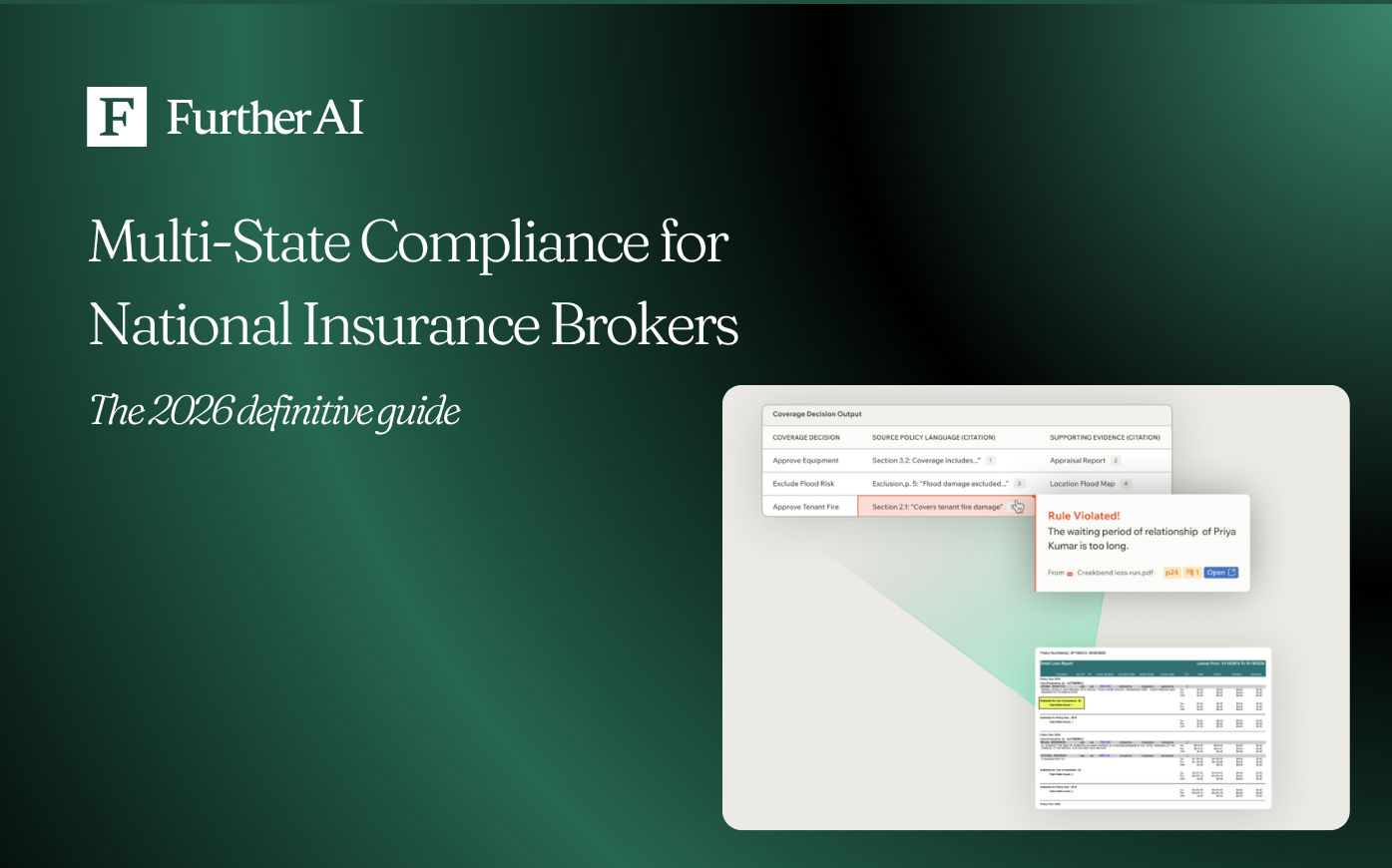
Managing compliance across multiple states is one of the most complex, high-stakes parts of running a national brokerage. The U.S. insurance market is regulated primarily at the state level, which means producers, surplus lines filings, and disclosures must clear 56 separate jurisdictions — the 50 states, DC, and five U.S. territories — each with its own rules, fee schedules, and renewal cycles. On top of that sits federal law (NRRA, GLBA, HIPAA) and a growing layer of state-specific cybersecurity and AI bulletins. Carrier-side state filing requirements — the forms and rates a program is filed on — are a separate obligation and a separate discipline from the licensing and surplus lines work below.
This guide explains what multi-state compliance covers in 2026, the best tools national brokers use to keep up with it, and a six-step program for getting audit-ready without growing headcount.
Key takeaways
- Brokers operate under at least 56 different licensing regimes — 50 states, DC, and 5 U.S. territories — each with its own renewal cycle and continuing-education rules.
- U.S. surplus lines premium crossed $100B for the first time in 2025, reaching approximately $100.9 billion (up from $81B in 2024), which means a record volume of multi-state tax allocations to file correctly.
- 29 jurisdictions now regulate insurer AI use. As of the NAIC's April 1, 2026 implementation map, 24 states plus D.C. have adopted the NAIC AI Model Bulletin, and four more states — California, Colorado, New York, and Texas — have their own insurance-specific AI regulation.
- Cybersecurity penalties are now in the eight figures. NYDFS levied a $2M penalty against Healthplex in August 2025 under 23 NYCRR 500, with statutory fines that can reach up to $75,000 per day for a knowing or willful violation under NY Banking Law § 44(d).
One of the leading independent U.S. brokers, uses FurtherAI to take loss runs and policy checks from hours to minutes — the kind of operational leverage national brokers need to scale compliance across all 56 jurisdictions.
What multi-state compliance actually means for national brokers
Multi-state compliance is the ongoing work of meeting every regulatory obligation — licensing, appointments, surplus lines tax, cybersecurity, disclosures — in every state a broker writes business. Because oversight is primarily state-based, no single rulebook applies. The NAIC coordinates models and reciprocity, but each Department of Insurance (DOI) writes its own version into law.
Federal frameworks fill specific gaps. The Non-Admitted and Reinsurance Reform Act (NRRA) assigns surplus lines tax collection to the insured's home state. GLBA sets the floor for consumer financial privacy. HIPAA governs PHI in health-related lines. State cyber regimes (most notably New York's 23 NYCRR 500) layer on prescriptive controls.
The four regulatory layers brokers must manage
Most multi-state compliance work sorts into four buckets:
Each layer has a different escalation path. Get a license filing wrong and you risk a fine of a few thousand dollars; get 23 NYCRR 500 wrong and NYDFS can charge up to $75,000 per day for a knowing or willful violation under NY Banking Law § 44(d). For national brokers, that asymmetry is what makes centralization non-negotiable.
Why multi-state compliance is harder now than three years ago
Three things changed at once. Surplus lines premium crossed $100B for the first time in 2025, reaching approximately $100.9 billion — which means a record volume of multi-state tax allocations to calculate and file correctly. AI-specific rules — 24 states plus D.C. adopting the NAIC Model Bulletin, with four more (California, Colorado, New York, Texas) running their own insurance-specific AI regulation — added documentation requirements that didn't exist in 2023. And state DOI enforcement got sharper: U.S. financial-services penalties totaled $5.44B in the second half of 2024, an 83% jump versus the prior six months, with fewer but higher-value actions.
Brokers feel the same operational drag from a different angle. McKinsey estimates that about 33% of insurance sales-and-service tasks are automatable, with the potential to lift agent productivity by up to 30%. In a multi-state shop, a big share of that headroom sits in compliance work — producer licenses, surplus lines filings, and CE tracking handled once in the agency management system and again in the carrier portal.
Best tools for national brokers to ensure multi-state compliance across carrier partners
We compared six platforms national brokers use to centralize multi-state compliance. The list is structured the same way for every entry (overview, best for, key features, strengths, limitations, pricing), so you can compare without re-reading.
At-a-glance comparison
1. FurtherAI
Overview. FurtherAI is the AI workspace for insurance, used by brokers, MGAs, carriers, and reinsurers to automate the high-volume, document-heavy compliance work that sits around license validation, surplus lines filings, policy checks, and audits. It connects to existing CRM and policy systems rather than replacing them. The platform processes approximately $30B in premium across 20+ lines of business and ~50 states.
Best for: National brokers and MGAs who need to scale compliance work across many states without growing the back-office team.
Key features:
- AI agents for license and appointment verification before bind
- Policy check and compare against carrier filings, including endorsements
- Automated audit prep and discrepancy detection
- SOC 2 Type 2, ISO 27001, GDPR, and HIPAA controls
Strengths:
- Documented customer outcomes: a reinsurer cut audit time 45% (200h → 110h per MGA), and an insurer hit 400% ROI within months on policy check and compare.
- Human-in-the-loop design — outputs are reviewable rather than black-box
- Forward-deployed-engineer model means workflows are tuned to the broker's actual carrier panel
Limitations:
- Not a stand-alone licensing system of record — pairs with NIPR/AgentSync/Sircon
- Enterprise-focused; smaller agencies may not need the full platform
Pricing: Custom, based on workflow scope and volume. Book a demo.
2. AgentSync
Overview. AgentSync is a Salesforce-native producer compliance platform focused on automating license and appointment management for carriers, agencies, and MGAs. The flagship product, Manage, enforces state producer licensing and appointment rules in real time.
Best for: Salesforce-centric carriers and MGAs that need just-in-time appointments and clean NIPR sync.
Key features:
- Just-in-time (JIT) appointment automation
- ProducerSync API with 200+ data points
- NIPR data integration and continuous validation
- Agent and developer self-service portals
Strengths:
- Best-in-class for license/appointment specifically
- Native Salesforce footprint reduces integration cost for that stack
Limitations:
- Doesn't cover surplus lines tax, policy comparison, or document-level workflows
- Average annual cost ~$100K, which can be steep for mid-market brokers
Pricing: Approximately $100K/year on average, up to $140K per Vendr benchmark data.
3. Vertafore Sircon
Overview. Sircon Producer Central is the long-standing enterprise compliance platform for producer onboarding, licensing, appointments, and continuing-education tracking. As per the company’s website, Sircon supports license application and renewal in all 50 states from a single workspace.
Best for: Large carriers and national agencies that want a mature, all-states system of record.
Key features:
- Online licensing and renewal across all U.S. jurisdictions
- Bulk transaction processing for high-volume changes
- Sircon Managed Services BPO option for outsourced execution
- APIs into policy admin and CRM systems
Strengths:
- Deepest state-by-state coverage in the category
- Managed services option absorbs the day-to-day compliance ops work
Limitations:
- Enterprise-grade implementation timelines
- Limited AI-native automation around document review and audit prep
Pricing: Custom; quoted by Vertafore based on entity size and module mix.
4. ReSource Pro Compliance
Overview. ReSource Pro Compliance combines software with a managed-service team to handle licensing, appointments, and ongoing compliance for brokers, agencies, and MGAs. Its Compliance Gateway provides 24/7 access to license status, project tracking, and renewal workflows.
Best for: Brokers who want a hybrid platform-plus-people model rather than pure SaaS.
Key features:
- Initial licensing and renewal services across all 50 states
- Continuous NIPR-based status verification
- Project tracking and onboarding visibility
- 25+ years of regulatory subject-matter expertise
Strengths:
- Strong service layer for brokers without internal compliance staff
- Useful for cleaning up legacy license data before a system migration
Limitations:
- BPO-heavy model can be slower than self-serve SaaS
- Less AI automation around document review
Pricing: Custom; quoted based on producer count and service scope.
5. Producerflow by Agentero
Overview. Producerflow is a newer entrant launched by Agentero in early 2025 to automate producer onboarding, license management, and appointments for carriers, MGAs, and agencies.
Best for: Carriers and MGAs that want a modern, single-pane producer compliance workflow without the legacy footprint.
Key features:
- Automated producer onboarding with license verification
- Centralized license and appointment management
- Contracting and compensation workflows
- API-first architecture
Strengths:
- Clean modern UX compared to legacy platforms
- Built by Agentero, which already operates a digital insurance network
Limitations:
- Newer product with a shorter customer reference list
- Surplus lines tax and document-level audit remain out of scope
Pricing: Custom; not publicly listed.
6. NIPR Gateway
Overview. The NIPR Gateway is the regulator-run electronic exchange between state insurance regulators and licensed entities. It's the system of record every compliance tool ultimately reads from.
Best for: Any broker, agency, or carrier that files licenses, appointments, or renewals electronically — which is effectively all of them.
Key features:
- Electronic appointment and termination submissions
- License renewal for resident and non-resident producers
- Producer Database (PDB) access — 5M+ entities, 54 jurisdictions
- Direct connection or via reseller integration
Strengths:
- Authoritative — this is the state regulator pipeline
- Low transaction-fee pricing for individual filings
Limitations:
- Not a workflow tool — there's no automation, dashboarding, or audit prep
- Requires either an internal system or a partner platform layered on top
Pricing: Per-transaction fee plus applicable state fees; published on the NIPR site.
How to build a scalable multi-state compliance program in six steps
- Map your footprint. Build a single inventory of producers, lines of business, and carrier appointments by state. This is the input for every other step.
- Pick one system of record for producer data. NIPR is upstream; you still need one operational layer (Sircon, AgentSync, ReSource Pro, or Producerflow) so renewals, appointments, and CE don't drift.
- Enforce license validation before bind. Real-time checks at the point of sale prevent the most common compliance violation — selling without active authority in the insured's state.
- Automate surplus lines tax allocation. Under NRRA, only the insured's home state collects the tax — but the calculation is still error-prone across multi-state risks.
- Lock down privacy and cyber controls. Map your obligations under GLBA, HIPAA (where applicable), 23 NYCRR 500, and other state cyber rules. Document the program; assume an audit is coming.
- Run quarterly mock audits. Pull a representative sample of bound policies and verify license status, appointment, surplus lines filings, disclosures, and data-privacy controls against current state rules. Document findings, fix gaps, and keep the trail — that's the evidence regulators ask for when a real examination starts. Pre-bind checks matter as much as post-bind ones: endorsement validation for brokers catches missing additional insured wording and outdated form editions before the file ever reaches the carrier.
Audit-readiness checklist
- Centralized, timestamped records for every producer and policy action
- Automated renewal and CE tracking with role-based escalation
- Surplus lines documentation retained for the state-required period (typically 5–7 years)
- Annual review of data-privacy posture and breach-response plan
- Documented sign-off on AI governance for any models used in marketing, pricing, or claims
Outcomes: What a working program looks like
When the compliance stack actually works, the numbers move. Leavitt Group, one of the largest independent brokerages in the U.S., uses FurtherAI to structure loss runs that previously took hours into minutes, with account managers reviewing outputs in-loop. An insurer's policy check and compare workflow delivered a 400% ROI within months, with automated processes reducing manual review time by up to 95%. And the reinsurer underwriting-audit case study above (200h → 110h per MGA) illustrates what compliance gains look like at scale across 100+ MGAs.
While AI does not replace compliance teams, they get to spend their time on judgment instead of data entry.
Frequently asked questions
DISCLAIMER
This article is for general informational purposes only and does not constitute legal, regulatory, compliance, underwriting, or other professional advice. The content reflects information available as of the date of publication, and FurtherAI undertakes no obligation to update it as laws, regulations, or AI technologies evolve.
Recent posts
.png)
.png)
.png)
Ready to go further and
transform your insurance ops?
Reclaim your time for strategic work and let our AI Assistant handle the busywork. Schedule a demo to see how you can achieve more, faster.




.svg)