FurtherAI Available in Microsoft Marketplace
Introducing Connectors



Submission Clearance: How Carriers and MGAs Automate It

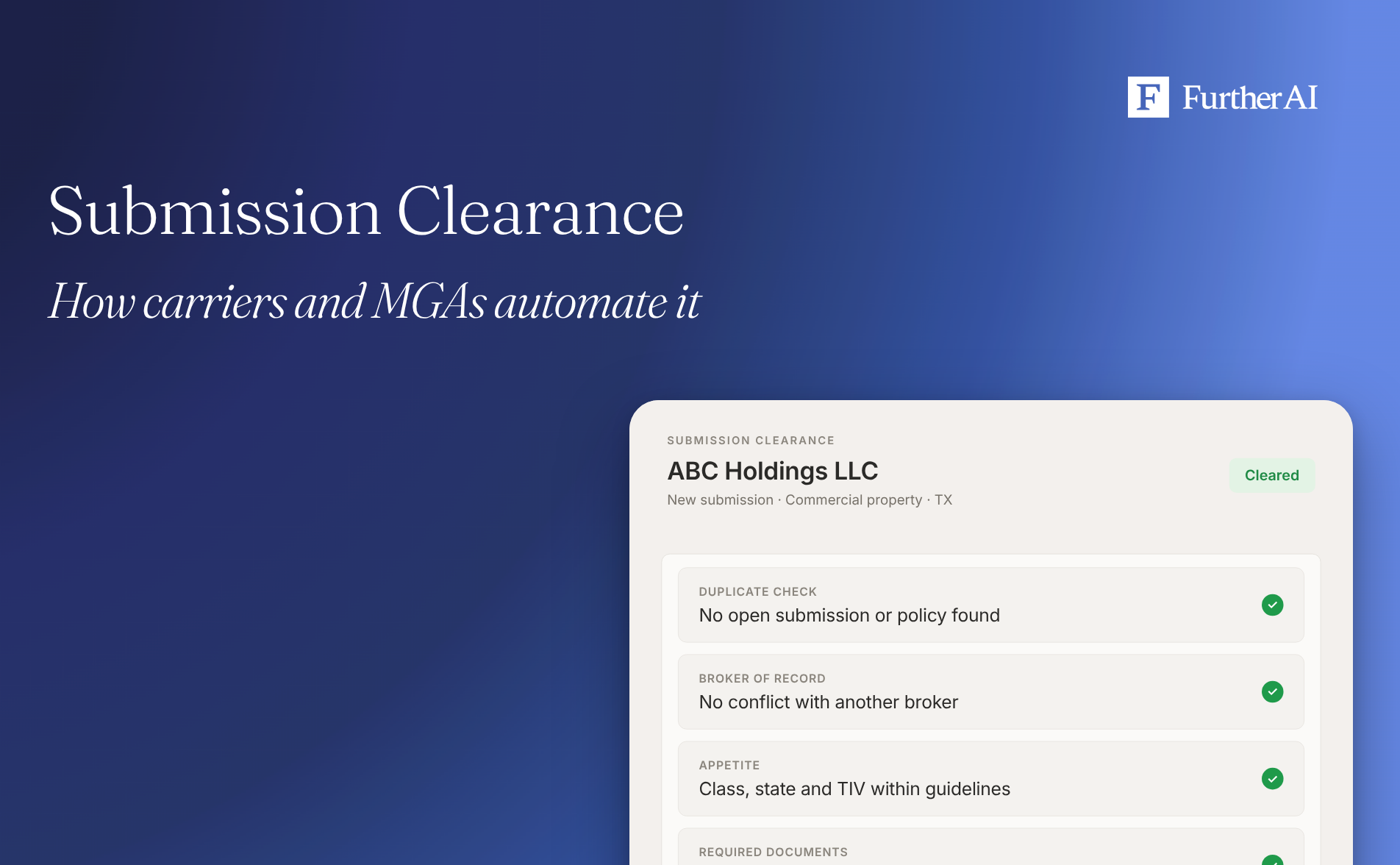
Submission clearance is the check a carrier or managing general agent (MGA) runs on every new submission before an underwriter works it. It answers three questions: is this insured already in our system, which broker controls the account, and is the risk inside our appetite? A cleared submission moves on to triage and quoting. A blocked one goes back to the broker with a reason. Automated clearance software reads the broker email and attachments, identifies the insured, checks for duplicates and conflicts against your own records, and applies your clearance rulebook automatically. At one U.S. MGA using FurtherAI, the average time to clear a submission fell from about 32 minutes to about one.
This guide explains what submission clearance is, how it differs from intake and triage, how the process works step by step, and how carriers and MGAs are automating it in production.
Key takeaways
- Submission clearance decides whether a submission can be worked at all. It checks for duplicate submissions, broker-of-record conflicts, and basic appetite fit before any underwriting time is spent.
- Clearance happens before triage. Clearance gives a yes, no, or review result; triage then ranks the cleared submissions so underwriters quote the best ones first.
- Volume is rising faster than premium. Surplus lines item filings in the 15 U.S. stamping-office states grew 16.9% in the first half of 2026 while premium grew 2.8%, according to WSIA data reported by Business Insurance.
- Agents move business away from friction. In Ivans' 2026 survey of 700+ agents, 90% said they had reduced business with a carrier because of workflow friction.
- Automation is working in production. Upland Specialty cut clearance time by roughly 30% to 40% after moving its clearance desk to FurtherAI.
What is submission clearance?
Submission clearance is the first gate in commercial underwriting. When a broker sends a new or renewal submission, the clearance team (or clearance software) confirms that the account can be worked before it reaches an underwriter's desk.
In practice, clearance answers three questions:
- Have we seen this insured before? The submission is matched against open submissions, quotes, and in-force policies.
- Who controls the account? If a different broker already submitted the same insured, the second submission is usually blocked.
- Can we write it? A quick check against appetite rules (class, state, limits, and similar) filters out risks the program can't take.
Carriers publish their own matching rules. For example, Amerisafe's agent documentation describes a clearance check that matches on the insured's FEIN and rating bureau ID, and treats a new submission as a conflict if its effective date falls within 90 days (a configurable default) of an existing submission that's cleared, quoted, withdrawn, or declined. When the data matches, the agent gets a "Not Clear" result.
Why the first broker usually wins
Clearance is generally a carrier business practice rather than a regulatory requirement. The usual convention is that the first broker to submit an insured holds that market. As one agency's guide puts it, "Whoever submitted first holds that market", and a second broker is told the account is already cleared or blocked. The insured can move the account with a broker of record (BOR) letter,but BOR guidelines published by Chubb note that "many companies have a waiting period, pending confirmation from the previous broker." Clearance is where those conflicts get caught and logged.
Submission clearance vs. intake vs. triage
The three terms often get used together, and many teams run them as one workflow. They answer different questions, though, and it helps to separate them when you're deciding what to automate.
Intake feeds clearance, because you can't match an insured you haven't identified. Clearance feeds triage, because there's no point ranking a submission you can't write. For the broader end-to-end view, see our guide to submission processing platforms for carriers and MGAs.
Why clearance is a bottleneck in 2026
Clearance is low-judgment work for most submissions and high-stakes for the rest. A missed duplicate can put two brokers in front of the same insured; a slow "no" leaves a broker waiting on a risk you were never going to quote. Three trends are making the queue harder to keep up with.
More transactions per premium dollar. In the first half of 2026, surplus lines item filings across the 15 U.S. stamping-office states rose 16.9% to 4.28 million while premium rose just 2.8% to $47.6 billion, per the Wholesale & Specialty Insurance Association (WSIA) midyear report. More transactions for slower premium growth means more files to clear for each dollar written.
MGAs are growing fast. Conning estimates total U.S. MGA premium reached about $128 billion in 2025, with MGA direct premium written up 12% against roughly 5% for the broader property and casualty market. Each new program adds a new set of appetite rules for clearance to apply.
Brokers move business to whoever responds first. Ivans found that 90% of agents have reduced business with a carrier due to workflow friction, and 79% named commercial submission automation as the area where they most want carriers to automate. Meanwhile, commercial-heavy agencies rely on email for submissions far more than on dedicated submission software (49% vs. 7%), according to Applied Systems' 2026 connectivity survey, as reported by Insurance Business. That means most clearance work still starts in an unstructured inbox.
How submission clearance works, step by step
Whether a person or software runs it, clearance follows the same five steps. Automation changes how fast each step happens and how consistently the rules get applied.
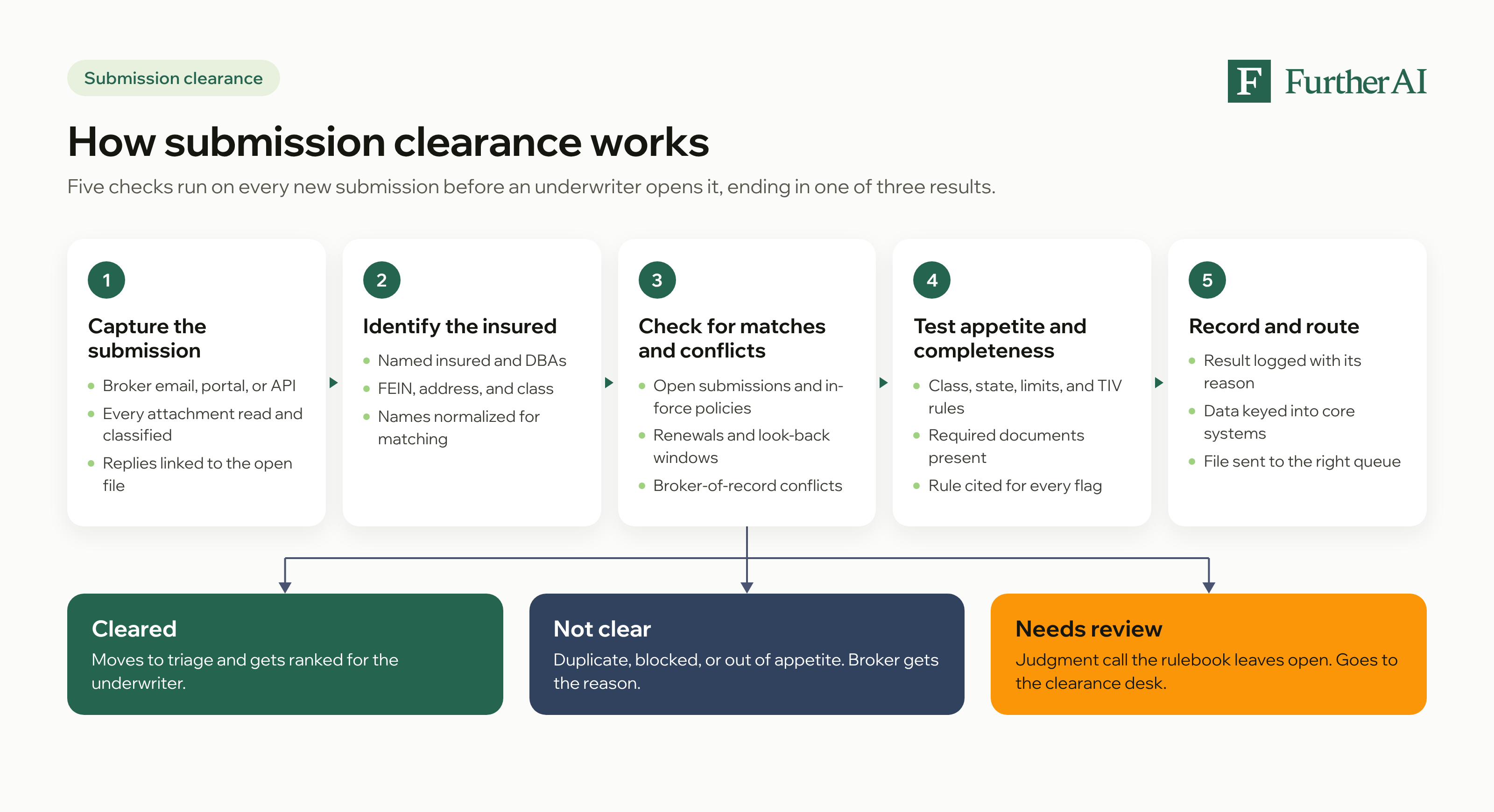
- Capture the submission. The submission arrives by email, portal, or API. Every attachment is opened and classified, and replies on an existing thread are linked to the file already in progress instead of opening a new one.
- Identify the insured. The named insured, DBAs, FEIN, mailing and location addresses, and class of business are pulled from the ACORD application and supporting documents. Names are normalized so "ABC Holdings LLC" and "A.B.C. Holdings" can match.
- Check for matches and conflicts. The insured is searched against open submissions, quotes, declines, and in-force policies within your look-back window. If another broker already holds the account, the conflict is flagged.
- Test appetite and completeness. The risk is checked against program rules such as eligible classes, states, limits, and total insured value (TIV), and against your list of required documents. Every flag should cite the rule that triggered it.
- Record and route. The result is logged with its reason. Cleared files move to triage with data already keyed into your systems, blocked files go back to the broker, and judgment calls go to the clearance desk.
What automated clearance software does differently
Older clearance tools are search screens. A clearance assistant still reads the email, types the insured's name into the policy system, scans the results, and decides. AI-based clearance software does that reading and checking itself, and leaves the clearance team with the exceptions.
The capabilities that matter most:
- Reads unstructured submissions. It handles broker emails, scanned ACORD forms, and spreadsheets regardless of file name or layout.
- Matches entities, not strings. It recognizes the same insured across name variations, DBAs, and addresses, so duplicates aren't missed on a typo.
- Applies your rulebook as written. Clearance and appetite rules are configured in plain language, so the software applies the same guidance you use to train your clearance staff.
- Explains every result. Each "not clear" or review flag points to the guideline and the source document behind it, so a person can confirm it in seconds.
- Keeps humans on the judgment calls. Rules that need interpretation route to the clearance desk instead of being forced into a yes or no.
Explainability also matters for governance. As of October 8, 2026, 29 jurisdictions had adopted the NAIC Model Bulletin on the use of AI systems by insurers, which expects insurers to maintain a written program, including governance and oversight, for AI systems that make or support insurance decisions. A clearance result with a cited rule and source document is much easier to defend than a black-box score.
What carriers and MGAs have achieved
Clearance is a practical place to start with AI in underwriting, because the rules already exist and the results are easy to measure. Here's what FurtherAI customers have reported.
Upland Specialty: automating a rulebook everyone assumed was too nuanced
Upland ran submissions for roughly a dozen lines of business through one centralized clearance desk, guided by a detailed rulebook that mixed if-then logic with judgment calls. The team assumed it was too nuanced for software. "We've improved our clearance time by roughly 30 to 40%," said Doug Alexander, CTO of Upland Specialty, in a conversation with FurtherAI CEO Aman Gour. Benefits showed up within weeks of rollout.
The rollout itself is a useful template. FurtherAI wrote its results to a hidden field in production while the clearance team kept working by hand, so Upland could compare the two. Upland switched the system on once agreement with its manual results reached 85%. Because every line shared one clearance process, Upland turned it on for all lines at once instead of going line by line.
How to roll out clearance automation
Based on what we've seen in production, these steps keep a clearance rollout fast and low-risk:
- Hand over the real rulebook. Use the same document you train new clearance staff on. Upland's rulebook was processed within days.
- Run in shadow mode first. Let the software clear submissions in parallel with your team and compare results before anything changes downstream.
- Set an agreement threshold up front. Decide what match rate with human decisions earns a go-live. Upland used 85%.
- Separate rules from judgment. Some fields that look simple turn out to be subjective. Route those to people and automate the rest.
- Measure time to clear and touch rate. Track minutes per submission and the share of submissions that need a human, by line of business. Our guide to underwriting turnaround time covers how to benchmark the rest of the cycle.
What to look for in submission clearance and triage software
If you're an MGA or carrier evaluating software for clearance and triage, these questions separate tools that work in production from tools that demo well:
- Does it read your actual inbox? Test it on a week of real broker emails, including forwards, replies, and scanned attachments.
- Can you configure the rules yourself? Appetite changes every renewal season. You shouldn't need a vendor ticket to update a class code or TIV limit.
- Does every decision cite its source? Underwriters and auditors should see the rule and the document behind each flag.
- Does it handle threads and duplicates? Replies should attach to the open submission; new risks should open new files.
- Does it connect to your systems? Clearance only saves time if results and extracted data land in your policy administration, rating, and agency management systems without rekeying.
- Does it hand cleared files to triage? The best results come when clearance, triage scoring, and underwriter routing run as one workflow.
Where FurtherAI fits
FurtherAI is an AI workspace for commercial insurance teams. Its Inbox Agent reads every submission email and attachment, separates replies from new risks, and checks each submission against appetite rules written as plain-language Skills. In-appetite submissions move forward with data already keyed, and out-of-appetite ones are flagged with the specific guideline behind the decision. The clearance and appetite agent returns a result (duplicate, broker-of-record conflict, or in or out of appetite) with the rule that triggered it, and sends the judgment calls to your clearance desk.
If you want to see how this would work on your own submissions and rulebook, book a demo with FurtherAI.
Frequently asked questions
DISCLAIMER
This article is for general informational purposes only and does not constitute legal, regulatory, compliance, underwriting, or other professional advice. The content reflects information available as of the date of publication, and FurtherAI undertakes no obligation to update it as laws, regulations, or AI technologies evolve.
Recent posts


Ready to go further and
transform your insurance ops?
Reclaim your time for strategic work and let our AI Assistant handle the busywork. Schedule a demo to see how you can achieve more, faster.