FurtherAI Available in Microsoft Marketplace
Introducing Connectors



The Two AI Transformations Facing Insurance Companies

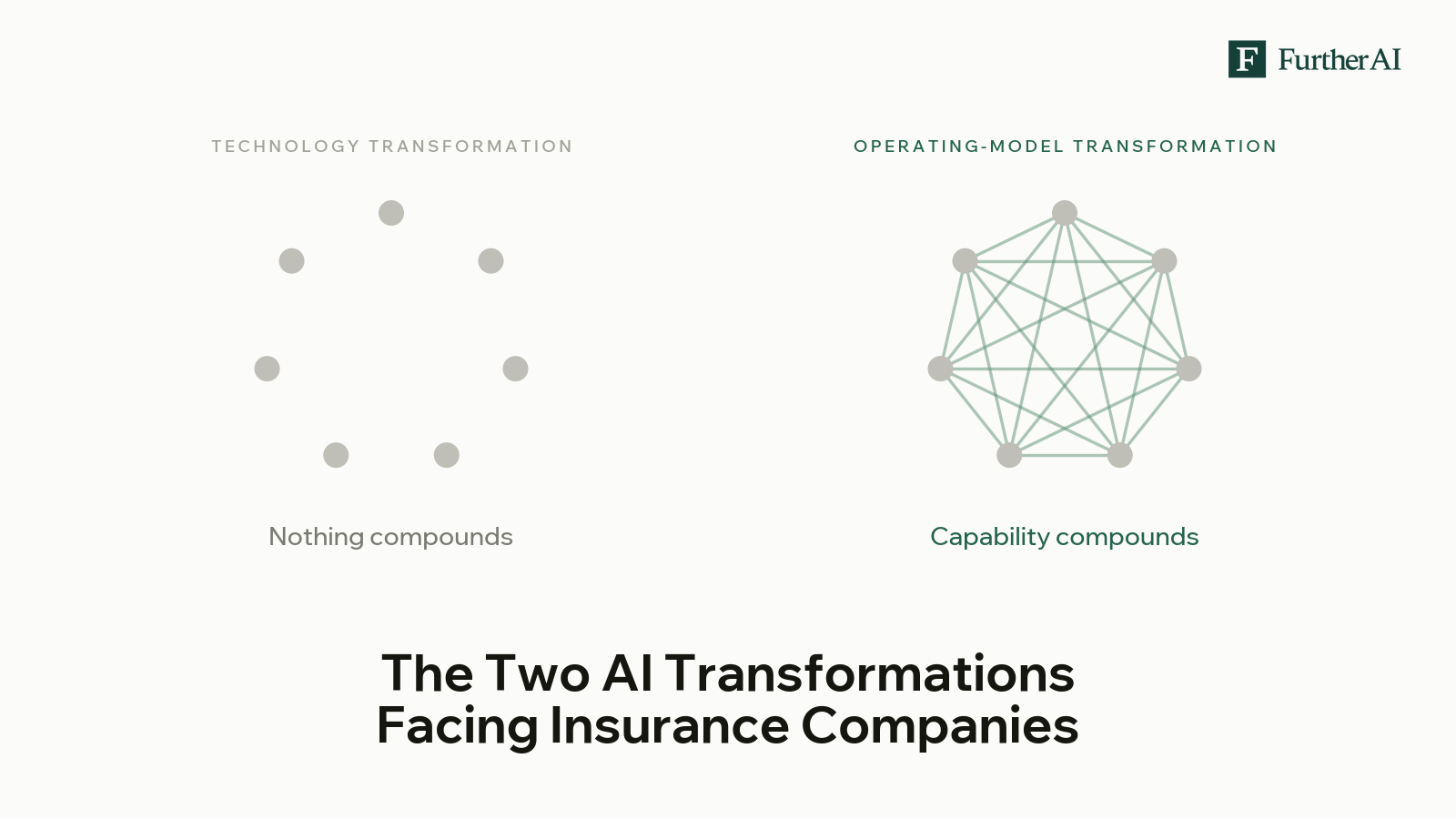
TL;DR — Two changes are coming to insurance, and they drive different types of long-term value for organizations running them. A technology transformation automates the work that already exists and takes you to the top of the operating model you already have. An operating-model transformation changes how the work is organized, delivers the technology transformation along the way, and keeps compounding once the first one has run out of room.
Every carrier, MGA, and broker in this market is being sold AI against the same promise: this workflow is slow and expensive, and we'll make it fast and cheap.
And while the promise is real, it does have a ceiling. Why? Because making today’s process cheaper still leaves you with today’s process, and that process itself is what sets your limits.
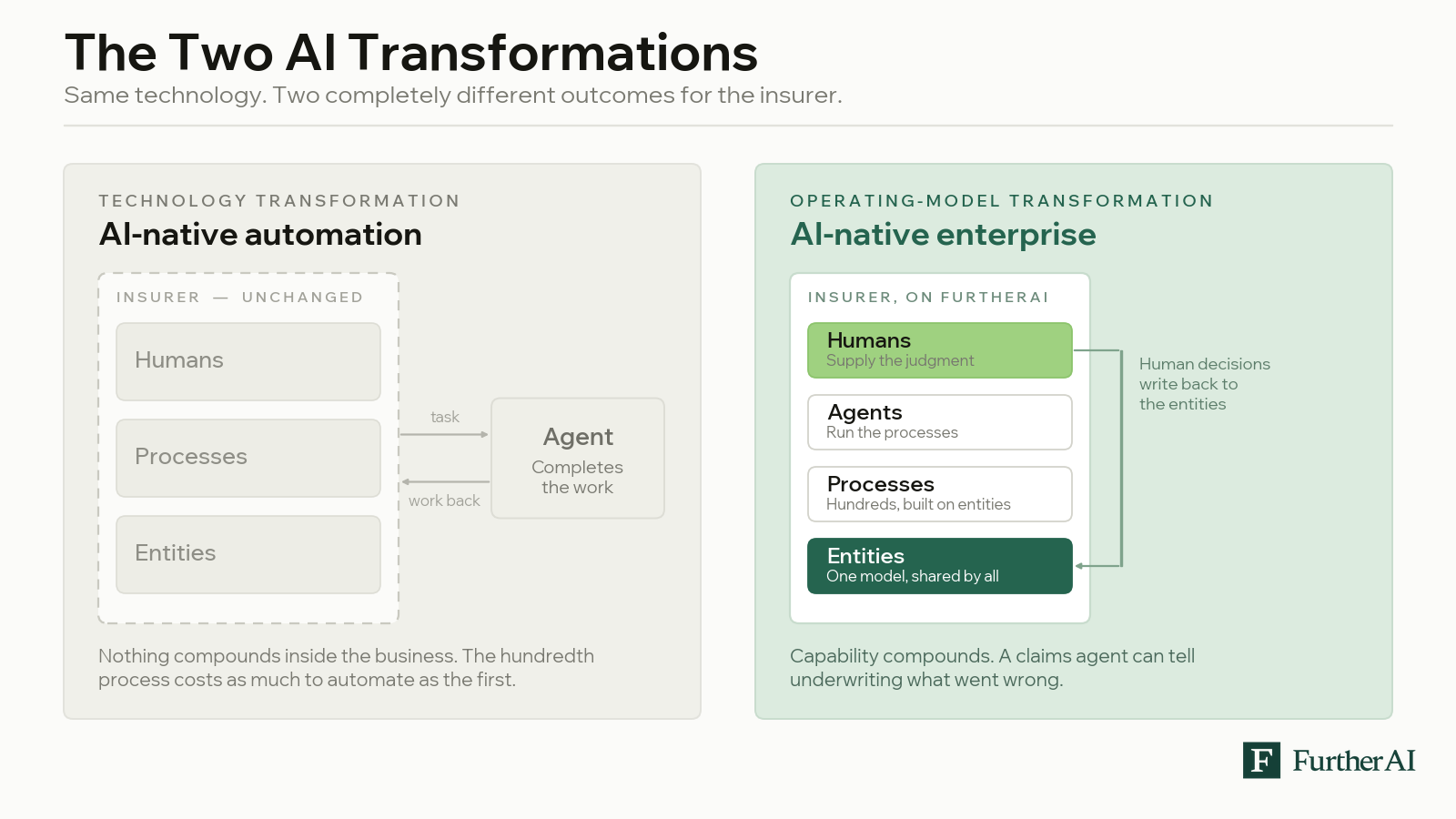
A technology transformation automates the work that already exists: the company comes out faster and cheaper, organized exactly the way it was before.
An operating-model transformation changes how the work is organized: agents run the processes end to end, and people move up to the judgment layer above them.
A technology transformation is a local maximum: it takes the operating model you already have and gets you to the top of it, which is worth real money, but then it stops.
An operating-model transformation moves the curve: it delivers the technology transformation along the way, and it keeps paying after that, because every process you add makes the next one cheaper to build.
Automating workflows one at a time never gets you there.
Why "faster and cheaper" stops working
BCG describes a company that used AI to cut a ten-day task to one day, while customers still waited ten days, because nothing around it changed. The automation worked, and yet the business didn't move. The same analysis found only 6% of companies seeing meaningful value from AI in cost or revenue.
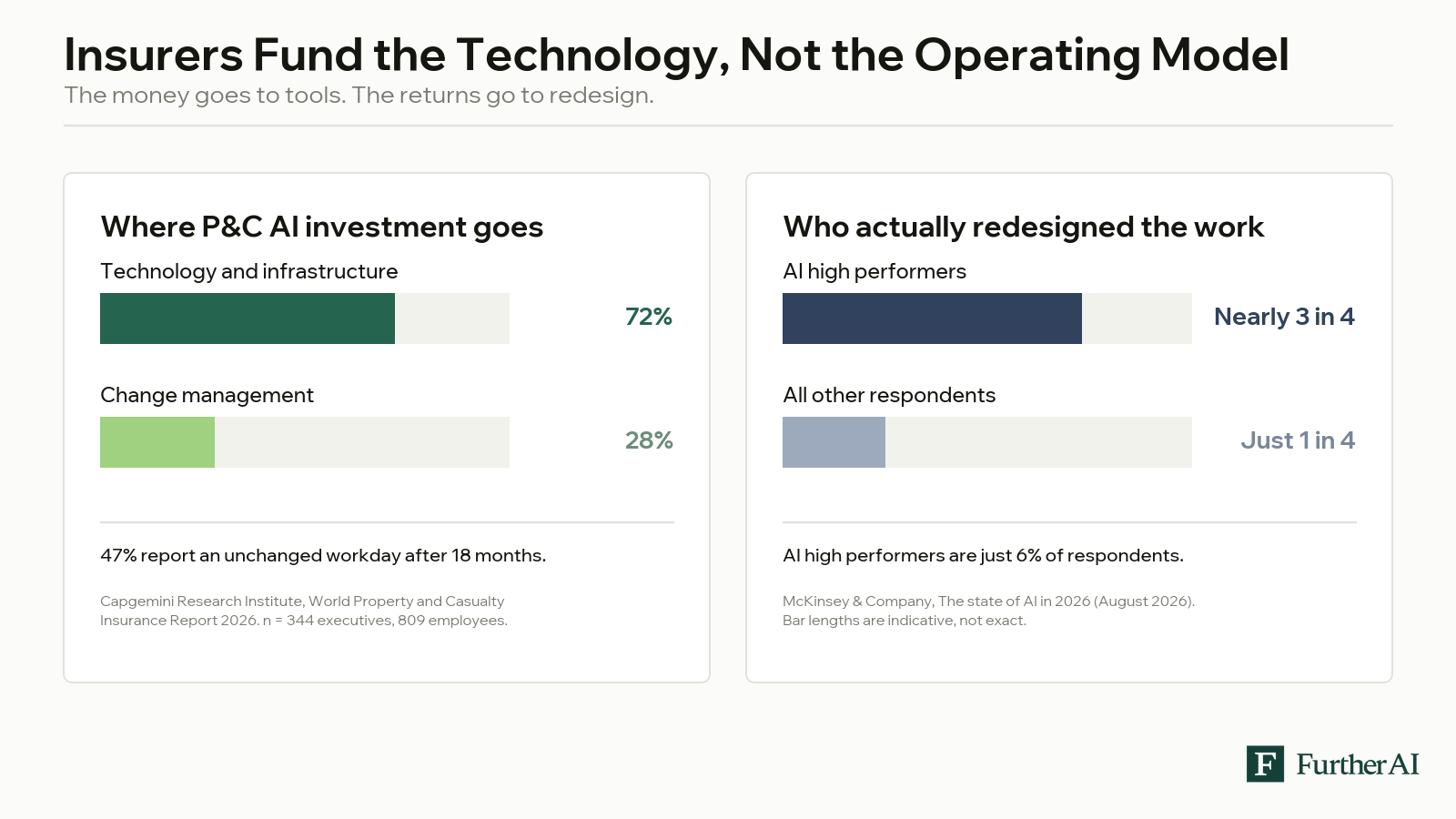
Insurance has its own version. Capgemini's May 2026 research found 47% of employees with AI access reporting an unchanged workday after 18 months, and 72% of P&C AI investment going to technology rather than change management. Eighteen months of AI, and the job looks essentially the same.
The technology itself didn't underperform. It just landed in an organization that wasn’t reshaped to receive it. McKinsey puts it sharply: nearly three-quarters of AI high performers report fundamentally redesigning workflows, against just one-quarter of everyone else. Gartner expects more than 40% of agentic AI projects to be canceled by the end of 2027.
Two kinds of offering
Underneath the marketing, vendors here are selling one of two things.
AI-native automation. Take an SOP, turn it into an agent, run the existing process. This sells quickly because the ROI is immediate and easy to model. Work goes out of the building, completed work comes back, and the insurer buys output rather than capability.
AI-native enterprise. The company defines its entities first (account, risk, exposure, quote, policy), and then defines its processes on top of them. Every process uses the same model, and every run writes back to it. The insurer owns the model, humans stay in the loop for judgment, and each process makes the next one easier to build.
That reads like architecture pedantry until you count the processes.
“Across our own deployments, a carrier runs hundreds of them. Automate each against its own SOP and you end up with hundreds of separate agents, each carrying its own idea of what a policy is, with no shared vocabulary between them. On a single model, the hundredth agent inherits what the first one already knows. A claims agent can tell underwriting what went wrong.”
That last sentence is the whole argument, and point automation can't produce it at any level of accuracy.
Underwriting, end to end
Take a commercial submission and run it both ways.
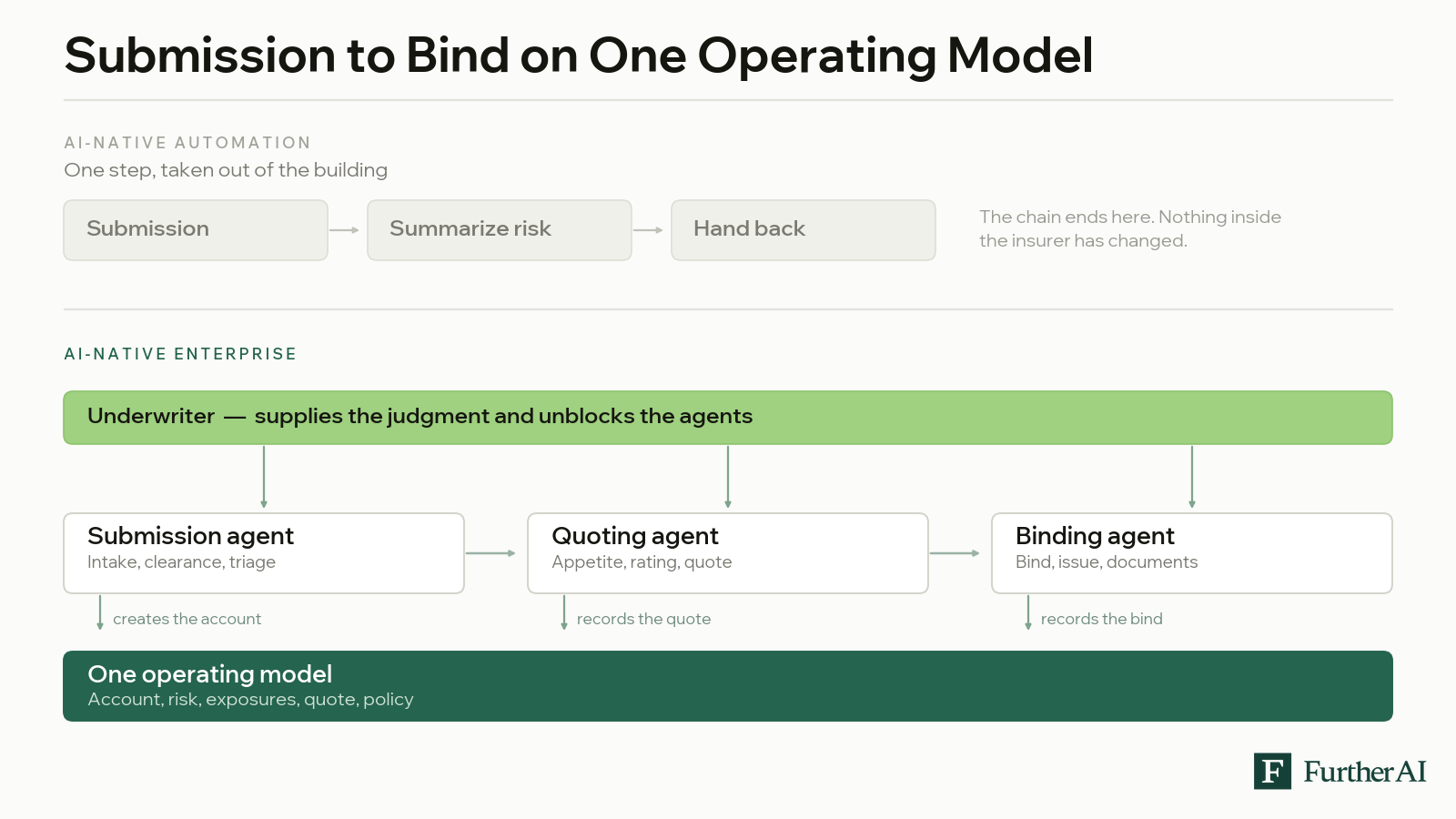
Under AI-native automation, the submission comes in, an agent summarizes the risk, and the summary goes back to the underwriter. One step, taken out of the building, and the chain usually ends there.
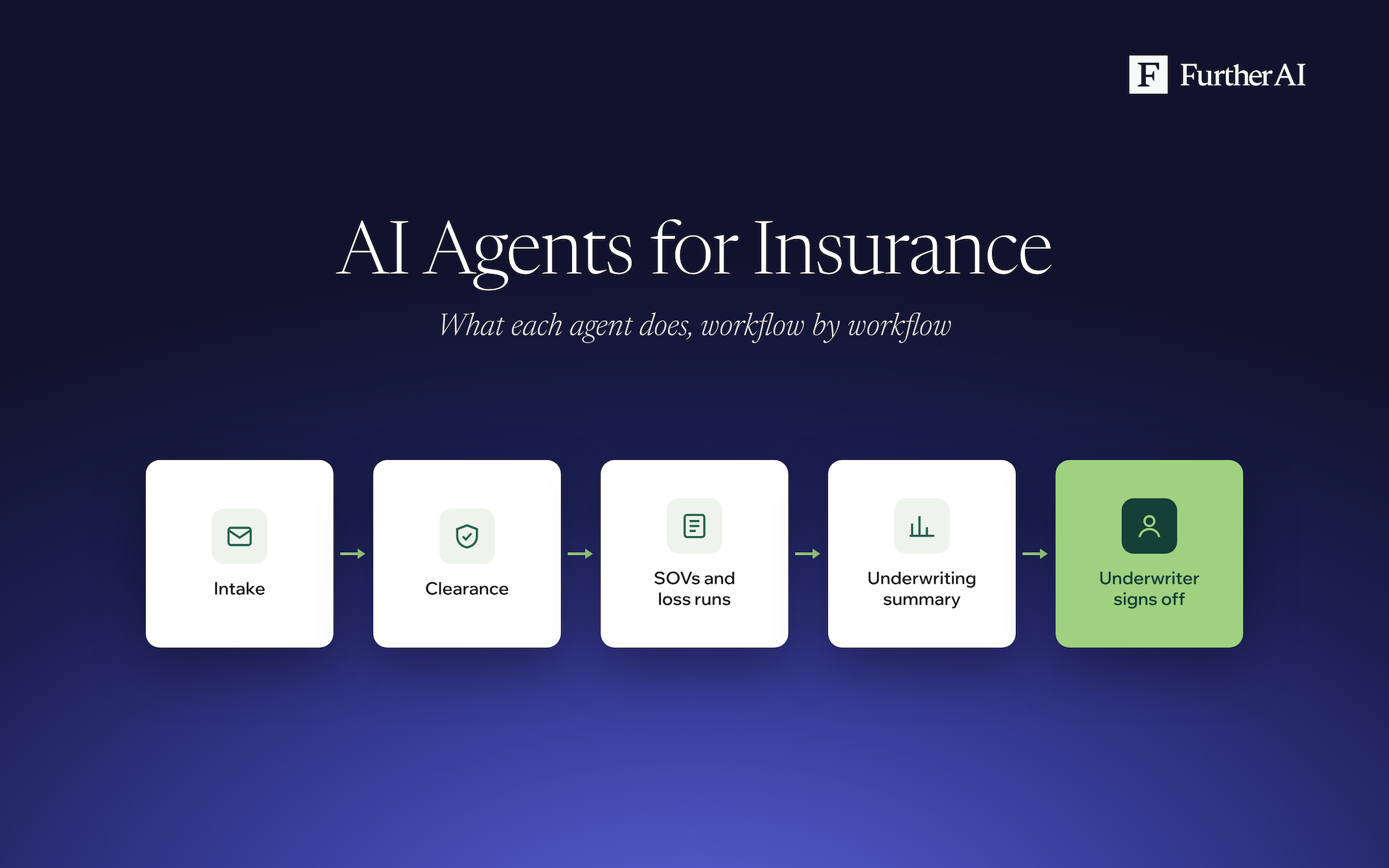
Under an AI-native enterprise, submission to bind runs on three agents and one operating model. The submission agent handles intake, clearance, and triage, and creates the account. The quoting agent works appetite, rating, and quote, and records that the risk was quoted. The binding agent binds, issues, and records the bind. The underwriter reviews the view, supplies the judgment, and unblocks the agents. Every step writes to the same entities, so the account the submission created is the account the quote prices and the policy the bind issues.
This matters because underwriters aren't spending their days underwriting. Accenture's longitudinal study with The Institutes, running since 2008, found in its 2021 survey that the average underwriter spends 70% of their time on non-underwriting activities — 40% on administrative tasks and 30% on negotiation and sales support.
“Automating one of those steps gives an underwriter a better afternoon, while reorganizing the work around a shared model changes what the role actually is.”
The financial difference shows up in which side of the combined ratio you can move. Automating existing work takes cost out of the expense ratio, and that's where a technology transformation's ceiling sits: you run the same book with fewer hours, and the gain stops once those hours are gone. Running submission to bind on one operating model reaches the loss ratio as well, because appetite and triage decisions read from the same entities the book's own history gets written back to. An expense-ratio gain is the one you only bank once, while a loss-ratio gain compounds.
Why this has always been slow
Operating-model transformation isn't exactly a new idea. And the reason it’s been slow is because it requires people. Palantir built its business on forward-deployed engineers who, as Everest Group describes the model, focus exclusively on one customer and build production workflows alongside that organization's own teams. Mapping entities by hand, one enterprise at a time, carries a cost structure that limits how many enterprises you can reach.
The unlock is building that model layer with software. An agent that builds workflow agents at scale means giving each enterprise its own operating model no longer takes a consulting engagement every time. EY lands in a similar place in its 2026 Global Insurance Outlook: agentic AI going mainstream will necessitate new processes and workflows, new skills, and even entirely new operating models.
The open question is whether that model gets built with services, with software, or not at all.
Where FurtherAI sits
We run three agents, and they map onto both transformations deliberately.
The work agent takes an SOP and automates the work; it’s our technology-transformation product, it sells fast, and it gets us into the account.
The workflow agent defines the entities, builds the processes on top of them, runs them with agents, and produces a view for a person to approve, so every decision the underwriter makes goes back into the operating model.
The builder agent builds workflow agents at scale, which is what lets us give each enterprise its own operating model without a consulting engagement behind it.
The work agent shows up in numbers customers can point at. A top-tier MGA with $1.5 billion in premium and 20+ programs cut the time to clear a property submission from about 32 minutes to about one, processing more than $20 billion in total insured value and saving over 2,000 manual hours in three months. A reinsurer supporting 100+ MGAs cut underwriting audit time 45%, from 200 hours per audit to 110, and put 50+ of the recovered hours back into proactive underwriting.
The operating-model work shows up differently. Lynx Specialty is growing about 35% this year, on submission volume from brokers they already worked with. As Paul Ritter, Senior Vice President of Lynx Specialty, put it: "More brokers within our existing relationships are sending more submissions in, because we're responding so quickly, that means more quotes out the door, more bind orders, and in a changing market, that's been crucial for us to continue to grow."
The automation companies will still be here in five years, and they'll be running on somebody's operating model. At FurtherAI, we intend for it to be ours.
DISCLAIMER
This article is for general informational purposes only and does not constitute legal, regulatory, compliance, underwriting, or other professional advice. The content reflects information available as of the date of publication, and FurtherAI undertakes no obligation to update it as laws, regulations, or AI technologies evolve.
Recent posts
.png)
.png)
Ready to go further and
transform your insurance ops?
Reclaim your time for strategic work and let our AI Assistant handle the busywork. Schedule a demo to see how you can achieve more, faster.




.svg)