FurtherAI Available in Microsoft Marketplace
Introducing Connectors



First AI Deployment in Insurance: The Pilot-to-Production Playbook (2026)

The best AI tool for an insurance team that has never deployed AI before is an insurance-native platform that automates one document-heavy workflow out of the box, works inside the systems and inbox your team already uses, keeps a person in the loop on every decision, and comes with hands-on help to get the first workflow live. FurtherAI is built for that: its forward-deployed engineers set up the first workflow with your team, and customers have reached measurable results within their first three months.
Most insurers haven't scaled AI yet. Fewer than one in four (23%) have achieved enterprise-wide AI integration, according to Accenture research reported by Insurance Journal in September 2026. If your team has no AI in production, you're starting from where most of the industry still is.
This playbook takes you from no AI to a first workflow in production: how to check readiness, choose the first workflow, decide what to buy or build, run a proof of concept, plan the first 90 days, avoid the common failures, and pick a platform. It's based on what we've seen across carriers, MGAs, and brokers.
Key takeaways
- Start with one workflow, not an AI strategy. Pick a repetitive, document-heavy process with a clear before-and-after number, such as loss runs or submission intake.
- Buy the platform, own the rules. Purchased AI tools and partnerships succeed about three times as often as internal builds, according to MIT NANDA research. Keep your data, guidelines, and business logic in your hands.
- A proof of concept should prove five things: accuracy on your documents, fit with how people work, a path into your systems, an audit trail, and a business number.
- Plan in 30/60/90 days. Scope and shadow first, go live with a small group next, then scale and pick the second workflow.
- Most failures happen before the model runs: unprepared data, scope that's too big, no baseline, and no plan for the people who'll use it.
What's the best AI tool for an insurance team that has never deployed AI before?
For a first deployment, the best tool is the one that gets a single workflow into production with the least new infrastructure. Look for five things:
- Insurance-native. It reads ACORD forms, statements of values (SOVs), loss runs, and policies without you training it.
- Works where your team works. It runs in Outlook, SharePoint, and your core systems rather than a separate tool people have to remember to open.
- Human in the loop. Every output is reviewable and traceable to its source document.
- Hands-on deployment help. A first-time team needs engineers who configure the workflow with them, not a self-serve login.
- Pricing that grows with use. You should want more people using it, not fewer.
General-purpose assistants such as Microsoft 365 Copilot or ChatGPT Enterprise are a good first step for drafting and research, but they don't come with insurance document handling, audit trails, or connections to your policy and claims systems. For production insurance workflows, an insurance-native platform usually gets there faster. Our insurance AI buying guide compares the two in depth.
Where most insurance teams are starting from
AI use is growing fast, but production at scale is still the exception:
- 41% of rated insurers and MGAs said their organization is actively using AI across core business areas, and nearly 20% said they're at an advanced stage, in an AM Best survey of more than 150 respondents published in April 2026. They named data readiness, security and privacy, and integration with legacy systems as the largest impediments.
- 63% of respondents to Gallagher's 2026 AI Adoption and Risk Survey have fully operationalized AI or implemented it in parts of their business, up from 45% in 2025. Firms that formally measure AI ROI expect an average of 28 months to realize returns, and more than half report AI skills gaps.
- Half (50%) of insurers cite legacy integration as the primary challenge to deploying AI at scale, and 45% cite access to high-quality data, according to Accenture.
The pattern is consistent: the blockers are data, integration, and skills, not the models. That's what a first deployment has to plan around.
AI readiness checklist for insurance teams
You don't need a data science team to deploy AI, but you do need these in place before you start. If you can tick seven or more, you're ready for a first workflow:
- A named business owner who's accountable for the workflow's results, not just the technology.
- One workflow with a measurable pain point, such as hours per file, turnaround time, or backlog.
- A baseline for that workflow, measured over at least a month.
- Sample documents, including the messy ones, that you can share with a vendor under a data agreement.
- Written rules: underwriting guidelines, checklists, or the steps your team follows today.
- Access to the systems involved, or a clear owner in IT who can grant it.
- A security and data review path that can sign off in weeks, not months.
- Two to five day-to-day users willing to test and give feedback, including at least one skeptic.
- A governance owner who'll decide how outputs are reviewed, logged, and audited. Roughly two dozen US jurisdictions have adopted the NAIC's AI model bulletin, according to the NAIC's adoption map, so plan for examiners to ask.
- Executive sponsorship for a 90-day commitment and a decision at the end of it.
MGAs can also use the readiness framework in our guide to the best agentic AI platform for MGAs, and IT leaders can use our CIO's guide to agentic AI claims.
How to choose your first AI workflow
The best first workflow is repetitive, document-heavy, rule-based, and easy to measure, and its output gets reviewed by a person anyway. That combination lets you prove value quickly with low risk. Good candidates:
- Loss run processing: high volume, dozens of formats, and a clear output.
- Submission intake and clearance: extracting what underwriting needs from ACORDs, SOVs, and emails.
- Policy checking: comparing quotes, binders, and issued policies.
- Claims intake: checking that a new claim has every required document and field.
- Proposal assembly: pulling quote details into a client-ready document.
Keep the first bite small.
Submission processing sounds like one workflow, but it's closer to 20, from ingestion and triage to guideline checks and clearance. So Arron Lamp, who leads technology for Tokio Marine HCC's Public Risk Group, started with loss runs alone, made that auditable, and only then moved to the next use case. Read more of Arron Lamp’s thoughts in our dedicated article, Tokio Marine HCC lessons.
Brad Craner, who leads underwriting transformation for Zurich's Global Specialty business, gives the same advice: "Pick one workflow. One pain point. One win." Read his full framework in How to Build an AI Playbook for Underwriting.
For ROI by workflow, see our guides to AI for insurance operations and how AI improves underwriting.
Upland Capital Group's first workflow
Upland Capital Group, a specialty property and casualty insurer based in Dallas, started with one workflow: using FurtherAI to ingest all of its broker submissions and extract the fields needed for underwriting and clearance, as per Upland announcement. From there, it expanded into other areas of underwriting, giving underwriters enriched risk data from documents and external sources.
The discipline came first. "We check a lot of references and prefer small proof-of-concept projects," Doug Alexander, Upland's chief technology officer, told Insurance Business. "We don't believe the hype. We break the problem down into small pieces, measure success quickly and focus on workflows that genuinely add value." Upland connects FurtherAI with OneShield, its policy administration platform, as per the same source.
A year after going live, Upland had cut clearance time by roughly 30 to 40%; here's how Upland proved FurtherAI in production before turning it on.
"After evaluating several vendors, we chose FurtherAI for its performance, insurance expertise, and partnership approach. The forward deployed engineer model makes a big difference — they work directly with our teams and help us get results quickly." — Doug Alexander, Upland Capital Group
What to buy, what to build
For a first deployment, buy the platform and build only what's uniquely yours. Purchasing AI tools from specialized vendors and building partnerships succeeds about 67% of the time, while internal builds succeed only a third as often, according to MIT NANDA research reported by Fortune.
- Buy: document extraction, model access, orchestration, audit trails, and connectors. These are hard to build well and improve every year.
- Own: your underwriting guidelines, checklists, data, and decisions. Configure them into the platform, but keep them portable.
- Keep it reversible: start with a contract that grows as results do.
For a full comparison, see our build-versus-buy guides for MGAs and TPAs.
What a first AI proof of concept should prove
A proof of concept (POC) earns a production decision only if it proves five things on your own work:
- Accuracy on your documents. Field-level accuracy against a set your team has checked, including the hardest files.
- Fit with how people work. The users who'll rely on it day to day say it saves them time. Leavitt Group gave account managers a decisive role in judging usability and workflow fit during its POC (see the full Leavitt Group story).
- A path into your systems. Results can reach the policy admin, claims, or agency management system without re-keying, even if full integration comes later.
- An audit trail. Every output links back to its source and shows who approved it.
- A business number. Time per file, turnaround, or backlog moves against the baseline.
Agree the scope, data, success metrics, and production terms before the POC starts. Gartner predicts over 40% of agentic AI projects will be canceled by the end of 2027 "due to escalating costs, unclear business value or inadequate risk controls." For POC terms and pricing models, see AI for insurance operations.
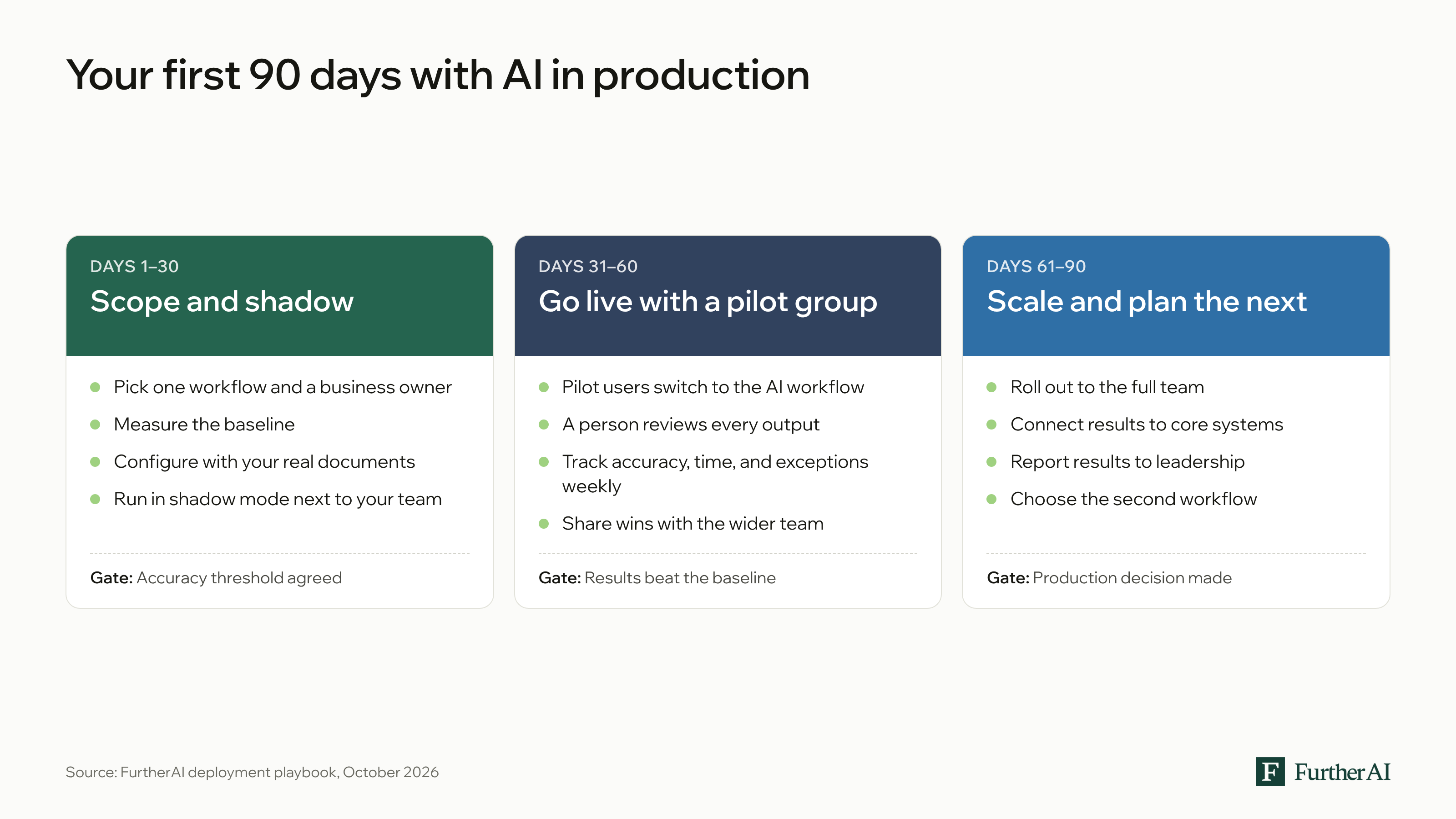
Your 30/60/90-day plan for a first AI deployment
Days 1–30: scope and shadow
- Confirm the workflow, the owner, and the baseline.
- Share sample documents and written rules, and complete the security review.
- Configure the workflow and run it in shadow mode alongside your team, comparing outputs.
- Agree on the accuracy threshold for go-live.
Days 31–60: go live with a pilot group
- Switch the pilot group to the AI workflow, with a person reviewing every output.
- Track accuracy, time per file, and exceptions weekly, and fix what breaks.
- Share wins with the wider team every week.
Days 61–90: scale and plan the next workflow
- Roll out to the full team and connect results to your core systems.
- Report results against the baseline to leadership.
- Pick the second workflow, ideally one that reuses the same documents or systems.
The timeline holds up in practice. One of the largest US MGAs, a client of FurtherAI, processed more than $20 billion in total insured value and saved more than 2,000 hours within its first three months on FurtherAI. Claims intake deployment of a specialty insurer (another client of FurtherAI) moved through design, integration, user testing, and go-live in phases, and now automates more than 90% of intake.
Common reasons first AI deployments fail
- The data wasn't ready. Insurance-native platforms shorten this, but someone still has to own the documents and rules.
- The scope was too big. "Automate submissions" has many workflows. Start with one.
- AI ran on the side. A tool that hands back an answer for someone to re-key doesn't save time. Put it in the middle of the workflow.
- There was no baseline. Without one, nobody can say whether it worked.
- The users weren't involved. Choose first users who include believers, neutrals, and skeptics, and let them shape the workflow.
- Governance came last. If you can't show how an output was produced, compliance won't sign off. See our guide to AI governance for insurance teams.
- The pilot had no production terms. Agree in advance what happens if the POC succeeds.
Which AI platforms suit first-time buyers?
Platforms fall into four types. For a first production workflow in insurance, the first type usually fits best:
For a ranked comparison of specific vendors, see our guide to the best AI platforms for insurance.
FurtherAI is built for first deployments. Forward-deployed engineers configure the first workflow alongside your team, and it runs in Outlook and connects to your systems through FurtherAI Connectors. Every output carries citations and an audit trail. It's also SOC 2 Type II certified and runs on a single-tenant architecture, which helps first-time teams through security review.
Frequently asked questions
REFERENCES
AM Best. "Best's Special Report: AM Best Survey Finds Most Insurers Expect to Leverage AI Though Data, Security Challenges May Impede Fast Adoption." Business Wire. businesswire.com
Fortune. "MIT Report: 95% of Generative AI Pilots at Companies Are Failing." fortune.com
FurtherAI. "What's Holding Back Large-Scale AI Deployments?" furtherai.com
FurtherAI. "How to Build an AI Playbook for Underwriting (From Someone Who's Lived It).” furtherai.com
FurtherAI. "Claims Case Study: 90% Intake Automation, 568% ROI." furtherai.com
FurtherAI. "How Leavitt Group Is Using FurtherAI to Redefine Insurance Operations." furtherai.com
FurtherAI. "MGA Case Study: 30x Faster Submission Processing." furtherai.com
FurtherAI. "Upland Capital Group Chooses FurtherAI as Strategic AI Partner." furtherai.com
Gartner. "Gartner Predicts Over 40% of Agentic AI Projects Will Be Canceled by End of 2027." gartner.com
Insurance Business. "Gallagher: AI Goes Mainstream, but Insurers Face Skills, Risk and Coverage Gaps." insurancebusinessmag.com
Insurance Business. "How Upland Specialty Uses Practical Innovation to Reshape Underwriting and Scale Operations." insurancebusinessmag.com
Insurance Journal. "How Insurers Can Gain the Most Value From Their AI Investments: Accenture." insurancejournal.com
National Association of Insurance Commissioners. "Implementation of NAIC Model Bulletin: Use of Artificial Intelligence Systems by Insurers." naic.org
DISCLAIMER
This article is for general informational purposes only and does not constitute legal, regulatory, compliance, underwriting, or other professional advice. The content reflects information available as of the date of publication, and FurtherAI undertakes no obligation to update it as laws, regulations, or AI technologies evolve.
Recent posts
.png)
.png)
.png)
Ready to go further and
transform your insurance ops?
Reclaim your time for strategic work and let our AI Assistant handle the busywork. Schedule a demo to see how you can achieve more, faster.




.svg)