FurtherAI Available in Microsoft Marketplace
Introducing Connectors



10 Best Insurance Automation Tools and Software in 2026

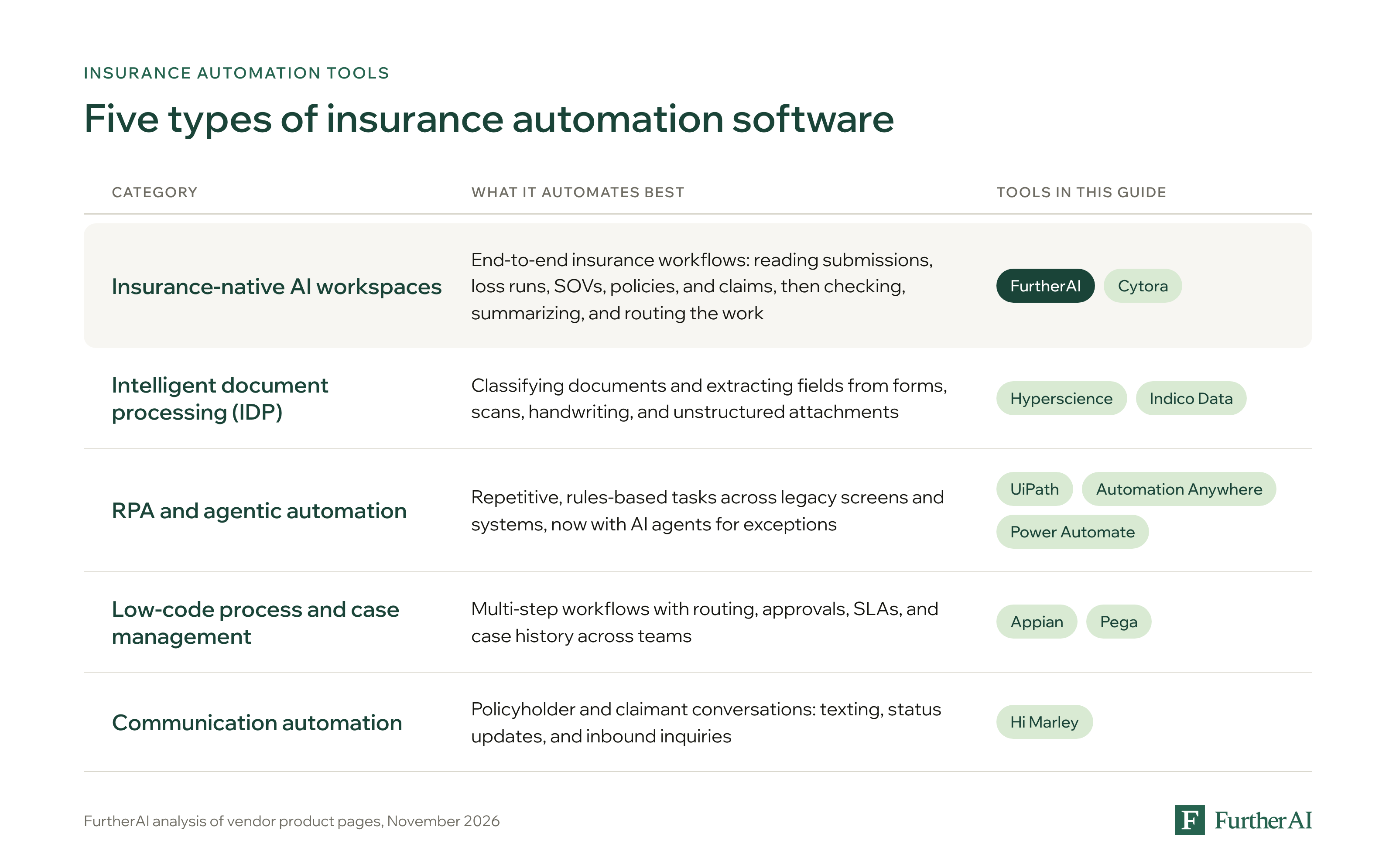
Insurance automation tools are software that take repetitive work off underwriters, claims teams, brokers, and operations staff: reading submissions, keying data into core systems, checking policies, routing claims, and answering status questions. In 2026, the category spans five kinds of product, from robotic process automation (RPA) bots to AI workspaces built specifically for insurance.
The short answer: the best insurance automation tool depends on the work you're automating. FurtherAI is the strongest choice for end-to-end commercial insurance workflows such as submissions, policy checking, claims intake, and audits. Cytora fits underwriting intake for large carriers, Hyperscience and Indico Data fit high-volume document extraction, UiPath, Automation Anywhere, and Microsoft Power Automate fit rules-based tasks across legacy systems, Appian and Pega fit case management, and Hi Marley fits claims communication. Many insurers end up combining two or three of these.
Key takeaways
- Insurance automation software comes in five types: insurance-native AI workspaces, intelligent document processing (IDP), RPA and agentic automation, low-code process and case management, and communication automation.
- Most insurers still automate tasks, not whole processes. 71% of insurance leaders say they mainly use AI for content generation or routine task automation, and only 29% run front-to-back processes through AI agents or automation, according to KPMG's September 2026 research.
- Agentic automation is moving fast at large carriers: 74% of large P&C carriers were piloting agentic AI in 2026, up from 22% in 2025, per Datos Insights.
- Insurance-specific tools win on unstructured documents. General RPA and workflow platforms are strong for structured, repeatable steps but need extra configuration to read submissions, loss runs, and policies.
- Measure outcomes, not activity. Track cycle time, touch time per file, accuracy, and straight-through processing before and after deployment.
Insurance automation tools compared at a glance
What is insurance automation software?
Insurance automation software is any tool that completes insurance work with little or no manual effort, such as extracting data from an ACORD form, clearing a submission against appetite, updating a policy record after an endorsement, or sending a claimant a status update. The work still happens under human oversight; the software handles the repetitive steps and routes exceptions to a person.
Older automation followed fixed rules: if a field says X, do Y. That works well on structured data and stable screens. It struggles with what insurance runs on: broker emails, statements of values (SOVs), loss runs, policy wordings, and medical records that arrive in a different layout every time. That's why newer tools add AI that reads documents from context, and why the market now splits into the five categories below.
If you're weighing a general-purpose tool against an insurance-specific one, our guide to horizontal vs dedicated insurance AI platforms walks through the trade-offs in more detail.
Why insurers are investing in automation in 2026
The pressure is the same one underwriting and claims leaders have described for years: skilled people spend too much of their day on data work. Accenture's Underwriting rewritten research found that more than a third of an underwriter's time still goes to non-core activities such as data collection and administration.
What's changed is how quickly insurers are moving from pilots to production. Insurers move 62% of AI pilots into production, more than any other industry among the five EXL surveyed in EXL's 2026 Enterprise AI Study. Agentic AI is now being piloted at most large carriers, as the chart below shows.

Results still lag the activity. KPMG found that only 11% of insurance leaders have a very clear view of the return on their AI investment, and nearly half of AI budgets go to operational and back-office efficiency, according to the same KPMG report. The IBM Institute for Business Value reports that just 12% of insurers have embedded AI across core operations with consistently high returns, and that those insurers embed it directly into claims, fraud, and underwriting workflows rather than running it as a standalone tool. The lesson for tool selection: pick software that runs inside real workflows and reports measurable outcomes.
How we chose these insurance automation tools
We looked at tools insurers can buy today and evaluated each one on five criteria:
- Insurance workflow fit: how much of a real insurance process (submission, policy, claim, audit) the tool can automate.
- Handling of unstructured documents: how well it reads the emails, PDFs, spreadsheets, and scans insurance runs on.
- Controls: human-in-the-loop review, audit trails, and governance for regulated work.
- Integration: documented connections to core, agency, and productivity systems.
- Public proof: named or described insurance customers with published outcomes.
Customer outcomes below come from vendor case studies, customer announcements, or trade press, and are labeled as reported. Results depend on your documents, systems, and volumes, so test any shortlisted tool on your own files.
The 10 best insurance automation tools in 2026
1. FurtherAI: best for end-to-end commercial insurance workflows
FurtherAI is an AI workspace built for insurance carriers, managing general agents (MGAs), brokers, and reinsurers. It combines an AI assistant, a library of insurance workflows, human-in-the-loop review, and more than 100 enterprise integrations in one place. Insurance teams use it to automate submission intake, risk analysis, policy checking and comparison, proposal generation, claims intake, and compliance and audit work, with confidence scoring and audit trails on claims data.
Where RPA moves data between screens, FurtherAI reads and reasons over the insurance documents themselves, such as SOVs with tens of thousands of locations, loss runs, and multi-version policy wordings, and then hands a reviewed, source-cited result to the person who owns the decision.
FurtherAI's published results span the insurance value chain. One of the largest U.S. MGAs cut the average time to clear a submission from about 32 minutes to about one minute. A specialty insurer automated more than 90% of its targeted claim intake workflow, saving about 2.5 hours per claim across more than 3,000 claims a year. A reinsurer cut underwriting audit time from about 200 hours to roughly 110 hours per MGA and Upland Specialty reports clearance time down roughly 30% to 40%.
Pros
- Covers underwriting, claims, policy servicing, and compliance in one workspace instead of separate point tools.
- Reads unstructured insurance documents (SOVs, loss runs, policies) with source citations and human review built in.
- Published, workflow-level outcomes from carriers, MGAs, brokers, and reinsurers; SOC 2 Type 2 and ISO 27001 certified.
Cons
- Built for commercial and specialty insurance work, so personal lines contact-center automation is a narrower fit.
- Works alongside your policy, rating, and billing systems rather than replacing them.
2. Cytora (Applied Systems): best for commercial underwriting intake at scale
Cytora is a risk digitization platform for commercial insurers that turns unstructured, multilingual submissions into structured, decision-ready risks and routes them by appetite and priority. Applied Systems acquired Cytora in September 2025 to speed up the exchange of risk data between agents and carriers, as per Insurance Journal.
Zurich completed the rollout across five countries in 90 days and plans to extend it to more than 20 markets over 16 months, with Cytora operating as an upstream intelligence layer in its underwriting workflow, according to Reinsurance News.
Pros
- Deep focus on commercial submission intake and triage.
- Multilingual processing suits global carriers.
- Strong public reference at a top-tier carrier.
Cons
- Concentrated on underwriting intake; claims, servicing, and audit work need other tools.
- Now part of Applied Systems, so check how the roadmap fits your agency and core system mix.
3. Hyperscience: best for high-volume forms, scans, and handwriting
Hyperscience is an intelligent document processing platform (Hypercell) that classifies and extracts data from printed, handwritten, and scanned documents, including faxes and phone photos. Its insurance offering includes pre-built models for ACORD forms, explanations of benefits, and health insurance cards.
Hyperscience lists insurance customers including Canada Life, Federated Insurance, Great American Insurance Group, Mercury Insurance, and Mutual of Omaha on its insurance page.
Pros
- Strong on messy inputs such as handwriting, faxes, and low-quality scans.
- Pre-built insurance document models shorten setup.
- Broad list of named insurance customers.
Cons
- Focused on extraction; appetite checks, policy comparison, and other insurance judgment steps need to be built around it.
- Cross-industry product, so insurance workflows depend on your configuration.
4. Indico Data: best for unstructured intake in specialty underwriting and FNOL
Indico Data describes itself as an intake and orchestration platform for insurance operations. According to FinTech Global, it ingests, enriches, validates, and routes unstructured data across underwriting, claims, and servicing.
In February 2026, Indico also announced that a global specialty insurer had expanded its deployment from underwriting submission intake into claims first notice of loss (FNOL), as per 406 Ventures.
Pros
- One intake layer can serve both underwriting and claims.
- Insurance-focused, with enrichment built into intake.
- Good fit for specialty and casualty submissions with variable formats.
Cons
- Concentrated on the front door of work; downstream review and decision steps happen elsewhere.
- Few named customers publish quantified outcomes.
5. UiPath: best for enterprise-wide RPA and agentic automation programs
UiPath is an automation platform that combines software robots, AI agents, document extraction (IXP), email classification (Communications Mining), and orchestration (Maestro). Its insurance solutions cover claims triage, underwriting submissions, endorsements, billing reconciliation, and customer service.
UK insurer NFU Mutual, a UiPath customer since 2018, runs more than 100 live automations and piloted an agentic process for pet and equine claims that reviewed vet invoices and caught an overpayment a handler had missed, as mentioned in diginomica.
Pros
- Mature platform for automating many processes at once, with strong governance tooling.
- Combines robots, agents, and document extraction in one product.
- Large partner ecosystem for implementation.
Cons
- Insurance logic (appetite, coverage, guidelines) is built by your team or a partner.
- Screen-based bots need maintenance when underlying applications change.
6. Automation Anywhere: best for back-office claims, audit, and finance tasks
Automation Anywhere offers agentic process automation, document automation, and an AI agent studio. Its insurance use cases cover claims intake and approvals, broker submission ingestion, policyholder service requests, bordereaux processing, and finance reconciliations.
The same insurer reported an 80% reduction in audits after automating policy audits, endorsements, and payroll updates with partner EXL.
Pros
- Broad library of insurance back-office use cases.
- Strong for finance, audit, and reconciliation work.
- Governance features such as PII masking and time-stamped logs.
Cons
- Most public insurance customer stories are anonymized.
- Reading complex insurance documents typically requires configuration and testing per document type.
7. Microsoft Power Automate: best for teams standardized on Microsoft 365
Power Automate is Microsoft's low-code platform for cloud workflows and desktop RPA, with Copilot features for building flows and Copilot Studio for agents. It's a natural starting point for teams already working in Microsoft 365.
Microsoft also reports that Nsure.com went from needing more than 100 people to validate and standardize carrier data to just a few.
Pros
- Published, predictable pricing and a low barrier to start.
- Native fit with Outlook, Teams, SharePoint, and Excel.
- Large community and partner base.
Cons
- No insurance-specific models or workflows; your team builds the insurance logic.
- Per-user and per-bot licenses add up as automation spreads across departments.
8. Appian: best for connected underwriting and claims workflows on legacy cores
Appian is a process automation platform with a prebuilt insurance application, Appian Connected Underwriting, that handles triage, data enrichment, recommendations, and routing while running alongside existing core systems.
In August 2026, Appian and Synechron introduced an "Open Underwriting Stack" reference architecture that pairs Appian Connected Underwriting with an open data layer for carriers modernizing around legacy systems.
Pros
- Strong orchestration, SLAs, and auditability for multi-team processes.
- Prebuilt underwriting application shortens time to value.
- Adds a workflow layer without a core system replacement.
Cons
- Implementations usually involve certified developers or a systems integrator.
- Insurance document understanding is one component among many, so test it on your own submissions.
9. Pega: best for complex claims and service cases at large insurers
Pega is a workflow and AI decisioning platform used by large insurers for claims, underwriting intake, customer service, and distribution. Pega Blueprint uses generative AI to design workflows that teams then build on the platform.
Pega's insurance customers include Aflac, Unum, Great Eastern, and Achmea, and Zurich North America presented its commercial operations automation work at PegaWorld 2026.
Pros
- Proven at very large insurers with complex rules and service volumes.
- Decisioning and case management in one platform.
- Strong for customer service and claims journeys.
Cons
- Enterprise implementations tend to be long and partner-led.
- Commercial insurance document work (SOVs, loss runs, policy wordings) usually needs added extraction tools.
10. Hi Marley: best for claims and policyholder communication
Hi Marley is a communication platform built for P&C insurance that runs claims and service conversations over text, with AI assistants that gather information, keep conversations moving, and flag items for human review, as per GlobeNewswire.
In June 2026, Hi Marley relaunched Hi Marley for Service to bring its claims platform into policyholder service, and in August it launched Unite.
Pros
- Purpose-built for P&C claims conversations.
- Quick for adjusters to adopt.
- Strong adoption among large carriers.
Cons
- Automates conversations, not back-office document and data work.
- Built around claims and service conversations, so complex commercial file review needs other tools.
Which insurance processes can you automate first?
Start where volume is high, inputs are document-heavy, and the steps repeat. These processes usually deliver results fastest:
RPA vs IDP vs AI agents: which do insurers need?
Most insurers need more than one. Each technology solves a different part of the problem:
- RPA repeats fixed steps across screens and systems. Use it for structured, stable tasks such as posting payments or copying data between systems.
- IDP turns documents into structured data. Use it when the bottleneck is reading forms, scans, and attachments.
- AI agents plan and carry out multi-step work, deciding what to do next within rules you set. Use them for workflows that vary from file to file, such as clearing a submission or triaging a claim, with people approving at defined checkpoints.
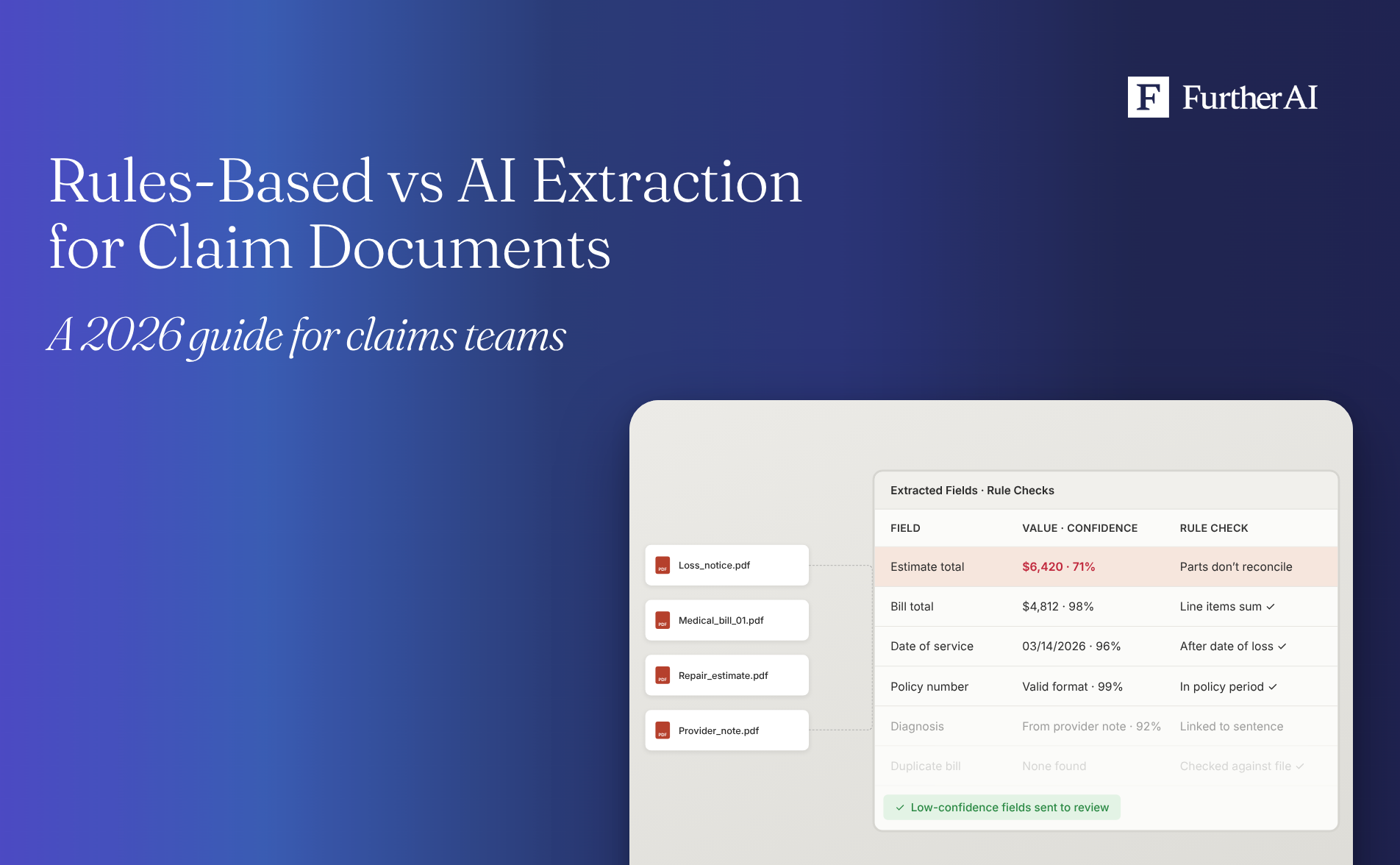
Insurance-native AI workspaces combine document understanding and agents with insurance context, so a single workflow can read a submission, check it against guidelines, and prepare it for an underwriter. Rules still matter after extraction: deterministic checks on totals, dates, and required fields catch errors before data moves downstream. We cover that hybrid pattern in rules-based automation vs AI extraction and agent by agent in AI agents for insurance.
How to choose insurance automation software
Governance is worth checking early. The NAIC's Model Bulletin on the use of AI systems by insurers had been adopted in 30 jurisdictions as of November 13, 2026. For a broader view of how AI platforms compare, see our guide to the best AI platforms for insurance and our market map of insurance AI workspaces.
How much does insurance automation software cost?
Pricing depends on the category. Low-code RPA tools publish per-seat and per-bot prices: Microsoft Power Automate Premium is $15 per user per month and Power Automate Process is $150 per bot per month, billed annually, as stated on Microsoft's pricing page. Enterprise RPA, IDP, case management, and insurance-native AI platforms are quote-based, and are usually priced on volume (documents, submissions, or claims), users, workflows, or a platform fee.
License cost is only part of the total. Budget for implementation, integration, testing on your own documents, change management, and ongoing maintenance, which is higher for screen-based bots. For cost ranges, pricing models, and proof-of-concept terms, see AI for insurance operations: costs and ROI.
How to roll out insurance automation
- Pick one workflow with a clear owner. Submission intake, policy checking, or claim intake are common first choices.
- Measure the baseline. Record cycle time, touch time per file, error rate, and backlog before you start.
- Pilot on real documents. Use a representative sample, including the messy files, and agree on what "correct" looks like.
- Keep people on exceptions. Route low-confidence results and rule failures to reviewers, and log every decision.
- Scale to the next workflow. Reuse the same integrations and controls so each new workflow goes live faster.
Where to go from here
The right next step depends on what you're deciding:
- To learn more about general-purpose vs insurance-specific AI, check our buying guide to horizontal vs vertical insurance AI.
- To read more about AI-native platforms, check our ranking of AI and agentic AI platforms for insurance.
- If you're interested in how AI agents work in insurance, check our breakdown of AI agents by insurance workflow.
- For more information about claims automation vendors, check our claims automation software comparison.
- If you'd like to learn more about costs and ROI, check our guide to back-office AI costs and ROI.
Frequently asked questions
DISCLAIMER
This article is for general informational purposes only and does not constitute legal, regulatory, compliance, underwriting, or other professional advice. The content reflects information available as of the date of publication, and FurtherAI undertakes no obligation to update it as laws, regulations, or AI technologies evolve.
Recent posts


Ready to go further and
transform your insurance ops?
Reclaim your time for strategic work and let our AI Assistant handle the busywork. Schedule a demo to see how you can achieve more, faster.