FurtherAI Available in Microsoft Marketplace
Introducing Connectors



How AI Agents Issue Certificates of Insurance Without Retyping (2026)


A brokerage can issue certificates of insurance (COIs) without retyping policy data by letting an AI agent read the emailed or phoned-in request, match it to the policy in the agency management system (AMS), fill the certificate from that record, check the holder's requirements against the policy, and send it once an account manager approves. The policy data never gets keyed twice, and anything the policy doesn't support goes to a person with the reason attached.
This guide explains how that works at FurtherAI, where a person should step in, and how six COI tools for brokers who get certificate requests by email compare in 2026.
Key takeaways
- Certificates are high-volume, low-margin, and urgent. IA Magazine cites estimates of more than 400 million COIs issued a year in the U.S., and a late certificate can hold up a client's contract or job site access.
- Retyping is where errors start. IA Magazine cites manual COI error rates of 5% to 10%. Issuing from the policy record removes the re-keying step.
- A certificate can't change coverage. State laws such as New York’s Insurance Law Section 502, and the NCOIL model act many states draw on, bar certificates that alter coverage or contain misleading information, so automation must stop at the policy's limits.
- Issuance and tracking are different jobs. Brokers issue certificates from their own policies; certificate holders track the certificates they receive. Check which one a tool does.
- Look for email intake plus policy-linked issuance. For brokers who get requests by email, the deciding features are reading the request, matching the policy, a human approval step, and certificates that update when the policy changes.
What is certificate of insurance automation?
A certificate of insurance is a one-page summary that proves a client has coverage. The holder is usually a landlord, a general contractor, or a customer, and liability certificates commonly use the ACORD 25 form. If the plain-English basics would help, see our guide to commercial insurance, explained.
Certificate of insurance automation uses software to turn a certificate request into a finished certificate with little or no manual data entry. The most capable tools read the request itself, find the right policy, fill the form from the policy record, check the holder's requirements, and log the result.
COI software splits into two categories that are easy to confuse:
This guide covers issuance, since that's the job a brokerage does.
Why certificate requests slow brokerages down
Each request is small, but the volume is relentless. IA Magazine's February 2026 analysis cites estimates that more than 400 million COIs are issued annually in the U.S. (according to EXL). It works through the math for a firm handling 5,000 certificates a year: at a 5% to 10% manual error rate (according to IRMI), 250 to 500 of those certificates may contain mistakes.
Speed matters as much as accuracy. As our voice and email intake post explains, a certificate that arrives late can hold up a client's contract or their access to a job site. We saw the gap from the customer side when FurtherAI needed a COI naming our landlord: writing the request took a minute; getting the certificate back took 27 days.
The work also arrives in the least structured way possible:
- Requests come by email and phone. 86% of agencies in the Big "I" 2026 Agency Universe Study prefer to service customers by phone, while emailed requests pile into a shared service inbox.
- Retyping is the norm. In the Ivans 2026 Agency-Carrier Connectivity Trends survey of 702 independent agents, 74% named re-keying data into multiple carrier portals as their top workflow pain point.
- General AI tools aren't a safe shortcut. 45% of agencies use ChatGPT or other public large language models (LLMs), according to the Big "I" 2026 Tech Trends Report. A chatbot can draft something that looks like a certificate, but it isn't connected to the policy record, so it can't prove the limits or endorsements it shows.
How can a brokerage issue certificates of insurance without retyping policy data?
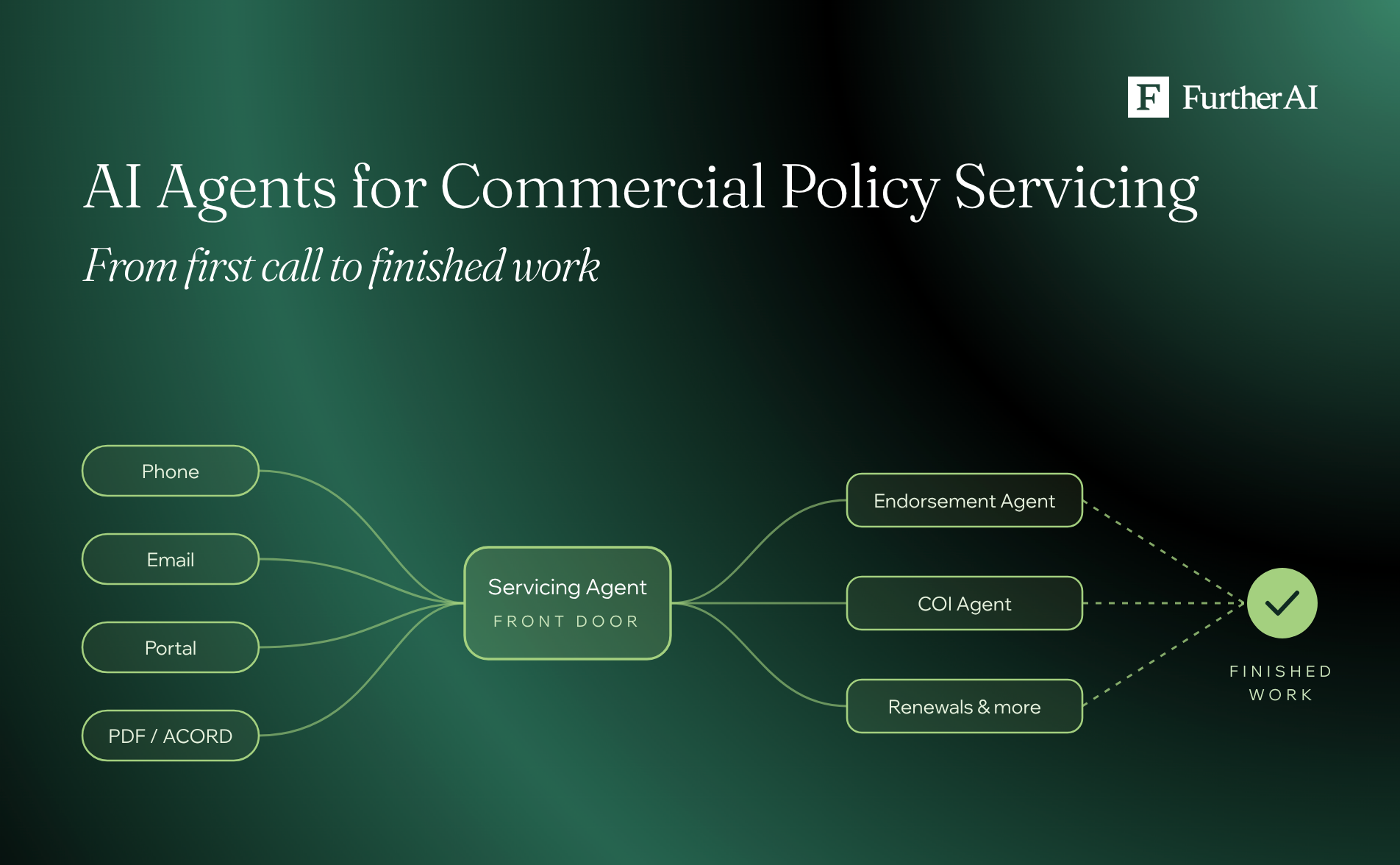
Issue the certificate from the policy record, not from someone's keyboard. At FurtherAI, two agents share the work as part of our policy servicing flow, which our guide to AI policy servicing covers end to end.
- Intake. The Servicing Agent answers the call or reads the email in your service inbox, recognizes a certificate request, and captures who needs the certificate and why.
- Policy match. It finds the account and matches the request to the right policy documents. If the policy check fails, the case ends with a summary for the account manager instead of producing a wrong certificate.
- Handoff. The case goes to the COI Agent with the request and any contract or holder requirements attached, so nobody asks the client twice.
- Gather and check. The COI Agent asks only for what's missing, such as the holder's exact name and address, and checks what the holder asked for against the policy and your rules. When a reply is needed, it waits, and an emailed answer picks the run back up.
- Fill from the record. The certificate is produced from the policy data in your agency management system, so the limits, dates, and policy numbers come from the source rather than being retyped. FurtherAI can also fill ACORD and other PDF forms from your documents.
- Approve and send. An account manager is tagged for approval where your rules require it, and once they approve, FurtherAI issues the certificate in the AMS and sends it. Every step is cited and logged.
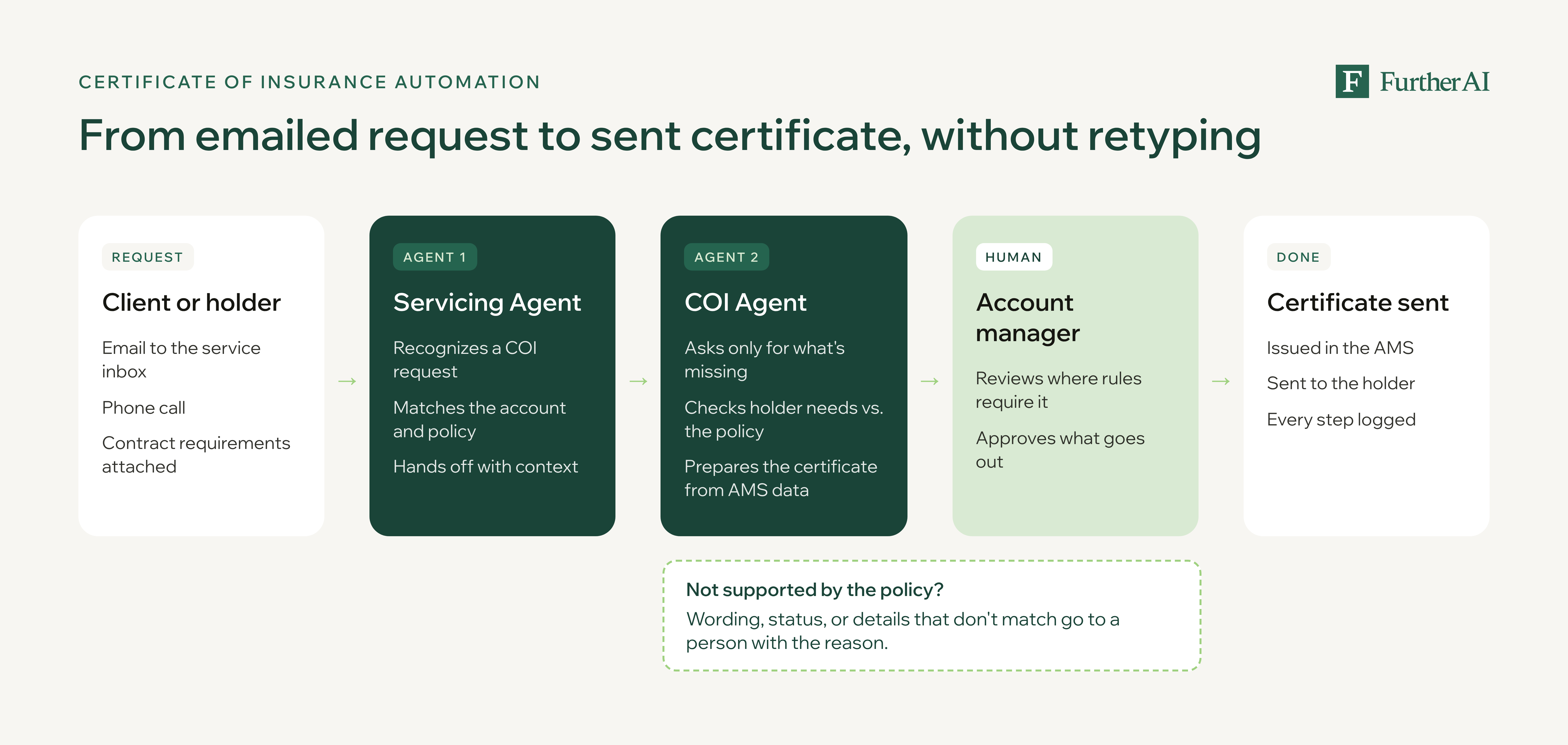
The account manager makes the call on what goes out. The agents do the reading, matching, and form filling around that decision.
When a person should step in
A certificate can only reflect the policy, and regulators say so. The NCOIL Certificates of Insurance Model Act (first adopted in 2012 and readopted in 2022) bars anyone from preparing or issuing a certificate that contains false or misleading information, or that purports to alter, amend, or extend the policy's coverage. New York's Insurance Law Section 502 applies the same principle and limits liability certificates to insurer forms or standard forms the Superintendent has approved.
That's why the agent should stop and route a request to a person, with the reason attached, when:
- The wording isn't supported. The holder asks for language, such as primary and noncontributory, that the policy's endorsements don't provide.
- The holder needs status the policy doesn't grant. For example, additional insured status with no matching endorsement. Adding it is a policy change, which our guide to endorsement processing automation covers.
- The request conflicts with the file. The named insured, dates, or limits don't match the policy on record.
- Your account rules say so. Some clients or holders always need an account manager's eyes.
Write these rules down with your team before launch. If you also review certificates against contracts before they go out, our guide to broker compliance review software covers that check in depth.
Keeping certificates in step with policy changes
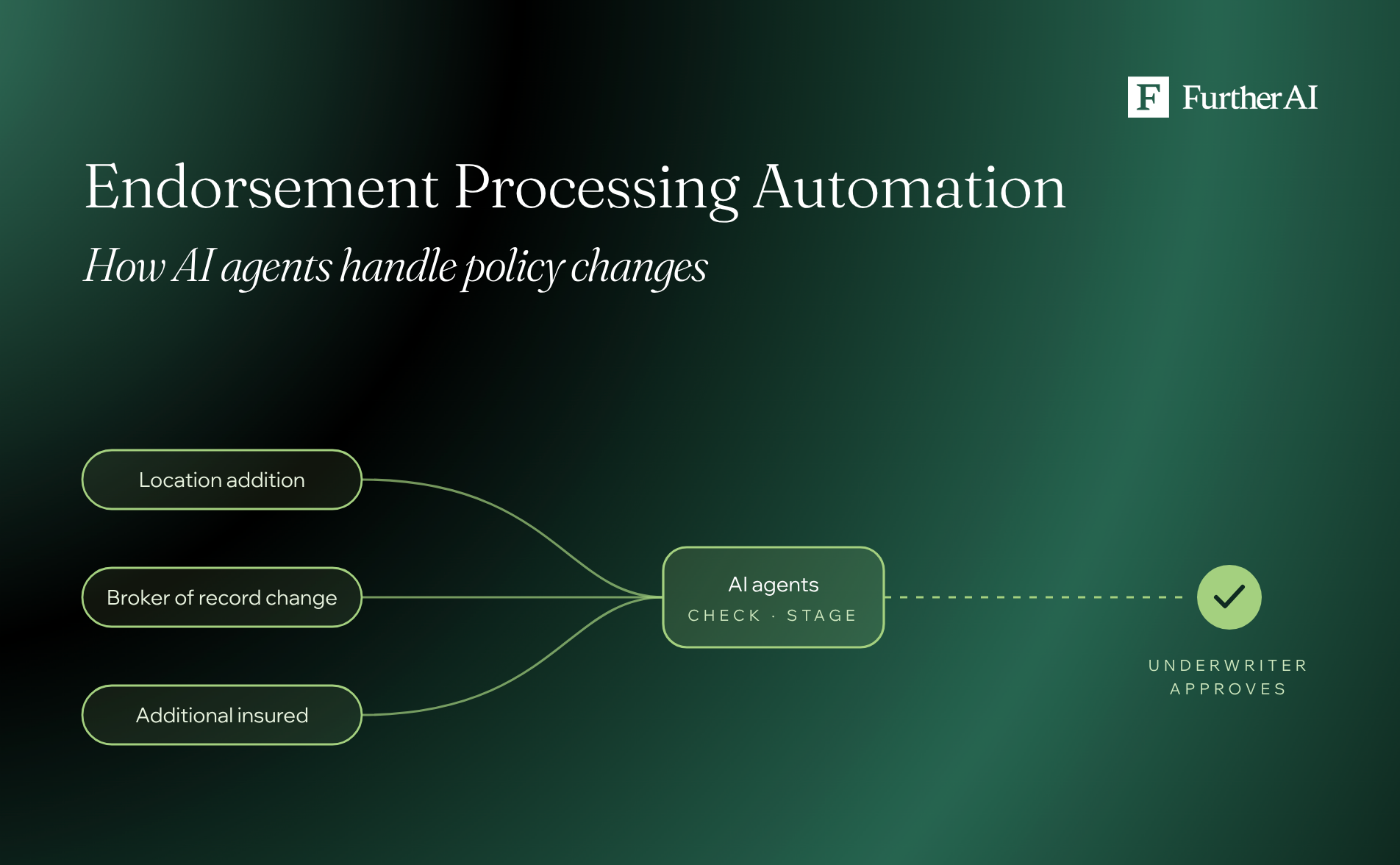
Coverage changes after a certificate goes out. A location is added, a limit rises, or a new additional insured is endorsed onto the policy. In FurtherAI's endorsement flow, premium, installments, and the COI are updated once the endorsement is issued, so the next certificate reflects the policy as it stands. The full flow is in our guide to endorsement processing automation.
What are the best COI tools for brokers who get certificate requests by email?
The best COI tools for brokers who get requests by email read the request themselves, issue the certificate from AMS or policy data, keep a person on approval, and update certificates when the policy changes. Self-service portals and AMS certificate modules remove retyping for issuing, but someone still has to read the email and act on it. AI tools aim to cover the reading as well.
Below are six issuance tools, listed alphabetically and not ranked. Each entry uses the same structure and draws on the vendor's own public materials as of November 2026. "Not documented" means we couldn't find the capability in those materials, not that the tool lacks it.
Applied Epic and Applied CSR24
What it is: Applied Systems' agency management system (Applied Epic) and its client self-service platform (Applied CSR24).
Email requests: Not documented. Requests that arrive by email are still read and actioned by staff.
How certificates get issued: Agency users issue certificates from templates under Proofs > Issue a Certificate, and insureds can work with holders through the Self-Service Portal and MobileInsured unless the agency locks holder details. Batch processing handles renewals. Certificial also offers a free plugin for Applied Epic and CSR24 users.
Human review: Not documented as a separate approval step.
Best for: Agencies already on Applied Epic that want clients to serve themselves.
Watch-out: Templates need setting up and maintaining, and self-service puts the request in the client's hands rather than reading the email that arrives.
Bevaya
What it is: The AI agent platform from Roots Automation, which covers policy servicing and operations alongside underwriting.
Email requests: Not documented in the materials we reviewed.
How certificates get issued: In a case study, Bevaya reports that a top 5 insurance brokerage cut COI issuance time from about 24 hours to minutes, reached 97% data extraction accuracy, and reduced annual business process outsourcing costs by more than $2M. It also cites an 80% reduction in manual effort.
Human review: Not documented.
Best for: Large brokerages with heavy COI volume and an existing outsourcing spend to replace.
Watch-out: The published results come from a single vendor case study; ask how review and AMS write-back work in your environment.
Certificial
What it is: A digital certificate network that issues "Smart COIs" for agents and offers COI tracking for certificate holders.
Email requests: Not documented.
How certificates get issued: Agencies integrate their AMS to issue certificates and automate reissuance. Smart COIs update automatically when coverage changes, such as limits and endorsements.
Human review: Not documented.
Best for: Agencies whose clients' certificate holders already use Certificial, and teams that want certificates to stay current after issuance.
Watch-out: The Big "I" has cautioned agencies about third-party digital proof-of-insurance requests, naming Certificial among others, and advises reviewing data-sharing and E&O exposure before participating.
COI Engine
What it is: A COI issuance add-on for commercial insurance agencies from COI ENGINE, Inc.
Email requests: Yes. It connects to the agency's certificate request inbox, parses each email, and identifies what's being requested.
How certificates get issued: It identifies the insured, pulls the correct policy, extracts the required endorsement pages, and assembles a draft.
Human review: Yes. A customer service representative (CSR) reviews, edits if needed, and sends.
Best for: Agencies that want email-driven COI drafting without an AMS project.
Watch-out: It runs outside the agency management system, and the site names no customers, so confirm how issued certificates get back into your AMS.
FurtherAI
What it is: AI agents for commercial insurance, with a policy servicing set that includes a Servicing Agent, an Endorsement Agent, and a COI Agent.
Email requests: Yes. Voice and email intake reads the service inbox and answers calls, then matches each request to the account.
How certificates get issued: The COI Agent prepares the certificate from the policy data on the account, and FurtherAI issues it in the agency management system. When an endorsement is issued, the COI updates with it.
Human review: Yes. An account manager is tagged for input or approval before anything goes out, wherever your rules require it.
Best for: Brokerages that want certificates handled in the same flow as endorsements and other servicing requests, with one approval model.
Watch-out: It's a broader servicing platform rather than a COI-only tool, and FurtherAI hasn't yet published a COI-specific customer case study.
Vertafore Certificates in AgencyOne
What it is: A certificates tool inside Vertafore's AgencyOne platform, announced on April 16, 2026.
Email requests: Not documented.
How certificates get issued: It pulls real-time data from AMS360 so certificates reflect current coverage, simplifies templates, and lets clients generate certificates 24/7 through InsurLink.
Human review: Not documented.
Best for: AMS360 agencies that want issuance and client self-service in one place.
Watch-out: It requires AMS360 and InsurLink, with Sagitta support due later in 2026, and the announcement doesn't mention email intake or AI.
How to choose
Use this checklist when you compare COI tools:
- Issuance, not only tracking. Does it produce and send the certificate, or only monitor certificates others issued?
- Email and phone intake. Can it read the request where it arrives, or does someone have to retype it into a portal?
- Policy matching. Does it confirm the right policy before issuing?
- Asks only for what's missing. Does it request specific details, such as the holder's address, rather than a full resubmission?
- Exception handling. Does it route unsupported wording or status to a person with the reason?
- Sync with policy changes. Do certificates update after endorsements?
- Audit trail. Is every step sourced and logged?
- Your systems. Does it work with your agency management system, and does the vendor hold SOC 2 Type II?
How to get started
- Pull a month of requests. Count how many certificate requests arrived, by channel, and how many needed a person's judgment.
- Write the rules. List the wording, holders, and situations that always need an account manager.
- Run past requests. Compare the agent's certificates with the ones your team issued.
- Go live with approval on. Keep an account manager on every certificate until the results earn your trust, then relax approval only for routine holders.
Next step: book a demo to see a certificate request move from the first email to a sent certificate.
Frequently asked questions
DISCLAIMER
This article is for general informational purposes only and does not constitute legal, regulatory, compliance, underwriting, or other professional advice. The content reflects information available as of the date of publication, and FurtherAI undertakes no obligation to update it as laws, regulations, or AI technologies evolve.
Recent posts

Ready to go further and
transform your insurance ops?
Reclaim your time for strategic work and let our AI Assistant handle the busywork. Schedule a demo to see how you can achieve more, faster.