FurtherAI Available in Microsoft Marketplace
Introducing Connectors



AI for Insurance Operations: Back-Office Use Cases, Costs and ROI (2026)

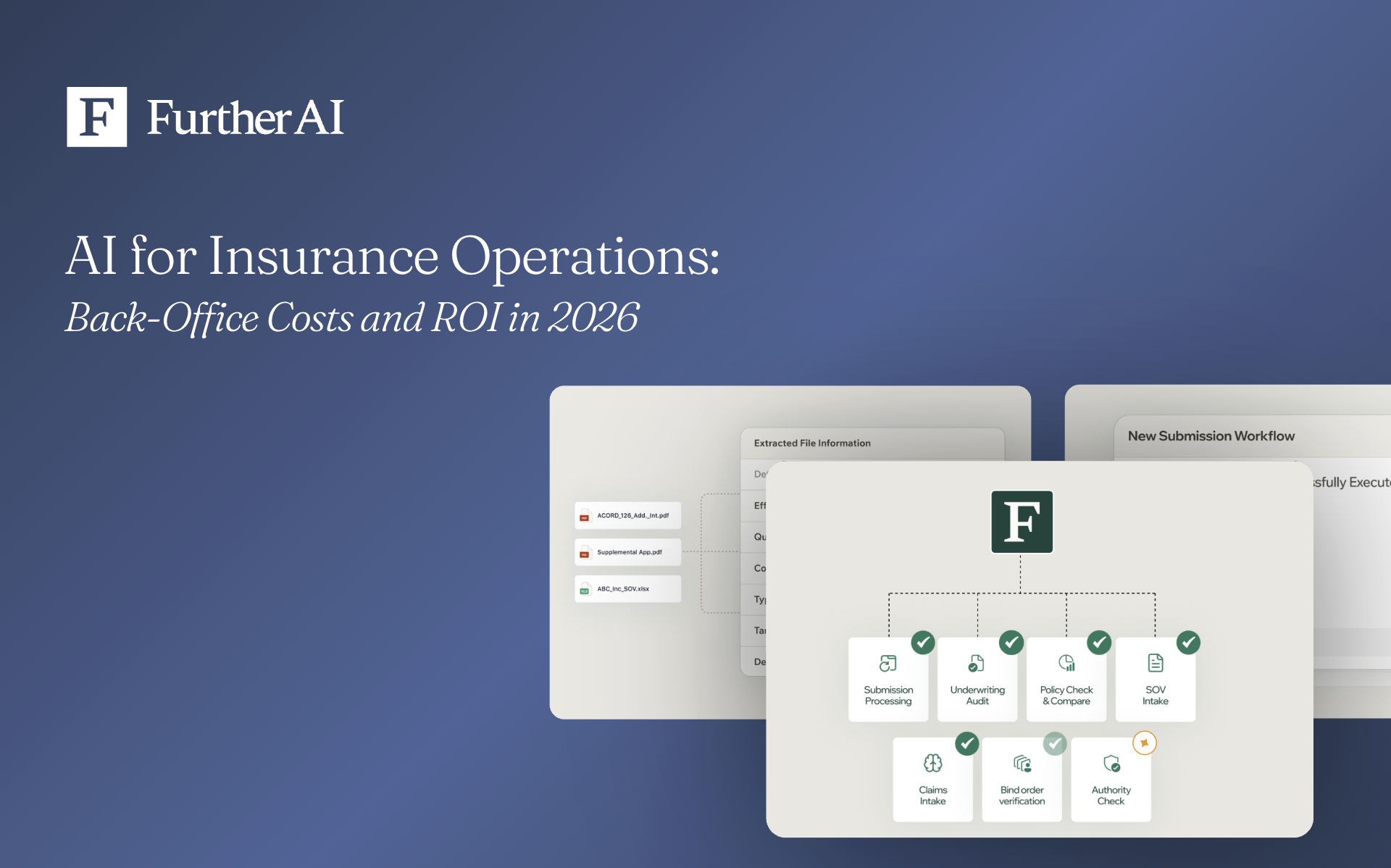
AI for insurance operations pays back fastest in the back office: claims intake, policy checking, loss run processing, proposals, and audits. These workflows are high-volume, document-heavy, and rule-bound, so an insurance-native AI platform can take most of the manual handling off your team, and often within the first few months. FurtherAI customers have automated more than 90% of claims intake and reported a 400% ROI on policy checks within months.
The research points the same way: MIT's NANDA initiative found "the biggest ROI in back-office automation," even though more than half of generative AI budgets go to sales and marketing tools, according to Fortune's coverage of the report. Insurers are already spending there: close to half of insurers' AI budgets go to operational and back-office efficiency, according to a KPMG study reported by Insurance Business in September 2026.
In this guide, we cover which back-office workflows to automate first, how to add capacity without adding headcount, what AI platforms cost, the ROI by workflow, and — most importantly — how to pick a platform.
For underwriting-specific benchmarks, see our guide to how AI improves underwriting.
Key takeaways
- Start where volume meets repetition. Claims intake, policy checks, loss runs, and proposals return value fastest because they're frequent, document-heavy, and checked against clear rules.
- Hiring won't close the capacity gap. Carriers plan to grow employment by just 0.78% over the next 12 months, according to the Jacobson Group and Aon, so growth has to come from throughput per person.
- Expect hybrid pricing. Most software vendors adding AI now combine a seat or platform fee with a usage meter. Ask how the price scales with your volume, not just what the first year costs.
- Scope the proof of concept tightly. One workflow, your own documents, agreed success metrics, and a decision date. Gartner expects over 40% of agentic AI projects to be canceled by the end of 2027 over cost, unclear value, or weak risk controls.
- ROI varies by workflow. FurtherAI deployments range from a 45% cut in audit time to a 568% ROI on claims intake.
What is AI for insurance operations?
AI for insurance operations is software that reads, checks, and routes the documents behind back-office work (claims notices, policies, loss runs, proposals, and audit files), then hands structured results to your team and systems for review. It covers the work around underwriting and claims decisions, so your experts spend their time on the decisions themselves.
Insurance back-office AI differs from a general-purpose assistant in three ways. It understands insurance documents such as ACORD forms and loss runs out of the box. It works inside your systems and email rather than a separate chat window. And it keeps an audit trail for every value it extracts, which matters when regulators or clients ask how a number was produced.
Which insurance back-office workflows should you automate first?
Automate the workflows that are high in volume, heavy in documents, and governed by clear rules. Those three traits make the work both expensive to do by hand and safe to hand to AI with a person reviewing the output. In most commercial insurance operations, that points to five workflows:
- Claims intake. Every new claim needs its documents checked, fields extracted, and a file opened. One specialty insurer spent about 2.5 hours of human time per claim on intake alone before automating it.
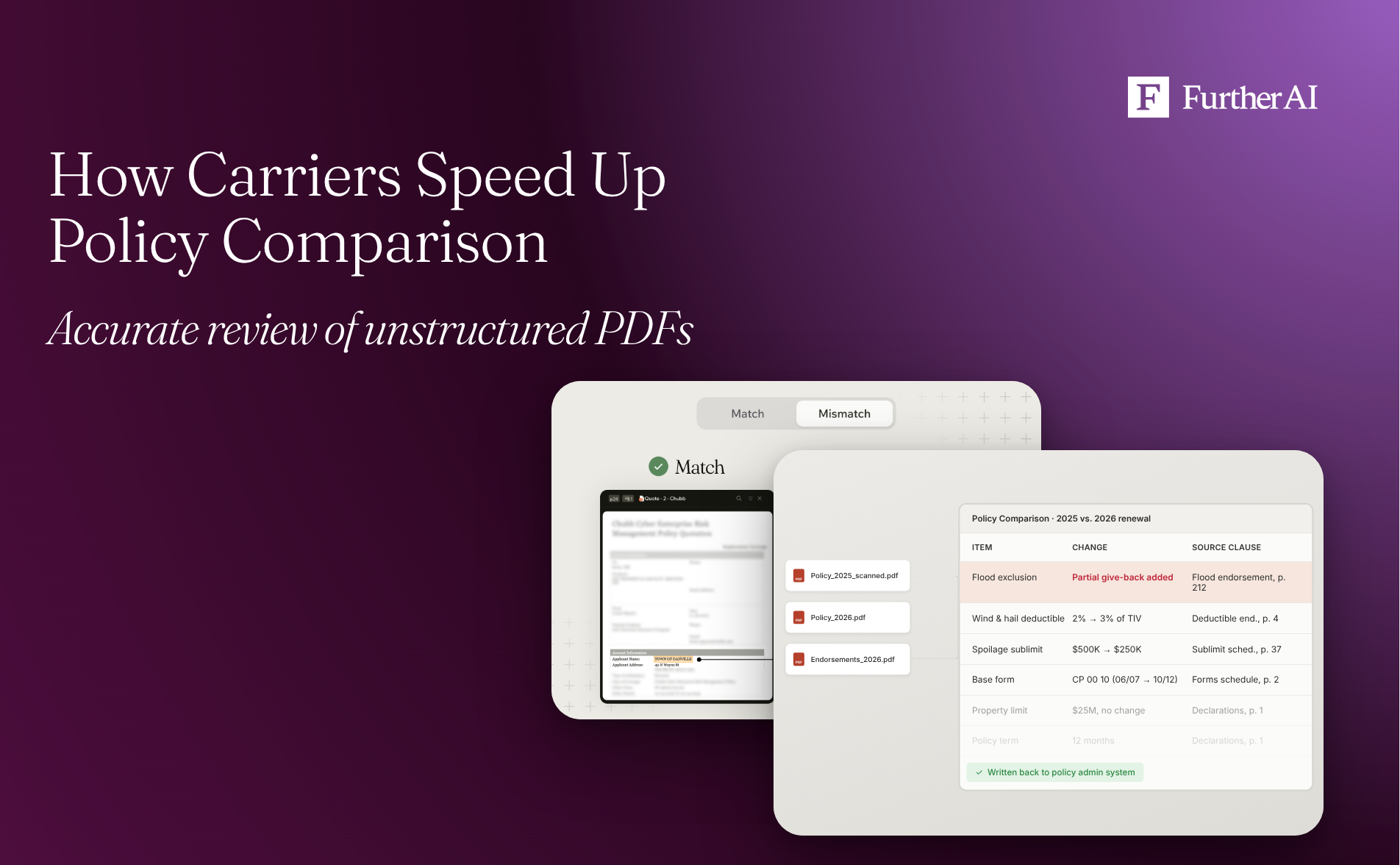
- Policy checking and comparison. Matching quotes, binders, and issued policies, and comparing coverage across policy versions, is repetitive and error-prone under deadline pressure.
- Loss run processing. Loss runs arrive in dozens of carrier formats and have to be normalized and summarized before a renewal or remarketing can move.
- Proposal assembly. Pulling quote details into a client-ready proposal is formulaic but time-consuming, and duplicate requests waste more time.
- Underwriting and compliance audits. Reviewing files against guidelines means extracting the same fields from every file before anyone can judge them.
Submission intake and clearance also fit these criteria. Because they sit inside the underwriting workflow, we cover their benchmarks separately in how AI improves underwriting.
Leavitt Group, one of the largest independent brokerages in the US and a FurtherAI customer, followed this pattern. It focused first on account manager workflows (proposal building, policy checking, document comparison, and loss run analysis) because they were "historically manual" and the highest sources of operational cost and delay.
What AI platform do insurance leaders recommend for scaling operations without adding headcount?
Insurance leaders scaling without new hires choose insurance-native platforms that automate the repetitive document work end to end, keep a person in the loop on every decision, and deploy on one workflow at a time. The reason is mostly arithmetic: volume keeps growing, and hiring plans don't.
Carriers expect employment to grow by just 0.78% over the next 12 months, according to the Jacobson Group and Aon's Q3 2026 Insurance Labor Market Study, and many are "hiring to backfill key positions and bring in new talent, rather than hiring for growth." says Jeffrey Blair, senior vice president at the Jacobson Group.
In claims, the US Bureau of Labor Statistics projects employment of claims adjusters, appraisers, examiners, and investigators to decline 6% from 2025 to 2035.
The answer is more throughput per person, and the right first move depends on your business:
- Mid-size MGAs hit a capacity wall in underwriting operations as submissions grow. Our guide on how mid-size MGAs scale underwriting operations without adding headcount gives a five-input capacity model and shows what to automate first at 50, 200, and 500 submissions a month. Lynx Specialty is growing about 35% this year by answering existing brokers faster, without adding new ones (read the Lynx Specialty case study).
- TPAs face rising claim volumes with a shrinking adjuster pool. Our guide on how TPAs handle high claim volumes without adding headcount covers throughput and cost-per-claim economics.
- Carriers and brokers can apply the same sequence to claims intake, policy checks, and account management work: measure the manual hours, automate the highest-volume step, then expand.
“AI is the only way to scale operational excellence. The teams that win will be the ones who automate first, intelligently.”— Aman Gour, CEO & Co-founder of FurtherAI
What does AI for insurance operations cost?
AI platforms for insurance operations are usually priced as an annual subscription scoped to your workflows and volume, often with a usage component, plus a one-time implementation effort. Insurance-native vendors rarely publish list prices, so the total cost depends on how many workflows you automate, how many documents run through them, and how much integration you need.
Pricing models
Most software vendors adding AI have kept seats in the picture. In a Bain & Company analysis of more than 30 SaaS vendors published in October 2025, 65% had layered an AI usage meter on top of seat-based pricing, 35% had raised seat prices to bundle AI in, and none had moved fully to usage- or outcome-based pricing. Here's how the common models compare for back-office automation:
Whatever the model, ask for the price at your current volume and at 1.5 and 2 times that volume. Back-office automation is meant to absorb growth, so the pricing should too.
Proof of concept terms
A proof of concept (POC) should prove one workflow on your own documents, against numbers you agree before it starts. Gartner predicts that over 40% of agentic AI projects will be canceled by the end of 2027 "due to escalating costs, unclear business value or inadequate risk controls." Tight POC terms address all three. Agree on these before you start:
- Scope: one workflow, one line of business or program, and a defined document set.
- Data: your real documents, including the messy ones, with security review and data handling agreed up front.
- Success metrics: a baseline and target for field-level accuracy, handling time per item, and exception rate.
- Users: the people who'll use it daily. Leavitt Group gave account managers a decisive role in evaluating usability and workflow fit during its POC.
- Duration and decision date: a fixed end date with a go or no-go decision, and the commercial terms for production agreed in advance.
Buying usually beats building here. Purchasing AI tools from specialized vendors and building partnerships succeeds about 67% of the time, while internal builds succeed only a third as often, according to the same MIT NANDA research. For the full comparison, see our build-versus-buy guides for MGAs and TPAs.
Time to value
On a scoped workflow, expect measurable results within weeks to a few months. One MGA processed more than $20 billion in total insured value and saved more than 2,000 hours within its first three months on FurtherAI. A mid-sized insurer reported a 400% ROI on policy checks "within months of implementation." The specialty insurer's claims intake deployment moved through design, integration, user testing, and go-live in phases before reaching production.
What slows time to value is rarely the AI itself. It's unclear success metrics, missing access to real documents, and integration work that wasn't scoped. FurtherAI's forward-deployed engineers work alongside your team on the first use case to keep those from stalling the rollout.
ROI of AI in insurance back-office operations, by workflow
Back-office ROI comes mostly from hours given back, then from fewer errors and faster turnaround. Here's what FurtherAI customers have reported, workflow by workflow. These are vendor-reported results from individual deployments, so use them as a guide to what's possible, then measure your own baseline.
To estimate ROI for your own operation, start with hours. Multiply the items you process a year by the minutes of manual handling each one takes, apply the share a platform can remove, and multiply by your loaded hourly cost. Then add what's harder to price: fewer errors reaching clients, faster turnaround, and growth you can take on without hiring. The specialty insurer's numbers show the scale: about 7,500 labor hours a year on intake for more than 3,000 claims, most of which automation gave back.
What's the best AI platform for insurance operations for the money?
The best AI platform for insurance operations for the money is the one that pays back on your highest-volume back-office workflow within the first few months, then extends to the next workflow without a new contract or integration project. For commercial and specialty insurers, MGAs, brokers, and TPAs, that usually means an insurance-native platform rather than a general-purpose AI tool. Use these five tests:
- Breadth across back-office workflows. One platform for claims intake, policy checks, loss runs, proposals, and audits costs less than five point tools.
- Accuracy on your documents. Measure field-level accuracy in the POC, not on the vendor's samples.
- Fit with your systems. Check connectors for your policy admin, claims, agency management, and document systems. Our guide to AI workspaces for policy administration covers how to test write-back.
- Human review and audit trails. Every output should be reviewable and traceable to its source document.
- Pricing that scales with volume. See the pricing section above.
FurtherAI is an agentic AI workspace for insurance that covers all five back-office workflows above, with native connectors to core insurance systems and a listing in the Microsoft Marketplace. For a side-by-side comparison of vendors, see our guide to the best AI platforms for insurance. To weigh general-purpose tools against insurance-specific ones, see our insurance AI buying guide.
Frequently asked questions
REFERENCES
Bain & Company. "Per-Seat Software Pricing Isn't Dead, but New Models Are Gaining Steam." bain.com
Fortune. "MIT Report: 95% of Generative AI Pilots at Companies Are Failing." fortune.com
FurtherAI. "Broker Case Study: Client Proposals in Under 10 Minutes." furtherai.com
FurtherAI. "Claims Case Study: 90% Intake Automation, 568% ROI." furtherai.com
FurtherAI. "How FurtherAI Powered 35% Growth at Lynx Specialty." furtherai.com
FurtherAI. "How Leavitt Group Is Using FurtherAI to Redefine Insurance Operations." furtherai.com
FurtherAI. "Loss Run Processing Automation for Insurance." furtherai.com
FurtherAI. "MGA Case Study: 30x Faster Submission Processing." furtherai.com
FurtherAI. "Policy Check & Compare Case Study: 400% ROI in Months." furtherai.com
FurtherAI. "Underwriting Audit Case Study: 45% Less Audit Time." furtherai.com
Gartner. "Gartner Predicts Over 40% of Agentic AI Projects Will Be Canceled by End of 2027." gartner.com
Insurance Business. "Insurers Rate Themselves AI Leaders but None Has Rebuilt Distribution Around It: KPMG." insurancebusinessmag.com
The Jacobson Group. "Q3 2026 Insurance Labor Market Study Results Reflect Slowing Turnover and Modest Growth." jacobsononline.com
U.S. Bureau of Labor Statistics. "Claims Adjusters, Appraisers, Examiners, and Investigators: Occupational Outlook Handbook." bls.gov
DISCLAIMER
This article is for general informational purposes only and does not constitute legal, regulatory, compliance, underwriting, or other professional advice. The content reflects information available as of the date of publication, and FurtherAI undertakes no obligation to update it as laws, regulations, or AI technologies evolve.
Recent posts

Ready to go further and
transform your insurance ops?
Reclaim your time for strategic work and let our AI Assistant handle the busywork. Schedule a demo to see how you can achieve more, faster.