FurtherAI Available in Microsoft Marketplace
Introducing Connectors



Most "Agentic AI" in Insurance Isn't Actually Agentic — Here's How to Tell


Most insurance software marketed as "agentic AI" in 2026 is actually rebranded generative AI. It does summarize, draft, and answer questions, but it can’t independently reason toward a goal, take action across systems, or be trusted to run a workflow without a person clicking every step. For CIOs evaluating vendor roadmaps, this distinction really matters: you can't govern, price, or scale something that’s been mislabeled.
In this guide, we show you how to tell the difference. We'll define what "agentic" actually means, show you where most current offerings fall short, and give you a checklist you can take into your next vendor evaluation.
Most of this comes down to knowing what the workflow actually contains. For technology leaders coming to insurance from outside it, we've written commercial insurance explained for technology teams, covering the parties, the documents, and the decision points without the jargon.
Key takeaways
- "Agentic" describes autonomy, not features. A true agent perceives context, reasons toward an objective, and acts across systems — not just generates text on request.
- Most vendor "AI agents" today are generative features in disguise. Gartner's January 2026 Agentic Core framework notes that many offerings labeled agentic AI are rebranded systems lacking the autonomy to be genuinely agentic.
- Watch for agents that mask inefficiencies. If an "agent" only replays data already on screen, you're paying to govern a workflow that a UI fix would solve faster and cheaper.
- Governance should scale with autonomy. The more independently an agent acts, the more rigorous your oversight, SLAs, and escalation paths need to be.
- Evaluate on the autonomy spectrum, not the label. Ask what the agent decides, what it does without a human, and what happens when it's wrong.
What "agentic" actually means
Agentic AI sits on a spectrum of autonomy, and it helps to think in three levels:
- Retrieval — the system gathers and processes data to give you timely context. A policy summary delivered to a call-center rep when a call connects is retrieval.
- Task — the system uses tools and applications to execute steps inside a workflow. Filing an incoming policyholder email into the right record, extracting the relevant data, and routing it to an administrator is task-level work.
- Goal — the system reasons about a situation, makes inferences, and drives toward an objective with limited human direction. Monitoring renewals from underperforming brokers and proactively engaging them to improve profitability is goal-level autonomy.
"There are two kinds of interrupts where AI can take human help. One is planned — before AI moves to the next step, you want a human to approve it. The other is when AI has low or no confidence, so it brings the human into the loop. That's where agentic systems are smarter: they know where to bring in the human, and where to just continue making the decision." — Aman Gour, Co-founder and CEO of FurtherAI
The further right you move, the more the system decides on its own. That's the real test of "agentic," and it's why the label can't be taken at face value.
Why most insurance "AI agents" don't clear the bar
They're generative features with an "agent" sticker
A large share of products pitched as agentic are actually last year's systems with a generative layer added. They draft correspondence, answer natural-language questions, or summarize documents. And even though it can be useful, it is assistive generation and not autonomous action.
Gartner makes a similar point in its 2026 Agentic Core framework, observing that the value of many current core-insurance agents is inconsistent because they replicate existing functions rather than drive meaningful change.
“One of the simplest ways we think of agentic AI is: can it work beyond the data it was trained on? And does it fail gracefully — or just break when it sees an input it hasn't seen before?“ — Aman Gour, Co-founder and CEO of FurtherAI
They mask inefficiencies instead of removing them
The most expensive mistake is deploying an agent that papers over a broken process. Gartner's analysts describe a claim-summarization agent that simply replayed claim data already in context — highlighting a weak interface rather than adding value. Investing in the UI, in that case, would have been faster and cheaper than building, deploying, and governing an agent.
Before you buy, ask whether the agent solves a real problem or hides a design flaw. Where it's the latter, lower-risk redevelopment or conventional automation usually wins.
They can't act across your systems
Genuine agentic work means touching the policy admin system, the billing engine, and the claims platform to complete an outcome end to end. Many "agents" stop at the boundary of a single application because they were never built to integrate. Without that reach, what you get is a smarter chat window instead of a workflow that finishes itself.
A CIO's checklist for evaluating agentic AI claims
Use these questions to score any vendor claim against the autonomy spectrum. If most answers land in the left column, you're looking at generative tooling regardless of how it's marketed.
Check our ultimate guide to selecting the best agentic AI platform for insurance.
Governance should scale with the autonomy you authorize
That's why the right governance question isn't "is it agentic?" but "how much autonomy are we authorizing, and what controls match that level?"
Practically, that means clear SLAs, monitoring, and escalation procedures tied to each agent's classification, plus a defined split between what IT owns and what the business owns. Authentic agents also need AI-ready data and accurate enterprise context, including the internal terminology and shorthand buried in adjuster notes. Otherwise, they'll act confidently on the wrong inputs.
Where FurtherAI fits
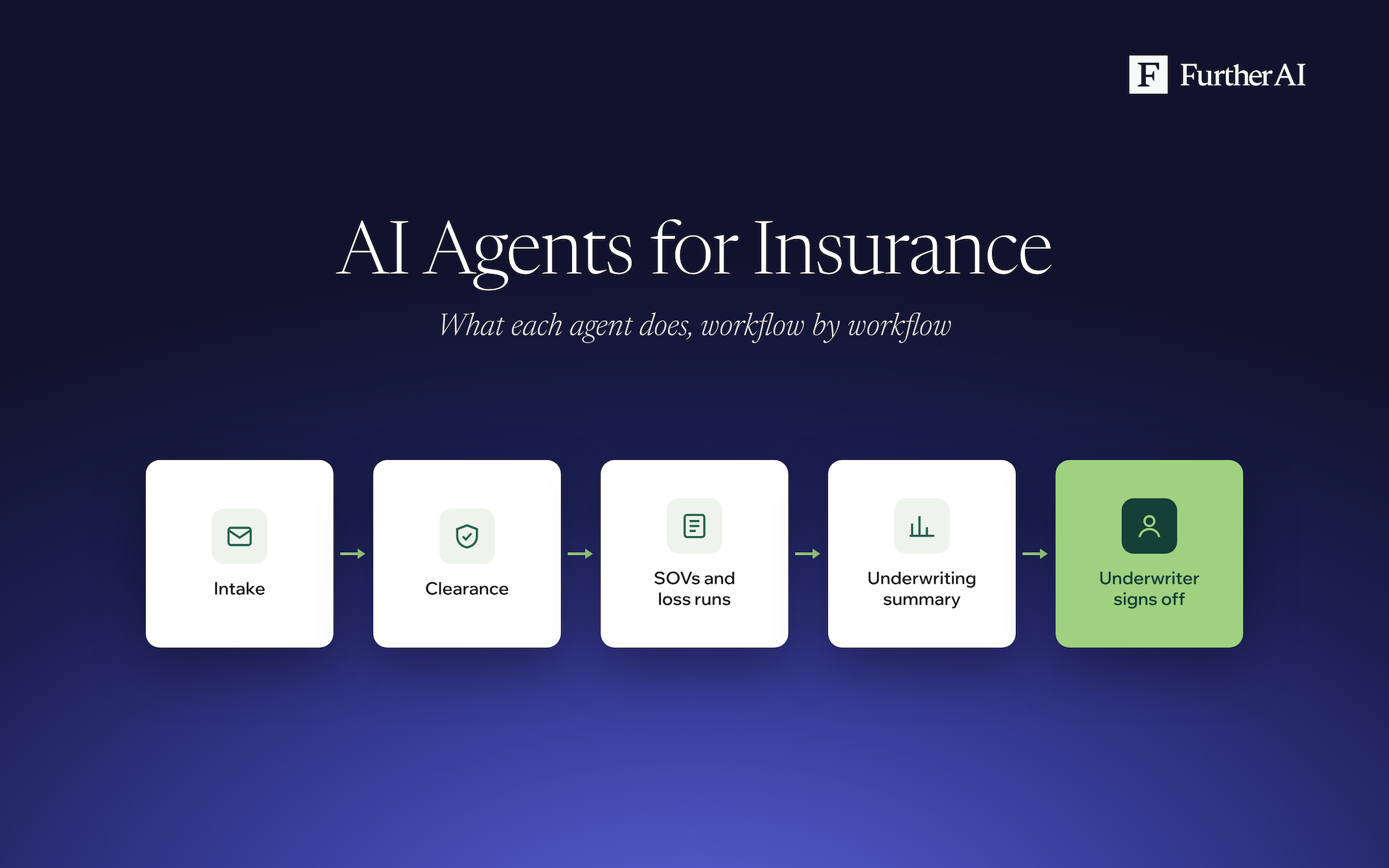
We built FurtherAI as a compliance-first AI workspace for carriers, MGAs, and TPAs, with the autonomy and the controls that regulated work demands. Our guide to AI agents for insurance walks through what each agent does, workflow by workflow.AI agents for insurance
Our agents extract submission data, validate coverage, and populate underwriting systems, flagging underwriters only when an anomaly arises rather than replaying what's already on the screen. They automate first notice of loss, claims verification, and compliance checks across the lifecycle, connected through more than 100 enterprise integrations so the work finishes inside your systems of record, not beside them.
That design is what lets teams report up to 30x faster processing and material accuracy gains, and it's why a16z led our $25M Series A to scale it. Every action is logged with the oversight and audit trails regulated environments require.
If your team hasn't shipped an AI workflow yet, start with our guide to deploying AI for the first time.
See it on your own workflows
If you're separating real agentic capability from rebranded generative tooling, the fastest test is your own data. We're happy to walk your team through how FurtherAI's agents handle submission intake, claims, and policy review end to end. Schedule a demo today.
REFERENCES
FurtherAI. "FurtherAI announces $25M Series A from Andreessen Horowitz to transform insurance workflows with AI, automating busywork." FurtherAI, October 7, 2025. furtherai.com
FurtherAI. "AI Agents for Insurance Submission Intake — How They Work." FurtherAI, accessed June 9, 2026. furtherai.com
FurtherAI. "Product." FurtherAI, accessed June 9, 2026. furtherai.com
FurtherAI. "AI Workforce for the Insurance Industry." FurtherAI, accessed June 9, 2026. furtherai.com
Gartner, Inc. "Agentic Core: Insurance CIOs Framework for Success." By Sham Gill. Gartner, January 30, 2026. ID G00842677. (Subscription-gated report; no public URL.)
DISCLAIMER
This article is for general informational purposes only and does not constitute legal, regulatory, compliance, underwriting, or other professional advice. The content reflects information available as of the date of publication, and FurtherAI undertakes no obligation to update it as laws, regulations, or AI technologies evolve.
Recent posts

Ready to go further and
transform your insurance ops?
Reclaim your time for strategic work and let our AI Assistant handle the busywork. Schedule a demo to see how you can achieve more, faster.




.svg)