FurtherAI Available in Microsoft Marketplace
Introducing Connectors



Audit Trails for Coverage Decisions: What Your Claim File Has to Prove

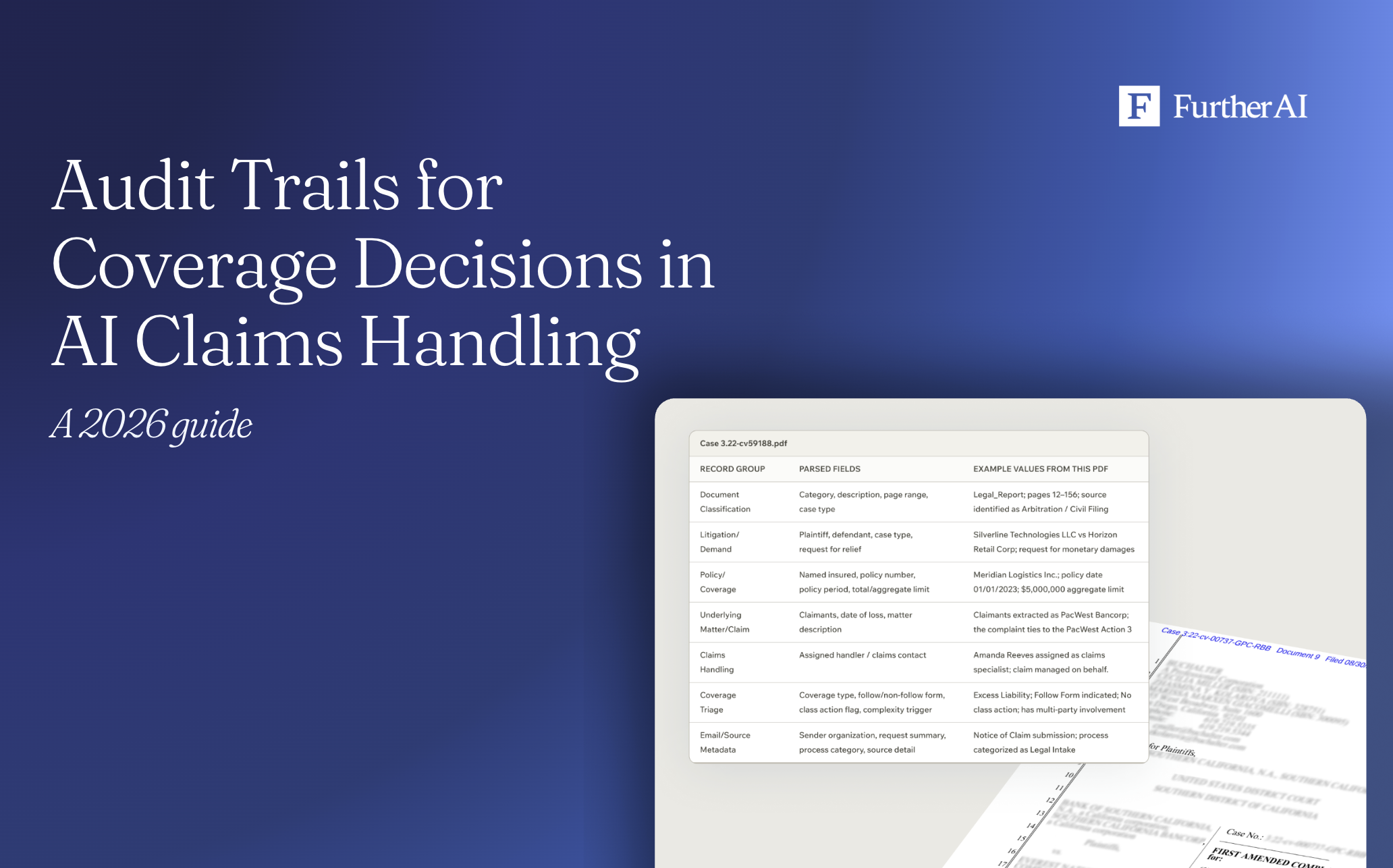
Every coverage decision your team makes is a record that someone may read back to you years later: a market conduct examiner sampling denied claims, a plaintiff's attorney in discovery, or a regulator asking why a model behaved the way it did. The question isn't whether your claims AI is accurate, but whether you can reconstruct, file by file, how each coverage position was reached and who stood behind it.
That standard is older than the technology itself. Since 1990, the NAIC's Unfair Property/Casualty Claims Settlement Practices Model Regulation has required that claim files contain enough documentation "to permit reconstruction of the insurer's activities relative to each claim." Nothing in that sentence changes when a model reads the policy instead of an adjuster.
What has changed is the volume of decisions and the speed at which a flawed one repeats. This guide covers what a defensible coverage decision record contains, which rules apply to it today, and how to grade the files you're producing right now.
Key takeaways
- The audit trail requirement predates AI by more than three decades. NAIC Model Regulation 902 requires documentation sufficient "to permit reconstruction of the insurer's activities relative to each claim," and nearly every state has an unfair claims settlement practices law built on the same foundation.
- The gap is evidentiary, not procedural. In Grant Thornton's April 2026 survey of 100 insurance leaders, 68% said their AI controls exist but the evidence is fragmented across teams and tools, and only 24% were very confident they could pass an independent review of AI governance and controls, with centralized evidence, in the next 90 days.
- Claims is the most AI-penetrated function in insurance. In the NAIC's survey of 193 private passenger auto insurers, 70% reported using AI or machine learning in claims operations — more than in rating, underwriting, or fraud detection.
- A model error becomes a general business practice by construction. Model 900 treats an act committed "with such frequency to indicate a general business practice" as an improper claims practice. A system applies the same logic to every file, which is precisely what that provision was written to catch.
- Texas now expects a human to agree, not just review. Commissioner's Bulletin B-0003-26, issued June 12, 2026, states that where AI makes a consequential decision, "TDI expects a person to review and agree with all decisions before action is taken."
What a coverage decision record actually has to prove
A coverage decision is a chain of reasoning, and the file has to hold every link. It starts with reading the policy correctly, which is why policy analysis software sits upstream of everything here. Regulators don't ask whether the outcome was reasonable in the abstract. They ask what the insurer knew, which policy language it applied, and whether the claimant was told.
Model Regulation 902 is specific about the mechanics. Claim data must be accessible and retrievable for the current year and the two preceding years, and each relevant document in the file has to be noted as to the date received, processed, or mailed. California doubles the retention window to the current year plus four preceding years under 10 CCR § 2695.3.
Denials carry an extra burden. Under Model 902, no insurer may deny a claim on the grounds of a specific policy provision, condition, or exclusion unless reference to that provision is included in the denial — in writing, with the file documenting it. Model 900 makes it an unfair claims practice to deny a claim or offer a compromise settlement without promptly providing "a reasonable and accurate explanation of the basis for such actions."
Read those together and the standard is clear enough to design against: name the provision, explain the basis, put it in writing, and keep a file that lets someone rebuild the sequence.
The six layers of a defensible coverage decision record
Most claim systems capture the outcome. Fewer capture the reasoning that produced it. These six layers are what separate a file that survives examination from one that merely records a result.
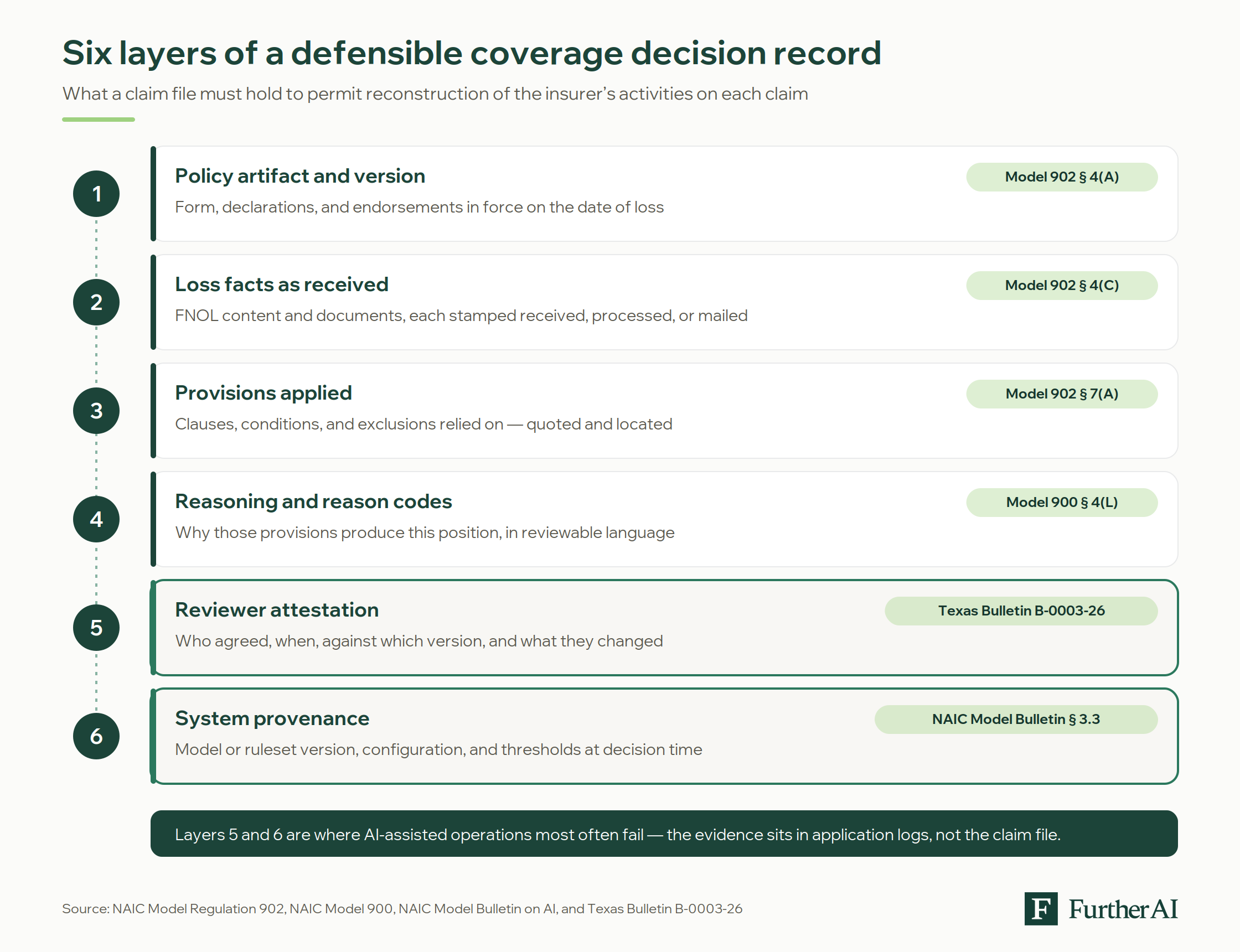
Layers one through four are what most carriers already attempt. Layers five and six are where AI-assisted operations tend to fail, because the information lives in application logs rather than in the claim file where an examiner looks.
Layer two is won or lost at intake. Our framework for secure, AI-powered claims intake covers the multichannel capture and validation that produces a complete, date-stamped file in the first place. Layer five depends on routing the right files to a person at the right moment, which is what human-in-the-loop escalation is for. Layer six starts before deployment: testing AI workflows before they hit production is how you establish the baseline a later examiner will ask you to reproduce.
Worth separating two things that get conflated: an access log records who opened a record, and a decision record captures why a position was taken. Security certifications cover the first. Only deliberate design covers the second.
Why AI changes the exposure, not the standard
The rules haven't moved, but the risk profile most certainly has.
Model 900 sets out two thresholds for an improper claims practice: an act committed "flagrantly and in conscious disregard" of the statute, or one "committed with such frequency to indicate a general business practice." A human adjuster's misreading of an exclusion is an outlier. A model's misreading is a pattern from the first file forward, and subsection B is the provision that converts it into one.
Market conduct findings already read this way. In a targeted examination resolved in January 2026, the Texas Department of Insurance found that Esurance failed to adopt and implement reasonable standards for prompt investigation in 19% of the private passenger auto claims payments reviewed — 21 files out of 110 — and assessed a $90,000 penalty. Findings expressed as error rates over a sampled population are exactly the shape an automated process produces — the same reason the difference between manual sampling and full-population review matters so much once a system is making the decisions.
The financial exposure sits well beyond the fine. In a May 2025 update, EY assessed that indemnity leakage represents approximately 7% to 14% of carriers' total spend — the kind of money post-payment and closed-claim audits exist to recover after the fact. And bad faith exposure is measured in multiples of policy limits rather than penalty schedules — the South Carolina Court of Appeals affirmed a $27.3 million judgment on $2.5 million of limits in December 2023.
There's a second-order effect worth naming. In August 2026, the Alabama Supreme Court allowed disclosure of State Farm's closely held information on how damage estimates are revised or reduced, to be shared across eight other roof-damage cases under signed exhibit agreements that bar release to competitors and the media. Whatever you record about how decisions are reached is discoverable. That argues for records that are complete and defensible, not sparse.
What regulators are asking for right now
Four developments matter for anyone running AI in a claims operation. Each one assumes a governance program underneath it, and our complete guide to AI governance in insurance covers how that program gets built.
The NAIC Model Bulletin was adopted December 4, 2023, and as of the NAIC's April 1, 2026 tracking map, 25 jurisdictions have adopted it — 24 states and the District of Columbia. Its scope explicitly covers "claim administration and payment," and it grounds itself in the Unfair Claims Settlement Practices Act. Section 3.3 asks for detailed documentation of model development and use, plus assessments of interpretability, repeatability, reproducibility, traceability, and the auditability of those measurements.
Texas issued the sharpest claims statement in the country on June 12, 2026. Beyond the review-and-agree expectation, Bulletin B-0003-26 points to Insurance Code Chapter 4101, under which investigating or adjusting losses is an act reserved to a licensed adjuster. The practical reading: a model's output is an input to a licensed human's decision, and the audit trail is what proves the human actually made it.
Colorado's statute already reaches claims, even though its implementing regulation doesn't yet. C.R.S. § 10-3-1104.9 defines "insurance practice" to include claims management, while Regulation 10-1-1 currently covers life, private passenger auto, and health benefit plans. Its documentation requirements are the most prescriptive in the country and worth reading as a preview — including a documented, up-to-date inventory of models "including version control."
A purpose-built examination instrument is coming. The NAIC's AI Systems Evaluation Tool was being piloted by 12 states as of March 2026, with adoption anticipated at the 2026 Fall National Meeting. It's designed to let examiners gather information about AI use, governance practices, high-risk models, and input data in a market conduct or financial exam context. If you want to get ahead of it, insurance audit readiness software is the category that closes the evidence gap before an examiner opens one.
One honest note on the federal picture: Executive Order 14365, issued in December 2025, directs challenges to state AI laws, and the NAIC responded within five days warning it could prevent regulators from addressing risks in claims processing. That fight doesn't touch Model 900 or Model 902, which are ordinary claims-practice law rather than AI law. Building the record is the right call regardless of how preemption resolves.
How to grade your own claim files
Pull 10 recently denied claims and 10 where coverage was limited. For each, check whether you can answer these without opening a system outside the claim file.
- Which policy version applied? Can you produce the form, declarations, and endorsements in force on the date of loss, not the current ones?
- Which provisions were relied on? Are they quoted and located in the source document, or merely named?
- Is the reasoning readable? Could a compliance reviewer follow the path from facts to position without a data scientist?
- Who agreed? Is there a named reviewer, a timestamp, and a record of what they changed?
- What was the system doing? Can you identify the model or ruleset version and the thresholds in force at decision time?
- Does the denial letter match the file? Does the provision cited to the claimant appear in the documented reasoning?
A file that fails questions four and five will still pass most internal QA. It won't reconstruct under examination, and it won't defend a bad faith allegation. Question three is the one teams underestimate: explainable AI produces source-backed, audit-ready findings that a compliance reviewer can check without help.
Where FurtherAI fits
We build the record as the work happens rather than reconstructing it afterward.
The most direct example is upstream of the coverage decision. A specialty insurer processing more than 3,000 claims a year was handling initial claim intake manually — validating that incoming notice-of-claim documentation contained every required document and field before an adjuster could open the file. That workflow consumed roughly 2.5 hours per claim, about 7,500 labor hours a year. After deployment, the insurer automated more than 90% of that intake workflow, saved over $360,000 annually, and processed claims more than 10 times faster, at roughly 568% ROI. Complete, structured, date-stamped intake is layer two of the record, and it's the layer everything downstream depends on.
On the coverage side, our policy summaries anchor each line to the source policy wording for auditability, which is the mechanism behind layer three. Our explainable AI approach produces source-cited findings rather than opaque scores, and the same principle applies to coverage positions: every exception links back to the exact document and the rule it was checked against.
We're honest about the boundary. Our published claims outcomes cover intake and document work. Coverage checking, reserve support, and adjudication assistance are capabilities we deliver, but the metric above measures intake specifically — and we'd rather you know which is which. FurtherAI is SOC 2 Type II certified, ISO 27001 certified, and GDPR and HIPAA compliant. You can see how the whole picture fits together for claims professionals.
If you're evaluating platforms rather than designing the record, our comparison of the best AI tools for claims processing at carriers and MGAs covers that ground directly, and there's a separate guide for TPAs administering claims on behalf of carrier clients. If the shortlist stage is where you're stuck, our claims automation vendor selection guide walks the full evaluation.
Want to see what a reconstructable claim file looks like on your own book? Schedule a demo.
REFERENCES
Colorado Secretary of State. "3 CCR 702-10, Regulation 10-1-1: Governance and Risk Management Framework Requirements." Colorado Secretary of State. sos.state.co.us
Cornell Law School Legal Information Institute. "10 CCR 2695.3 — File and Record Documentation." Cornell Law School. law.cornell.edu
Ernst & Young LLP. "Property and Casualty Insurers Tackle Indemnity in Litigated Claims." EY, 2025. ey.com
FindLaw. "Colorado Revised Statutes § 10-3-1104.9." FindLaw. codes.findlaw.com
Grant Thornton. "Insurance Insights: 2026 AI Impact Survey Report." Grant Thornton, April 21, 2026. grantthornton.com
Insurance Journal. "SC Appeals Court: Insurer's Bad Faith Meant Award Was 10X Policy Limit." Insurance Journal, December 14, 2023. insurancejournal.com
National Association of Insurance Commissioners. "Artificial Intelligence." NAIC, last updated April 3, 2026. content.naic.org
National Association of Insurance Commissioners. "Implementation of NAIC Model Bulletin: Use of Artificial Intelligence Systems by Insurers." NAIC, status as of April 1, 2026. content.naic.org
National Association of Insurance Commissioners. "Model Bulletin: Use of Artificial Intelligence Systems by Insurers." NAIC, adopted December 4, 2023. content.naic.org
National Association of Insurance Commissioners. "Private Passenger Auto Artificial Intelligence/Machine Learning Survey Report." NAIC, December 2022. content.naic.org
National Association of Insurance Commissioners. "Statement of the National Association of Insurance Commissioners on AI Executive Order." NAIC, December 16, 2025. content.naic.org
National Association of Insurance Commissioners. "Unfair Claims Settlement Practices Act (Model 900)." NAIC. content.naic.org
National Association of Insurance Commissioners. "Unfair Property/Casualty Claims Settlement Practices Model Regulation (Model 902)." NAIC. content.naic.org
Rabb, William. "State Farm Must Give Up Trade Secrets in Claims Lawsuits, but Under Court Review." Insurance Journal, August 19, 2026. insurancejournal.com
Texas Department of Insurance. "Commissioner's Bulletin B-0003-26: Use of Artificial Intelligence." Texas Department of Insurance, June 12, 2026. tdi.texas.gov
Texas Department of Insurance. "Official Order No. 2026-9750: Esurance Insurance Company." Texas Department of Insurance, January 22, 2026. tdi.texas.gov
DISCLAIMER
This article is for general informational purposes only and does not constitute legal, regulatory, compliance, underwriting, or other professional advice. The content reflects information available as of the date of publication, and FurtherAI undertakes no obligation to update it as laws, regulations, or AI technologies evolve.
Recent posts
.png)
Ready to go further and
transform your insurance ops?
Reclaim your time for strategic work and let our AI Assistant handle the busywork. Schedule a demo to see how you can achieve more, faster.




.svg)