FurtherAI Available in Microsoft Marketplace
Introducing Connectors



From Basic Automation to AI Agents: Transforming Insurance Submission Processing

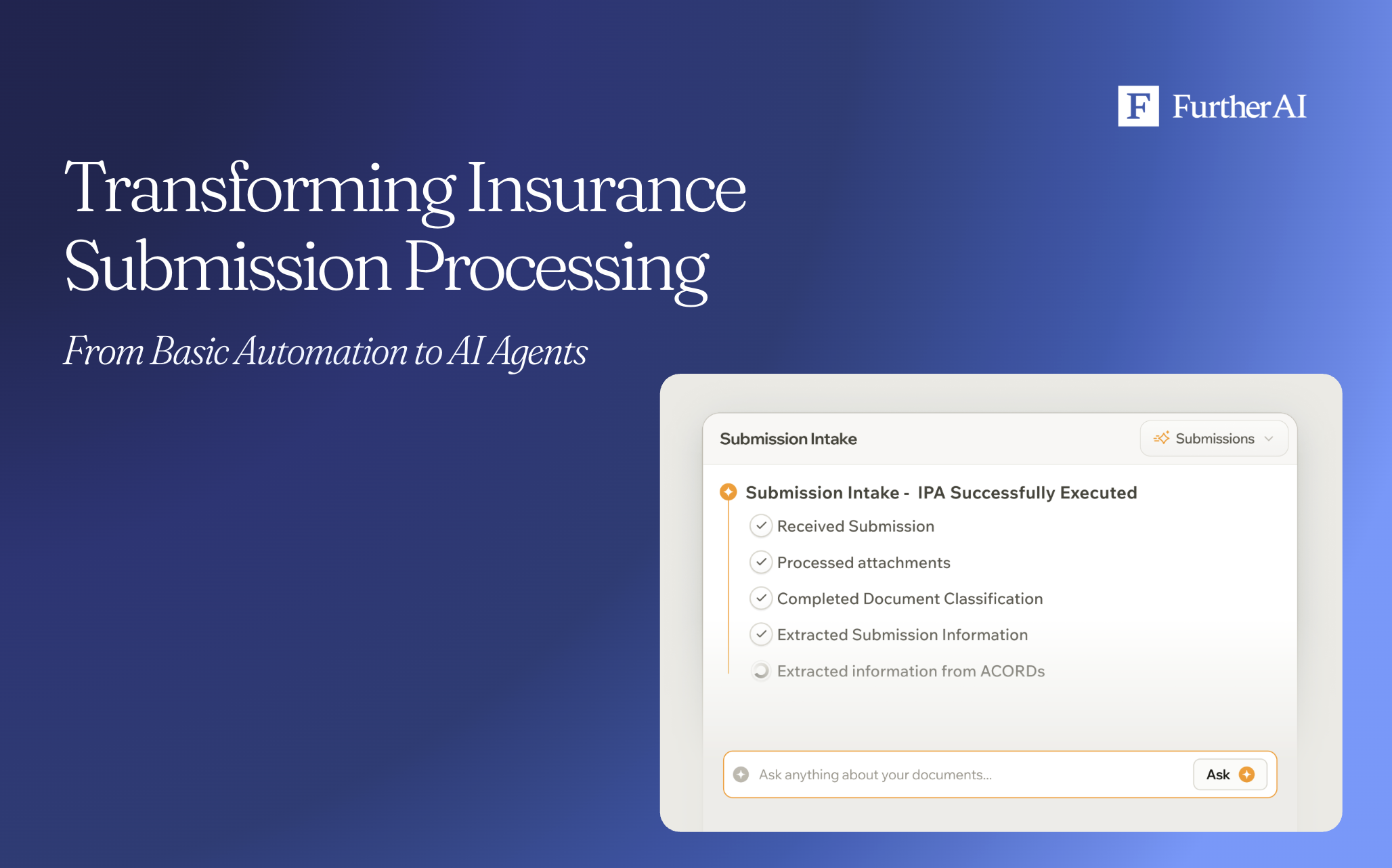
AI agents process insurance submissions by reading unstructured documents — broker emails, ACORD forms, statements of value (SOVs), and loss runs — then extracting the data, validating it, enriching it, and pushing it into underwriting systems with little to no manual entry. Unlike older rules-based automation, AI agents handle messy, non-standard inputs and complete multi-step workflows on their own. One MGA using FurtherAI cut its average time to clear a submission from about 32 minutes to roughly one, a 30x speed gain.
In this guide, we explain what submission intake involves, where manual processing breaks down, how AI agents differ from basic automation, and what results carriers, MGAs, and brokers are seeing today.
Key takeaways
- Underwriters spend most of their day on work that isn't underwriting. Accenture found the average underwriter spends 70% of their time on non-underwriting activities, including 40% on administrative tasks.
- A single commercial submission can hold 300–500 pieces of information, yet legacy processes often capture only about 50 of them, leaving the rest as unused "dark data."
- AI agents differ from optical character recognition (OCR) and robotic process automation (RPA) because they interpret unstructured documents, adapt to new formats, and make decisions across multiple steps.
- FurtherAI customers report outcomes including 30x faster intake, 200%+ efficiency gains, and 646% ROI on complex property intake.
- Generative AI adoption in insurance is accelerating fast; Conning found early or full adoption of large language models (LLMs) jumped from 18% to 63% in a single year.
What insurance submission intake actually involves
Submission intake is the first step of underwriting: receiving a new business or renewal request and turning a stack of documents into structured, decision-ready data. For commercial lines, that stack typically includes ACORD applications, SOVs, loss runs, financial statements, and certificates of insurance.
The work is unavoidable. An underwriter can't price a property risk without extracting the exposure data from ACORD forms and SOVs. The problem is the format: the tens of thousands of independent agencies licensed in the U.S. each submit data their own way, so structure, terminology, and completeness vary wildly from one file to the next.
Why manual submission processing is slow and costly
Manual intake quietly drains underwriting capacity. According to McKinsey, in large commercial lines, 30 to 40 percent of an underwriter's time goes to administrative tasks such as rekeying data or running manual analyses. Accenture's long-running P&C underwriting survey puts the figure higher: the average underwriter spends 70% of their time on non-underwriting activities, split across 40% administrative work, 30% negotiation and sales support, and just 30% on actual underwriting.
The data loss is just as costly as the time loss. Accenture estimates a typical commercial submission contains 300–500 pieces of information, but a conventional intake process often converts only about 50 of those 500 fields into usable data. The rest stays trapped in PDFs and spreadsheets as dark data the carrier owns but never sees.
Basic automation vs. AI agents
Earlier automation helped, but it was brittle. OCR and RPA work well on standardized templates and predictable steps, and they stall the moment a document looks unfamiliar. AI agents, built on LLMs, read context the way a person does and act across a whole workflow.
How AI agents process a submission, step by step
In submission intake, an AI agent works through the same sequence a skilled underwriting assistant would, only faster and around the clock. Here's the workflow FurtherAI runs for its MGA and carrier customers:
- Receive and classify. Incoming submissions are forwarded to the AI agent, which identifies and sorts each attachment — ACORD forms, SOVs, loss runs, and supporting documents.
- Extract data. The agent pulls key fields such as coverage limits, loss histories, and insured details, and converts SOVs into a standardized format for consistency.
- Validate information. It checks for inconsistencies like mismatched coverage dates or missing documents, then flags anomalies for underwriter review.
- Enrich with context. The agent overlays third-party and web data to fill gaps and add context the original submission lacked.
- Run eligibility and triage. It checks each submission against underwriting guidelines and prioritizes the highest-value risks so they reach underwriters first.
- Summarize and populate systems. Finally, it produces a risk summary and writes clean data into policy administration, customer relationship management (CRM), and rating platforms without manual entry.

What results look like in practice
Submission AI is moving from pilot to production because the numbers hold up. The table below shows outcomes FurtherAI customers have reported across intake and adjacent underwriting workflows.
The pattern behind these results is consistent: the AI handles repetitive extraction and verification, brokers get materially faster quote turnaround, and underwriters spend their time on complex risk decisions instead of data entry.
Why this matters now
AI-driven intake is becoming a competitive baseline rather than an edge. Conning's 2025 industry survey found that early or full adoption of LLMs among insurers rose from 18% to 63% in 12 months, with 90% of U.S. insurers evaluating generative AI. Carriers, MGAs, and brokers that automate submission intake free up underwriting capacity, quote faster, and capture the submission data their competitors leave behind.
If you want to see what these gains could look like for your team, FurtherAI can walk through your submission workflow and the metrics that matter to your book.
REFERENCES
Accenture. "Intelligent ingestion: The start of commercial digital insurance." Insurance Blog | Accenture. insuranceblog.accenture.com
Accenture. "Why underwriters don't underwrite much." Insurance Blog | Accenture. insuranceblog.accenture.com
Conning. "Conning Releases 2025 Survey on AI & Insurance Technology: The C-Suite Verdict." Conning. conning.com
FurtherAI. "Submissions Processing." Customer Stories. furtherai.com
McKinsey & Company. "Insurance productivity 2030: Reimagining the insurer for the future." McKinsey & Company. mckinsey.com
DISCLAIMER
This article is for general informational purposes only and does not constitute legal, regulatory, compliance, underwriting, or other professional advice. The content reflects information available as of the date of publication, and FurtherAI undertakes no obligation to update it as laws, regulations, or AI technologies evolve.
Recent posts
Ready to go further and
transform your insurance ops?
Reclaim your time for strategic work and let our AI Assistant handle the busywork. Schedule a demo to see how you can achieve more, faster.




.svg)