FurtherAI Available in Microsoft Marketplace
Introducing Connectors



How MGAs Consolidate Claims Data From TPAs, Carriers, and Brokers Into One View (2026)

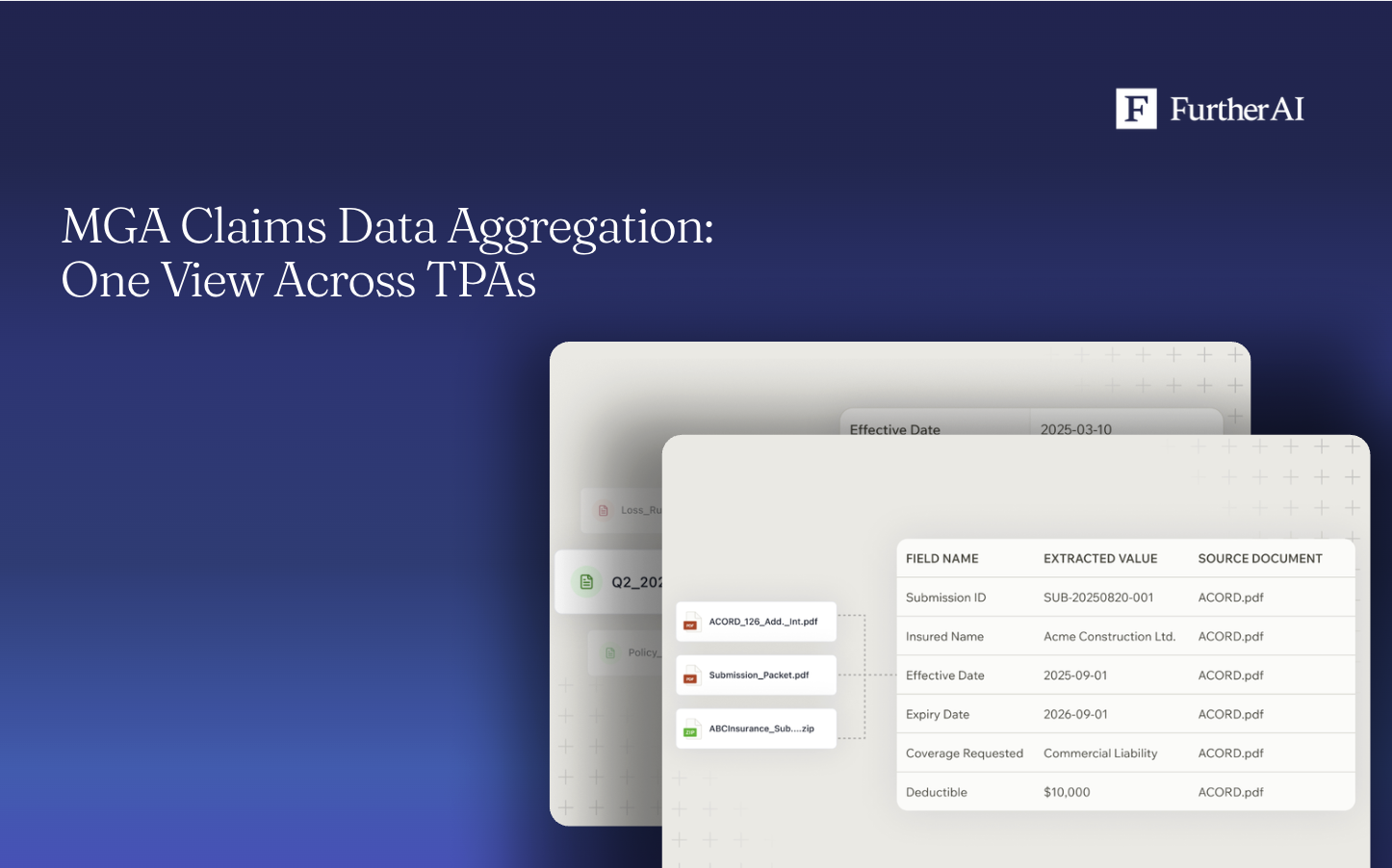
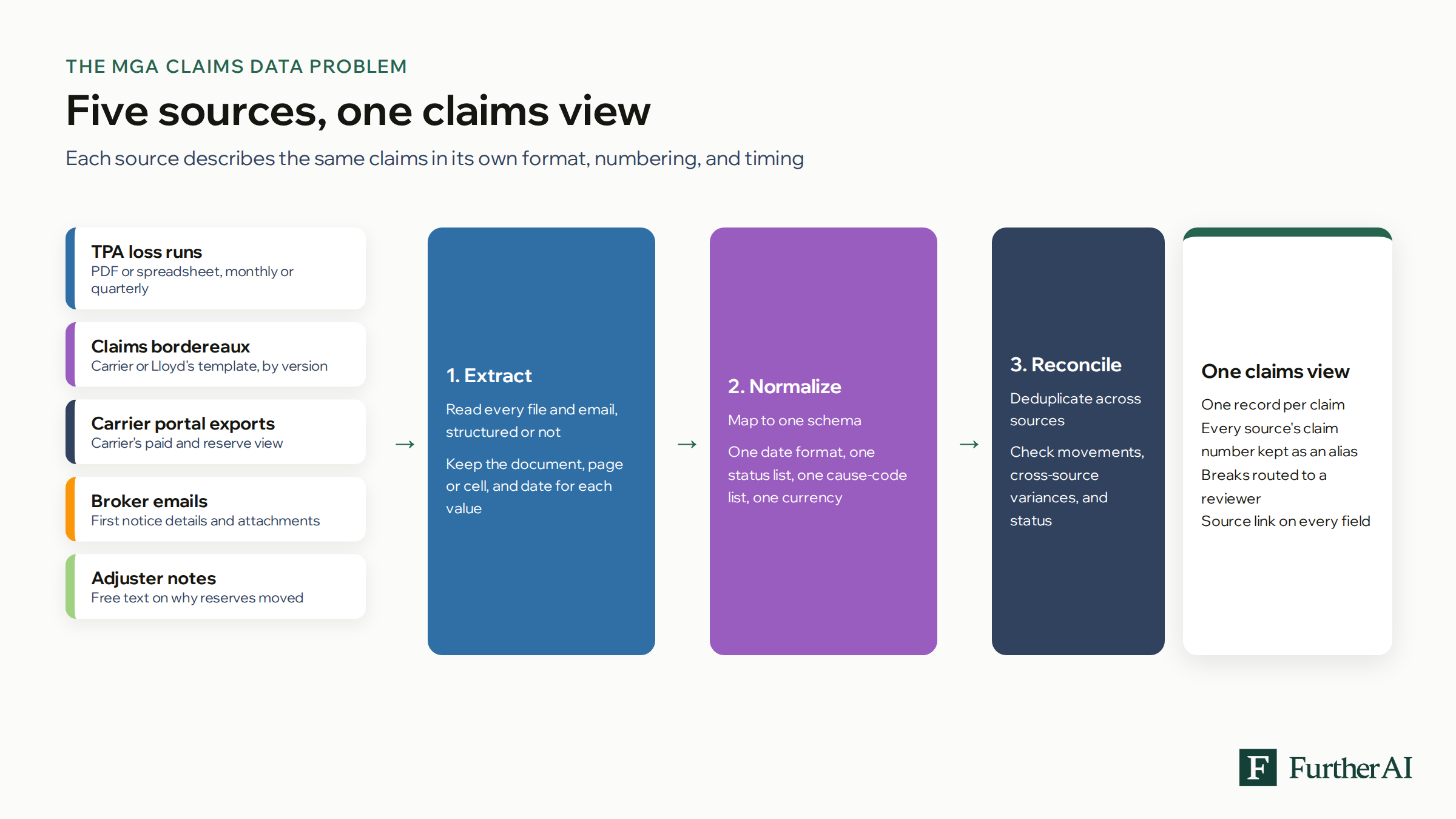
MGAs consolidate claims data by pulling every source into one claims schema, then matching records across sources before anyone reads a number. TPA loss runs, claims bordereaux, carrier portal exports, broker emails, and adjuster notes all describe the same claims in different formats. The software that handles this well extracts each source, maps it to shared fields, deduplicates and reconciles the results, and keeps a link from every value back to the document it came from.
In this guide, we cover why the problem gets harder as a managing general agent (MGA) grows, a normalization schema you can adapt, how reconciliation and deduplication work, what changes for mid-size MGAs as volume climbs, the KPIs to track, and the tools MGAs use, all presented in the same format.
Key takeaways
- The problem is five formats describing one claim. TPA loss runs, claims bordereaux, carrier portals, broker emails, and adjuster notes rarely share field names, dates, or claim numbers.
- Normalize to one schema first. Lloyd's Coverholder Reporting Standards alone define dozens of claims fields, so a shared schema is the foundation for everything else.
- Reconcile movements as well as totals. Last month's incurred plus this month's movement should equal this month's incurred, for every claim, from every source.
- Volume is rising across the segment. AM Best reports that direct premiums written through delegated underwriting authority enterprises reached $108.7 billion in 2025, up from $92.3 billion in 2024.
- Every value needs a source link. When a TPA and a carrier disagree on a reserve, the reviewer should see both documents side by side.
The MGA claims data problem
An MGA with several carrier partners and more than one TPA often has no single claims system of record. Instead it has a collection of files, and each one covers part of the picture:
- TPA loss runs arrive monthly or quarterly as PDFs or spreadsheets, each TPA with its own layout, claim numbering, and status codes.
- Claims bordereaux follow a carrier's or Lloyd's template, but templates differ by capacity provider and change between versions.
- Carrier portals hold the carrier's view of paid and reserved amounts, often available only as manual exports.
- Broker emails carry first notice details, follow-ups, and attachments such as ACORD loss notices that never make it into a loss run.
- Adjuster notes explain why a reserve moved, in free text, and often start as claims call notes or voicemails.
The pressure to get this right is growing. AM Best's latest MGA market segment report found that direct premiums written sourced from delegated underwriting authority enterprises reached $108.7 billion in 2025, up from $92.3 billion in 2024. The same report notes that "a slightly higher percentage of MGAs in 2025 were empowered to handle claims and underwrite risks for their carrier partners." More premium and more claims authority mean more claims data to report and defend.
A normalization schema for MGA claims data
The first job is agreeing on what a claim record looks like. If your capacity includes Lloyd's, you already have a reference point: Lloyd's Coverholder Reporting Standards v5.2 set out the claims information coverholders report. Mandatory items include the Unique Market Reference (or agreement number), a unique claim reference, and the TPA or delegated claims administrator (DCA) name wherever a TPA manages the claim, alongside fields for paid, reserve, and total incurred amounts.
The table below is a practical core schema built around those fields.
The last row is the one most spreadsheets skip. Without it, every disagreement turns into an email thread about which file someone used, and it's the first thing auditors ask for when AI outputs need to be explainable.
"Every data point FurtherAI processes cites back to exactly where in the document it came from. If it creates a data point, it gives a reason why it thinks that's right. If it has low confidence, it says so — is it because there's conflicting information, or because it can't process it? Auditability, transparency, and the repeatability of action are super important." — Aman Gour, Co-founder & CEO at FurtherAI
Reconciliation and deduplication
Once the sources share a schema, two jobs remain: making sure each claim appears once, and making sure its numbers add up.
Deduplication catches the same claim arriving from several sources under different references. Match on a combination of policy reference, date of loss, insured name, claimant, and loss location, because each TPA and carrier numbers claims its own way and claim number alone won't line them up. Route near-matches (a misspelled insured, a date off by a day) to a reviewer before merging.
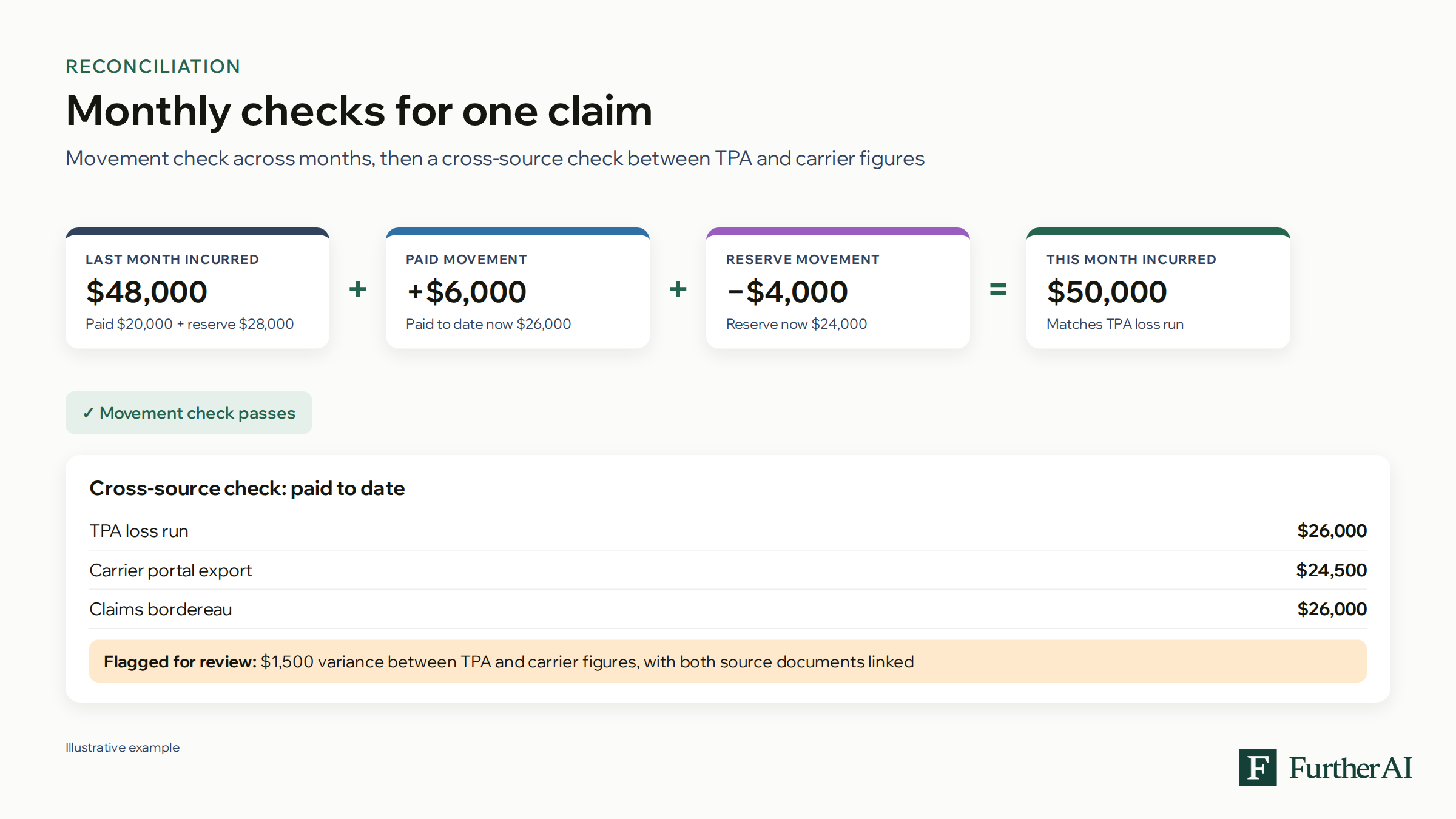
Reconciliation checks that the numbers are consistent across sources and across months:
- Movement check: last period's total incurred plus this period's paid and reserve movement should equal this period's total incurred.
- Cross-source check: the TPA's paid-to-date should match the carrier portal and the bordereau within a set tolerance.
- Status check: a claim marked closed should have zero outstanding reserve, and a reopened claim should show a new reserve.
- Completeness check: every open claim from last month should appear this month, or carry a closure record.
Format problems cause many of the breaks. Lloyd's own claims bordereaux submission procedure warns submitters to avoid formulas and macros, merged cells, duplicate headings, and inconsistent date formats. Good software catches those before the numbers are compared.
Reconciliation is also where claims data meets oversight. If your carrier partners or reinsurers audit your bordereaux, our guide to automating premium audits for delegated authority programs covers that side of the process.
How mid-size MGAs handle rising claims volume
Mid-size MGAs usually feel the problem first when a second or third program goes live. Each new program can add a carrier template, a TPA, and a reporting calendar. Claims volume grows with the book, and the month-end close for claims data starts to take days instead of hours.
Three changes keep claims volume manageable without adding headcount:
- Extract once, report many times. Normalize every source into the shared schema as it arrives, then generate each carrier's bordereau from that one dataset, ideally with every source system connected to one workspace.
- Review exceptions only. Let matching and reconciliation run automatically, and route only breaks (duplicates, variances, missing claims) to a person.
- Keep source links on every field. When a carrier asks about a number, the answer is one click away instead of a search through last quarter's files.
The scaling pattern is the same one we see in claims intake. A specialty insurer FurtherAI works with grew from five to ten insurance programs while sustaining more than 20% annual premium growth for three consecutive years. Its claim documentation "arrived in diverse layouts, requiring manual normalization of fields." Automating intake validation reached more than 90% automation of the intake process and saved about 7,500 hours a year. For the underwriting side of the same growth problem, see our guide on scaling underwriting operations at mid-size MGAs.
KPIs for MGA claims data aggregation
Track these monthly, by program and by source.
Tools MGAs use to aggregate claims data
The tools below take different approaches: an insurance-specific AI workspace, delegated authority platforms, a data services firm, and a risk management information system (RMIS). They're listed alphabetically, each in the same format. All capabilities and figures come from each company's own published material, so verify them on your own files. For platforms that cover MGA underwriting and operations more broadly, see our comparison of agentic AI platforms for MGAs.
FurtherAI
Sources: claims case study, multi-source risk data
Insurance Data Solutions
Source: MGA bordereaux to analytics case study
Novidea
Source: Novidea March 17, 2026 release
Regure
Source: Regure Lloyd's bordereaux reporting guide
Riskonnect
Source: Riskonnect RMIS
How FurtherAI fits
FurtherAI handles the part that breaks most spreadsheets: turning documents in "diverse layouts" into structured fields, with a source link on each one. Our roundup of AI tools for unstructured claim documents covers that extraction step in more depth. For a top-10 global carrier processing large property schedules, that approach reached field-level accuracy above 95% at go-live, rising to 97% within six months. Conflicts between sources are surfaced for review, and each resolution is recorded. For a specialty insurer scaling from five to ten programs, the same approach to claim intake reached more than 90% automation.
If you're sizing the problem, count how many sources fed last month's claims bordereau and how many hours went into reconciling them. That number usually makes the case on its own.
Frequently asked questions
REFERENCES
AM Best. "Best's Market Segment Report: Managing General Agents Adapt to Changing Demands and Added Scrutiny." Business Wire, June 30, 2026. businesswire.com
FurtherAI. "Claims Case Study: 90% Intake Automation, 568% ROI." furtherai.com
FurtherAI. "How Risk Engineers Aggregate Multi-Source Risk Data Into One Verifiable View." furtherai.com
Insurance Data Solutions. "MGA Bordereaux to Analytics in two Weeks." insurancedatasolutions.co.uk
Lloyd's. "Coverholder Reporting Standards User Guide Version 5.2." August 20, 2019. assets.lloyds.com
Lloyd's. "Delegated Data Manager (DDM) Claims Bordereaux Standard Operating Procedure (SOP)." Version 1.1. assets.lloyds.com
Novidea. "Novidea Releases Updated Version of Its Insurance Management Platform with Significant Enhancements Across Policy Administration, Bordereaux, Claims and Accounting." GlobeNewswire, March 17, 2026. globenewswire.com
Regure. "Bordereaux Reporting Guide for Lloyd's Coverholders 2026." getregure.com
Riskonnect. "Risk Management Information System (RMIS)." riskonnect.com
DISCLAIMER
This article is for general informational purposes only and does not constitute legal, regulatory, compliance, underwriting, or other professional advice. The content reflects information available as of the date of publication, and FurtherAI undertakes no obligation to update it as laws, regulations, or AI technologies evolve.
Recent posts

Ready to go further and
transform your insurance ops?
Reclaim your time for strategic work and let our AI Assistant handle the busywork. Schedule a demo to see how you can achieve more, faster.




.svg)