FurtherAI Available in Microsoft Marketplace
Introducing Connectors



How Carriers Cut Time to Adjuster Assignment: AI Triage for Commercial Claims (2026)

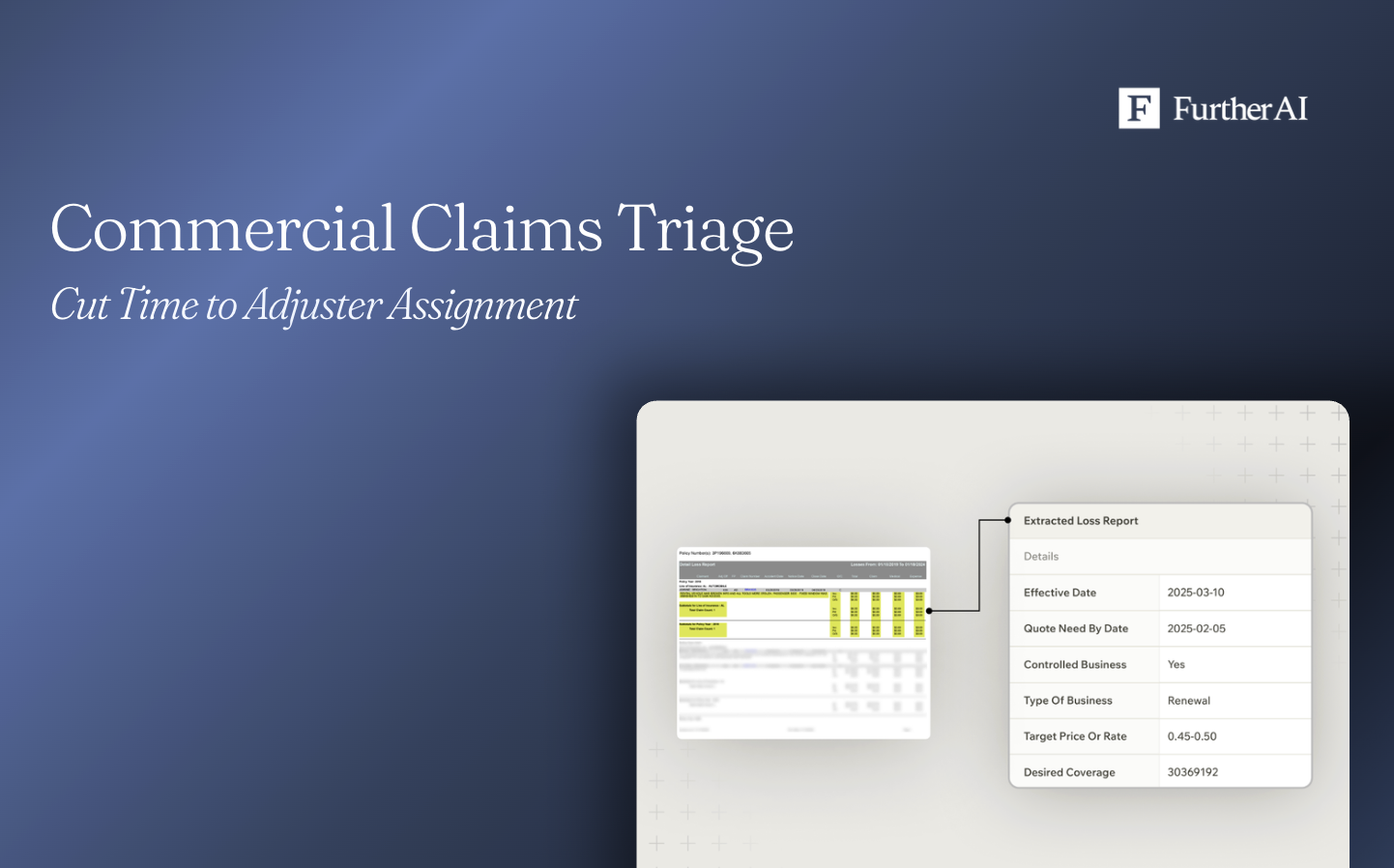
Carriers cut time to adjuster assignment by moving four checks to the moment the first notice of loss (FNOL) arrives: is the notice complete, is the loss covered, how severe and complex is it, and which adjuster is allowed and available to take it. When those checks run automatically and cite the documents they read, most commercial claims reach the right desk on day one, and only the edge cases wait for a supervisor.
That's the short answer. In the rest of this guide, we cover where assignment time actually goes, a triage scoring framework you can adapt, how the signals change across property, general liability (GL), commercial auto, workers' compensation, and specialty lines, which KPIs to track, and the tools carrier claims teams use for each step.
Key takeaways
- Time to assignment is lost in four places: incomplete FNOL, coverage verification, severity scoring, and routing rules. Fix them in that order, because each one feeds the next.
- The regulatory clock starts at notice. The NAIC's model claims regulation gives insurers 15 days to acknowledge a claim, and every day spent chasing a missing policy number comes out of that window.
- Triage is a scoring problem with a paper trail. Each routing decision should trace back to a signal, and each signal to a source document an auditor can open.
- Measure reassignment alongside speed. A fast first assignment that bounces to a second adjuster costs more than a slower one that sticks.
- Most tools cover one or two stalls. Intake and completeness, predictive severity, and assignment engines are often different products, so map vendors to stalls before you compare them.
Where time to adjuster assignment goes
Every commercial claim passes through the same four stalls between FNOL and the adjuster who'll own it. Some carriers clear them in hours. Others take days, and the difference usually isn't adjuster headcount.
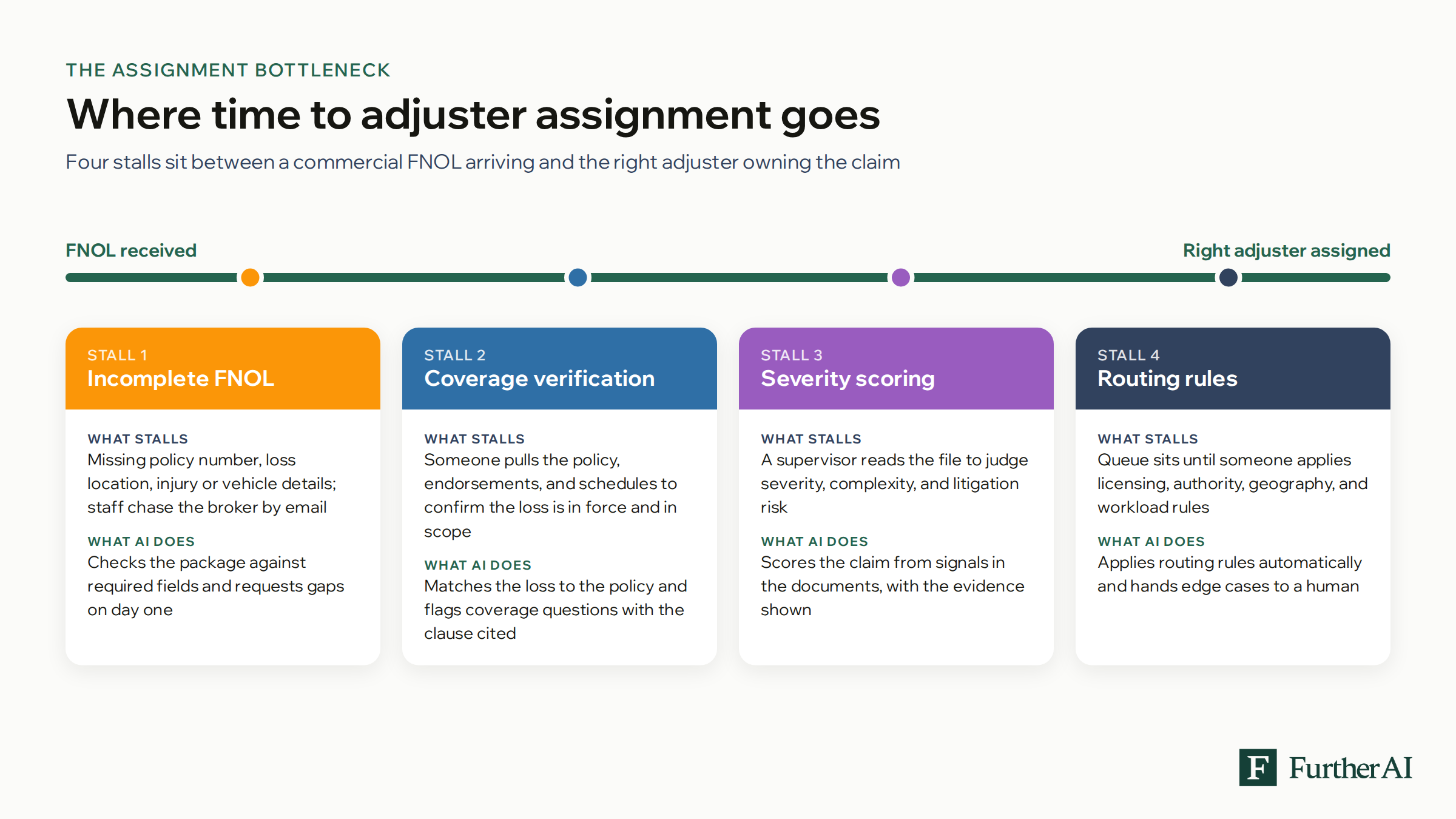
1. Incomplete FNOL. Broker emails arrive without a policy number, loss location, or injured party details. Someone has to notice the gap, write back, and wait. Until the notice is complete, nobody can check coverage.
2. Coverage verification. Commercial policies carry schedules, endorsements, and exclusions that decide whether a loss is in scope. Pulling and reading them by hand is slow, and it's often done twice: once at intake and again by the adjuster.
3. Severity scoring. A supervisor reads the file to judge how big and how complex the claim is. That judgment decides everything downstream, yet it's rarely written down in a consistent way.
4. Routing rules. Licensing, settlement authority, geography, line expertise, and current caseload all constrain who can take the claim. When those rules live in a supervisor's head or a spreadsheet, claims queue until that person is free.
We've seen how much time the first stall alone absorbs. A specialty insurer we work with was processing over 3,000 claims a year with 98% of its claim workflows done manually, and initial claim intake alone took about 2.5 hours of human time per claim, roughly 7,500 hours a year, before a claim could be opened.
Why the clock matters more in commercial lines
Commercial claims teams face three pressures at once.
The regulatory window is short. Under the NAIC's Unfair Property/Casualty Claims Settlement Practices Model Regulation, every insurer "shall, within fifteen (15) days, acknowledge the receipt of such notice unless payment is made within that period of time." State versions differ, but a triage delay spends regulatory time before an adjuster has even opened the file.
Delay costs money, especially in casualty lines. NCCI research on workers' compensation found that for lost-time claims, median cost rises by about 35% for claims reported in week three relative to week two. That study measures how long employers take to report an injury, so it isn't a carrier assignment benchmark, but it shows how quickly an unmanaged injury claim gets more expensive. Commercial auto has less room still: AM Best reports the segment posted its 14th consecutive year of underwriting losses, with $4.9 billion lost in 2024.
Adjuster capacity isn't growing. The U.S. Bureau of Labor Statistics projects employment of claims adjusters, appraisers, examiners, and investigators to decline 6% between 2025 and 2035. And catastrophes arrive in surges: Florida's Office of Insurance Regulation logged 385,146 Hurricane Milton claims, including 23,901 commercial property claims, as of December 9, 2025. Routing rules that work on a normal Tuesday break when a single event lands thousands of claims in a week.
A triage scoring framework for commercial claims
Good triage turns each stall into a gate. Each gate reads a specific document, produces a signal, and pushes the claim toward a route. The table below is a starting point to adapt to your own lines, authority levels, and state footprint.
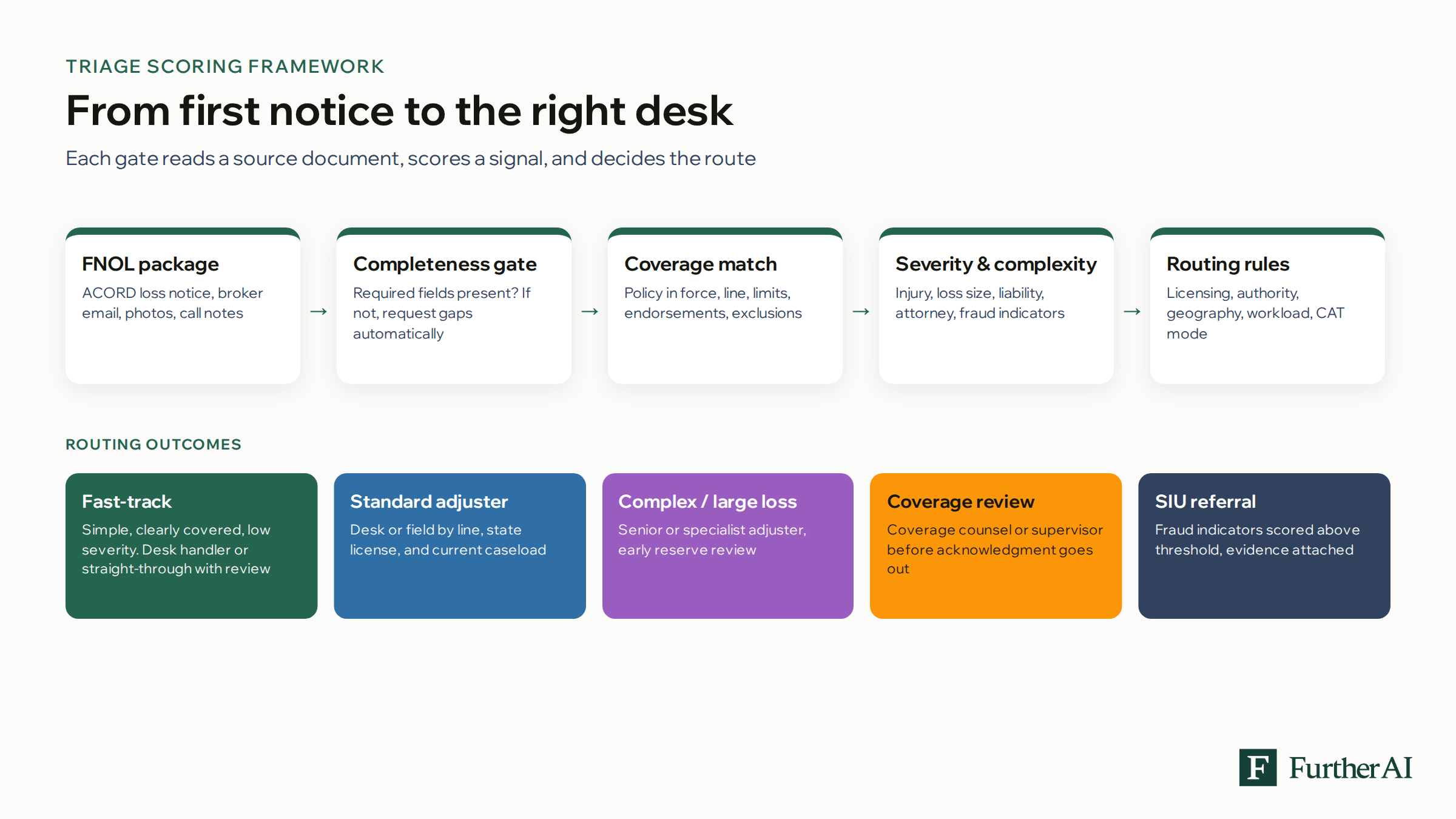
Two design rules make this framework hold up. First, every flag should cite its source, down to the page or clause, so a supervisor can confirm a route in seconds rather than re-read the file. Second, keep the completeness gate first. Coverage and severity scores built on a half-empty notice are guesses.
How triage signals change by commercial line
The gates stay the same across lines, but the signals that decide the route don't. Here's what matters most in each.
KPIs that show whether triage is working
Speed alone can hide problems. Track these together from one consistent start point: the timestamp the FNOL arrives in any channel. Starting the clock when someone keys the claim into the system hides the intake delay entirely.
Reassignment rate is the easiest KPI to overlook. Every reassignment means a second adjuster re-reading the file, a second first contact, and a claimant who has to explain the loss again. If time to assignment drops but reassignment climbs, the triage model is routing fast and routing wrong.
Tools that help carrier claims teams cut time to adjuster assignment
No single category covers all four stalls. Intake and completeness tools clear stall one and feed the rest. Predictive triage models score severity. Claims management platforms apply routing and assignment rules. The five tools below are listed alphabetically, and every figure comes from the vendor's own published material, so treat each one as a claim to verify in a pilot. For a broader view of the category, see our comparison of FNOL automation platforms.
How to roll out AI triage without breaking routing
- Baseline first. Pull 90 days of claims and measure time to assignment, reassignment rate, and touches by line before changing anything.
- Start with the completeness gate. It's the lowest-risk step and it makes every later score more reliable.
- Run triage in shadow mode. Let the model score and route in parallel for a few weeks while supervisors keep assigning. Compare where they disagree.
- Widen fast-track slowly. Expand it only as fast-track accuracy holds, one line and one state at a time.
- Keep humans on the edges. Route low-confidence scores, coverage questions, and fraud flags to a person, with the evidence attached. That's the approach behind how FurtherAI agents loop in a human at the right moment.
McKinsey expects the claims handler role to split between straightforward claims and complex claims that need human judgment. Triage is where that split happens, so it's worth designing deliberately.
How FurtherAI fits
FurtherAI works on the front half of this process: the FNOL package, the policy, and the documents in between. For the specialty insurer above, we automated the check that every incoming notice had the documents and field-level data needed to open a claim. That took intake to more than 90% automation, cut processing time by more than 10x, and saved more than $360K a year (see case study).
In Canada, RMA Insurance partnered with FurtherAI to take manual assembly out of its claims work. "Partnering with FurtherAI allows us to leverage insurance-specific AI to remove manual friction from our claims processes, ultimately enabling our teams to focus on what matters most: supporting our members," said Ed Yeung, SVP Insurance Solutions at RMA.
If you're sizing where your own assignment time goes, start with a sample of last month's FNOLs and count how many were complete on arrival. That number usually tells you which stall to fix first.
Frequently asked questions
REFERENCES
AM Best. "Best's Market Segment Report: US Commercial Auto Insurance Segment Stuck in Reverse as Losses Keep Mounting." September 22, 2025. news.ambest.com
CLARA Analytics. "CLARA Triage | AI-Powered Claims Triage Solution." claraanalytics.com
Cultu, Deniz, Kristen Ganjani, Elixabete Larrea Tamayo, and Michael Müssig. "Claims 2030: Dream or reality?" McKinsey & Company, May 2, 2022. mckinsey.com
Five Sigma. "Clive™: The Multi-Agent AI Claims Expert." fivesigmalabs.com
Florida Office of Insurance Regulation. "Hurricane Milton." Data as of December 9, 2025. floir.gov
FurtherAI. "Claims Case Study: 90% Intake Automation, 568% ROI." furtherai.com
FurtherAI. "RMA Insurance Partners with FurtherAI to Bring Purpose-Built AI to Canadian Claims." July 29, 2026. furtherai.com
Gradient AI. "Gradient AI Solution Launches Workers' Comp Insurance Triage Solution That Flags Potentially Expensive or Complex Claims Upon First Notice of Loss." Business Wire, March 17, 2026. businesswire.com
National Association of Insurance Commissioners. Unfair Property/Casualty Claims Settlement Practices Model Regulation. Model #902, July 1997. content.naic.org
Sheppard, Thomas. "The Relationship Between Accident Report Lag and Claim Cost in Workers Compensation Insurance." NCCI, January 2015. ncci.com
Snapsheet. "Commercial Lines Claims Management System." snapsheetclaims.com
U.S. Bureau of Labor Statistics. "Claims Adjusters, Appraisers, Examiners, and Investigators." Occupational Outlook Handbook. bls.gov
DISCLAIMER
This article is for general informational purposes only and does not constitute legal, regulatory, compliance, underwriting, or other professional advice. The content reflects information available as of the date of publication, and FurtherAI undertakes no obligation to update it as laws, regulations, or AI technologies evolve.
Recent posts
Ready to go further and
transform your insurance ops?
Reclaim your time for strategic work and let our AI Assistant handle the busywork. Schedule a demo to see how you can achieve more, faster.




.svg)