FurtherAI Available in Microsoft Marketplace
Introducing Connectors



Turning Claims Calls Into FNOL Summaries: Generic Speech-to-Text vs Insurance-Specific AI (2026)

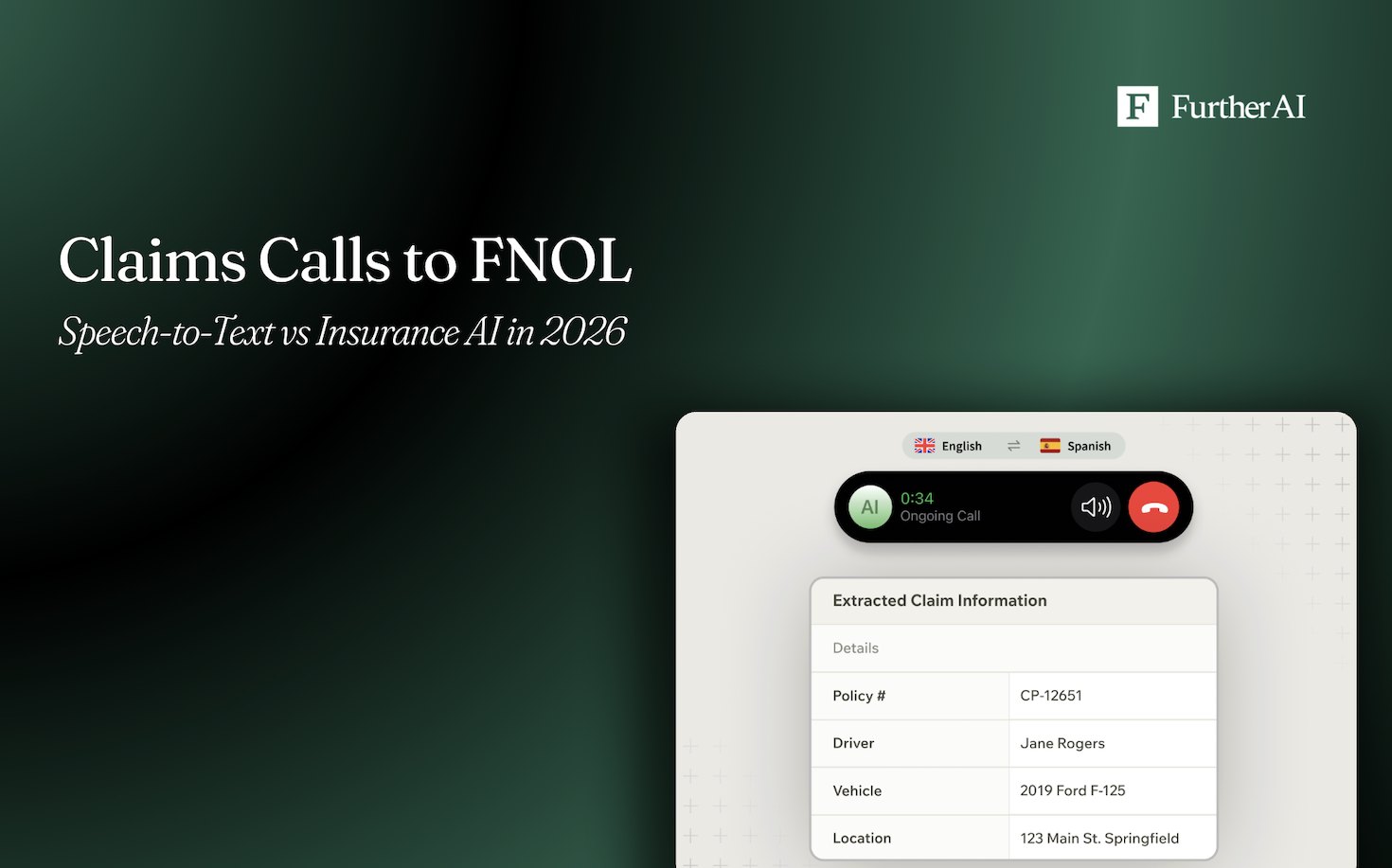
For turning claims calls into first notice of loss (FNOL) summaries, insurance-specific AI is the better choice, and it usually runs on top of a general speech-to-text (STT) engine. Generic STT does one job well: it turns audio into timestamped words and labels who said them. Everything that makes a transcript a claim comes after that step: pulling out the insured, the date and cause of loss, the vehicles and injuries, matching them to the policy, filling FNOL fields, and flagging what the caller never said. That second layer needs insurance context that a general transcription API doesn't ship with.
So the practical decision is whether you build that insurance layer yourself on a generic engine, or you buy it. In this guide, we compare the two, walk through the call-to-FNOL pipeline, cover what carriers and small managing general agents (MGAs) each need, and list tools in the same format so you can compare them directly.
Key takeaways
- Generic STT handles transcription. Major engines return word-level timestamps and speaker labels, and let you add custom vocabulary, but they stop at the transcript.
- Insurance-specific AI handles the claim. It extracts incident details, maps them to FNOL fields, checks them against the policy, and flags gaps before an adjuster picks up the file.
- Every FNOL field should link back to a moment in the call. That timestamp link is what makes a summary auditable, and the NAIC's AI model bulletin expects insurers to document their AI program and audit third-party AI vendors.
- Transcription can invent words. Researchers found that roughly 1% of transcripts from one widely used STT model contained entire hallucinated phrases that weren't in the audio.
- Carriers and small MGAs need different setups. Carriers usually process high call volumes through a telephony stack, while small MGAs mostly deal with voicemails, adjuster notes, and occasional recordings.
Generic speech-to-text vs insurance-specific AI
Here's how the two approaches compare on the capabilities that decide whether a call becomes a usable FNOL.
How a claims call becomes a structured FNOL
Every call-to-FNOL workflow runs through the same four steps. Generic STT covers the first one. The other three are where insurance-specific AI does its work.
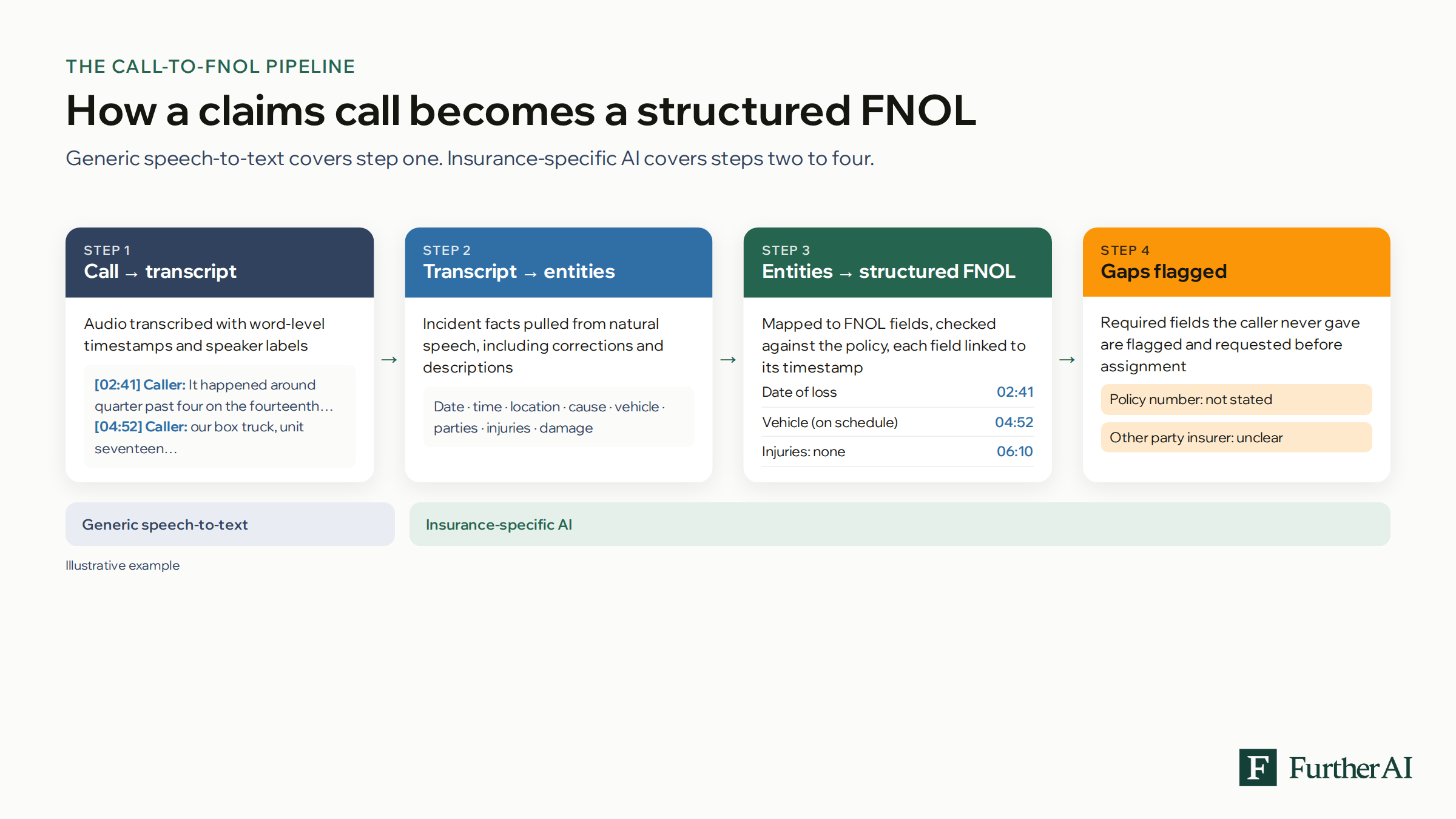
1. Call to transcript. The audio is transcribed with timestamps and speaker labels. Google Cloud Speech-to-Text, for example, returns the beginning and end of each spoken word "in increments of 100ms". Accuracy on domain words depends on tuning: Amazon Transcribe recommends custom vocabularies for "domain-specific terms, such as brand names and acronyms, proper nouns, and words that Amazon Transcribe isn't rendering correctly."
Transcription can also add words that were never said. In a study of OpenAI's Whisper presented at ACM FAccT 2024, researchers found that "roughly 1% of audio transcriptions contained entire hallucinated phrases or sentences which did not exist in any form in the underlying audio". Newer models may perform differently, but the lesson holds for claims: treat every transcript as evidence to check.
2. Transcript to entities. The model reads the transcript and pulls out the facts an FNOL needs: who's reporting, the policy, when and where the loss happened, what caused it, which vehicles, property, or people are involved, and whether anyone was hurt. It also has to handle how people actually talk, correcting themselves mid-sentence or describing a location as "the lot behind our second warehouse."
3. Entities to structured FNOL. Extracted facts are mapped to your FNOL fields and checked against the policy. A reported vehicle should match the schedule. A loss location should be an insured premises. Each field keeps a link to the timestamp and speaker it came from.
4. Structured FNOL to flagged gaps. Required fields the caller didn't provide are flagged before the claim reaches an adjuster: no policy number, an unclear date of loss, no answer on injuries. Those gaps trigger an automatic follow-up request before an adjuster ever opens the file. Our guide to commercial claims triage and adjuster assignment covers what happens to the claim next.
Why the audit trail should point back to the timestamp
A summary that says "insured reports rear-end collision at 4:15 p.m." is only useful if someone can check it. When each field links to the second of the call it came from, a reviewer can replay that moment instead of listening to a 15-minute recording.
That traceability also matters for governance. The NAIC's Model Bulletin on the Use of Artificial Intelligence Systems by Insurers, adopted December 4, 2023, asks insurers to document compliance with their AI program and to hold third-party AI vendors to contract terms that include "audit rights and/or entitle the Insurer to receive audit reports." More than 20 jurisdictions had adopted the bulletin as of April 1, 2026. A timestamp-linked FNOL gives you that evidence for every claim.
Two more checks belong in any evaluation. First, redaction isn't perfect. Amazon's own documentation warns that its PII redaction "may not identify and remove all instances of sensitive data in your transcript" and recommends reviewing the output. Second, recording consent varies by state. Justia's 50-state survey lists California, Florida, Illinois, Maryland, Massachusetts, Pennsylvania, and Washington among the states that require all parties to consent to a recorded call. Confirm your disclosures with counsel before you process recordings at scale.
What carriers need from claims call processing
Carriers take FNOL calls at volume, through contact centers, adjuster lines, and after-hours services. Digital reporting is still the minority: even in homeowners claims, J.D. Power found that only 38% of customers used digital tools to report first notice of loss in its 2026 study. Commercial claims, reported by brokers, fleet managers, and risk managers, add complexity: more parties, scheduled vehicles and locations, and policy wording that decides coverage.
For carriers, the tool has to:
- Connect to the telephony stack and handle two-channel audio, so agent and caller speech stay separate
- Hold accuracy on line-specific vocabulary, from vehicle identification numbers to building and business interruption terms
- Write structured FNOL data into the claims system instead of attaching a summary for someone to rekey
- Link every field to the call timestamp so quality assurance teams can sample calls efficiently
- Scale for catastrophe surges without a drop in extraction quality
Our commercial auto page shows what that looks like in practice: with FNOL voice intake, transcripts and extracted entities (driver, vehicle, cause) prefill claim files and route them to the right queue, delivering ~80% faster intake, with call handling cut from ~12 minutes to under three.
What small MGAs need: notes, voicemails, and recordings
Small MGAs rarely run a claims call center. FNOL information arrives in pieces: a voicemail from the insured on Sunday night, a broker's email with a photo, a call recording from a third-party administrator (TPA), and an adjuster's typed notes. The job is to turn all of it into one complete FNOL without a dedicated intake team.
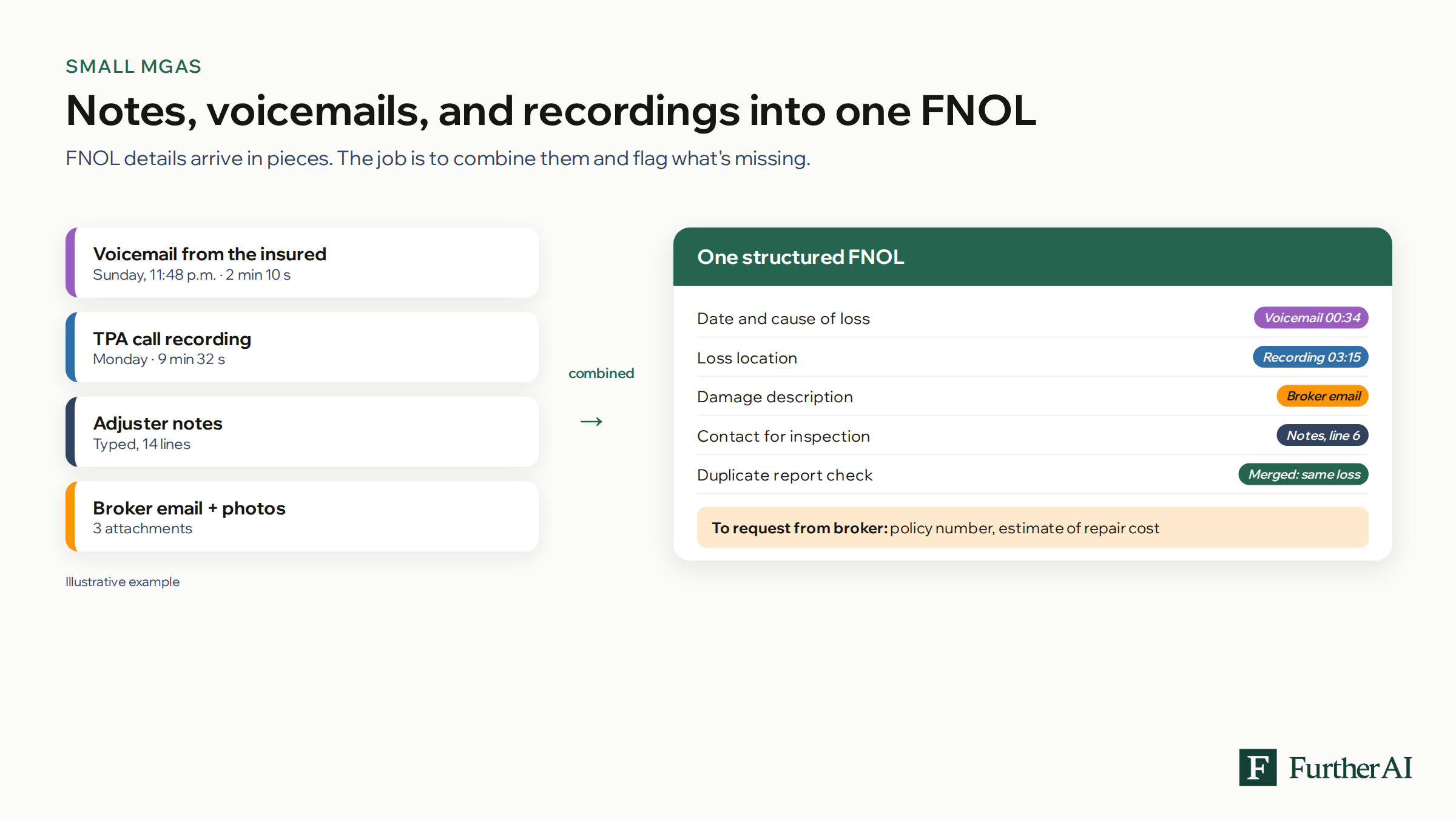
For small MGAs, the tool should:
- Accept mixed inputs in one workflow: audio files, voicemails, typed notes, and emails
- Combine them into a single FNOL so the same loss reported twice doesn't become two claims
- Flag missing items back to the broker or insured automatically
- Need little IT support, with no telephony integration required to start
- Keep the source link for every field, whether it came from minute four of a voicemail or line three of a note
Generic STT can transcribe the voicemail, but it can't reconcile the voicemail with the broker's email or tell you that nobody has confirmed the policy number yet. That's the work that takes a small team's time.
Tools for turning claims calls into FNOL summaries
The tools below fall into three groups: general speech-to-text engines, voice-FNOL agents that take the call themselves, and insurance-specific AI that processes calls, recordings, and notes into FNOL data. Each is presented in the same format, listed alphabetically within its group. All capabilities and figures come from each vendor's own published material, so verify them on your own calls. For a broader view of FNOL tools, see our comparison of FNOL automation platforms.
General speech-to-text engines
Amazon Transcribe
Sources: custom vocabularies, Call Analytics, diarization, PII redaction
Deepgram
Sources: Keyterm Prompting, diarization, redaction
Google Cloud Speech-to-Text
Sources: model adaptation, word timestamps, diarization, Sensitive Data Protection
Voice-FNOL agents
Assured
Source: Assured Voice AI
Liberate
Source: Liberate
Strada
Source: Strada
Insurance-specific AI for calls, recordings, and notes
FurtherAI
Sources: FurtherAI commercial auto, single-tenant architecture, SOC 2 Type II
How to test a tool on your own claims calls
Vendor accuracy figures rarely tell you how a tool will do on your calls. Run a short pilot instead.
- Build a test set of real calls. Include clean calls, noisy calls from job sites or roadsides, voicemails, and calls with heavy accents or crosstalk.
- Score the fields that matter. Word error rate matters less than whether the date of loss, location, policy number, and injury status came out right.
- Check every field's source link. Click through to the timestamp and confirm the audio says what the field says.
- Look for invented facts. Flag any field with no support in the audio. Given the hallucination research above, this is the check that matters most.
- Test redaction and gap flags. Confirm sensitive details are masked, and that the tool flags missing items instead of guessing.
How FurtherAI fits
FurtherAI processes the whole FNOL package: calls and recordings, plus the documents that arrive around them. On the voice side, our FNOL voice intake prefills claim files from transcripts and extracted entities, cutting call handling from ~12 minutes to under three. On the document side, Claims Document AI turns FNOL packets, estimates, and police reports into a structured claim file with source citations.
For one specialty insurer handling more than 3,000 claims a year, automating intake validation reached more than 90% automation of the intake process and more than 10x faster processing, saving more than $360K a year. If your FNOL information arrives as a mix of calls, voicemails, and notes, start by sampling a week of claims and counting how many needed a follow-up for missing details. That number is usually the clearest case for automating the step.
Frequently asked questions
REFERENCES
Amazon Web Services. "Analyzing call center audio with Call Analytics." Amazon Transcribe Developer Guide. docs.aws.amazon.com
Amazon Web Services. "Custom vocabularies." Amazon Transcribe Developer Guide. docs.aws.amazon.com
Amazon Web Services. "Partitioning speakers (diarization)." Amazon Transcribe Developer Guide. docs.aws.amazon.com
Amazon Web Services. "Redacting or identifying personally identifiable information." Amazon Transcribe Developer Guide. docs.aws.amazon.com
Assured. "Voice AI for Insurance Claims." assured.com
Deepgram. "Diarization." Deepgram Docs. developers.deepgram.com
Deepgram. "Keyterm Prompting." Deepgram Docs. developers.deepgram.com
Deepgram. "Redaction." Deepgram Docs. developers.deepgram.com
FurtherAI. "Claims Case Study: 90% Intake Automation, 568% ROI." furtherai.com
FurtherAI. "Complex fleets, simple decisions." Commercial auto. furtherai.com
Google Cloud. "Detect different speakers in an audio recording." Cloud Speech-to-Text documentation. docs.cloud.google.com
Google Cloud. "Get word timestamps." Cloud Speech-to-Text documentation. docs.cloud.google.com
Google Cloud. "Improve transcription results with model adaptation." Cloud Speech-to-Text documentation. docs.cloud.google.com
J.D. Power. "2026 U.S. Property Claims Satisfaction Study." March 17, 2026. jdpower.com
Justia. "Recording Phone Calls and Conversations Under the Law: 50-State Survey." Updated September 2024. justia.com
Koenecke, Allison, Anna Seo Gyeong Choi, Katelyn X. Mei, Hilke Schellmann, and Mona Sloane. "Careless Whisper: Speech-to-Text Hallucination Harms." ACM Conference on Fairness, Accountability, and Transparency (FAccT '24), 2024. arxiv.org
Liberate. "Insurance runs on Liberate." liberate.ai
National Association of Insurance Commissioners. "Implementation of NAIC Model Bulletin: Use of Artificial Intelligence Systems by Insurers." Status as of April 1, 2026. content.naic.org
National Association of Insurance Commissioners. "Use of Artificial Intelligence Systems by Insurers." Model Bulletin, adopted December 4, 2023. content.naic.org
Strada. "Strada: Phone, Email, and Chat AI for Insurance Carriers & Brokers." getstrada.com
DISCLAIMER
This article is for general informational purposes only and does not constitute legal, regulatory, compliance, underwriting, or other professional advice. The content reflects information available as of the date of publication, and FurtherAI undertakes no obligation to update it as laws, regulations, or AI technologies evolve.
Recent posts
Ready to go further and
transform your insurance ops?
Reclaim your time for strategic work and let our AI Assistant handle the busywork. Schedule a demo to see how you can achieve more, faster.




.svg)