FurtherAI Available in Microsoft Marketplace
Introducing Connectors



General vs. Specific Intelligence: Where Insurers Get Their AI Edge

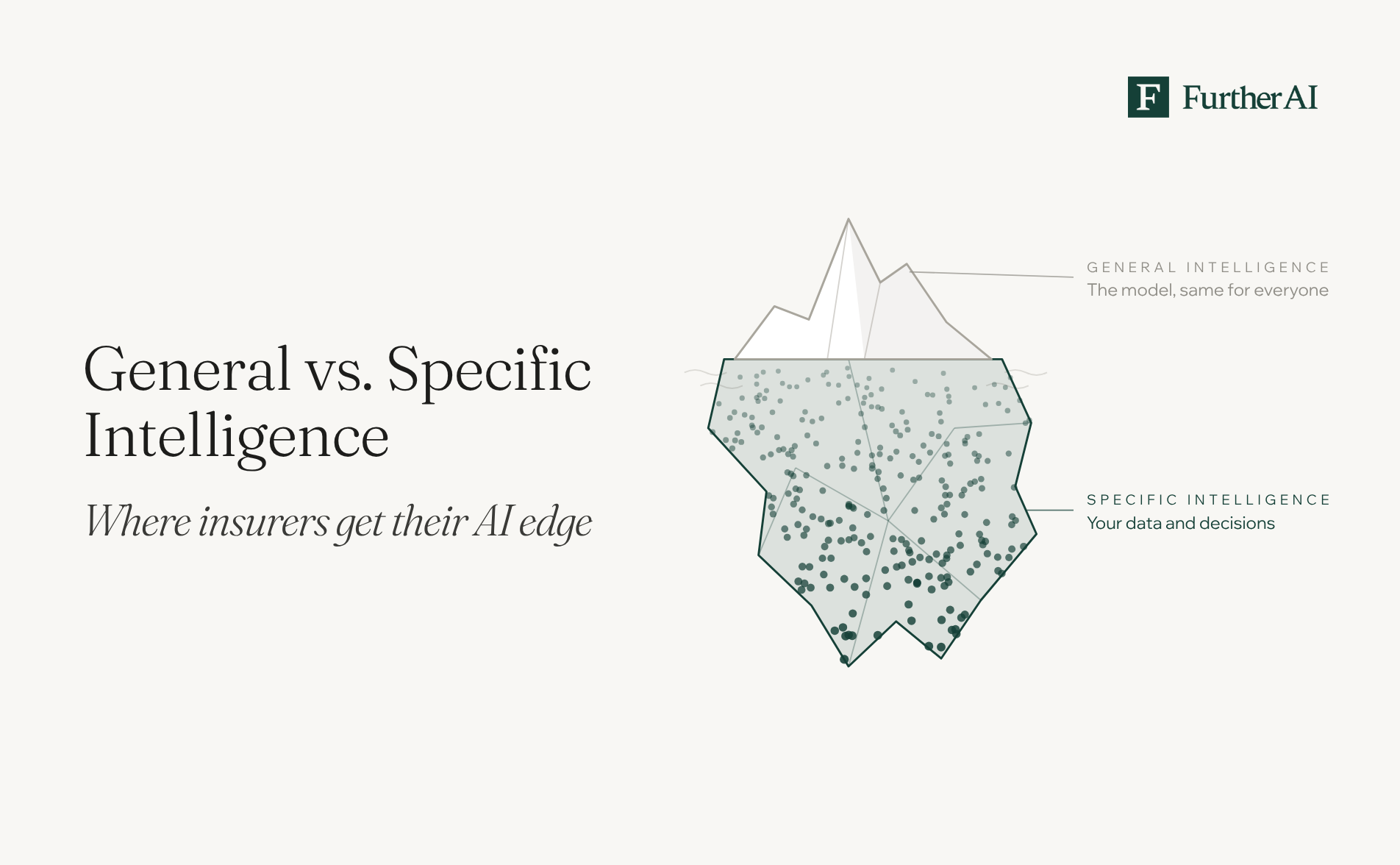
AI models have made general intelligence a commodity: every insurer now has access to the same models. So what really sets an insurance company apart from its competitors? I believe it’s specific intelligence: the company’s own past data and the decisions its people made on it. Building it takes two moves: shift people from the center of the work to the judgment layer, and capture every judgment they make as an asset the company owns.
What I got wrong in my keynote
Earlier this year, I gave the keynote at The Insurer's annual conference. I wrote up the main ideas in From Chatbots to Agentic Workflows in One Year, and one line from that talk has stayed with me: intelligence has become a commodity.
I still think the urgency behind it is right. In WTW's 2026 survey, P&C insurers that lean heavily into advanced analytics and AI reported combined ratios six points lower than their peers. The risk of moving slow is now higher than the risk of moving fast.
But the line itself was only half right, because there are two kinds of intelligence, and only one of them is a commodity.
General intelligence vs. specific intelligence
General intelligence is what the models know. It covers language, reasoning, and broad knowledge of the world, including a lot about insurance. That has become a commodity. Every carrier, managing general agent (MGA), and broker can buy access to the same models, so none of them gets an edge from the model alone.
Specific intelligence is what your company knows. It's your past submissions, policies, and claims, and the decisions your underwriters and claims teams made on them: which risks they took, which they declined, where they bent a guideline and why. For most insurance companies, this is becoming the differentiating factor, because nobody else has it.
Step 1: Move people to the judgment layer
Today, most insurance professionals sit at the center of the work, reading documents, re-keying data, and chasing missing information before they make a decision.
The first move is to hand that work to AI agents and move people up to the judgment layer, where they approve risks and set prices. I wrote about what this looks like in The Two AI Transformations Facing Insurance Companies.
Our customers are already seeing the results:
- Underwriting productivity has doubled. One MGA saw a 200% improvement in underwriting efficiency in three months.
- Operations and outsourcing spend is down. A specialty insurer automated more than 90% of its claims intake and saved over $360,000 a year.
- Compliance work goes further. A reinsurer cut underwriting audit time from about 200 hours to roughly 110 hours per MGA, freeing time for more oversight.
Step 2: Capture every judgment and make it yours
Once people work at the judgment layer, every decision they make becomes data worth keeping. The next move is to capture it as your specific intelligence.
"Most companies record only the outcome: the risk was declined, the price was set. The reasoning stays in an underwriter’s head or an email thread. But if you capture why someone overrode a recommendation or made an exception, that reasoning can guide the next decision and every agent working on your book." — Aman Gour, Co-founder and CEO at FurtherAI
This is the part insurers should own rather than outsource. Models improve for everyone; your record of judgment improves only for you, and it compounds with every decision. Our Skills are one way teams already bring their own guidelines into the work.
What this means for insurance leaders
At FurtherAI, we help insurance organizations make both moves: putting their people at the judgment layer, and turning the judgments they make into intelligence the company owns. The insurers that start capturing it now will have something their competitors can't buy.
Watch the keynote clip
Want to see how this works on your own book? Book a demo with FurtherAI.
DISCLAIMER
This article is for general informational purposes only and does not constitute legal, regulatory, compliance, underwriting, or other professional advice. The content reflects information available as of the date of publication, and FurtherAI undertakes no obligation to update it as laws, regulations, or AI technologies evolve.
Recent posts


Ready to go further and
transform your insurance ops?
Reclaim your time for strategic work and let our AI Assistant handle the busywork. Schedule a demo to see how you can achieve more, faster.