FurtherAI Available in Microsoft Marketplace
Introducing Connectors



Email and PDF Submission Automation for Carriers: Tools 2026


The most effective tools for handling email and PDF submissions for carriers are insurance-native AI platforms that read inbound emails, classify and extract data from attached PDFs, and feed clean, structured information straight into underwriting workflows. FurtherAI leads this category for carriers, MGAs, and brokers, but there are also general-purpose document AI engines, fraud and claims platforms, and no-code workflow tools serving narrower slices of the same problem.
Below we break down what submission automation actually does, why it matters for underwriting capacity, and how the leading tools compare in 2026.
Key takeaways
- Submission automation reads email and PDF intake automatically. The strongest tools ingest emails, classify attachments like ACORD forms, statements of values (SOVs), and loss runs, and extract structured data without manual re-keying.
- Underwriters spend 70% of their time on non-underwriting work. Accenture's most recent P&C underwriting survey found the average underwriter spends just 30% of their time on actual underwriting, with the rest lost to admin, negotiation, and sales support.
- Insurance-native tools handle the "variety problem" best. Submissions arrive in inconsistent formats from tens of thousands of agents, so platforms built for insurance documents outperform generic OCR.
- ROI shows up as capacity, speed, and accuracy. One MGA using FurtherAI cut average "time to clear" a submission from about 32 minutes to one, a 30x speedup, with 99% extraction accuracy.
- Adoption is now mainstream. In Conning's 2025 survey, 90% of insurers were in some stage of generative AI evaluation, so the question for most carriers is which tool, not whether. Our guide to submission processing platforms for carriers and MGAs compares the options.
What is email and PDF submission automation for carriers?
Email and PDF submission automation is technology that captures incoming submissions from an underwriting inbox, identifies and reads the attached documents, and turns them into structured data your team can act on. A typical submission lands as an email with a stack of PDFs: an ACORD application, a statement of values, prior loss runs, financials, and supplemental forms.
Done manually, an underwriting assistant opens each file, reads it, and types the relevant fields into a rating or policy system. Automation collapses that work. The software classifies each attachment, extracts the data, standardizes it into a consistent format, runs eligibility checks, and routes the submission to the right underwriter, often in under a minute.
For carriers, this matters because intake is the front door to every quote. When the door is slow, quote turnaround slips, brokers route business elsewhere, and underwriters drown in data entry instead of pricing risk.
Why underwriters lose 70% of their time to manual submission intake
Underwriters barely underwrite. Accenture's P&C underwriting survey, conducted with The Institutes, found that the average underwriter spends 70% of their time on non-underwriting activities — 40% on administrative tasks, 30% on negotiation and sales support, and only 30% on actual underwriting.
That administrative load is largely document handling: opening submission emails, re-keying data from PDFs, chasing missing information, and reformatting SOVs. The same Accenture research found that technology has often made things worse, with 64% of underwriters saying their tools have increased their workload or made no difference, and just 46% saying technology has helped automate or eliminate non-core tasks..
The takeaway for carriers is direct: every hour an experienced underwriter spends typing data out of a PDF is an hour not spent on risk selection, pricing, or broker relationships. Submission automation targets that exact gap, which is why adoption has accelerated. Conning's 2025 survey of insurance executives found 90% of respondents in some stage of generative AI evaluation, with 55% in early or full adoption.
How automation handles the submission variety problem
The hard part of submission intake is variety, because there's no such thing as a standard submission. With tens of thousands licensed P&C agents in the U.S., the same risk can arrive in dozens of formats: scanned PDFs, fax-to-email conversions, native spreadsheets, and multi-document bundles with no consistent structure or naming.
Modern submission automation handles this through a layered approach:
- Email ingestion. The tool monitors a shared underwriting inbox, reads the email body and thread, and pulls every attachment.
- Document classification. It identifies what each file is — an ACORD form, an SOV, a loss run, or financials — even when filenames are unhelpful.
- Intelligent extraction. Using optical character recognition (OCR) and large language models (LLMs), it reads structured and unstructured documents, including messy scans, and pulls the fields that matter.
- Standardization and enrichment. It maps data into a consistent schema, flags missing information, and enriches records with third-party data.
- Triage and routing. It runs eligibility checks against appetite and routes prioritized submissions to the right underwriter.
The difference between a basic email parser and an insurance-native platform shows up at steps two through four, where domain understanding determines whether a half-legible loss run becomes clean data or a manual exception. We cover that progression in depth in our guide to moving from basic automation to AI agents in submission processing, and the specific challenge of SOVs in transforming SOV processing in submission intake.
“Unstructured PDFs are not an edge case in insurance. It’s the operating environment. FurtherAI handles them by combining document understanding, extraction, classification, validation, and workflow logic so that incomplete submissions can still be routed, enriched, and reviewed intelligently. When the system is uncertain, that uncertainty should be visible so people can apply judgment where it matters.” — Ben Grosser, Head of Insurance AI at FurtherAI
Top email and PDF submission automation tools for carriers in 2026
Here's how the leading options compare. The table gives a quick view; each tool below uses the same structure so you can evaluate them on equal footing.
1. FurtherAI
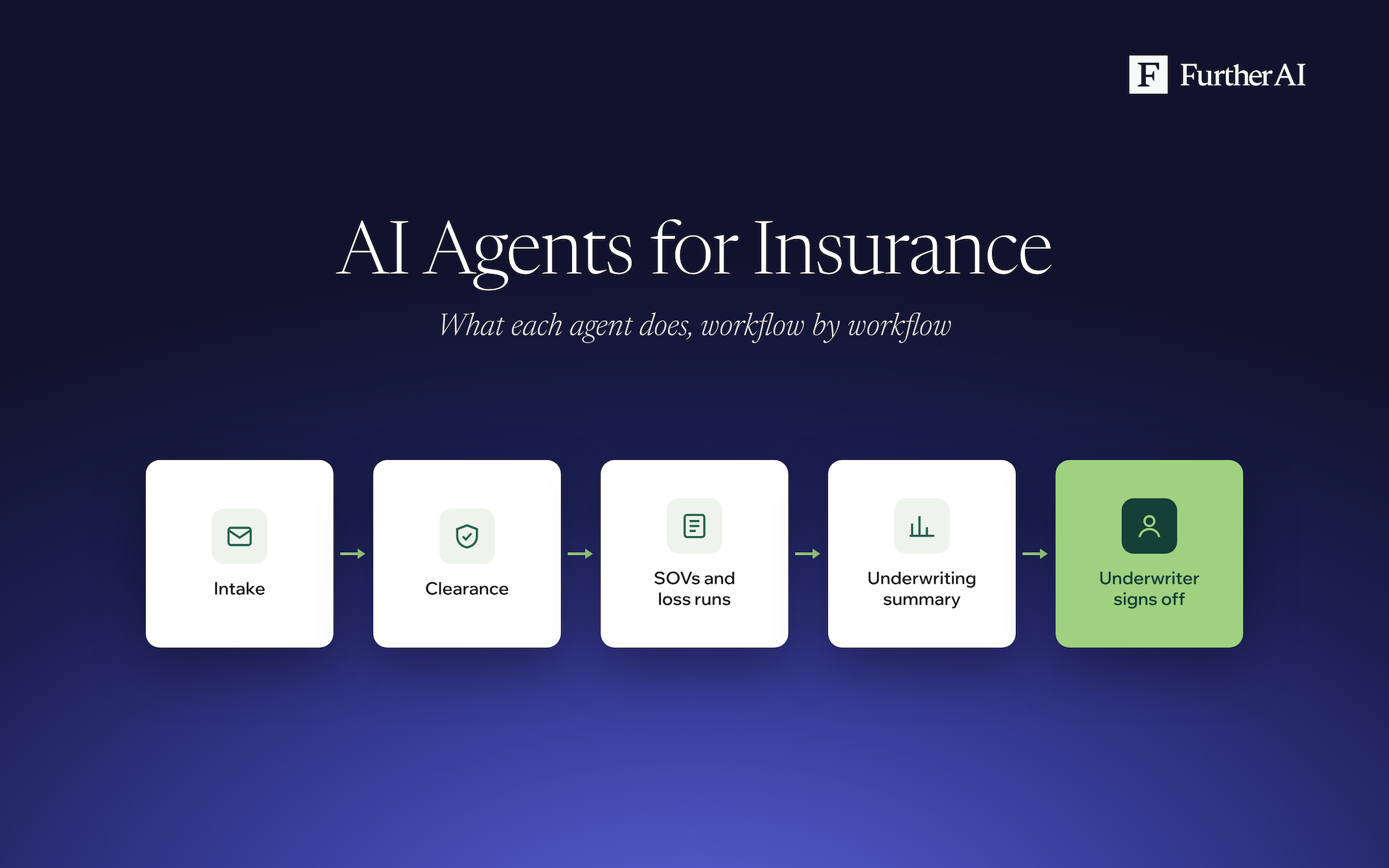
FurtherAI is an insurance-native AI workspace built to automate submission intake and downstream underwriting workflows for carriers, MGAs, and brokers. Its AI Assistant monitors the underwriting inbox, classifies attachments, extracts data from ACORD forms, SOVs, and loss runs, runs eligibility checks against appetite, and produces a structured submission summary for the underwriter.
At a glance
Pros
- Purpose-built for insurance documents, so it handles the variety problem out of the box.
- Covers the full intake flow: ingestion, extraction, enrichment, eligibility, and triage.
- Proven carrier and MGA outcomes, including 646% ROI on complex property SOV intake.
Cons
- Focused on insurance workflows, so it isn't aimed at general cross-industry document use.
- Best value comes from automating whole workflows rather than a single isolated task.
2. V7 Go (V7 Labs)
V7 Go is a general-purpose document AI platform that uses OCR and LLM orchestration to extract information from unstructured documents, with insurance among its target use cases. It can process submissions, slips, and market reform contracts, and is built to be configured by the customer for a given document type.
At a glance
Pros
- Flexible extraction engine that adapts to many document types.
- Strong at unstructured data and scanned documents.
Cons
- Horizontal tool, so insurance-specific logic (appetite, ACORD, SOV mapping) must be configured.
- Less coverage of the full carrier intake workflow beyond extraction.
3. Shift Technology
Shift Technology is an insurance-native AI platform best known for fraud detection and claims decisioning. It integrates with core systems via API and supports straight-through processing for low-complexity claims, which makes it relevant to carriers automating claims rather than new-business submission intake.
At a glance
Pros
- Deep, insurance-specific capability in fraud and claims.
- Integrates with major core platforms.
Cons
- Oriented to claims and fraud, not underwriting submission intake.
- Limited fit for email-to-quote new-business workflows.
4. Guidewire
Guidewire provides a complete core insurance software suite covering policy administration, billing, claims, and analytics. Automation features exist inside its modules, so submission handling is part of a broader core system rather than a standalone intake product.
At a glance
Pros
- Comprehensive core platform that centralizes operations.
- Strong fit for carriers consolidating on one system.
Cons
- Intake automation is a feature of the suite, not a dedicated, best-in-class capability.
- Implementation and configuration are heavier than point solutions.
5. Majesco
Majesco is an insurance-specific platform supporting underwriting for life, health, and P&C carriers, with a pre-built rules engine intended to speed up configuration. Like Guidewire, it positions submission handling within a broader core and underwriting system.
At a glance
Pros
- Insurance-specific with a ready-made underwriting rules engine.
- Reduces time spent configuring underwriting logic from scratch.
Cons
- Document extraction and email intake are not its core differentiator.
- Best suited to carriers committing to its broader platform.
6. FlowForma
FlowForma is a no-code workflow automation tool that lets business users build, test, and deploy automated processes without developers. Insurers use it to standardize approval and claims workflows, though it isn't an insurance-native document extraction engine.
At a glance
Pros
- Easy for non-technical users to build and adjust workflows.
- Useful for standardizing rule-based approval steps.
Cons
- Not insurance-native and not built for PDF/email extraction at scale.
- Limited ability to read messy, unstructured submission documents.
Key features to evaluate in submission automation platforms
When you compare tools, weigh them on the capabilities that actually move intake time and accuracy:
- Email and thread ingestion. Can it read a shared underwriting inbox, capturing the email body and forwarded threads alongside the attachments?
- Document classification. Does it correctly identify ACORD forms, SOVs, loss runs, and financials regardless of filename?
- Unstructured extraction. Can it read scanned PDFs and fax-to-email conversions, or does it need clean, structured inputs?
- Insurance-native logic. Does it understand appetite, eligibility, and SOV mapping, or must you build that yourself?
- Workflow integration. Does extracted data flow into your rating, policy, or core system, and does it triage submissions to the right underwriter?
- Accuracy and exception handling. What's the measured extraction accuracy, and how are low-confidence fields surfaced for review?
- Scale. Can it absorb peak submission volume without adding headcount?
A practical way to test these is to run a sample of your real, messy submissions through a pilot and measure clearance time and accuracy against your current baseline. Our complex property SOV intake case study shows how these features perform on genuinely difficult documents.
Measuring ROI: From email volume to underwriting capacity
ROI from submission automation shows up in three measurable places: turnaround time, accuracy, and capacity. The cleanest way to quantify it is to track average "time to clear" a submission before and after, multiply the time saved by submission volume, and translate the freed hours into additional quote capacity.
The results can be substantial. One large MGA — over $1.5 billion in premiums across 20+ programs — partnered with FurtherAI and cut average time to clear a submission from about 32 minutes to one, a 30x speedup. Within three months the AI Assistant processed more than $20 billion in total insured value, saved over 2,000 hours of manual effort, and delivered a 200%+ efficiency gain at 99% accuracy.
Those gains compound downstream. Faster, cleaner intake means brokers get quotes sooner, underwriters spend their time on risk rather than re-keying, and audit quality improves. A reinsurer using FurtherAI cut underwriting audit time by 45%, from 200 hours to 110 hours per MGA. For a fuller framework on quantifying these outcomes, see our guide to AI for insurance operations.
“Communication check is critical not only for ROI but for customer satisfaction and service quality and SLAs. For an insurer, timely check of communications, and adequate and relatable response to such communications, is mission critical. To accomplish this, the requirement is timely capture of emails and accurate comprehension of the communication’s content (e.g. pdf, email body, and other files).” — Ben Grosser, Head of Insurance AI at FurtherAI
Get started with FurtherAI's submission automation
If your underwriters are losing the bulk of their week to email and PDF intake, the fastest path to capacity is automating the front door. FurtherAI is purpose-built for that work and is already processing roughly $30 billion in premiums across multiple lines of business and 50 states.
Explore the full range of carrier capabilities across all FurtherAI solutions, or see how submission automation connects to downstream quality control in our underwriting audit case study.
DISCLAIMER
This article is for general informational purposes only and does not constitute legal, regulatory, compliance, underwriting, or other professional advice. The content reflects information available as of the date of publication, and FurtherAI undertakes no obligation to update it as laws, regulations, or AI technologies evolve.
REFERENCES
Reilly, Michael. "Why Underwriters Don't Underwrite Much." Accenture Insurance Blog, Feb. 8, 2022. insuranceblog.accenture.com
Conning. "Conning Releases 2025 Survey on AI & Insurance Technology: The C-Suite Verdict." PR Newswire, June 25, 2025. prnewswire.com
FurtherAI. "Submissions Processing: An MGA Partnered With FurtherAI for 30x Faster Submissions." FurtherAI Customer Stories. furtherai.com
FurtherAI. "Complex Property SOV Intake: A Carrier Achieves 646% ROI." FurtherAI Customer Stories. furtherai.com
FurtherAI. "Underwriting Audit: A Reinsurer Cuts Audit Time 45%." FurtherAI Customer Stories. furtherai.com
Recent posts

Ready to go further and
transform your insurance ops?
Reclaim your time for strategic work and let our AI Assistant handle the busywork. Schedule a demo to see how you can achieve more, faster.




.svg)