FurtherAI Available in Microsoft Marketplace
Introducing Connectors



How AI Transforms SOV Processing in Submission Intake

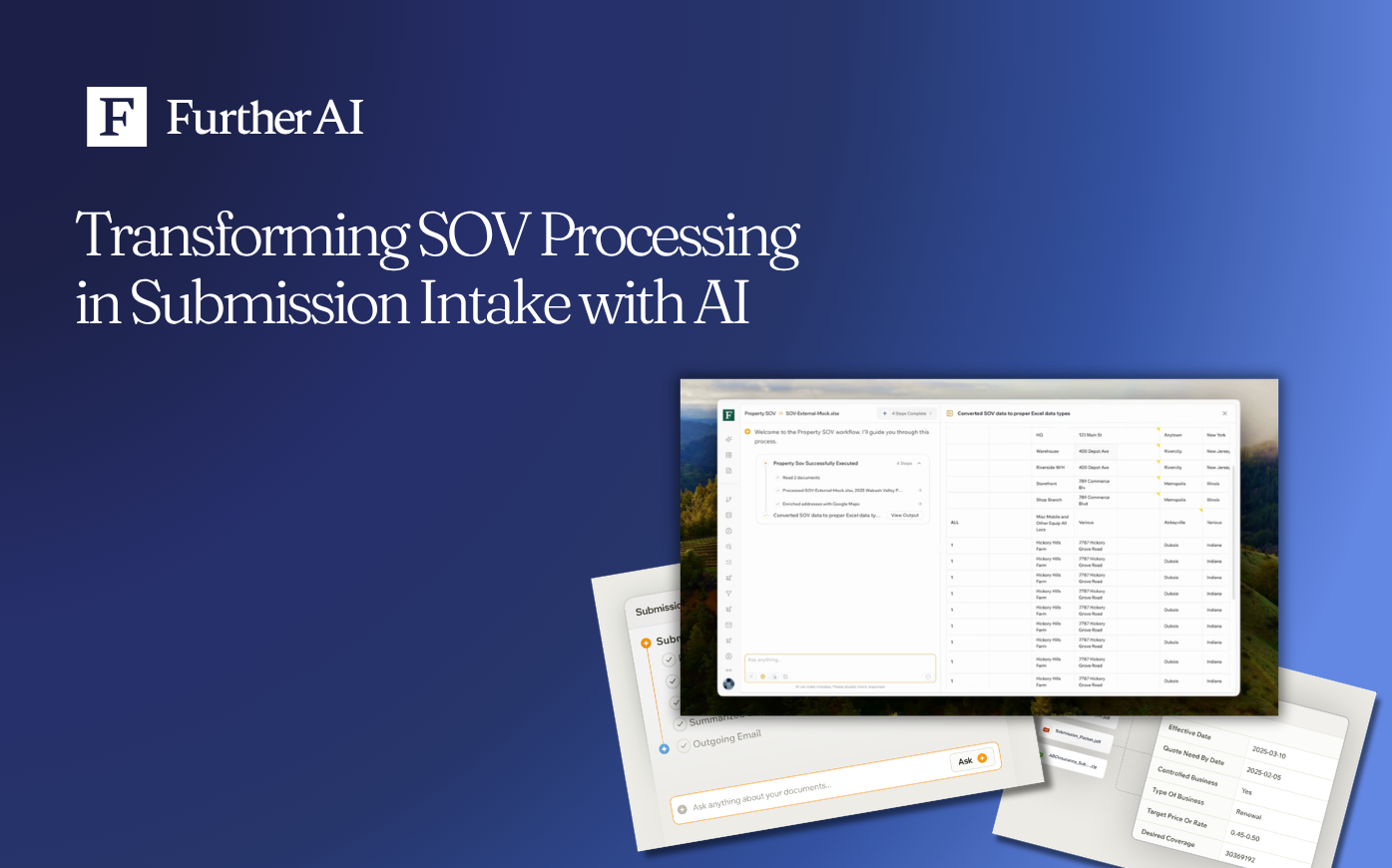
AI agents now cut Statement of Values (SOV) processing from days to under 10 minutes by reading SOVs in any format, validating the data, standardizing it to your schema, and populating your underwriting systems automatically. For commercial property teams, that turns the slowest step in submission intake into one of the fastest.
Statement of Values processing is one of the most time-consuming bottlenecks in submission intake. SOVs arrive as spreadsheets, PDFs, and unstructured broker emails, and a single schedule can list anywhere from a few hundred to 100,000 locations, each carrying up to 60 data fields. Validating, correcting, and reformatting all of that by hand is exactly the kind of low-value work that keeps underwriters from underwriting.
Key takeaways
- Manual SOV intake is slow and costly. Complex schedules can take one to five days each to process, and underwriters spend one to two minutes validating a single location's address.
- It is also a drag on talent. McKinsey estimates underwriters spend 30% to 40% of their time on administrative tasks like rekeying data.
- AI agents automate the full cycle — extraction, validation, standardization, and system population — across spreadsheets, PDFs, and emails.
- The results are measurable. One top-10 global carrier reached a 646% ROI and sub-10-minute intake; an MGA saw 30x faster clearance and a 200%-plus efficiency gain.
What is a Statement of Values, and why is it a bottleneck?
A Statement of Values is the spreadsheet that lists every property a commercial policy covers, with details like address, construction type, occupancy, protection class, and insured value. Underwriters rely on it to assess risk and price the account, so nothing moves until the SOV is clean.
The problem is scale and inconsistency. A 500-location SOV can hold roughly 30,000 individual field-level values; a 10,000-location schedule can exceed 600,000. Brokers submit them in wildly different layouts, often across multiple tabs, with missing or mis-coded fields. With more than 30,000 property and casualty agents licensed in the U.S., no two submissions look quite the same.
Why manual SOV processing slows submission intake
Manual intake creates three compounding problems for underwriting teams.
It is slow. Before automating, the top-10 carrier we worked with spent one to two minutes of human time per location just validating and correcting addresses. Full SOVs took one to five days to process, and quote turnarounds of two to three weeks were common — well behind broker expectations.
It wastes underwriting talent. When 30% to 40% of an underwriter's day goes to administrative work, according to McKinsey, capacity shrinks and the best people spend their hours on data prep instead of risk selection.
It introduces error and undervaluation. Property data is frequently incomplete or out of date. A Kroll appraisal study reported by Risk & Insurance found that 68% of buildings were underinsured by 25% or more, and close to 90% were undervalued overall. Errors in the SOV ripple downstream into premium calculations, catastrophe models, and claims.
How AI agents process SOVs in four steps
Our AI agents work like a digital teammate sitting alongside your underwriting assistants. They handle the full SOV cycle in four steps.
- Extract data automatically. Agents read structured and unstructured sources — SOV spreadsheets, PDFs, and broker emails — and pull key details like addresses, coverage limits, insured values, construction, occupancy, and protection measures. This removes manual data entry from the equation.
- Validate for accuracy. Agents check each submission for completeness and consistency, flagging missing property details, mismatched coverage limits, conflicting construction or occupancy data, and valuation anomalies before they reach an underwriter.
- Standardize and convert. Agents transform inconsistent formats into clean, structured data mapped to your underwriting schema, so underwriters start from verified records instead of a raw broker file.
- Populate systems seamlessly. Validated data flows into policy administration, rating, and CRM platforms, eliminating redundant entry and speeding up quote turnaround.
Generative AI is well suited to this work because so much of a submission is unstructured. Deloitte notes that natural language processing can extract targeted insights from messy documents and meaningfully accelerate risk assessment.
What results look like in practice
Two FurtherAI customer deployments show what automated SOV processing delivers at scale.
A top-10 global carrier with over $20B in gross written premium deployed our Complex SOV Intake AI Teammate across its Large Property unit, which handles SOVs of 500 to 100,000 locations.
Source: FurtherAI Complex Property SOV Intake case study
A leading MGA with over $1.5B in premiums and more than 1 million policyholders automated its broader submission intake, including SOVs, ACORD forms, and loss runs.
Source: FurtherAI Submissions Processing case study
Across all deployments, FurtherAI has processed roughly $30B in premiums across 20+ lines of business in 50 states.
The next era of SOV processing
The shift underway is simple to state: the data prep that used to define submission intake is becoming invisible. As AI agents take on non-standard SOV conversion, clearance, and enrichment, underwriters get clean data from the start and spend their time on judgment that only they can provide.
If your team is still wrangling SOVs by hand, the bottleneck is now optional. Schedule a demo to see how we can do for your team what we have already done for leading carriers and MGAs.
DISCLAIMER
This article is for general informational purposes only and does not constitute legal, regulatory, compliance, underwriting, or other professional advice. The content reflects information available as of the date of publication, and FurtherAI undertakes no obligation to update it as laws, regulations, or AI technologies evolve.
REFERENCES
McKinsey & Company. "Insurance Productivity 2030: Reimagining the Insurer for the Future." McKinsey & Company, Oct. 8, 2020. mckinsey.com
Wright, Alex. "Underinsured Properties Are Crushing Reinsurers. Why Proper Valuations Will Be a Focus for Years to Come." Risk & Insurance, Mar. 8, 2023. riskandinsurance.com
Deloitte. "Underwriter's Edge: Harnessing Generative AI for Optimal Outcomes." Deloitte US. deloitte.com
FurtherAI. "Complex Property SOV Intake: A Carrier Achieves 646% ROI." FurtherAI Customer Stories. furtherai.com
FurtherAI. "Submissions Processing: An MGA Partnered With FurtherAI for 30x Faster Submissions." FurtherAI Customer Stories. furtherai.com
Recent posts


Ready to go further and
transform your insurance ops?
Reclaim your time for strategic work and let our AI Assistant handle the busywork. Schedule a demo to see how you can achieve more, faster.




.svg)