FurtherAI Available in Microsoft Marketplace
Introducing Connectors



How AI Speeds Up Claims Settlement for Carriers in 2026

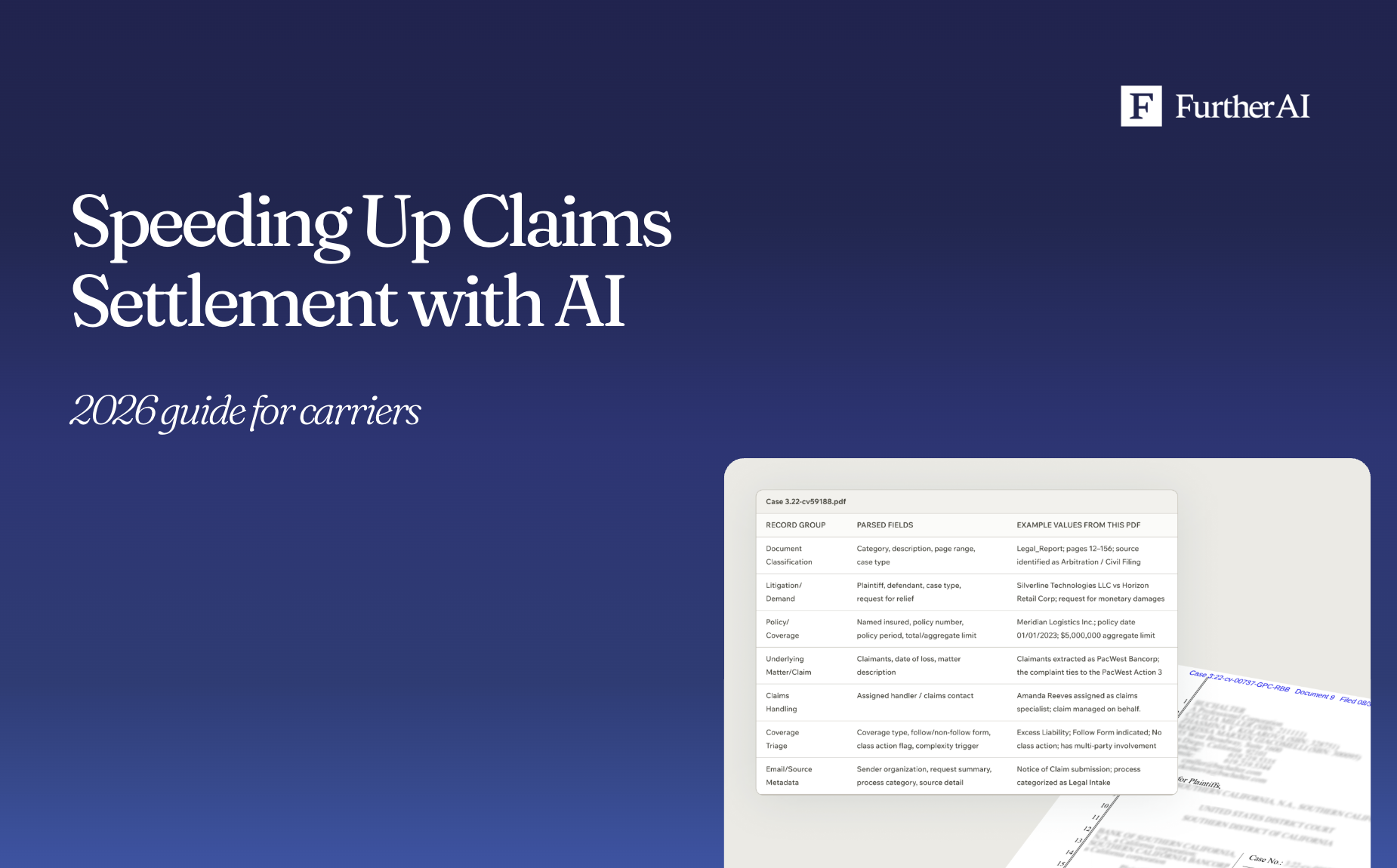
Claims are taking longer to settle, not shorter. The average property claim now runs more than 44 days from first notice of loss to final payment (the slowest pace since 2008) and customer satisfaction falls off a cliff from 762 (if a claim is complete within the first 10 days) to 595 (once repairs pass the 31-day mark), on a 1,000-point scale, as per J.D. Power. AI is the fastest way to reverse that curve.
This guide is for carriers, managing general agents (MGAs), third-party administrators (TPAs), and adjusters who want to settle faster and decide faster. We show where time is actually lost in a claim, which AI tools remove it, and how to choose by your role and workflow. Every figure links to a primary source so your team can verify it.
If your priority is cutting manual document review specifically, our companion guide to the best AI tools for insurance claims processing goes deeper on that angle. This article focuses on end-to-end settlement speed and decision velocity.
Key takeaways
- Settlement speed is a source-of-time problem. Claims stall at intake, document review, appraisal, and triage. AI compresses each stage, so simple claims move from weeks to minutes and complex ones reach an adjuster faster.
- The proof is concrete. One specialty insurer using FurtherAI automated more than 90% of claim intake and cut processing time more than 10-fold, saving over $360K a year at a 568% return on investment (ROI). Aviva's claims models cut complex-case liability assessment by 23 days, as per McKinsey.
- The best tool depends on your role. Carriers and TPAs gain most from end-to-end orchestration; adjusters gain most from tools that hand them a complete, decision-ready file.
- Faster can't mean sloppier. A 2025 survey of claims professionals found only 16% express medium-to-high trust in AI acting alone
Where claims settlement actually slows down
Speed gains come from attacking specific time sinks, not from "adding AI" in general. Four stages account for most of the delay in a typical claim.
Intake is manual and repetitive: in one real case, initial claim intake alone consumed about 2.5 hours per claim. Document review buries adjusters in loss runs, medical records, and policy wording; appraisal waits on a physical or desk inspection; triage misroutes files, so complex claims sit in the wrong queue. AI that targets these stages is what moves the 44-day average down.
What "AI to speed up claims settlement" means
AI to speed up claims settlement is software that uses document AI, natural language processing (NLP), computer vision, and agentic automation to complete or accelerate claim stages — intake, review, appraisal, triage, and decision support — so straightforward claims settle in minutes and complex claims reach a human adjuster faster, with full audit trails.
The upside is well documented. McKinsey found that insurers rewiring the entire claims domain see a 3% to 5% accuracy improvement in claims alongside major cycle-time gains, and AI leaders generated 6.1 times the total shareholder return of laggards over five years.
The AI tools that speed up claims settlement in 2026
Each tool below uses the same structure — a short overview, a table showing where it removes time, and pros and cons — so you can compare them on speed rather than marketing.
FurtherAI
FurtherAI is an end-to-end AI workspace built for insurance, and the strongest fit for carriers, MGAs, and TPAs that want to compress the whole claim rather than one step. It configures to your intake schema, extracts and validates documents, keeps audit logs, and escalates edge cases to adjusters. Across its customer base, FurtherAI has processed roughly $30 billion in premiums across more than 20 lines of business.
On settlement speed specifically, a specialty insurer growing more than 20% a year automated over 90% of claim intake and cut processing time more than 10-fold, saving more than $360K annually at a 568% ROI. That workflow had been consuming about 2.5 hours per claim across 3,000-plus claims a year.
Pros
- Compresses the full claim, not one step, with human-in-the-loop escalation built in.
- Documented speed and ROI outcomes, with audit logs for regulated lines.
- Configures to your schema and existing core systems.
Cons
- Enterprise-focused, with custom rather than off-the-shelf pricing.
- Full-workflow deployments deliver the most speed, so single-task pilots understate the gain.
Kognitos
Kognitos suits teams that need fast decisions to stay explainable. Its neurosymbolic, deterministic approach combines language understanding with rule-based logic, so decisions are consistent and auditable rather than probabilistic — useful when speed can't come at the cost of defensibility in regulated lines.
Pros
- Deterministic logic keeps fast decisions auditable and defensible.
- Handles unstructured input while keeping outputs consistent.
Cons
- Rule-heavy configuration can lengthen implementation.
- Strongest where explainability, not raw throughput, is the priority.
Shift Technology
Shift Technology focuses on agentic AI for fraud detection, triage, and rapid decisioning at high volume. Agentic AI refers to systems that autonomously run multi-step workflows and escalate low-confidence cases, which speeds triage and fraud scoring. Because Shift competes directly with several tools here, treat its published speed and automation figures as vendor-reported and validate them in a pilot.
Pros
- Purpose-built for fast fraud detection and automated triage at scale.
- Agentic workflows prioritize and route claims with limited manual input.
Cons
- Performance claims are vendor-reported and warrant validation.
- Focused on triage and fraud rather than end-to-end settlement.
Tractable
Tractable speeds the appraisal stage in auto and property with computer vision. A claimant uploads photos and the system returns a line-by-line repair estimate, sometimes in mere seconds, which turns a multi-day appraisal into a near-instant step. Its AI processes thousands of claims daily, with customers including Aviva, Tokio Marine, and Admiral Group.
Pros
- Near-instant, consistent photo estimates that enable touchless settlement.
- Proven at multibillion-dollar repair volume across many insurers.
Cons
- Narrow to visual appraisal; not an end-to-end platform.
- Limited value outside auto and property damage.
Snapsheet
Snapsheet accelerates intake and virtual appraisal for auto and P&C carriers that want speed without replacing their core system. Its virtual appraisal cuts time-to-settlement by about 70% versus field inspections, and it has processed more than 2 million claims for 16 of the top 20 property and casualty (P&C) carriers, as per their website.
Pros
- Quick to deploy alongside existing systems, with strong time-to-value.
- Broad carrier adoption and a mature virtual appraisal capability.
Cons
- Focused on auto and P&C rather than complex commercial lines.
- Less suited to deep, document-heavy adjudication.
Sprout.ai
Sprout.ai speeds document-heavy claims using optical character recognition (OCR) and NLP. OCR extracts text from scans and images; NLP understands and classifies it. Together they turn messy files into decision-ready data, which shortens review in health, P&C, and specialty lines. According to Insurtech Digital, Sprout.ai supports 450-plus document types with auto-adjudication and escalation.
Pros
- Strong on unstructured, high-variety document environments.
- Auto-adjudication and escalation cut manual file review time.
Cons
- Specialized in documents rather than full-lifecycle settlement.
- Enterprise setup; less plug-and-play.
CLARA Analytics
CLARA Analytics speeds resolution on complex claims by flagging litigation risk and escalation early, especially in casualty and workers' compensation. It surfaces the claims most likely to escalate so adjusters intervene sooner. CLARA reports claimants return to work 35% faster on claims processed through its platform, and customers such as Amerisure have seen roughly a 7-day lower average claim cycle, as per CLARA Analytics website.
Pros
- Predictive signals help adjusters act before claims escalate.
- Documented gains in return-to-work and cycle time.
Cons
- Analytics layer rather than an intake or document engine.
- Most relevant to casualty and workers' comp.
The fastest AI by who you are
The best tool depends on your role and where your time goes. Here's how the shortlist maps to carriers, TPAs, and adjusters.
For carriers, end-to-end orchestration delivers the biggest settlement-speed gain because it compresses every stage and keeps decisions auditable. FurtherAI and Kognitos lead here, with Tractable or Snapsheet added where auto and property photo volume is high. For fraud-heavy books, layer in Shift Technology for faster triage.
For TPAs, configurability across many clients matters most. FurtherAI fits because it adapts to each client's intake schema, keeps per-client audit logs, and connects to existing claims systems, so you speed decisions without rebuilding a workflow per account. CLARA Analytics helps prioritize complex casualty files that would otherwise stall.
For adjusters, the fastest path is a complete, decision-ready file. FurtherAI automates intake and document review so the adjuster starts with structured data, Tractable delivers instant photo estimates, and CLARA flags claims likely to escalate. Each keeps the adjuster in control of the final call while removing the manual work around it.
Comparing the tools on settlement speed
Whatever you shortlist, pilot it and measure more than speed. Track automation rate, error rate, and cycle time, but also auditability and explainability, so you don't trade fast settlements for decisions you can't defend. For a structured evaluation, see our guide to choosing a claims automation vendor.
How faster settlement improves accuracy, not just speed
Speed and accuracy rise together when AI removes manual handling. Consistent extraction, precise triage, and early fraud flags reduce rework and misrouting, which is what actually shortens a cycle. Aviva's claims transformation improved routing accuracy by 30%, cut complex-case liability assessment by 23 days, and reduced customer complaints by 65%, as per McKinsey.
The stage where this matters most is intake, because everything downstream depends on clean data. For a deeper look at turning messy inputs into decision-ready files, see our guide to AI tools that process unstructured claim documents and photos, and for stopping leakage while you speed up, our guide to software that detects claims leakage and fraud.
Keeping speed trustworthy with human review
Fast settlement only works if people trust the decisions, especially on complex, high-severity, or disputed claims. One claims professionals report only 16% medium-to-high trust in AI operating alone, and adding human review raises confidence roughly four-fold. Deloitte likewise finds 86% of Swiss policyholders believe important decisions should ultimately be made by a person.
Human-in-the-loop is the model that squares speed with trust: AI auto-processes clean, low-complexity claims in minutes and escalates edge cases to an adjuster, with full audit trails attached. That's how you move the 44-day average down without eroding confidence in the outcome.
REFERENCES
CLARA Analytics. "The AI Analytics Platform Built for Insurance." claraanalytics.com.
Deloitte. "AI in Insurance: Customers Set Clear Conditions for Acceptance." deloitte.com
FurtherAI. "Claims Processing: A FurtherAI-Enabled Claim Intake." furtherai.com.
FurtherAI. "Customer Stories." furtherai.com
Insurance Thought Leadership. "The Claims Industry's AI Trust Paradox." insurancethoughtleadership.com
InsurTech Digital. "Sprout.ai Reveals Growing Acceptance of AI in Health Claims." insurtechdigital.com
J.D. Power. "2025 U.S. Property Claims Satisfaction Study." jdpower.com
Kognitos. "Neurosymbolic, Deterministic Automation for the Enterprise." kognitos.com
McKinsey & Company. "The Future of AI in the Insurance Industry." mckinsey.com
Snapsheet. "Automated Claims Management Software." snapsheetclaims.com
Sprout.ai. "AI-Powered Claims Automation." sprout.ai.
Tractable. "AI for Accident and Disaster Recovery." tractable.ai.
DISCLAIMER
This article is for general informational purposes only and does not constitute legal, regulatory, compliance, underwriting, or other professional advice. The content reflects information available as of the date of publication, and FurtherAI undertakes no obligation to update it as laws, regulations, or AI technologies evolve.
Recent posts


Ready to go further and
transform your insurance ops?
Reclaim your time for strategic work and let our AI Assistant handle the busywork. Schedule a demo to see how you can achieve more, faster.




.svg)