FurtherAI Available in Microsoft Marketplace
Introducing Connectors



From Backlog to Breakthrough: How AI Speeds Up Insurance Submission Workflows

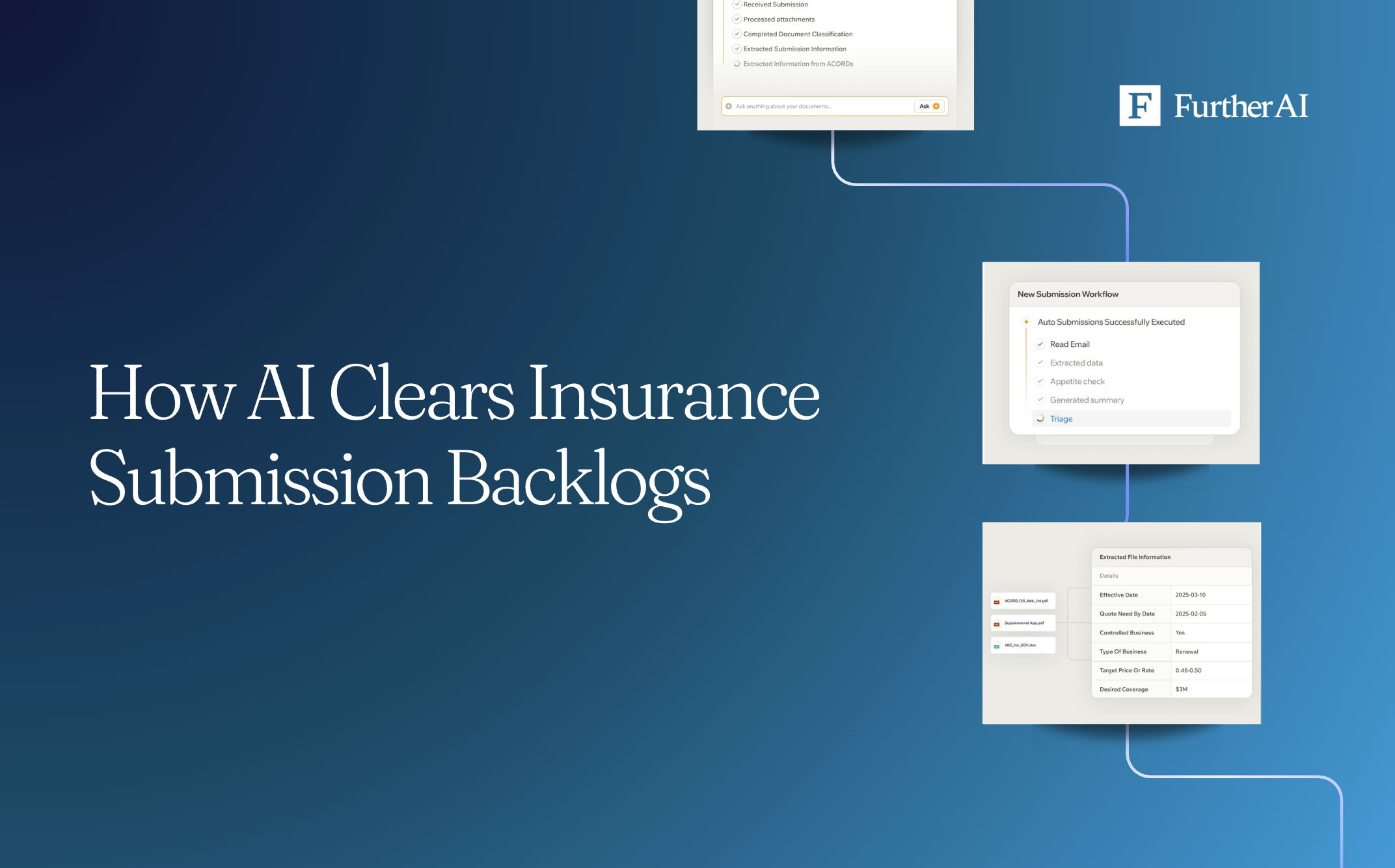
AI speeds up insurance workflows by automating the manual parts of submission intake — reading broker emails and attachments, extracting and validating the data, and writing clean records into your underwriting systems. That collapses intake from hours to minutes, so underwriters spend their time selecting and pricing risk instead of rekeying it. Across FurtherAI deployments, that shift has produced 30x faster submission processing and a 646% return on investment for the carriers and MGAs running it.
Here's why submission backlogs form, how AI clears them, and what the change means for your underwriting team.
Key takeaways
- Underwriters lose 30% to 40% of their time to administrative work like rekeying data, according to McKinsey. That time is the backlog.
- AI automates intake in four steps: data extraction, real-time validation, system integration, and continuous monitoring.
- Real FurtherAI outcomes include 30x faster processing, sub-10-minute intake on 50,000-location schedules of values (SOVs), and 90% claims-intake automation.
- Faster responses compound: Lynx Specialty grew about 35% by answering its existing brokers quickly rather than chasing new ones.
- Industry adoption is accelerating — Accenture expects AI use in underwriting to climb from 14% to 70% within three years.
Why do insurance submissions stall?
Traditional submission intake runs on manual effort. Underwriters and their assistants sift through spreadsheets, PDFs, ACORD forms, loss runs, and broker emails just to extract the values needed to begin underwriting. The work is slow, repetitive, and easy to get wrong.
It's also expensive in a way that's easy to miss. McKinsey found that in commercial lines, anywhere from 30% to 40% of an underwriter's time goes to administrative tasks such as rekeying data or manually running analyses. That's not a small leak; it's a third of your most expensive talent spent on work a machine can do.
Three patterns create the bottleneck:
- Inconsistent formats. Submissions arrive in every layout imaginable, so each one needs reformatting before it's usable.
- Manual validation. Checking for missing limits, mismatched values, and incomplete SOVs eats hours per file.
- Limited visibility. Tracking progress across dozens of in-flight submissions is hard, so high-value risks wait behind low-value ones.
The cost compounds at the top of the funnel. When intake is slow, brokers wait, quotes go out late, and submissions that could have bound age out. Accenture reports that underwriting executives now cite rising demand for speed and better service as a force reshaping the function.
How does AI automation clear the backlog?
AI handles the time-consuming parts of intake with speed and consistency, then hands a decision-ready file to the underwriter. At FurtherAI, an AI Teammate runs the workflow in four steps.
- Automated data extraction. The AI reads broker emails, submission forms, ACORD applications, SOVs, and loss runs, then pulls key values like coverage limits, total insured value (TIV), and property details — no manual entry.
- Real-time validation. It flags missing fields, mismatched values, and inconsistencies, so a submission is complete and in-appetite before it reaches an underwriter.
- System integration. It writes clean, structured data into underwriting platforms, CRMs, and policy systems, aligning broker submissions to your own schema and eliminating duplicate entry.
- Continuous monitoring. Dashboards track every submission's progress and alert the team when something needs a human.
This is the direction the whole industry is moving. Accenture's survey of 430 underwriting executives found that intelligent ingestion — using AI to extract and prepare data from submissions — is set to rise from 9% adoption today to 68% within three years.
What results are insurers actually seeing?
The numbers below come from FurtherAI customer deployments. Each links to the full case study so you can check the details.
The throughline is consistent: when intake stops being a manual chore, capacity and speed both go up without adding headcount.
What faster workflows mean for underwriting teams
Clearing the backlog gives underwriters their time back for the work only they can do — assessing risk, structuring coverage, and building broker relationships. The compounding effect shows up clearly at Lynx Specialty, where faster responses turned existing relationships into more business.
"More brokers within our existing relationships are sending more submissions in, because we're responding so quickly. That means more quotes out the door, more bind orders, and in a changing market, that's been crucial for us to continue to grow at about a 35% cliff this year so far." — Paul Ritter, Senior Vice President, Lynx Specialty
That's the operating model the industry is converging on. Accenture expects AI use in underwriting to rise from 14% to 70% within three years, and points to carriers like QBE that now process 100% of the broker submissions they receive on AI-enabled product lines. The teams that move first turn a historic bottleneck into a competitive advantage.
Ready to turn your backlog into a breakthrough?
FurtherAI builds AI Teammates that fit the way your underwriters already work, starting with a single use case — submission intake, triage, clearance, or audit — and expanding from there. Book a demo to see how AI-driven automation can clear your submission backlog.
REFERENCES
Accenture. "Underwriting Rewritten: Harnessing the Power of Gen AI for Data-Driven Risk Management." Accenture. accenture.com
FurtherAI. "Claims Processing." FurtherAI. furtherai.com
FurtherAI. "Complex Property SOV Intake." FurtherAI. furtherai.com
FurtherAI. "How FurtherAI Powered 35% Growth at Lynx Specialty." FurtherAI. furtherai.com
FurtherAI. "Submissions Processing." FurtherAI. furtherai.com
FurtherAI. "Underwriting Audit." FurtherAI. furtherai.com
McKinsey & Company. "Insurance productivity 2030: Reimagining the insurer for the future" McKinsey & Company. mckinsey.com
DISCLAIMER
This article is for general informational purposes only and does not constitute legal, regulatory, compliance, underwriting, or other professional advice. The content reflects information available as of the date of publication, and FurtherAI undertakes no obligation to update it as laws, regulations, or AI technologies evolve.
Recent posts
Ready to go further and
transform your insurance ops?
Reclaim your time for strategic work and let our AI Assistant handle the busywork. Schedule a demo to see how you can achieve more, faster.




.svg)