FurtherAI Available in Microsoft Marketplace
Introducing Connectors



Why the World's Largest Insurers Are Coming to a16z: A Conversation With Joe Schmidt

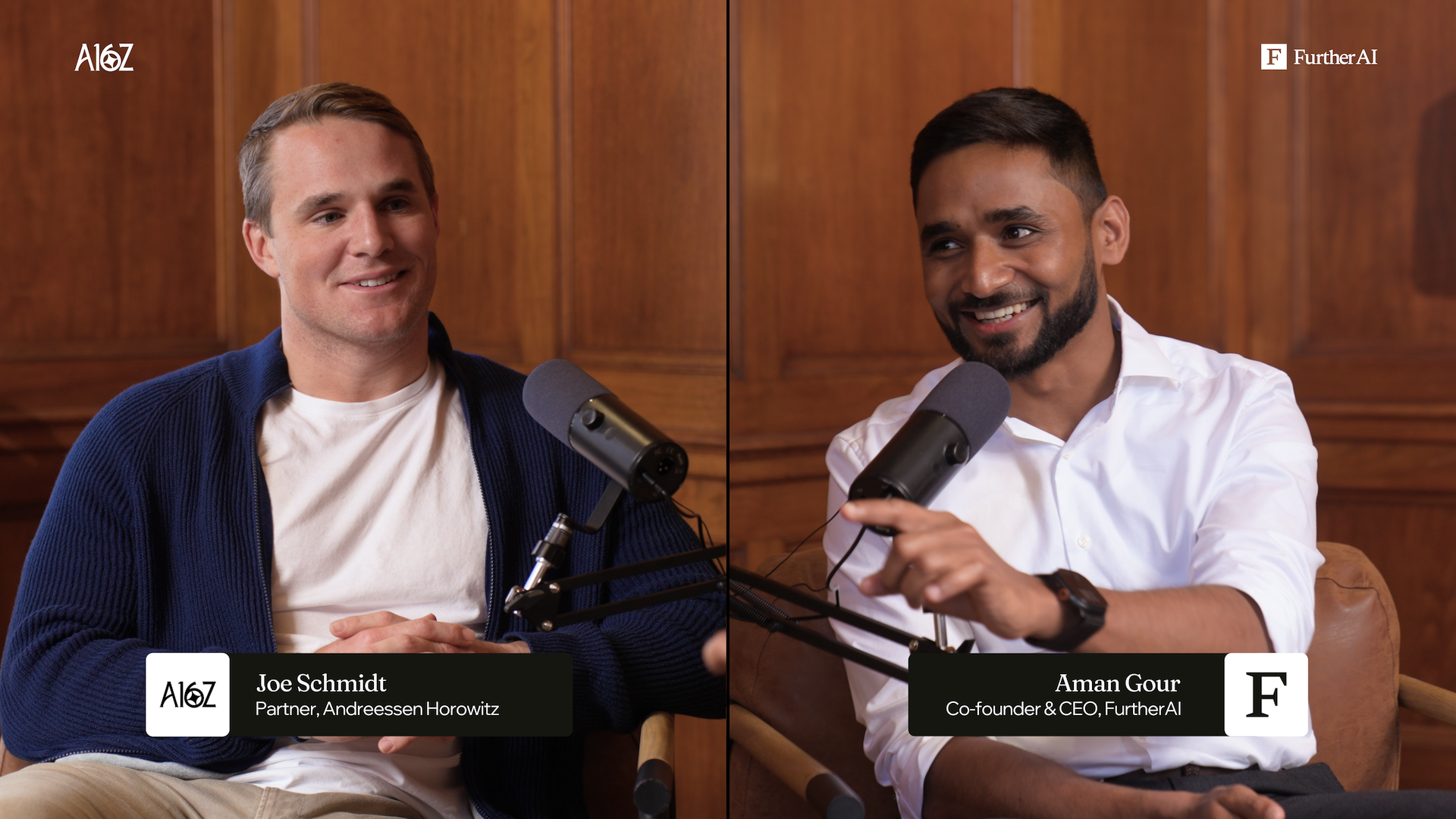
In just the calendar year 2026, 25 of the 100 largest insurance companies in the world have come through Andreessen Horowitz — visiting the office, or joining a dinner or event the firm hosted. That's the data point Joe Schmidt, Partner at a16z and a board member at FurtherAI, pointed to when we sat down with him at our office.
It's a striking number, and it tells you where the industry's attention is right now. And it isn't just someone from these companies showing up. As Joe describes it, it's the CEO or the entire executive leadership team — a level of engagement from Fortune 100 insurers he says he's never seen in over a decade in the industry.
We talked with Joe about what's driving this moment, why the hard part of AI in regulated industries comes at the very end, and how insurance companies should think about where to begin.
Who is Joe Schmidt?
Joe Schmidt is a Partner at Andreessen Horowitz and a board member at FurtherAI. He's a licensed insurance agent, has spent over a decade in insurance, and sits on the board of multiple insurance software companies.
The real opportunity is growth
Most conversations about AI in insurance start and end with cost savings. Joe's doesn't. When we asked him what's really at stake, he reframed the whole opportunity around growth.
"This is going to allow us to insure way more risk, and it's going to allow these insurance companies to grow much faster. The big insurance companies grow a few percent every year. If you can move that number, that's a big deal." — Joe Schmidt, Partner at a16z and a board member at FurtherAI
As Joe sees it, the public discourse is stuck on the expense side of the house — efficiency, cost, and headcount — and is missing the bigger story. The opportunity he keeps pointing to is growth: writing more risk, unlocking new markets, and competing for business that wasn't reachable before.
Why the last mile is everything in regulated industries
A recurring theme in the conversation is the last mile. When it's this easy to spin up a demo, Joe says, teams assume the last 20% of the work will be as easy as the first 80%. In his experience, it isn't — and won't be for a long time.
"Last mile is everything," as he puts it. The hard part isn't the initial build; it's the configuration, the implementation, and everything required to make a system hold up in production. That's especially true in a regulated business. Joe challenges insurers on it directly: do you want to work with someone who isn't thinking about your regulation and security every day of the week?
That's why he describes the last mile as the hardest and most important part of building AI for insurance.
Getting to a working demo is comparatively easy. Closing the remaining distance — so an underwriter or claims professional can rely on the output, and so it clears the regulatory and security bar every time — is the real work.
Where insurance companies should start
The natural follow-up question for any operator is a practical one: given all of this, where do you begin?
Joe splits the answer into two buckets. The first is what he calls the oil wells: the one or two core systems a company commits to overhauling over the next 12 to 18 months, whether that's the actuarial platform, the claims system, the CRM, or IT. Those are big, high-value projects, but the ROI takes time to show up, and that's the nature of them.
The second bucket moves faster. These are the pipeline-style projects that go after specific, unstructured workflows without ripping out a core system — the kind of work where a company can put some AI points on the board quickly. Because a partner often handles much of the transformation, these don't require heavy internal resources. Joe's advice is to identify which projects deliver the fastest, most significant time to value, and start there.
Watch the full conversation
The full interview covers what's driving executive-level AI adoption, why the last mile is everything in regulated industries, and how insurance companies should think about where to start.
Watch the full interview with Joe Schmidt here.
Thank you to Joe Schmidt and Andreessen Horowitz for the conversation and the continued partnership.
DISCLAIMER
This article is for general informational purposes only and does not constitute legal, regulatory, compliance, underwriting, or other professional advice. The content reflects information available as of the date of publication, and FurtherAI undertakes no obligation to update it as laws, regulations, or AI technologies evolve.
Recent posts

Ready to go further and
transform your insurance ops?
Reclaim your time for strategic work and let our AI Assistant handle the busywork. Schedule a demo to see how you can achieve more, faster.




.svg)