FurtherAI Available in Microsoft Marketplace
Introducing Connectors



Eliminating Manual Underwriting Documentation: Standardizing Output Across Teams and Lines

Hand the same property risk to two underwriters and you'll likely get back two files that don't line up. One runs nine pages and never says why the risk sits inside appetite; the underwriter has written this class for eleven years and the answer felt too obvious to type. The other is four pages, leads with the appetite rationale, and stops the loss history at the expiring term.
Both get signed off. Both feed the same portfolio report, which treats them as equivalent. Six months on, when someone asks why the property loss ratio moved, neither file can be set against the other. Nobody had written down what a finished file contains, so forty underwriters arrived at forty reasonable answers, each defensible alone and useless in aggregate.
This is a playbook for standardizing underwriting documentation: the file standard, what may legitimately vary by line, how to govern it, and where automation earns its place. Proving the decision afterwards, to a carrier auditor or a regulator, runs on different mechanics and is covered separately in our guide to underwriting summaries with audit capabilities.
Key takeaways
- Standardization is about comparability, not conformity. The goal isn't that two underwriters reach the same answer. It's that when they don't, you can see why.
- The variance is larger than leadership thinks. In a noise audit at a large insurer, underwriters pricing identical policies differed by a median of 55%, against executives who expected around 10%.
- The gap is far wider than intuition suggests. Expert judgment in these audits varied by four to five times what senior executives predicted. Training people toward consistency does not close a gap that size; defining the output does.
- Write the standard before you automate. A tool pointed at an undefined output produces inconsistency faster.
- Version the standard like code. Owner, version number, change log, and a defined path for line-specific extensions. Templates that live in individual inboxes are not a standard.
Why underwriting documentation drifts
It’s important to note that documentation drift isn't caused by a discipline problem; it is simply what happens when a judgment-heavy task has no defined output.
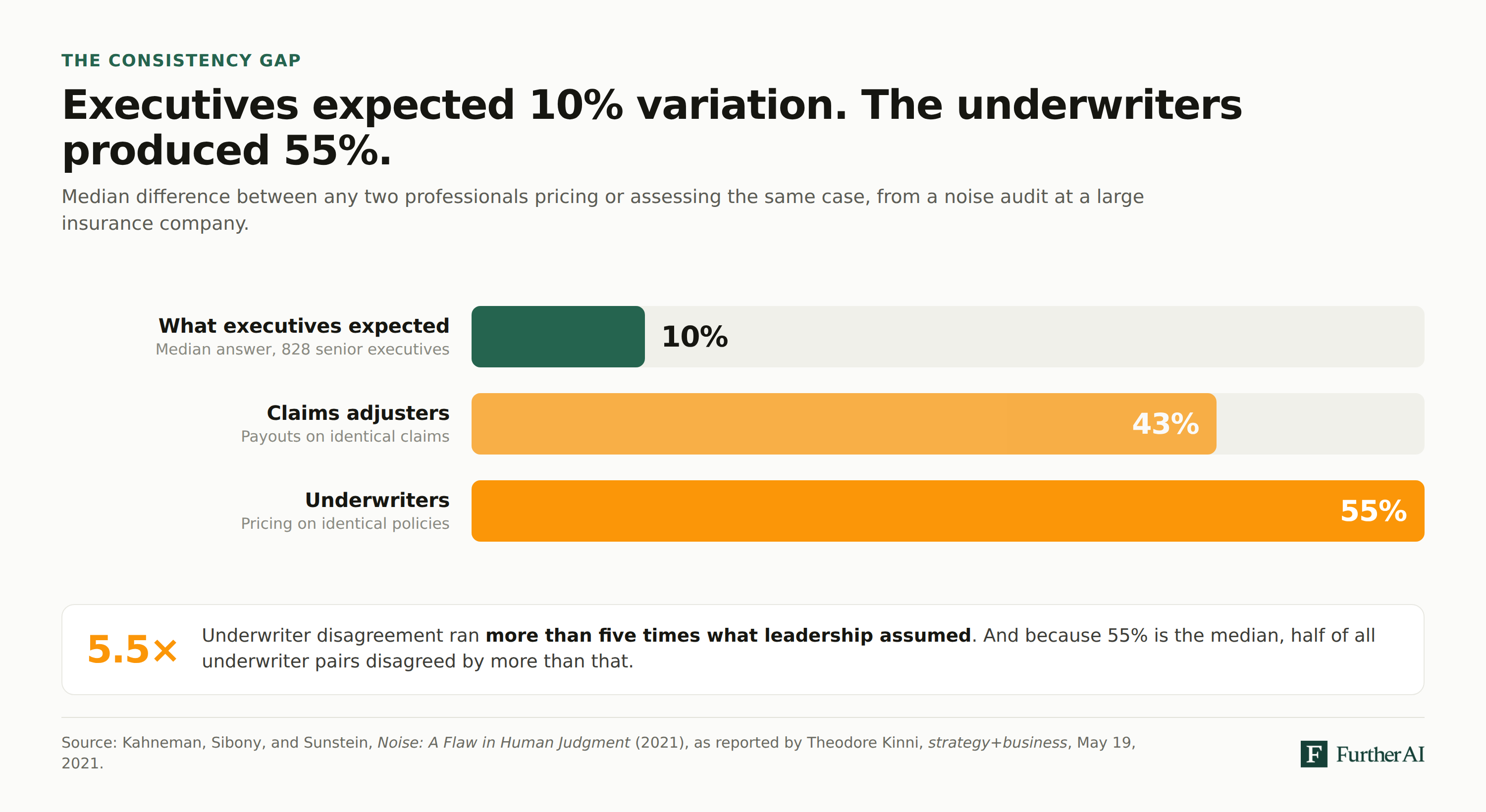
The clearest measurement of the underlying variance comes from a noise audit conducted at a large insurance company and reported in Noise: A Flaw in Human Judgment.
Underwriters were asked to price the same realistic cases independently. The median difference between any two underwriters' quotes was 55%, and for claims adjusters assessing identical claims it was 43%. When 828 senior executives were asked beforehand how much variation they expected among their own experts, the median answer was 10%.
Two details make that finding more useful than it first appears. It's a median, so half of all underwriter pairs disagreed by more than 55%. And the distance between expectation and reality was not marginal: across the noise audits the authors describe, variation in expert judgment ran four to five times what executives predicted. There is no training your way out of a gap that size. The only way through is to define the output.
Carriers know it's happening. In Capgemini's 2024 research on property and casualty insurers, 70% said inconsistent underwriting decisions were a prevailing issue, alongside 77% reporting incomplete risk evaluation and 73% reporting limited pricing accuracy, all of it traced back to weak underlying data.
And the documentation work itself consumes the time that would otherwise go to judgment. Capgemini found that 41% to 43% of commercial and personal lines underwriters' time goes to administrative activities like data entry and record keeping, against 32% to 33% on core activities such as risk assessment, premium calculation, and book management. The manual underwriting tasks behind that share are mostly assembly work: rekeying the same figures, reformatting the same sections, and rebuilding a structure that should have been fixed once and reused.
Step 1: Write the file standard
Start with the artifact and not the tool. Convene the people who actually read underwriting files (line underwriters, the referral authority, portfolio management, and whoever answers carrier questions) and write down what a complete file contains. Make it one page; section names, not prose.
A workable starting standard for commercial property and casualty:
That last row matters more than its size suggests. A file with a stated gap is more useful than a file with a plausible default, because the gap is actionable and the default is invisible.
The market has already done a version of this work in delegated authority, where files are reviewed by outside parties as a matter of routine. The LMA's coverholder audit scope sets out an underwriting file review that tests, line by line, whether updated risk information was obtained before quotation, whether risks outside authority were correctly referred, whether wordings and endorsements were correctly applied, and whether the underwriting record is complete. If you write MGA or coverholder business, that list is a free first draft of your own standard.
Step 2: Separate what varies from what never varies
The most common objection to standardization is that lines of business are genuinely different (they are). And the answer to that is a core-plus-extension structure, not an exemption.
The eight sections above are the core, with every file in every line containing all of them. Line-specific requirements extend the core with additional fields:
- Property adds construction, protection, and occupancy detail per location, plus catastrophe modelling assumptions.
- Casualty adds operations description, prior litigation, and jurisdiction exposure.
- Professional and cyber add revenue by service line, control questionnaires, and prior claim circumstances.
- Specialty and manuscript adds the wording rationale, since the form itself is part of the risk.
The rule to write down explicitly: extensions add sections, they never remove them. An underwriter who cannot complete a core section records it as an open gap rather than deleting the heading. This single rule is what makes files from three different lines comparable at portfolio level.
Step 3: Govern the standard like code
A standard that nobody owns decays within two renewal cycles. Treat it as a controlled document:
- Name an owner. One person, usually in underwriting operations, accountable for the standard's content. Not a committee.
- Version it. "Underwriting file standard v2.1," with a change log recording what changed and why. Underwriters need to know which version their file was written against.
- Define the change path. How a line requests an extension, who approves it, and how long approval takes. If the official path is slower than working around it, people work around it.
- Set a review cadence. Quarterly is typical. Renewals, new programs, and regulatory changes all generate legitimate amendments.
- Retire old templates actively. The single biggest source of drift is a superseded template still sitting in someone's folder. Deprecate by date, and make the current version the only one the system will accept.
This is also where regulatory expectations quietly align with operational ones. Market conduct examiners test whether a carrier follows its own underwriting guidelines and whether file documentation supports the decisions made, under standards set out in the NAIC's Market Regulation Handbook. Lloyd's, in its 2026 Market Oversight Plan, singled out delegated authorities, which account for around 45% of the market's gross written premium, because performance deterioration there "tends to be less visible and harder to remediate, meaning issues can compound before corrective action is taken." Reviewing that plan, PwC advised firms to be clear in their rationale and evidence for why they are pricing appropriately. A governed standard is how that rationale exists in the first place.
Record retention rules also argue for one standard rather than per-state variants. New York's Regulation 152 requires a policy record to be kept for six calendar years after the policy is no longer in force, or until after the examination report in which it was reviewed, whichever is longer. Applications where no policy was issued carry their own six-year requirement on the same terms. Build the file to the strictest standard you operate under and the rest takes care of itself.
Step 4: Enforce at creation, not at review
Review-stage enforcement fails for a structural reason: by the time a reviewer sees the gap, the underwriter has moved on and the broker is waiting. The correction cost is highest exactly when the appetite for correcting is lowest.
Enforcement at creation means the system assembles the required sections from source documents, populates what it can, and refuses to present a file as complete while a required section is empty. The underwriter's attention goes to the judgment calls rather than the assembly.
Manual versus automated, by task
Read this table as a template, not as a benchmark. The time ranges are illustrative of commercial mid-market work and will not match your book. The column that matters is variance, and it's the one most teams have never measured. Run a baseline before you buy anything: take one real risk, give it to five underwriters, and compare the files.
The pattern holds in production. A mid-sized insurer with over 1,500 employees and $1 billion in annual revenue deployed automated policy checking and comparison and reported a 400% return on investment within months, over 95% gain in operational efficiency, and manual review times cut by up to 95%, with policy checking running more than 20 times faster and policy comparison more than 30 times faster. The speed is the visible result. The durable one is that every comparison now examines the same elements in the same order.
Step 5: Roll it out across teams
Standardization fails at rollout more often than at design. A sequence that works:
- Pilot on one program, not one line. A single program has a bounded document set and a small enough group to correct in one conversation. Two to four weeks.
- Measure completeness before quality. The first metric is the share of files containing all core sections. Quality debates stall pilots; completeness is unarguable.
- Expand to the rest of the line. Extensions get written here, once the core has survived contact with real submissions.
- Cross the line boundary. This is the real test, and the point at which the core-plus-extension rule earns its keep.
- Fold in delegated business last. Coverholders and MGAs need the standard expressed as a data specification with a transition period, not as a template dropped into an inbox.
For multi-program MGAs, the sequencing changes slightly: standardize the sections across programs first, then align the fields inside them. Programs vary more than lines do, and forcing field-level uniformity early creates exemption requests that never close.
What to measure
Four metrics, tracked monthly:
- Core section completeness. Share of files containing all required sections. Target above 95% within two quarters.
- Gap declaration rate. Share of files with at least one explicitly stated open gap. A rate near zero means underwriters are defaulting rather than declaring.
- Cross-underwriter variance. Re-run the five-underwriter baseline quarterly on a fresh risk. This is the number that tells you whether the standard is working.
- Time to file completion. Useful, but last. If completeness is falling while time improves, the standard is being bypassed.
Where this ends and audit begins
A standard makes files consistent at the point of writing. It does not, by itself, make them defensible years later under examination. Those are different problems with different solutions, and conflating them produces a standard that satisfies nobody.
For the defensibility side (what evidence attaches to a decision, how it's retained, and what a carrier auditor or regulator expects to find) see our guides to underwriting summaries with audit capabilities for MGAs and running an underwriting audit in one workflow. For the input side, where conflicting source documents get reconciled before any file is written, see multi-source risk data. And for choosing the platform layer underneath all of it, see our underwriting workflow software buyer's guide.
Frequently asked questions
REFERENCES
Capgemini. "Insurance Leaders Optimistic About AI's Impact on Underwriting Quality and Fraud Reduction, but Underwriter Confidence Lags." Capgemini, April 17, 2024. capgemini.com
Capgemini Research Institute. "Unleashing Growth: The Evolving Role of Underwriters." Capgemini, April 30, 2024. capgemini.com
FurtherAI. "Policy Check and Compare." FurtherAI. furtherai.com
Kinni, Theodore. "How Noisy Is Your Company?" strategy+business, May 19, 2021. strategy-business.com
Lloyd's Market Association. "Coverholder Audit Scope and Associated Guidance." LMA, October 22, 2025. lmalloyds.com
Lloyd's. "2026 Market Oversight Plan." Lloyd's, January 13, 2026. assets.lloyds.com
NAIC. "Market Regulation Handbook." National Association of Insurance Commissioners, 2025 edition. content.naic.org
New York State. "11 NYCRR 243.2: Records Required for Examination." New York Codes, Rules and Regulations. law.cornell.edu
PwC UK. "Lloyd's of London Sets Out 2026 Market Oversight Priorities." PwC UK, January 13, 2026. pwc.co.uk
DISCLAIMER
This article is for general informational purposes only and does not constitute legal, regulatory, compliance, underwriting, or other professional advice. The content reflects information available as of the date of publication, and FurtherAI undertakes no obligation to update it as laws, regulations, or AI technologies evolve.
Recent posts


Ready to go further and
transform your insurance ops?
Reclaim your time for strategic work and let our AI Assistant handle the busywork. Schedule a demo to see how you can achieve more, faster.




.svg)