FurtherAI Available in Microsoft Marketplace
Introducing Connectors



Why Every Insurance Executive Needs to Own AI Themselves | In Conversation With Alexander Vollert (Former CEO & COO, AXA Group)

When we started FurtherAI, we knew practically nothing about insurance. The best way to understand a business shaped by centuries of history is to learn from the people who have spent their careers transforming it, so that's what we've been doing ever since.
Few people fit that description better than Dr. Alexander Vollert. He's run technology and operational transformation inside some of the largest insurers in the world, and when he talks about AI, it comes from having done the work rather than from having watched it.
Aman Gour, our co-founder and CEO, sat down with him for a conversation on the FurtherAI podcast. This article is a short tour of what came out of it. Watch the full interview here.
Meet Alexander Vollert
Alexander Vollert served as Chief Operating Officer of AXA SA and Chief Executive Officer of AXA Group Operations through December 2025, sitting on the Group Management Committee for the duration. He became CEO of AXA Germany in 2016, and before that held senior leadership roles at Allianz SE, ultimately running its German property and casualty business as CEO. Earlier in his career he spent nine years at McKinsey & Company, advising financial services clients on strategy, technology, and large-scale transformation. He now serves as senior advisor to AXA's Group Management Committee, sits on the board of Guidewire, and advises FurtherAI.
Where AI actually creates real value in insurance
Vollert starts where most insurers start, with the arithmetic of time saved. A task that took an hour now takes five minutes, so 55 minutes come back. Then he stops and asks what happens to them.
"But this is the value creation. The question is, what about the value capture? Because you still need the person, the person is still around." — Alexander Vollert, former Group Chief Operating Officer, AXA
His view on the modelled savings in most AI business cases is direct:
"You can write down a lot of big numbers. That's what's currently happening a lot. People are getting there. We can reduce the amount of work that's needed by 50, 60, 70% and say, okay, so nice, but show me that you can realize it."
He also thinks the industry is looking at the smaller number. Efficiency is easy to count, which is why it dominates the conversation, but in insurance he sees a larger prize in effectiveness: better risk selection, better fraud detection in claims, better recovery, sharper pricing. Those gains take longer to prove, because you're measuring half a point of loss ratio across a treated population rather than minutes on a clock, and in his experience the effectiveness gain is sometimes the bigger one.
Why the layers underneath have to change first
Asked whether AI in insurance is evolution or revolution, Vollert says it depends entirely on what's underneath. Plenty of incumbents still run technologies from the 70s, 80s, and 90s at the core, and those systems were built around constraints that no longer exist. Business logic sits baked into the mainframe rather than in modular or object-oriented architectures. Product models are flat where a modern AI application needs hierarchical structure. Data lives in fields it was never designed for.
His conclusion follows from that: "You cannot revolutionize because you need to extract the business logic. You need to clean up the data." Where the stack is modern and documents are already in one repository, he describes something closer to a genuine revolution, with millions of documents reachable at the fingertips.
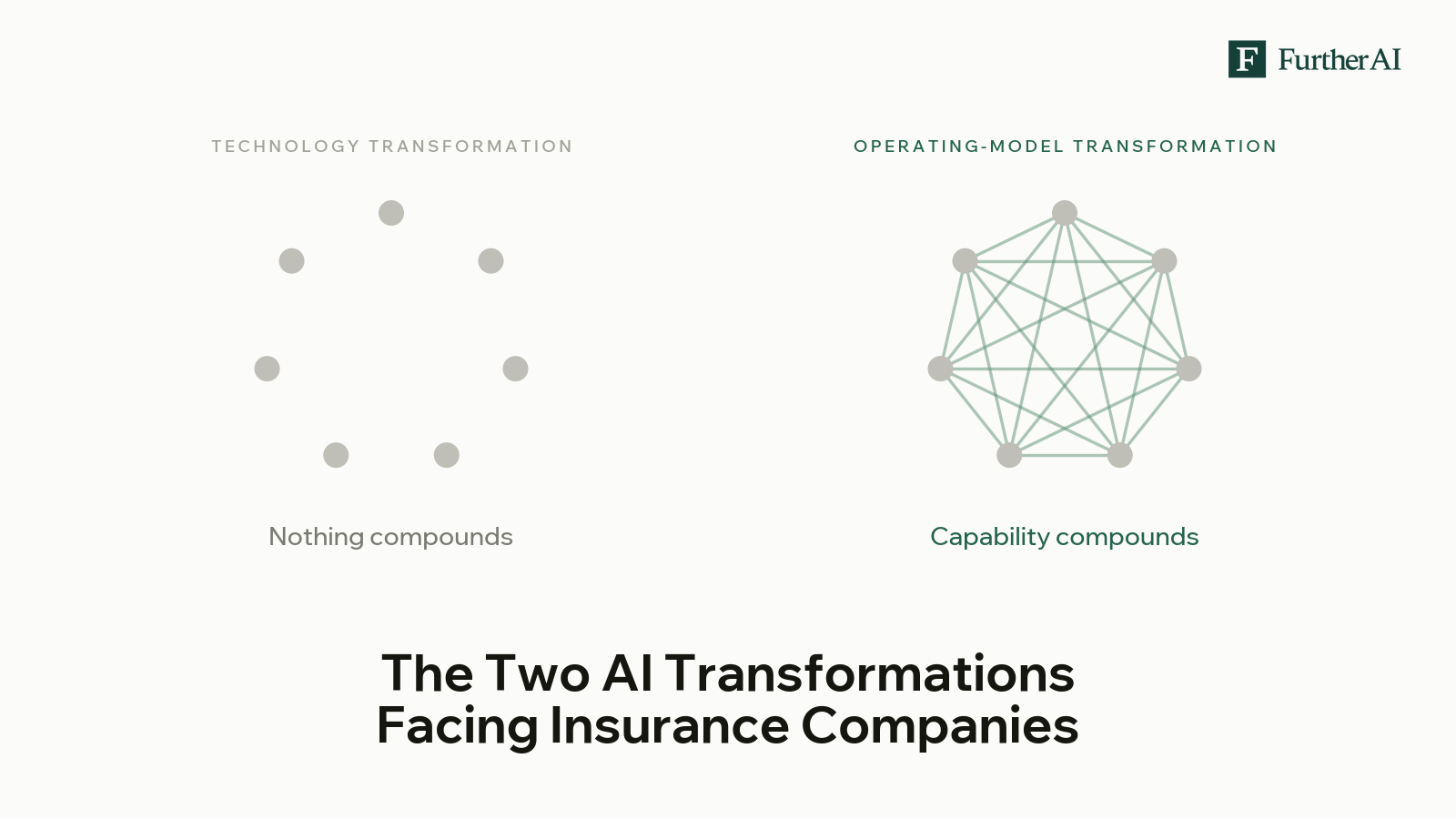
The same logic applies a level up, to how the work itself is arranged. "If you're not completely redesigning the operating model in a certain domain, you will not capture the full potential and the full value."
What it takes to move from pilots to scale
On organizational design, Vollert refuses the question insurers usually ask. Whether AI should be led by business or by technology is "the wrong discussion," in his words, because structure follows strategy and both depend on a company's culture. What he'll commit to are principles.
The first is that business and technology have to speak a common language, which he says many companies simply don't have, and that building it is management's job rather than a happy accident. The second is training, for senior executives as much as for everyone else, so leaders can feel what the technology does instead of being told. His advice for closing that gap is four words long: "Be curious, not judgmental."
The second half of scaling is governance that speeds things up rather than slowing them down. During his time at AXA, while competitors were cutting off intranet access to OpenAI over data protection concerns, his teams built their own version on their own tenant and called it Secure GPT, later widening it into a model garden with several LLMs behind one entry point. That single door gave them a common retrieval-augmented generation (RAG) standard, compliance they could evidence, and visibility into which applications were burning tokens, which matters more than it sounds: he warns that using an LLM for what a search engine would do, at 60 or 300 or 5,000 times the cost, is its own productivity trap.
The last piece is portfolio discipline. Run bets bottom up and top down at once, keep transparency over what's running, and then cut, which he'd elevate to the highest ranks of the company precisely because subtraction is the part organizations avoid.
Three more moments worth your time:
- Systemic risk and affordability. Cyber and natural catastrophe are getting harder to keep insurable, and as wealth gaps widen, Vollert argues the industry has an obligation to keep basic cover within reach.
- Digital twins and spatial data. He expects the next real advance in risk assessment to come from spatial information, from simulating a car accident off damage photographs to assessing fire risk inside a factory from a desk.
- Why the industry is worth the effort. Transferring individual risk into collective risk is, in his words, "a noble cause actually and a very important element of society."
His closing advice to executives came down to two words: own it. "If you don't walk in the shoes, you're only talking about it." He has Sunday-afternoon lessons lined up with his 18-year-old son on working with Claude in a Python programming environment, for exactly that reason.
Watch the full conversation
The full interview runs through where AI creates real value in insurance, what has to change underneath before it can, and what moving from pilots to scale actually demands of an organization.
Thank you to Alexander Vollert for the conversation and for his continued partnership with FurtherAI.
Recent posts


Ready to go further and
transform your insurance ops?
Reclaim your time for strategic work and let our AI Assistant handle the busywork. Schedule a demo to see how you can achieve more, faster.




.svg)