

Underwriting Transformation at Scale: A Conversation with Ryan Specialty's Brian Alvin

June 17, 2026
While attending The Future of Insurance 2026, I had a chance to sit down with Brian Alvin, Chief Underwriting Transformation and Automation Officer at Ryan Specialty, and have a chat about the big changes that happen to underwriting, at scale.
Ryan Specialty is a global insurance intermediary managing more than 40 MGUs, and Brian has spent his career translating actuarial rigor into practical, adopted technology for underwriters. What stayed with me is the discipline Brian brings to a decision most teams are treating as urgent: where AI fits, when it fits, and what has to be true before it earns its place.
The order of operations: Transformation first, AI second
Brian's title is Chief Underwriting Transformation and Automation Officer, and on stage, he explained why "AI" isn't in it. Transformation is the objective at Ryan Specialty, and AI is one of the tools that gets there. The right sequence for any operational improvement, in his framing, is to remove the outdated processes first, simplify what's left, apply deterministic automation next, and only then reach for generative AI where it actually fits.
That order of operations pushes back on a very common mistake: treating AI as a hammer for every problem. Reaching straight for AI without doing the workflow simplification first is what Brian called a recipe for disaster, because it puts spend on generative solutions in places where a rules engine would have delivered a better outcome faster.
The same lesson shows up from a different angle in the actuarial world Brian came from. A perfectly calibrated model that underwriters won't use delivers exactly zero impact. In fact, sophistication only matters once the underwriters actually adopt what you've built. Understanding the business problem first, and then finding the right technology fit for it, is the only path that scales.
AI gets underwriters to the 20-yard line
Eliminating the work that surrounds the underwriting decision itself is the goal. Data extraction, web research, auto-declinations, submission triage — none of that is what an underwriter's judgment is for.
In Brian's framing, AI should get the underwriter "to the 20-yard line." By the time an experienced underwriter opens an account, the packet is already assembled, the routine data is normalized, and the obvious declinations are already flagged. The underwriter picks up from there, applying the judgment and client understanding that AI can't replicate.
At Ryan Specialty, the use cases already in production follow that logic exactly: submission ingestion, triage, risk recommendation, and quoting. Each of them removes non-underwriting friction while leaving the actual underwriting decision with the human running the book.
Trust gets earned incrementally, with visible accuracy
Trust-building surfaced in two connected threads.
One is scope. Attempting to automate 40 MGUs at once, or building a 36-month program to automate an entire underwriting process end to end, is a recipe for disaster. The approach that actually earns credibility is to carve out incremental solutions, prototype fast, and let each small win open the door to the next one.
The other is monitoring. The bar Ryan Specialty holds itself to on model performance metrics — accuracy, precision, recall, and drift detection — is deliberately hard.
"I want to know when the model is wrong before you get a question from an underwriter," Brian said. "If an underwriter comes to me and says, Brian, the model is not working, I failed. You need to set up that process so that we are getting that notification first.”
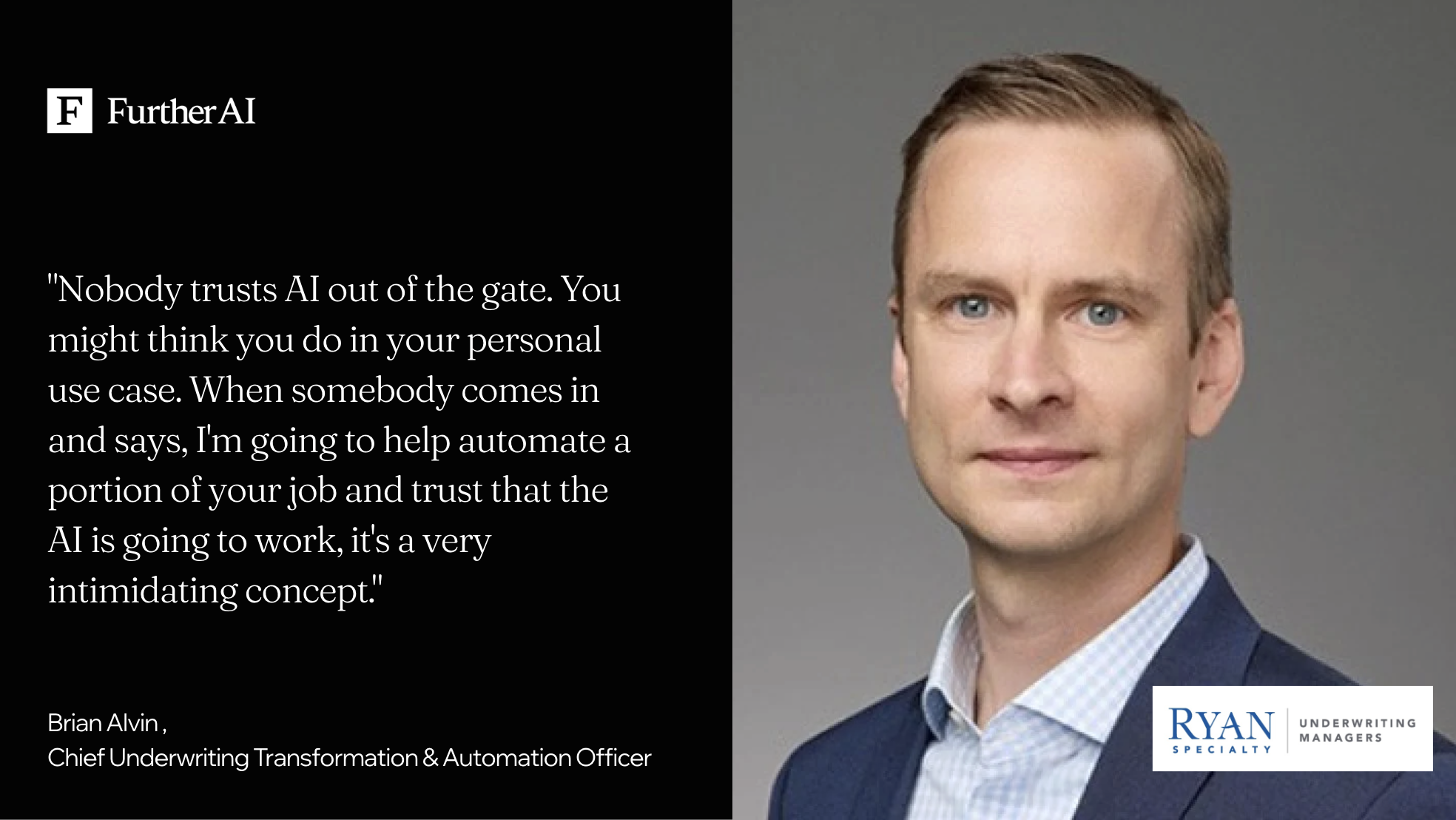
That posture is what makes trust possible. Nobody trusts AI out of the gate, especially when it touches their job, and the way to change that is to demonstrate reliability at the row level, on real submissions, over time.
The cost of lagging has surpassed the cost of leading
Two structural observations closed our conversation, one about talent and one about competitive posture.
Insurance is losing veteran underwriters to retirement faster than it can train replacements, and the people still holding that expertise now carry a dual responsibility: train the next generation of human underwriters, and train the AI models that will sit alongside them. A well-trained AI model, in Brian's framing, can act as a "virtual 30-year veteran" sitting next to a trainee, offering the warnings and guidance that would otherwise take a decade to internalize.
The competitive picture is starker. The bleeding edge is expensive and its advantages are short-lived, because the market catches up. The laggard's position, though, is the truly dangerous one; the cost of falling behind on transformation is exponentially higher than the cost of moving forward on the leading edge. At the end of the day, it's a board-level question. Security, legal, regulatory, and operational voices all belong at the table, with the productive tension between innovation and safety keeping the decisions in balance.
See what this approach looks like inside your own book
Underwriting transformation is an operating philosophy more than a project — a set of positions on where AI belongs, what it should do, how trust gets earned, and what the industry loses if it moves too slowly. The value of the conversation was watching all of those threads hold together with actuarial rigor, operational pragmatism, and a clear-eyed view of where AI fits into the underwriting process.
If you want to see what a similar approach looks like inside your own book, get in touch.
Recent posts

Ready to Go Further &
Transform Your Insurance Ops?
Reclaim your time for strategic work and let our AI Assistant handle the busywork. Schedule a demo to see how you can achieve more, faster.




.svg)