FurtherAI Available in Microsoft Marketplace
Introducing Connectors



The Broker Isn't Disappearing. A New Version Is Emerging.

For decades, the broker's authority came from knowing things their clients didn't.
The broker has always been the interpreter standing between a business and an insurance system too complex for a generalist to navigate alone.
It's brokers who would have insights into what exclusions to push back on or how to read a loss run and translate it into a narrative carrier would accept.
That version of the broker isn't going away, but the traditional systems that surround it are creating costs that most teams can't yet see and didn't choose.
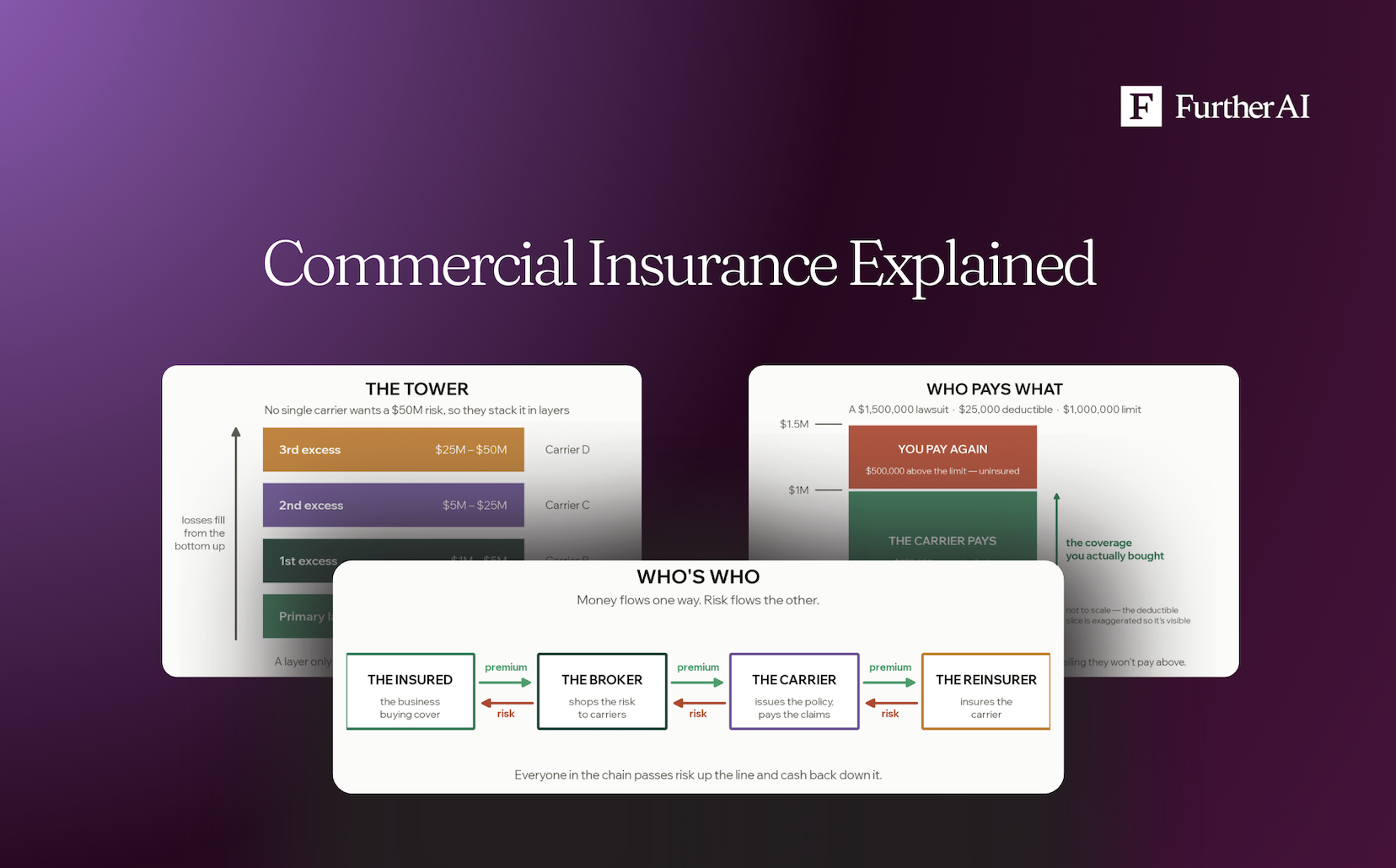
The broker's position in the chain is what makes the role durable. For anyone mapping that chain for the first time, we've set out who does what in commercial insurance — the insured, the broker, the carrier, and the reinsurer, and how premium and risk move between them.
What used to be knowledge is now a prompt
The VP of Operations at a mid-sized commercial contractor isn't waiting for her annual renewal meeting to think about coverage anymore. She uploaded her policy documents to an AI last quarter and asked it to explain her completed operations exclusion and whether her umbrella limits looked right for a company her size.
She got what she needed without picking up the phone.
This is the scenario most broker workflows weren't built to respond to. She wasn't a sophisticated risk manager running a careful gap analysis, just a busy generalist with fifteen minutes. The AI gave her an answer with confidence, and she moved on. No follow-up call, no renewal conversation, no chance for her broker to add the context that turns a coverage summary into actual guidance.
“The client who used to wait for their broker to explain their coverage is now uploading their policy to an AI at 10pm on a Tuesday,” says Aman Gour, Co-Founder and CEO of Further AI. “That shift has already happened. The question for brokers isn't whether to respond to it, it's whether their tools give them any way to."
This is happening at scale. Businesses are uploading commercial policy documents into AI tools for independent analysis. BofA Global Research quantified the downstream risk in early 2026: more than $15 billion in U.S. broker commissions tied to low-complexity business bear AI disintermediation risk.
The threat is most apparent in personal lines and small commercial. In large complex or specialty placements, the advisory value of a broker remains structurally irreplaceable. But even there, BofA noted, AI will "de-mystify insurance markets" for sophisticated buyers in ways that create pricing pressure brokers haven't faced before.
The middle market is where this is playing out right now, and that's exactly where most regional brokers live.
The broker relationship is about trust under uncertainty
When a client places their program, they transfer uncertainty to someone who knows what to do with it. By buying coverage, they hire someone who understands their exposures well enough to anticipate problems before they become claims and, even more importantly, be accountable when something goes wrong.
That distinction matters now more than ever. While AI can close the information gap, it cannot close the trust gap without the right infrastructure.
The brokers whose client relationships are most durable are the ones whose systems give them space to be genuinely present in those relationships, not buried in preparation work.
The financial advisory industry learned this a decade ago. When index funds and robo-advisors made basic portfolio construction available to anyone at near-zero cost, the advisors who built the most durable practices weren't the ones with the best stock picks. They were the ones whose model gave them space to become genuine financial partners: integrated into their clients' business decisions, present at major inflection points, and trusted on questions that went beyond the portfolio.
What we're witnessing now is insurance brokers facing the same moment, but on a compressed timeline.
Legacy workflows are repricing the broker relationship
Over time, traditional tools and workflows pushed the day-to-day work toward administration. Last year's renewal pack became the template for this year’s because the system made it easy to copy. Discovery conversations followed the same script because that’s what the intake process was built around. Although the expertise was still there, the systems didn’t make it visible.
Now, being able to run her own policy analysis and get a reference point faster than ever before, the VP of Operations is likely to question if not the value of a classic broker's renewal conversation itself, but at least the fee attached to it. That's where commoditization starts: not with a lost account, but with a client who starts treating the broker relationship as a procurement decision rather than a trusted advisory one. Eventually, when a competitor shows up offering something that feels different, switching costs that used to feel high don't feel high anymore.
The renewal conversation is your first test, and most workflows aren't built to pass it
The old process ran on the same script every year: identify what changed and what's new, document it, and move on. The new discovery conversation arrives with the client already informed: they've asked an AI about their endorsements, they have questions, and some of those answers are partially wrong in ways they can't detect.
When the only tool available is a standard intake form, the conversation feels like a slower, more expensive version of what the client already did. It produces a client who starts paying closer attention at renewal, while the relationship erodes in ways that don't show up until it's too late.
If you arrive having already cross-referenced their program against this year's operational changes, having already flagged the exposure the AI didn't catch, the conversation is different.
Great judgment trapped in legacy systems stays invisible
Brokers have always been the most valuable part of the insurance relationship, and that’s increasingly true when their expertise complements what AI can already handle.
AI is unlikely to tell your client whether a specific excess carrier will defend them aggressively or look for an out when underlying limits are exhausted. It rarely knows that their primary property carrier has tightened its stance on frame construction in coastal counties this quarter. It struggles to read the room on a difficult renewal negotiation, or know that a new logistics contract isn't just an operations question — it's a hired and non-owned auto question, a cargo question, and a contractual liability question all at once.
The trouble is, when legacy systems sit between a broker’s expertise and the client’s experience, the client never really sees the judgment. They see the process. And that invisible gap doesn’t show up on a P&L today. Instead, it shows up in retention rates two years from now.
The window to differentiate is open, but it won't stay that way.
According to the Big "I" and Reagan Consulting's 2025 Best Practices Study, producers using AI tools maintained book sizes averaging $168,000 larger than peers without access. The gap isn't explained by seniority or market access. Instead, it’s explained by what those producers do with the time AI gives back: more accounts touched, more proactive outreach, more of the relationship spent on the work that actually builds loyalty.
With this new broker model in place, a typical Monday morning looks different. Unlike the past, brokers are now expected to run coverage analysis before client meetings. The good part is they can run the renewal prep much faster (what used to take three hours now takes about forty-five minutes). And when the client and the broker meet, time should be allocated to the broker's observations about the client's business, an added value AI analysis alone wouldn't be able to give.
Every team still running on legacy workflows — not by choice, but because no one has given them something better — deserves tools that finally let their judgment show.
Schedule a demo with Further AI to learn more about AI automation tools for brokers.
Recent posts
Ready to go further and
transform your insurance ops?
Reclaim your time for strategic work and let our AI Assistant handle the busywork. Schedule a demo to see how you can achieve more, faster.




.svg)