FurtherAI Available in Microsoft Marketplace
Introducing Connectors



AI Governance In Insurance

.png)
The conversation about AI in insurance tends to focus on speed and efficiency, and there's good reason for that. The less visible part of that conversation is happening in compliance reviews and late-stage procurement calls, and it's about what responsible deployment actually requires. That one matters just as much.
The scrutiny is already here
Insurance is built around decisions that carry real weight for real people. When regulators look at coverage approvals, pricing, and claims outcomes, they care not just that a decision was made but how it was made. AI hasn't changed that expectation. In most jurisdictions, it's increased it.
The NAIC's Model Bulletin on AI, issued in 2023, requires insurers to "develop, implement, and maintain a documented AI program that supports responsible AI practices," with controls that account for "the transparency and explainability of outcomes to the impacted consumer." That bulletin has since been adopted or referenced by a growing number of states. The NAIC has now gone further, forming a dedicated AI working group and developing an AI systems evaluation tool, which signals a shift from principles-based guidance toward structured examination and enforcement.
The questions regulators are asking have gotten more specific too. Not just whether you use AI responsibly in the abstract, but whether you can demonstrate how your models are governed, monitored, and audited. Colorado's SB 169 requires that automated systems don't produce discriminatory outcomes. The EU AI Act classifies insurance underwriting AI as high-risk, meaning conformity assessments, documentation, and ongoing monitoring are all part of what deployment looks like.
These aren't future requirements. They're in effect now, and the bar is moving.
Governance means showing your work
Governance in insurance AI comes down to three things, and they're worth naming plainly.
Explainability means that when an AI system recommends declining a submission or flagging a claim, the reasoning behind that recommendation is visible to whoever needs to see it. A model that produces outputs without showing its work creates exposure that compounds over time.
Auditability means every AI-assisted decision has a record behind it, tracing what data was used, what the model saw, and what a human decided after reviewing the output. As one analysis of the NAIC bulletin put it: "Traceability in AI models takes the black box problem away and replaces it with accountability, so you can clearly see which model version, training data, or human decision led to an issue." Without that trail, responding to regulatory inquiries is slow, catching errors at scale is harder, and defending your process when it gets challenged becomes a serious problem.
Repeatability means the same inputs produce consistent outputs. When a model gives different recommendations for identical submissions depending on when they were processed or which version was running, the inconsistency tends to surface at the worst possible moment.
Here's what that looks like in a real workflow.
Take submission intake. Without a governance layer, the process moves fast. AI reads the submission, extracts data, pushes it to the underwriting system. The problem is opacity. When something goes wrong downstream, the trail back to what happened is thin.
With a governance layer, the same workflow runs like this:
- AI reads the submission packet
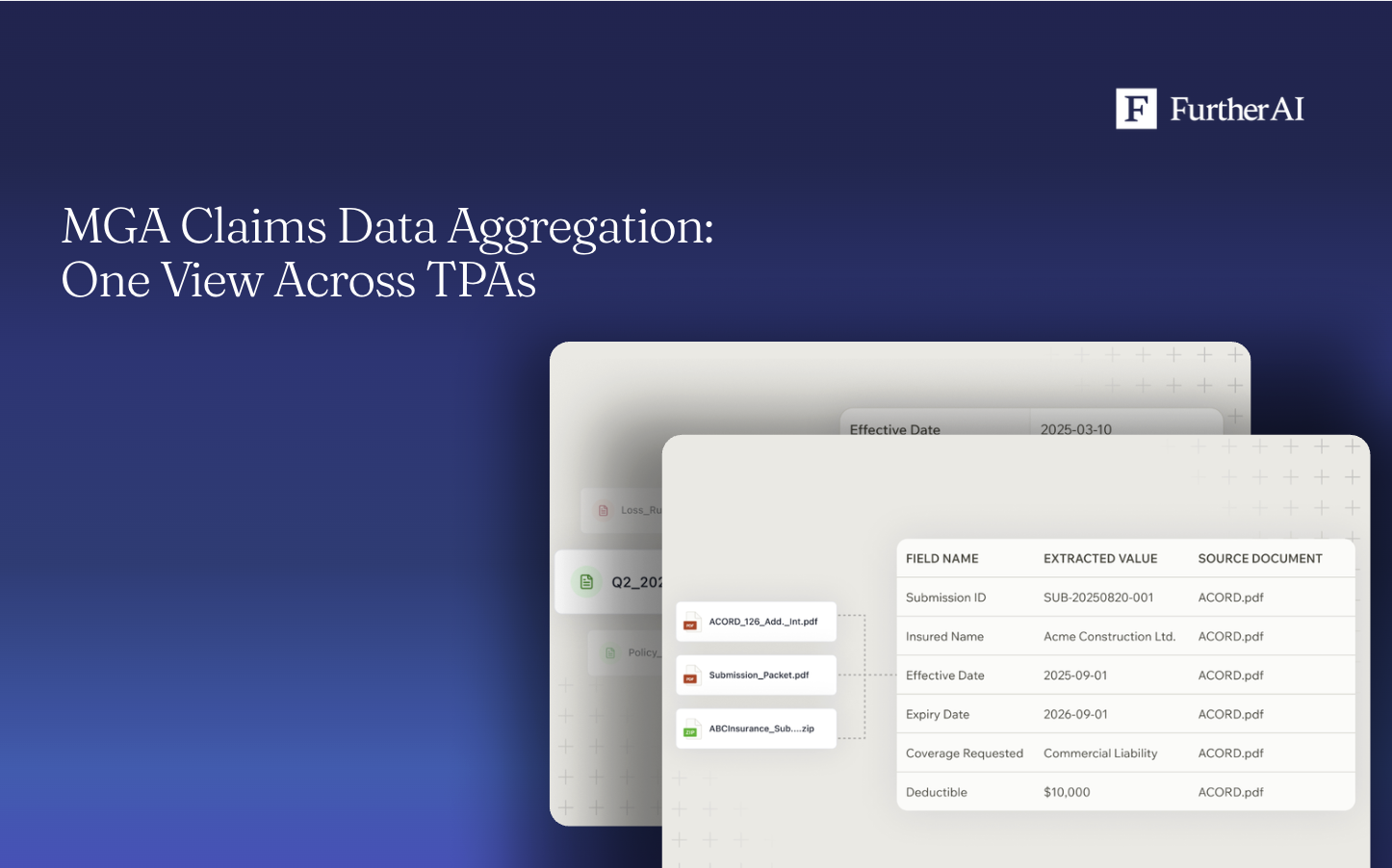
- Extracts fields
- Shows sources for each field
- Flags low-confidence items
- Underwriter reviews
- System logs everything
- Output moves to the policy system
The end result is the same. Data lands in the underwriting system either way. The difference is that the process is now defensible and auditable. You can see what the AI pulled, where it came from, and what a human decided to do with it.
The infrastructure wasn't built for this
The teams doing this work are under genuine pressure to move faster, process more, and still maintain quality across every submission that comes through. Governance requirements can feel like weight added to a process that's already heavy. That frustration makes sense.
Most of the systems these teams are working with weren't designed with AI in mind. They were built for a different era of the business and they served their purpose. Adding accountability infrastructure to something that's already live is legitimately hard, and the teams navigating it aren't doing anything wrong by finding it difficult.
What tends to shift the picture is getting governance into the design conversation before deployment rather than after. When the audit trail is automatic and confidence flags surface without a separate review step, human review can stay focused on what actually needs judgment. It stops feeling like friction. The speed comes back and the accountability is just there.
Designed for accountability from the start
At FurtherAI, we work with carriers, MGAs, and brokers across underwriting, compliance, and claims. Governance comes up in nearly every serious enterprise conversation, usually early.
The deployments that work share a consistent pattern. The AI reads the submission, surfaces its reasoning, and flags what it's uncertain about. The underwriter reviews, makes a call, and that decision is logged. The loop closes and the trail is clean.
Underwriters adopt it faster when the reasoning is visible, compliance teams sign off more readily when every output traces back to its inputs, and when regulators ask questions the answers are already organized.
The foundation is what scales
Workflows across insurance that used to take hours are being compressed into minutes. That's real and it's continuing. The organizations that sustain it are the ones building on a foundation that can be explained, audited, and shown to be consistent. Not only because regulators require it, though they do. Because it's the version of AI in insurance that holds up.
Schedule a demo with FurtherAI.
Recent posts
.png)
Ready to go further and
transform your insurance ops?
Reclaim your time for strategic work and let our AI Assistant handle the busywork. Schedule a demo to see how you can achieve more, faster.




.svg)