
How We Made Browser Use Agents 3.5x Faster with Jev

We paired Claude Opus 5 with a fast classifier called Jev and cut a realistic insurance-quoting workflow from 18 minutes to just over 5. Here’s the side-by-side result and the architecture behind it.
Web agents are core to how our customers use FurtherAI
Insurance teams spend hours inside carrier portals to quote policies, retrieve loss runs, order MVRs, and check claim status. Our web agents operate those portals directly, which makes speed a core product constraint.
Why insurance portal automation is slow
Quoting a commercial package policy in a carrier portal means finding the right transaction among expired, active, and voided ones, and then completing eight sections and dozens of fields, many with dependent logic and validation errors that surface late. Our Opus-only agent completed this workflow in 18 minutes. Our implementation team estimates that completing the same work manually would take roughly 45 minutes.
The Opus–Jev control loop
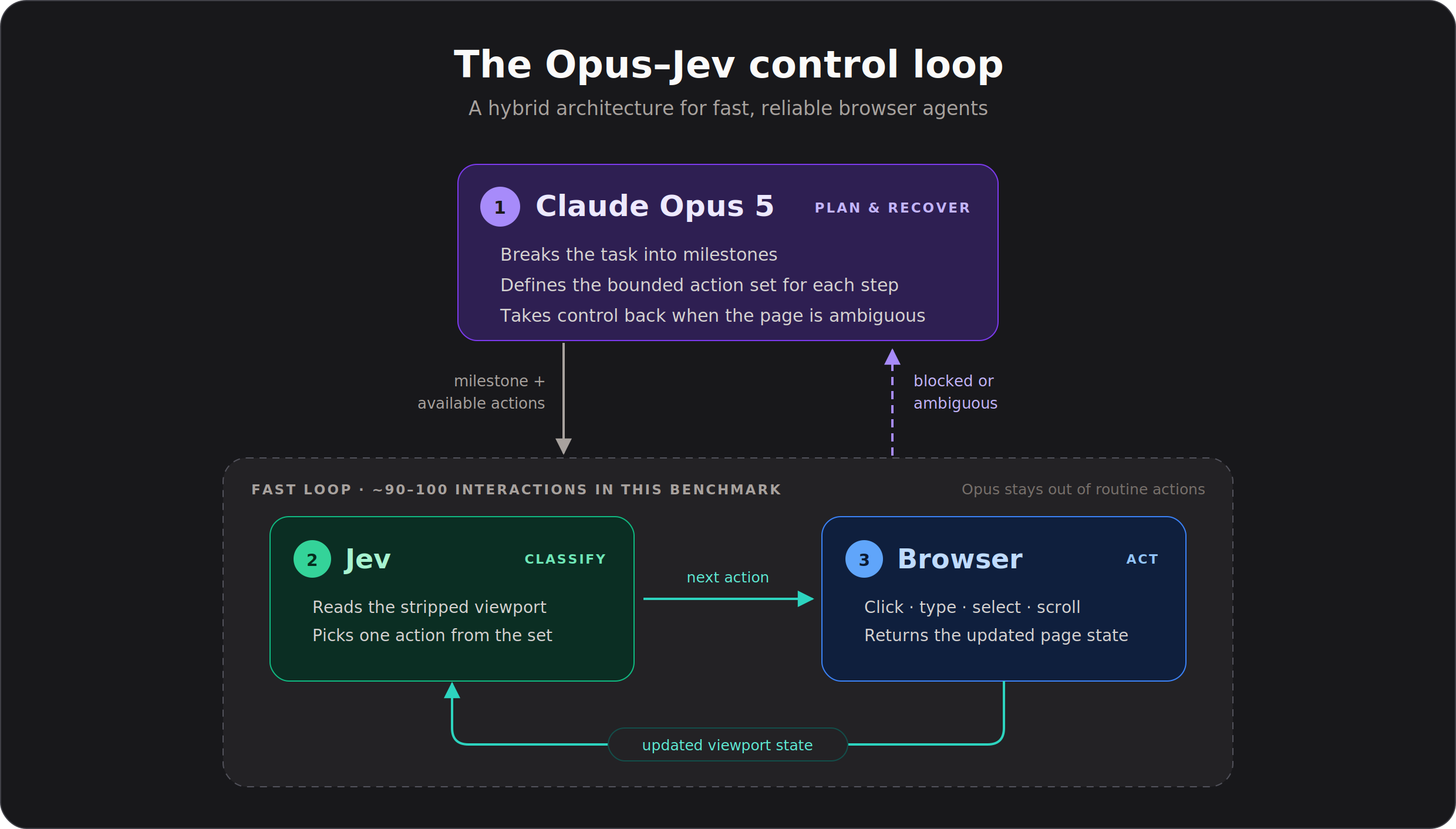
Most browser steps are straightforward: click, type, select, or scroll. Planning, ambiguity, and recovery require deeper reasoning. Our baseline sent both kinds of work through LLMs. We split the loop.
Claude Opus 5 handles planning and recovery. Jev, a fast classification model built by TypeSafe, handles high-frequency browser actions.
The workflow
We tested the architecture on a synthetic commercial insurance portal designed to mirror a real carrier workflow. The task was an end-to-end pre-rating review of a commercial package quote covering Property, General Liability, Inland Marine, Crime, and Automobile. It spanned 10 pages, eight insurance sections, 38 entered values, and roughly 90–100 UI interactions.
The agent had to find the correct transaction, configure coverages and exposures across multiple locations, handle dependent controls, dynamic fields and validation errors, save all eight sections, and complete pre-rating sign off.
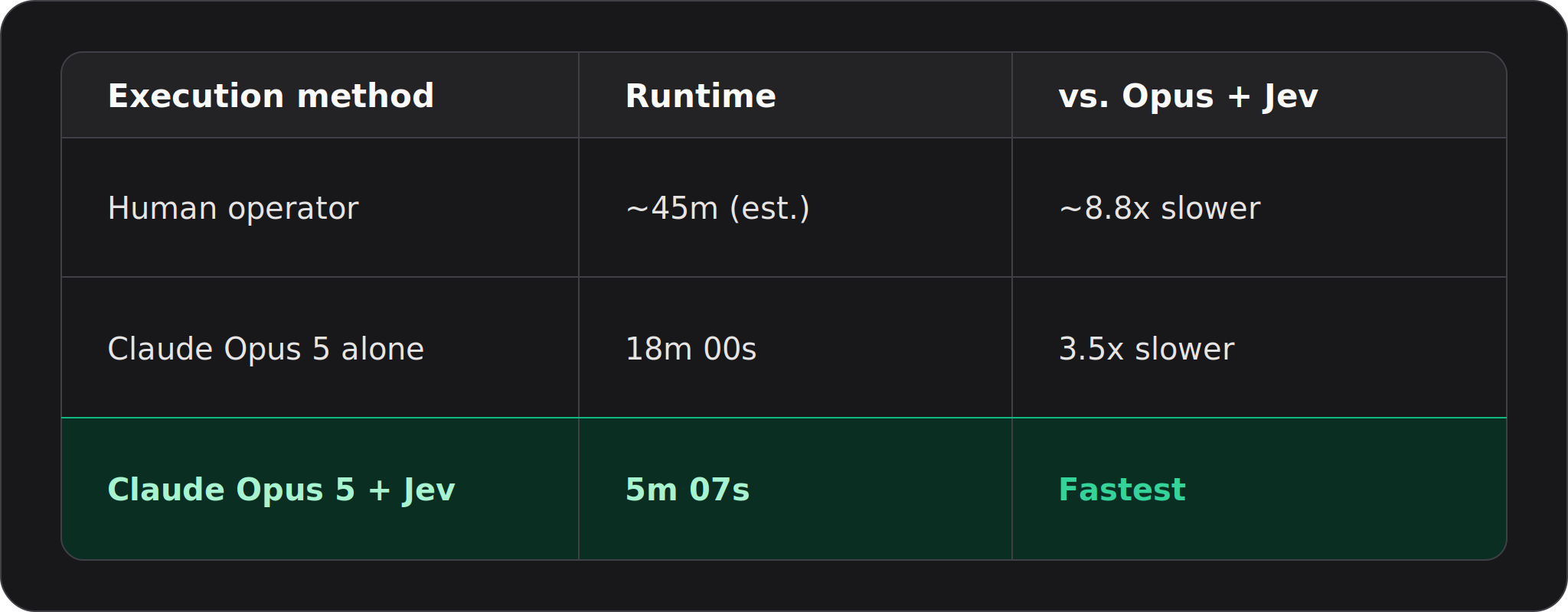
Opus + Jev finished in 5m 07s, compared with 18 minutes for Opus alone - a 3.5× speedup.
We’re incorporating this architecture into our web agents and testing the same approach on citation refinement, document classification, and internal evaluation tooling.
What we’re testing next
We built and benchmarked the integration over a weekend. That’s how we like to build at FurtherAI: take a new capability, test it against real insurance work, measure the result, and move quickly.
If you want to work on browser agents, evals, and the infrastructure for long-running AI systems, we’re hiring.




.svg)