FurtherAI Available in Microsoft Marketplace
Introducing Connectors



No-Code Claims Adjudication for TPAs: Deploy Fast With Low IT Lift

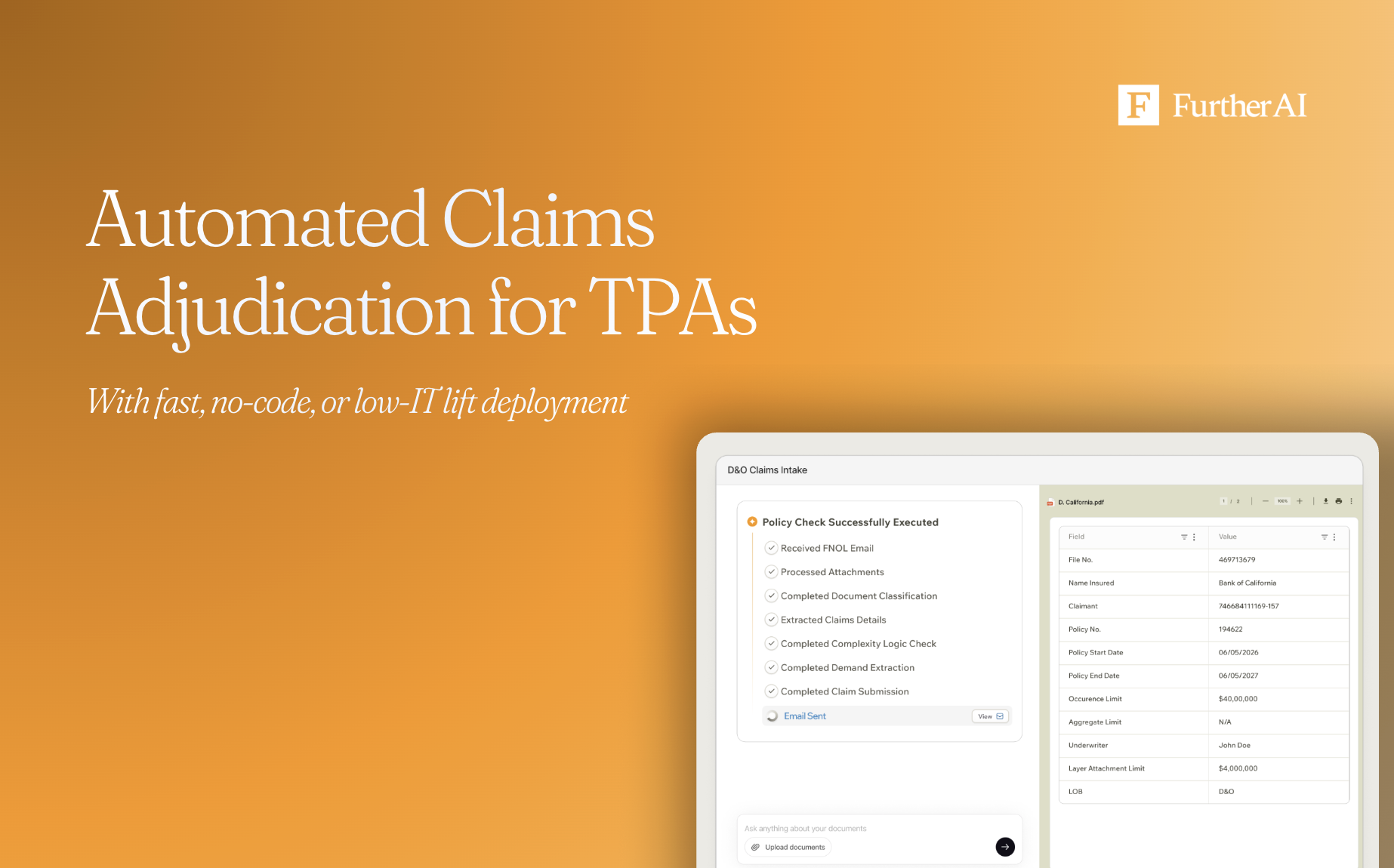
No-code claims adjudication lets a third-party administrator (TPA) automate claim decisions through configuration rather than custom software, without replacing a core system. Done well, it goes live quickly and with low IT lift, meaning the workflow gets configured and validated without pulling your engineering team onto a long build. For a mid-size TPA under pressure to handle more claims without a bigger IT budget, that speed to value is the whole point.
This guide covers what no-code and low IT lift actually mean in practice, how configuration works, how the platform connects to your existing claims systems, and what a realistic time-to-live looks like. For the full landscape of platforms, see our parent guide to the best AI for claims processing and adjudication at TPAs.
Key takeaways
- No-code means configuration, not custom development. Adjudication logic and workflows are set up through configuration rather than a ground-up software build, so making a change doesn't wait on an engineering backlog.
- Low IT lift is concrete. It shows up as a fast go-live without a core-system replacement, and minimal demand on your internal developers.
- Legacy systems are the reason speed matters. More than half of insurers, 54%, spend over half their IT budget just maintaining existing systems, according to West Monroe research reported by Insurance Business.
- FurtherAI deploys through a phased, configuration-first rollout. One specialty insurer moved claim intake automation from almost zero to more than 90% without disrupting live operations, per our claims processing case study.
- Start with one workflow. Pilot a single high-volume claim type, validate automation and error rates against your own history, then expand.
What "no-code" and "low IT lift" actually mean for a TPA
No-code claims adjudication centers the build on configuration rather than software development. Document requirements, extraction fields, validation rules, and routing logic are defined in a configuration layer instead of being hand-coded, so when a client changes a form or a rule, the update is a configuration change rather than a development project. The lighter the coding requirement, the less the work depends on scarce engineering time.
Low IT lift describes what the deployment asks of your technology team. A high-lift project means a multi-quarter integration, dedicated developers, and a core-system change. A low-lift deployment means the platform sits alongside your existing systems, connects through prebuilt integrations, and goes live without your IT staff building from scratch — they review security and access instead. For a mid-size TPA without a large in-house development team, that difference decides whether a project happens this quarter or next year.
The distinction matters most because TPAs juggle many clients at once. Every client brings its own forms, schemas, and service-level agreements, so a platform that requires custom code for each new program doesn't scale. Configuration, in its turn, does.
Why deployment speed is a TPA problem worth solving
The math facing TPAs is straightforward. Claim volume keeps rising, and the people who process claims are harder to find. U.S. employment of claims adjusters, appraisers, examiners, and investigators is projected to decline 5% from 2024 to 2034, according to the U.S. Bureau of Labor Statistics, which names automation directly as the reason productivity rises while headcount falls. You need to do more with the same team, and you need it soon.
Traditional IT modernization can't move at that pace. Two-thirds of insurance executives expect it will take another three to seven years to move their core systems to the cloud, and 54% already spend more than half their IT budget maintaining what they have, per West Monroe research reported by Insurance Business. The same research found that 46% of insurers say launching even a minor product update takes nine to 16 weeks. A TPA waiting on that kind of timeline loses client renewals in the meantime.
No-code, low-lift deployment sidesteps the bottleneck. You don't replace the core; you add an automation layer on top of it, configured to fit how you already run claims.
How no-code claims adjudication gets configured
A configuration-first deployment follows a repeatable sequence. FurtherAI's claims processing engagement used this phased approach to keep the work off the engineering backlog and away from live operations.
- Map the workflow. Work with your claims team to document each step, the required documents, and the field-level data needed to open or adjudicate a claim. This becomes the schema the platform enforces.
- Configure the rules. Define validation logic, coverage checks, and routing in the configuration layer, using your historical claims and templates as the reference for what "complete and correct" looks like.
- Connect the systems. Link the platform to your existing claims, document, and core systems through prebuilt integrations so data flows in and out without manual re-keying.
- Test against real claims. Run the configured workflow in a user-testing environment on historical claims, compare its output to known outcomes, and refine the configuration through an iterative feedback loop.
- Go live and monitor. Move to production on one workflow, tracking automation rate, error rate, and processing time, then tune before expanding to the next claim type.
Because each step is configuration rather than custom code, the build sits with the platform and its forward-deployed engineers working alongside your claims subject-matter experts, so your own IT team reviews security and integrations rather than writing the solution. That's what keeps the lift on your side low.
Integrating with your existing claims systems
Low IT lift depends on integration that extends your stack instead of replacing it. Modern claims AI connects to your claims management, document, and core systems through APIs or prebuilt connectors, so the automation layer reads incoming claims and writes structured, validated data back where your adjusters already work.
FurtherAI is designed to fit existing insurance systems and roll out in phases, and it holds SOC 2 Type II certification for the security posture carrier clients expect a TPA to maintain. That combination — integration without rip-and-replace, plus a certified security foundation — is what lets an IT team approve a deployment quickly rather than scoping a year-long project.
What fast time-to-live looks like in practice
The clearest measure of low IT lift is the outcome. A specialty insurer processing more than 3,000 claims a year had run its claim intake almost entirely by hand, spending roughly 2.5 hours per claim and about 7,500 labor hours a year. After deploying FurtherAI's configured claim intake workflow, it automated more than 90% of intake, saved over $360K annually, and cut processing time by more than 10x — a 568% return on investment — without disrupting live operations, as detailed in our case study.
The path there was a single high-volume workflow, validated against the insurer's own historical claims before scaling. That's the template for a mid-size TPA: prove one claim type, then extend the same configuration approach to the next client or line.
For a broader look at handling rising volume, see how TPAs handle high claim volumes without adding headcount. If you're weighing configuration against a custom build, our guide on whether to build or buy claims automation walks through the trade-offs. For the full evaluation criteria, the parent guide lays out how to choose across platforms.
REFERENCES
Bureau of Labor Statistics. "Claims Adjusters, Appraisers, Examiners, and Investigators: Occupational Outlook Handbook." U.S. Bureau of Labor Statistics. bls.gov
Insurance Business. "Legacy Systems, Budget Constraints Stall Insurance Modernization – West Monroe." Insurance Business. insurancebusinessmag.com
DISCLAIMER
This article is for general informational purposes only and does not constitute legal, regulatory, compliance, underwriting, or other professional advice. The content reflects information available as of the date of publication, and FurtherAI undertakes no obligation to update it as laws, regulations, or AI technologies evolve.
Recent posts


Ready to go further and
transform your insurance ops?
Reclaim your time for strategic work and let our AI Assistant handle the busywork. Schedule a demo to see how you can achieve more, faster.




.svg)